


Trump to sign executive order on reform of H-1B visa system

April 18, 2017

Washington, Apr 18: US President Donald Trump is set to sign an executive order that would tighten the process of issuing the H-1B visas and seek a review of the system for creating an "entirely new structure" for awarding these visas, the most sought-after by Indian IT firms and professionals.
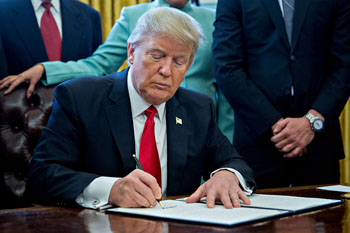
Trump1Trump is scheduled to travel to Milwaukee, Wisconsin, the home state of House of Representatives Speaker Paul Ryan, to sign the 'Buy American, Hire American' Executive Order.

This was a transitional step aimed at achieving a more skills-based and merit-based immigration system. The executive order would be signed a day after the US Citizenship and Immigration Services (USCIS) announced that it has completed the computerised draw of lots from the 199,000 petitions it received for the Congressional mandated 65,000 H-1B visas for the fiscal year 2018 beginning October 1 this year.

The lottery was held for the 20,000 H-1B visas for those applicants having higher education from US educational institutions. Opposing the traditional lottery system for H-1B visas, a senior administration official told White House reporters that these visas were being used by companies to bring in foreign workers at a low wage rate and displace local workers.

The official argued that there were enough qualified people within the country to meet the demand of technology professionals. "With respect to the H-1B visa programme in particular, which deals mostly with STEM jobs, we graduate about twice as many STEM students each year as find jobs in STEM fields.

"The issue of training workers for skilled manufacturing jobs is a different aspect of a policy then, say, the H-1B visa, which obviously is for STEM occupations," the official said. The official argued that the reality was that the US has large numbers of unemployed American workers. "Right now we're creating an environment with our guest- worker programmes where those workers are being bypassed," the official said.

"If you make it harder to abuse the guest-worker programmes, it creates more of a market for domestic workers, as well as more of a market for the kinds of job training and vocational training programmes that you're talking about," said the official, who spoke on condition of anonymity. Trump had made the alleged abuse and fraud in H-1B visa system a major election issue during his campaign.

The executive order signed by Trump today will call for the strict enforcement of all laws governing entry into the United States of labour from abroad, for the stated purpose of creating higher wages and higher employment rates for workers in America, the official said.

"It would further call on the departments of Labour, Justice, Homeland Security and State to take prompt action to crackdown on fraud and abuse, which should both be understood as separate problems, in our immigration system in order to protect workers in the United States and their economic conditions," the official asserted.

"As a practical matter, you're creating an entirely new structure for awarding these visas. I mean, it is a completely...total transformation of the H-1B programme," the official said. According to the senior administration official, these reforms were broadly supported by groups that represent American workers in the US, and that a lot of the driving action historically for these kinds of guest-worker reforms have been from groups that in fact even tilt Democratic.

"This (executive order) would apply across the board, but in particular, the executive order has an additional clause on the H-1B visa programme, and calls on those same four departments to put forward reforms to see to it that H-1B visas are awarded to the most skilled or highest-paid applicants," the official said. Noting that right now the H-1B visas were awarded by random lottery, the official said 80 per cent of H-1B workers were paid less than the median wage in their fields.

Only about five to six per cent, depending on the year, of H-1B workers command the highest wage tier recognised by the Department of Labour, there being four wage tiers, he said. "The highest wage tier, for instance in 2015, was only five per cent of H-1B workers. So 80 per cent received less than the median wage and only 10 per cent received the median wage," he noted.

"And, so only five per cent were categorised at the highest wage tier of the four wage tiers that are in place for the H-1B guest-worker visa," the official said. The result of that is that workers are often brought in well below market rates to replace American workers, sort of violating the principle of the programme, which is supposed to be a means for bringing in skilled labour, the official said.

"And instead, you're bringing in, a lot of times, workers who are actually less skilled and lower paid than the workers that they're replacing," he stated. The official said Trump has done more to bring a national spotlight onto the abuses in the H-1B guest-worker programme than anybody in the country has at any point in recent history.

"If you change that current system that awards visas randomly without regard for skill or wage to a skills-based awarding, it makes it extremely difficult to use the visa to replace or undercut American workers. These are not bringing in workers at beneath the market wage," he said. The top three recipients of the H-1B visas, the official said, were Tata (TCS), Infosys and Cognizant.

"Some companies oftentimes are called outsourcing firms. They're like the top recipients of H-1B visa. You know, are companies like Tata (TCS), Infosys, Cognizant. They will apply for a very large number of visas; more than they get. Like putting extra tickets in the lottery raffle, if you will," the official said.

"And then they'll get the lion's share of visas," the official said. As part of the executive order, the agencies have been asked to do everything they can, he said. "But you could be looking at things on the administration side like increasing fees for H-1B visas. You could be looking at things like if we could adjust the wage scale to have a more honest reflection of what the prevailing wages actually are in these fields," the official said.

Comments

Add new comment

  • Coastaldigest.com reserves the right to delete or block any comments.
  • Coastaldigset.com is not responsible for its readers’ comments.
  • Comments that are abusive, incendiary or irrelevant are strictly prohibited.
  • Please use a genuine email ID and provide your name to avoid reject.
Agencies
June 27,2020

Washington, Jun 27: Facebook has said that it will flag all "newsworthy" posts from politicians that break its rules, including those from President Donald Trump.

Separately, Facebook's stock dropped more than 8 per cent, erasing roughly USD 50 billion from its market valuation, after the European company behind brands such as Ben & Jerry's and Dove announced it would boycott Facebook ads through the end of the year over the amount of hate speech and divisive rhetoric on its platform.

Later in the day, Coca-Cola also announced it joined the boycott for at least 30 days.

CEO Mark Zuckerberg had previously refused to take action against Trump posts suggesting that mail-in ballots will lead to voter fraud, saying that people deserved to hear unfiltered statements from political leaders.

Twitter, by contrast, slapped a "get the facts" label on them.

Until Friday, Trump's posts with identical wording to those labelled on Twitter remained untouched on Facebook, sparking criticism from Trump's opponents as well as current and former Facebook employees.

Now, Facebook is all but certain to face off with the president the next time he posts something the company deems to be violating its rules.

"The policies we're implementing today are designed to address the reality of the challenges our country is facing and how they're showing up across our community," Zuckerberg wrote on his Facebook page announcing the changes.

Zuckerberg said the social network is taking additional steps to counter election-related misinformation.

In particular, the social network will begin adding new labels to all posts about voting that will direct users to authoritative information from state and local election officials.

Facebook is also banning false claims intended to discourage voting, such as stories about federal agents checking legal status at polling places.

The company also said it is increasing its enforcement capacity to remove false claims about local polling conditions in the 72 hours before the US election.

Ethan Zuckerman, director of the Massachusetts Institute of Technology's Center for Civic Media, said the changes are a "reminder of how powerful Facebook may be in terms of spreading disinformation during the upcoming election".

He said the voting labels will depend on how good Facebook's artificial intelligence is at identifying posts to label.

"If every post that mentions voting links, people will start ignoring those links. If they're targeted to posts that say things like 'Police will be checking warrants and unpaid traffic tickets at polls' a classic voter suppression disinfo tactic and clearly mark posts as disinfo, they might be useful," he said.

But Zuckerman noted that Facebook "has a history of trying hard not to alienate right-leaning users, and given how tightly President Trump has aligned himself with voter-suppressing misinfo, it seems likely that Facebook will err on the side of non-intrusive and ignorable labels, which would minimize impact of the campaign."

Earlier in the day, shares of Facebook and Twitter dropped sharply after consumer-product maker Unilever announced a new ad boycott on Facebook, Twitter and Instagram through at least the end of the year.

The European company said it took the move to protest the amount of hate speech online.

Unilever said the polarised atmosphere in the United States ahead of November's presidential election placed responsibility on brands to act.

In addition to the decline in Facebook shares, Twitter ended the day more than 7 per cent lower.

Unilever, which is based in the Netherlands and Britain, joins a raft of other advertisers pulling back from online platforms.

Facebook in particular has been the target of an escalating movement to withhold advertising dollars to pressure it to do more to prevent racist and violent content from being shared on its platform.

"We have decided that starting now through at least the end of the year, we will not run brand advertising in social media newsfeed platforms Facebook, Instagram and Twitter in the U.S.," Unilever said.

"Continuing to advertise on these platforms at this time would not add value to people and society."

Facebook did not immediately respond to a request for comment. On Thursday, Verizon joined others in the Facebook boycott.

Unilever "has enough influence to persuade other brand advertisers to follow its lead," said eMarketer analyst Nicole Perrin.

She noted that Unilever pulled back spending "for longer, on more platforms (including Twitter) and for more expansive reasons" in particular, by citing problems with "divisiveness" as well as hate speech.

Sarah Personette, vice president of global client solutions at Twitter, said the company's "mission is to serve the public conversation and ensure Twitter is a place where people can make human connections, seek and receive authentic and credible information, and express themselves freely and safely."

She added that Twitter is "respectful of our partners' decisions and will continue to work and communicate closely with them during this time."

Comments

Add new comment

  • Coastaldigest.com reserves the right to delete or block any comments.
  • Coastaldigset.com is not responsible for its readers’ comments.
  • Comments that are abusive, incendiary or irrelevant are strictly prohibited.
  • Please use a genuine email ID and provide your name to avoid reject.
News Network
February 19,2020

London, Feb 19: UK Home Secretary Priti Patel today announced the launch of the Britain's new points-based visa system, aimed at attracting the "brightest and the best" from the world, including from India, and cutting down numbers of cheap, low-skilled workers coming to the country.

The new system will come into force from January 1, 2021 at the end of the transition period after the UK's exit from the European Union (EU) last month, which will formally end free movement of people within the economic bloc for the UK as a non-member.

The new post-Brexit system, which will apply equally to the EU and non-EU countries like India, is based on assigning points for specific skills, qualifications, salaries and professions, with visas only awarded to those who gain enough points.

"Today is a historic moment for the whole country. We're ending free movement, taking back control of our borders and delivering on the people's priorities by introducing a new UK points-based immigration system, which will bring overall migration numbers down," said Ms Patel, the senior-most Indian-origin Cabinet minister.

"We will attract the brightest and the best from around the globe, boosting the economy and our communities, and unleash this country's full potential," Ms Patel, in charge of the UK's visa and immigration system, said.

The UK Home Office said the new system is a direct response to the 2016 referendum in favour of Brexit, which was seen as a vote to end the country's reliance on cheap migrant labour and reduce overall levels of migration with tighter security.

"The new single global system will treat the EU and non-EU citizens equally. It will give top priority to those with the highest skills and the greatest talents, including scientists, engineers and academics," the Home Office said.

The Global Talent Scheme, a fast-track visa to be in operation from Friday, will also apply to the EU citizens from next year to allow highly-skilled scientists and researchers to come to the UK without a job offer.

Professor Alice Gast, President of Imperial College London, said: "British science is global. The new post-study work and Global Talent visas will help us to attract the world's brightest students and researchers, wherever they come from."

"From the race to develop a coronavirus vaccine to clean energy, British science's international collaborations drive innovation and excellence."

The government said the points threshold for the new system will be carefully set to attract the talent the UK needs. Skilled workers will need to meet a number of relevant criteria, including specific skills and the ability to speak English, to be able to work in the UK. All applicants will be required to have a job offer and, in line with the Migration Advisory Committee''s (MAC) recommendations, the minimum salary threshold will be set at 25,600 pounds - lower than the previous 30,000 pounds level for Tier 2 work visas.

The new points-based system will also expand the skills threshold for skilled workers.

Those looking to live and work in the UK will need to be qualified up to A-level or equivalent, rather than degree-level under the current system. This will provide greater flexibility and ensure UK business has access to a wide pool of skilled workers, the Home Office said.

In line with the British Prime Minister Boris Johnson's manifesto commitment in the December 2019 General Election, there will be no specific route for low-skilled workers.

"It is estimated 70 per cent of the existing EU workforce would not meet the requirements of the skilled worker route, which will help to bring overall numbers down in future," the Home Office said.

Student visa routes will also be points-based and be opened up to EU citizens from next year.

Those wishing to study in the UK will need to demonstrate that they have an offer from an approved educational institution, that they can support themselves financially and that they speak English.

To address the specific labour concerns of the agricultural sector reliant on seasonal workers from the EU, the Seasonal Workers Pilot will be expanded in time for the 2020 harvest from 2,500 to 10,000 places.

EU citizens and other non-visa nationals will not require a visa to enter the UK when visiting the UK for up to six months.

However, the use of national identity cards will be phased out for travel to the UK and the Home Office highlighted that as part of its post-Brexit offer, those EU citizens resident in the UK by December 31 2020 can still apply to settle in the UK through the EU Settlement Scheme until June 2021.

Comments

Add new comment

  • Coastaldigest.com reserves the right to delete or block any comments.
  • Coastaldigset.com is not responsible for its readers’ comments.
  • Comments that are abusive, incendiary or irrelevant are strictly prohibited.
  • Please use a genuine email ID and provide your name to avoid reject.
News Network
April 10,2020

Melbourne, Apr 10: Scientists have identified six drug candidates from more than 10,000 compounds that may help treat COVID-19.

The research, published in the journal Nature, tested the efficacy of approved drugs, drug candidates in clinical trials and other compounds.

"Currently there are no targeted therapeutics or effective treatment options for COVID-19," said Professor Luke Guddat from the University of Queensland in Australia.

"In order to rapidly discover lead compounds for clinical use, we initiated a programme of high-throughput drug screening, both in laboratories and also using the latest computer software to predict how different drugs bind to the virus," Guddat said.

The project targeted the main COVID-19 virus enzyme, known as the main protease or Mpro, which plays a pivotal role in mediating viral replication, the researchers said.

This makes it an attractive drug target for this virus, and as people don't naturally have this enzyme, compounds that target it are likely to have low toxicity, they said.

"We add the drugs directly to the enzyme or to cell cultures growing the virus and assess how much of each compound is required to stop the enzyme from working or to kill the virus. If the amount is small, then we have a promising compound for further studies," said Guddat.

After assaying thousands of drugs, researchers found of the six that appear to be effective in inhibiting the enzyme, one is of particular interest.

"We're particularly looking at several leads that have been subjected to clinical trials including for the prevention and treatment of various disorders such as cardiovascular diseases, arthritis, stroke, atherosclerosis and cancer," Guddat said.

Researchers said compounds that are already along the pipeline to drug discovery are preferred, as they can be further tested as antivirals at an accelerated rate compared to new drug leads that would have to go through this process from scratch.

"With continued and up-scaled efforts we are optimistic that new candidates can enter the COVID-19 drug discovery pipeline in the near future," Guddat said.

Comments

Add new comment

  • Coastaldigest.com reserves the right to delete or block any comments.
  • Coastaldigset.com is not responsible for its readers’ comments.
  • Comments that are abusive, incendiary or irrelevant are strictly prohibited.
  • Please use a genuine email ID and provide your name to avoid reject.