



Trump, sworn in as US president, promises to put 'America First'

January 21, 2017

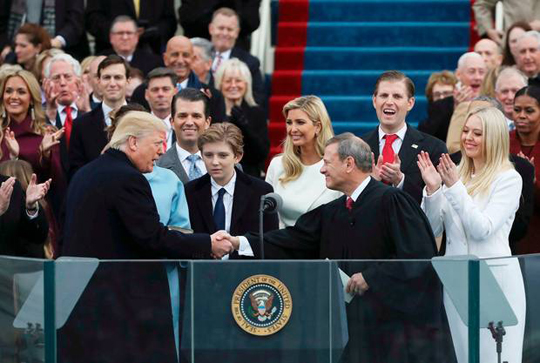
Washington, Jan 21: Donald Trump was sworn in as the 45th president of the United States on Friday, succeeding Barack Obama and telling a bitterly divided country he will pursue “America First” policies at home and abroad.
trump018

As scattered protests erupted elsewhere in Washington, Trump raised his right hand and put his left on a Bible used by Abraham Lincoln and repeated a 35-word oath of office from the US Constitution, with US Chief Justice John Roberts presiding.

Afterward, he stretched his arms wide and hugged his wife, Melania, and other members of his family. Then he turned around to a podium and delivered his inaugural address.

“This moment is your moment, it belongs to you,” Trump told a large crowd that had earlier booed Chuck Schumer, the Democratic minority leader in the US Senate.

Revisiting themes from his improbable campaign victory, Trump said his presidency would aim to help struggling middle-class families, build up the US military and strengthen US borders.
obamacare-main

“We are transferring power from Washington D.C. and giving it back to you,” he said.

“From this day forward a new vision will govern our land,” Trump said. “From this day forward it's going to be only America First.”

The transition from a Democratic president to a Republican took place on the West Front of the domed US Capitol before a crowd of former presidents, dignitaries and hundreds of thousands of people on the grounds of the National Mall. The crowd stretched westward on a cool day of occasional light rain.

Trump, 70, takes over a country divided after a savage election campaign. A wealthy New York businessman and former reality TV star, he will set the country on a new, uncertain path at home and abroad.

Away from the Capitol, masked activists ran through the streets smashing windows with hammers at a McDonald's restaurant, a Starbucks coffee shop and Bobby Van's Grill steakhouse several blocks from the White House.

They carried black anarchist flags and signs that said, “Join the resistance, fight back now.” Police used pepper spray and chased them down a major avenue, a Reuters eyewitness reported.

In another location not far from the White House, protesters also scuffled with police, at one point throwing aluminum chairs at them at outdoor café.

Hillary Clinton, the Democratic candidate who Trump defeated on Nov 8, attended the ceremony with her husband, former President Bill Clinton. Former presidents George W. Bush and Jimmy Carter were also present with their wives. Bush's father, former President George H.W. Bush, 92, was in Houston recovering from pneumonia.

Trump and his vice president, Mike Pence, began the day attending a prayer service at St. John's Episcopal Church near the White House. Trump, wearing a dark suit and red tie, and Melania Trump, clad in a classic-styled, powder blue ensemble, then headed into the White House for a meeting with Obama and his wife, Michelle.

Trump took office with work to do to bolster his image.

During a testy transition period since his stunning election win, Trump has repeatedly engaged in Twitter attacks against his critics, so much so that one fellow Republican, Senator John McCain, told CNN that Trump seemed to want to “engage with every windmill that he can find.”

An ABC News/Washington Post poll this week found only 40 percent of Americans viewed Trump favorably, the lowest rating for an incoming president since Democrat Carter in 1977, and the same percentage approved of how he has handled the transition.

Trump's agenda

His ascension to the White House, while welcomed by Republicans tired of Obama's eight years in office, raises a host of questions for the United States.

Trump campaigned on a pledge to take the country on a more isolationist, protectionist path and has vowed to impose a 35 percent tariff on goods on imports from US companies that went abroad.

His desire for warmer ties with Russian President Vladimir Putin and threats to cut funding for North Atlantic Treaty Organization nations has allies from Britain to the Baltics worried that the traditional US security umbrella will be diminished.

In the Middle East, Trump has said he wants to move the US embassy in Israel from Tel Aviv to Jerusalem, at the risk of angering Arabs and stirring international concern. He has yet to sketch out how he plans to carry out a campaign pledge to “knock the hell out of” Daesh militants.

The inaugural festivities may have a more partisan edge than usual, given Trump's scorching campaign and continuing confrontations between him and Democrats over his take-no-prisoners Twitter attacks and pledge to roll back many of Obama's policies.

More than 60 Democratic lawmakers planned to stay away from the proceedings to protest Trump, spurred on after he derided US Representative John Lewis of Georgia, a hero of the civil rights movement, for calling him an illegitimate president.

Thousands of anti-Trump protesters were expected among the inauguration crowd and many demonstrators will participate in a “Women's March on Washington” on Saturday. Protests are also planned in other cities in the United States and abroad.

Keith Kidwell, chairman of the Republican Party in Beaufort County, North Carolina, was among the crowds on Friday, eager to see the start of the Trump presidency.

“I cling to my guns and my Bible. I've been waiting a long eight years for this day,” said Kidwell, adding he initially supported US Senator Ted Cruz to be the Republican presidential nominee but was now squarely behind Trump.

Quick action

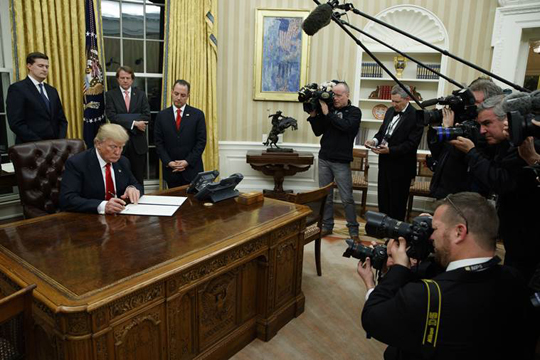
Trump's to-do list has given Republicans hope that, since they also control the US Congress, they can quickly repeal and replace Obama's signature health care law, approve sweeping tax reform and roll back many federal regulations they say are stifling the US economy.

“He's going to inject a shock to the system here almost immediately,” Trump senior adviser Kellyanne Conway told Fox News.

Democrats, in search of firm political footing after the unexpected defeat of Hillary Clinton, are planning to fight him at every turn. They deeply oppose Trump's anti-immigrant rhetoric from the campaign trail and plans to build a wall along the southern US border with Mexico.

Trump's critics have been emboldened to attack his legitimacy because his win came in the Electoral College, which gives smaller states more clout in the outcome. He lost the popular vote to Clinton by about 2.9 million.

Trump's critics also point to the conclusion of US intelligence agencies that Russia used hacking and other methods during the campaign to try to tilt the election in the Republican's favor. Trump has acknowledged the finding — denied by Moscow — that Russia was behind the hacking but said it did not affect the outcome of the election.

To his critics — including Obama who during the campaign called Trump temperamentally unfit for the White House — his straight talk can be jarring, especially when expressed in tweets. His supporters, many of them working-class whites, see Trump as a refreshingly anti-establishment figure who eschews political correctness.

“He's here for the working man” supporter Adam Coletti of Plainfield, Connecticut, said as he headed toward the inauguration.

Comments

Add new comment

  • Coastaldigest.com reserves the right to delete or block any comments.
  • Coastaldigset.com is not responsible for its readers’ comments.
  • Comments that are abusive, incendiary or irrelevant are strictly prohibited.
  • Please use a genuine email ID and provide your name to avoid reject.
News Network
June 1,2020

Jun 1: The new coronavirus is losing its potency and has become much less lethal, a senior Italian doctor said on Sunday.

"In reality, the virus clinically no longer exists in Italy," said Alberto Zangrillo, the head of the San Raffaele Hospital in Milan in the northern region of Lombardy, which has borne the brunt of Italy's coronavirus contagion.

"The swabs that were performed over the last 10 days showed a viral load in quantitative terms that was absolutely infinitesimal compared to the ones carried out a month or two months ago," he told RAI television.

Italy has the third-highest death toll in the world from COVID-19, with 33,415 people dying since the outbreak came to light on Feb. 21. It has the sixth-highest global tally of cases at 233,019.

However new infections and fatalities have fallen steadily in May and the country is unwinding some of the most rigid lockdown restrictions introduced anywhere on the continent.

Zangrillo said some experts were too alarmist about the prospect of a second wave of infections and politicians needed to take into account the new reality.

"We've got to get back to being a normal country," he said. "Someone has to take responsibility for terrorizing the country."

The government urged caution, saying it was far too soon to claim victory.

"Pending scientific evidence to support the thesis that the virus has disappeared ... I would invite those who say they are sure of it not to confuse Italians," Sandra Zampa, an undersecretary at the health ministry, said in a statement.

"We should instead invite Italians to maintain the maximum caution, maintain physical distancing, avoid large groups, to frequently wash their hands and to wear masks."

A second doctor from northern Italy told the national ANSA news agency that he was also seeing the coronavirus weaken. "The strength the virus had two months ago is not the same strength it has today," said Matteo Bassetti, head of the infectious diseases clinic at the San Martino hospital in the city of Genoa.

"It is clear that today the COVID-19 disease is different."

Comments

Add new comment

  • Coastaldigest.com reserves the right to delete or block any comments.
  • Coastaldigset.com is not responsible for its readers’ comments.
  • Comments that are abusive, incendiary or irrelevant are strictly prohibited.
  • Please use a genuine email ID and provide your name to avoid reject.
News Network
July 4,2020

Maryland, Jul 4: The total number of coronavirus cases worldwide has touched 11 million, according to the latest data by the Johns Hopkins University on Saturday.
More than 523,613 people have died globally due to the infection, according to the data compiled by the university.

Though the virus is believed to have emerged from the Chinese city of Wuhan, the United States is the worst-hit country from COVID-19, which was declared as a pandemic by the WHO on March 11.

At least 129,275 people have died in the US from the coronavirus, according to Johns Hopkins University's latest tally.
There are at least 2,786,178 cases of the disease in the country. The US has the highest number of cases in the world.

The second worst-hit country is Brazil, which has reported 1,496,858 lakh cases. The country's death toll stands at 61,884.

The countries around the world including the US, India, Denmark, and Italy have started the process of lifting the lockdown by easing restrictions despite the number of cases continues to rise.

Comments

Add new comment

  • Coastaldigest.com reserves the right to delete or block any comments.
  • Coastaldigset.com is not responsible for its readers’ comments.
  • Comments that are abusive, incendiary or irrelevant are strictly prohibited.
  • Please use a genuine email ID and provide your name to avoid reject.
Agencies
July 3,2020

The dollar's dominance will slowly melt away over the coming year on weakening global demand and a sombre U.S. economic outlook, according to a Reuters poll of currency forecasters whose views depend on there being no second coronavirus shock.

Despite fears a surge in new Covid-19 cases would delay economies reopening and stymie a tentative recovery, world stocks have rallied - with the S&P 500 finishing higher in June, marking its biggest quarterly percentage gain since the height of the technology boom in 1998.

Caught between bets in favour of riskier investments, weak U.S. economic prospects as well as an easing in the thirst for dollars after the Federal Reserve flooded markets with liquidity, the greenback fell nearly 1.0 per cent last month. It was its worst monthly performance since December.

While there was a dire prognosis from the top U.S. medical expert on the coronavirus' spread, the June 25-July 1 poll of over 70 analysts showed weak dollar projections as Fed Chair Jerome Powell on Monday reiterated the economic outlook for the world's largest economy was uncertain.

"The dollar rises in two instances: when you see risk off or when there is a situation where the U.S. is leading the global recovery, and we don't think that's going to be the case anytime soon," said Gavin Friend, senior FX strategist at NAB Group in London.

"The U.S. is playing fast and loose with the virus, and chronologically they're behind the rest of the world."

Currency speculators, who had built up trades against the dollar to the highest in two years during May, increased their out-of-favour dollar bets further last week, the latest positioning data showed.

About 80 per cent of analysts, 53 of 66, said the likely path for the dollar over the next six months was to trade around current levels, alternating between slight gains and losses in a range. That suggests the greenback may be at a crucial crossroad as more currency strategists have turned bearish.

But more than 90 per cent, or 63 of 68, said a second shock from the pandemic would push the dollar higher. Five said it would push the U.S. currency lower.

Much will also depend on debt servicing and repayments by Asian, European and other international borrowers in U.S. dollars.

While an early shortage of dollars in March from the pandemic's first shock pushed the Fed to open currency swap lines with major central banks, international funding strains have eased significantly since. In recent weeks, usage of the facility has reduced dramatically.

That trend is expected to continue over the next six months with major central banks' usage of swap lines to "stay around current levels", according to 32 of 46 analysts. While 13 predicted a sharp drop, only one respondent said use of them would "rise sharply".

The dollar index, which measures the greenback's strength against six other major currencies, has slipped over 5 per cent since touching a more than three-year high in March.

When asked which currencies would perform better against the dollar by end-December, a touch over half of 49 respondents said major developed market ones, with the remaining almost split between commodity-linked and emerging market currencies.

"The dollar is so overvalued, and has been overvalued for a long time, it's time now for it to come back down again, as we head towards the (U.S.) election," added NAB's Friend.

Over the last quarter, the euro has staged a 1.8 per cent comeback after falling by a similar margin during the first three months of the year. For the month of June, the euro was up 1.2 per cent against the dollar.

The single currency was now expected to gain about 2.5 per cent to trade at $1.15 in a year from around $1.12 on Wednesday, slightly stronger than $1.14 predicted last month. While those findings are similar to what analysts have been predicting for nearly two years, there was a clear shift in their outlook for the euro, with the range of forecasts showing higher highs and higher lows from last month.

"In comparison to even a month or two ago, the outlook in Europe has improved significantly," said Lee Hardman, currency strategist at MUFG.

"I think that makes the euro look relatively more attractive and cheap against the likes of the dollar. We're not arguing strongly for the euro to surge higher, we're just saying, after the weakness we have seen in recent years, there is the potential for that weakness to start to reverse."

Comments

Add new comment

  • Coastaldigest.com reserves the right to delete or block any comments.
  • Coastaldigset.com is not responsible for its readers’ comments.
  • Comments that are abusive, incendiary or irrelevant are strictly prohibited.
  • Please use a genuine email ID and provide your name to avoid reject.