



Trump victory elicits fears, some cheers around the globe

November 9, 2016

London, Nov 9: The world faces a starkly different America led by a President Donald Trump.trumpGlb
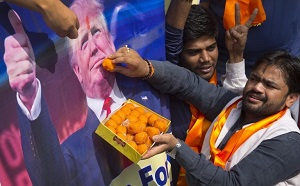
While the billionaire businessman's election was welcomed in some countries, others saw it as a big shock, as governments will now have to deal with a man who has cozied up to Vladimir Putin, told NATO allies they would have to pay for their own protection and vowed to make the Mexican government pay for a multibillion-dollar border wall.

Trump's win was particularly startling in Mexico, where his remarks calling Mexican immigrants criminals and 'rapists' were a deep insult to national pride. Financial analysts have predicted a Trump win would threaten billions of dollars in cross-border trade, and government officials say they have drawn up a contingency plan for such a scenario, though without releasing details.

"It's DEFCON 2," Mexican analyst Alejandro Hope said. "Probably something as close to a national emergency as Mexico has faced in many decades."

"It depends if he means what he says and if he can do what he claims he wants to do," Hope added. "A massive deportation campaign could really put some stress on Mexican border communities. A renegotiation of NAFTA could seriously hobble the Mexican economy. It could create a lot of uncertainty. ... Financial markets could suffer."

The Mexican peso, which has tracked the U.S. election closely, fell sharply to 20.45 to the dollar late Tuesday before recovering somewhat. The Bank of Mexico's interbank rate had stood at 18.42 at the end of the day's trading.

In Europe, NATO allies now wait to see if Trump follows through on suggestions that America will look at whether they have paid their proper share in considering whether to come to their defense.

Trump's rhetoric has challenged the strategic underpinning of the NATO alliance, rattling its leaders at a time when Russia has been increasingly aggressive.

German Defense Minister Ursula von der Leyen called the vote 'a big shock' and 'a vote against Washington, against the establishment.'

Von der Leyen said on German public Television Wednesday that while many questions remain open, "We Europeans obviously know that as partners in NATO, Donald Trump will naturally ask what 'are you achieving for the alliance,' but we will also ask 'what's your stand toward the alliance.'"

The French populist, anti-immigrant politician Marine Le Pen congratulated Trump even before the final results were known, tweeting her support to the "American people, free!"

Foreign Minister Jean-Marc Ayrault said France would work with the new president and that European politicians should heed the message from Trump votes. "There is a part of our electorate that feels ... 'abandoned,' including people who feel left behind by globalization," he said.

Trump's victory is being viewed with shock and revulsion in Ireland, a country close to the Clintons and fearful of Trump's campaign pledge to confront US companies using Ireland as a tax shelter.

The newspaper of record, the Irish Times, branded the New York businessman a 'misogynistic racist liar' who would fan instability overseas and intolerance at home.

Irish Times columnist Fintan O'Toole wrote Wednesday: "The republic of Washington, Jefferson, Lincoln and Roosevelt is now the United Hates of America."

"President Trump is the creation of the same demographic that gave Europe its far-right authoritarian movements with such disastrous consequences for the world," he wrote. "This does not mean that we are facing an American fascism. But it does mean that Trump will not be able to rule without stoking and manipulating fear."

British Prime Minister Theresa May issued a statement saying she looks forward to working with Trump and building on the two countries' longstanding 'special relationship.' Her predecessor, David Cameron, had been outspoken in his criticism of Trump during the primary campaign.

Nigel Farage, acting leader of the UK Independent Party, which played an important role convincing Britons to leave the European Union, told The Daily Telegraph that Trump's victory would bring a 'massive result' for Britain. A spokesman said Farage - who campaigned briefly with Trump- was flying to Washington Wednesday.

Russian President Vladimir Putin sent Trump a telegram Wednesday morning congratulating him on his victory.

Moscow has been unusually prominent in the race. Clinton's campaign and the Obama administration blamed Russian hackers for leaked emails from the Democratic National Committee and Clinton campaign staff. Trump, in turn, has made complimentary remarks about Putin; the ties some of his advisers and former campaign officials have to Russia have raised suspicions.

"We of course regard with satisfaction that the better candidate of the two presented to the American voters was victorious," said Vladimir Zhirinovsky, leader of Russia's nationalist Liberal Democratic party, according to the Interfax news agency.

In Asia, security issues and trade will top the agenda for the new administration, from North Korea and the South China Sea to the contentious and yet-unratified Trans-Pacific Partnership trade agreement.

Chinese state media and government-backed commentators had signaled Beijing's preference for a Trump win. Like Russia, China is seen as favoring Trump because he appears less willing to confront China's newly robust foreign policy, particularly in the South China Sea.

Clinton, by contrast, is disliked in Beijing for having steered the US 'pivot' to Asia aimed at strengthening US engagement with the region, particularly in the military sphere.

Scholar Mei Xinyu wrote in the Communist Party newspaper Global Times that China would find it easier to cope with a Trump presidency.

"Trump has always insisted on abandoning ideological division and minimizing the risks that unnecessary conflicts with other countries may bring to the U.S.," Mei wrote.

In Indonesia, the world's most populous Muslim country, social media was abuzz with speculation about whether Trump would follow through on campaign rhetoric calling for a ban on Muslims entering the United States. Some said they fear they would be prevented from visiting relatives and friends who live in America or traveling there as tourists.

News of Trump's widening lead hit hard in Cuba, which has spent the last two years negotiating normalization with the United States after more than 50 years of Cold War hostility, setting off a tourism boom. Trump has promised to roll back Obama's opening with Cuba unless President Raul Castro agrees to more political freedoms.

"If he reverses it, it hurts us," taxi driver Oriel Iglesias Garcia said. "You know tourism will go down."

In pubs, bars and restaurants in much of the world, people watched TV and took in the surprise news of Trump's victory.

At a pub in Sydney, Pamela Clark-Pearman, a 63-year-old Clinton supporter, sat nursing a beer.
"I never thought the Americans could be so stupid. I just think it's Brexit all over again,'' Clark-Pearman said, referring to the June 23 British vote to leave the European Union.

Serving the last drinks of the night at a Mexico City tavern where a half-dozen TVs were tuned to election news, bartender Angel Mendoza wondered what will happen to his 15 or so family members living in the United States, about half of whom are there illegally.

"They're not coming here," he said. "Their lives are already made there, but (now) with a certain fear."

Comments

ABD
 - 
Wednesday, 9 Nov 2016

When Authority / Power comes to the hands of unfit person, then wait for the Hour - Muhammad(Pbuh)

Add new comment

  • Coastaldigest.com reserves the right to delete or block any comments.
  • Coastaldigset.com is not responsible for its readers’ comments.
  • Comments that are abusive, incendiary or irrelevant are strictly prohibited.
  • Please use a genuine email ID and provide your name to avoid reject.
News Network
July 25,2020

Madrid, Jul 25: Spain is witnessing a new surge in virus" coronavirus infections with nearly a thousand cases daily, a month after lifting the pandemic lockdown.

The country is reinstating both voluntary guidelines and mandatory restrictions that it had lifted on June 21, The Washington Post reported.

Spain on Wednesday reported over 224 outbreaks and 2,622 virus" coronavirus cases. According to a report in Washington Post, the new surge is attributed primarily to seasonal farmworkers, people attending family get-togethers and nightclub partyers.

On Thursday, the health ministry reported an additional 971 cases.

"The majority are related to fruit collection and also to the spaces where measures to avoid contact are relaxed," Spain Health Minister Salvador Illa told parliament. "We have to call on citizens to not lose respect for the virus not to be afraid of it, but not to lose respect for it either."

The government of Spain lifted all restrictions put in place to combat virus" coronavirus on June 21 and declared 'a new normal'. 

The virus" coronavirus pandemic till then had killed 24,000 people and infected more than 2,70,166.

Countries around the world are witnessing the second surge of virus" coronavirus. The resurgence could threaten the economic bounce Spain was hoping to get from vacationers eager for summer fun.

The surge in cases has been greatest in the northeastern region of Catalonia with more than 7,953 new confirmed cases since July 10.

Spain's National Epidemiological Survey has predicted that the rate of increase more than doubled in the past three weeks.

Meanwhile, the Catalan government reverted to pre-June 21 confinement rules in Barcelona and a dozen other municipalities in the metropolitan area, as well as in Figueras, Vilafant, La Noguera and Lleida.

Authorities have ordered bars and restaurants to limit indoor occupancy to 50 per cent, reduced sports to fewer than 10 people, closed night clubs and gyms and blocked some cultural activities.

The epidemiologist in charge of the region's biggest hospital warned in an interview last week with the Spanish daily El Pais that the situation in the agricultural hub of Lleida, located about 100 miles west of Barcelona, "had clearly gotten out of hand."

"Nobody foresaw that there would be a number of people coming from abroad to pick fruit in unfavourable conditions and that they might be infected," said epidemiologist Magda Campins of Vall d'Hebron in Barcelona. "And when the infections began to be detected, it was hard to keep tabs on the cases and their contacts because some of them, although they should have been in isolation, got away because they needed to earn money."

Catalonia's Department of Labour, Social Affairs and Family is using a hotel in Lleida to quarantine fruit workers who test positive for COVID-19 but are unable to isolate at home.

In the capital of Madrid, which was the epicentre during the pandemic's first wave in the spring, authorities reported 710 new cases in the past week. The use of face masks is widespread, but the region has shied away from making them mandatory in public.

Madrid's regional health secretary, Enrique Ruiz Escudero, defended that position while citing an uptick in infections in the under-40 age group. He told young people not to let down their guard.

"We can't take even one step backwards. Young people have to be aware of the responsibility they have," Ruiz Escudero said in a news conference Thursday. "I ask them to use the face mask and to maintain a safe distance."

Comments

Add new comment

  • Coastaldigest.com reserves the right to delete or block any comments.
  • Coastaldigset.com is not responsible for its readers’ comments.
  • Comments that are abusive, incendiary or irrelevant are strictly prohibited.
  • Please use a genuine email ID and provide your name to avoid reject.
News Network
January 24,2020

Davos, Jan 24: Pakistan Prime Minister Imran Khan claimed that he met with a “brick wall” when he approached Indian Prime Minister Narendra Modi with a peace proposal, soon after assuming office.

In an interview to Foreign Policy magazine on the sidelines of WEF 2020 here, Khan also said he told Modi that Pakistan will act firmly if it was given evidence of any involvement in the Pulwama terror attack, but India instead “bombed” Pakistan.

Tensions have escalated between the two countries, following India withdrawing the special status of Jammu and Kashmir in August 2019. Even since, Khan has been trying to seek global intervention to de-escalate the tensions between the two countries.

On Thursday, India's External Affairs Ministry spokesperson Raveesh Kumar categorically ruled out any third party role on the Kashmir issue, asserting that any issue between the two countries should be resolved bilaterally.

In the interview, Khan said that he is a firm believer that military means are not a solution to ending conflicts. “After assuming office, I immediately reached out to Prime Minister Modi. I was amazed by the reaction I got, which was quite weird.

The subcontinent hosts the greatest number of poor people in the world, and the best way to fight poverty is to have a trading relationship between the two countries rather than spending money on arms. This is what I said to the Indian Prime Minister. But I was met by brick wall,” Khan said.

Khan took charge as Prime Minister in August 2018. Referring to the suicide attack in Pulwama, Khan said he immediately told Modi ,“if you can give us any actionable intelligence (that Pakistanis were involved), we will act on it. But rather than do so, they bombed us.”

Noting that the both countries are not close to conflict right now, Khan said that it is important that the UN and the US act.

When asked about US President Donald Trump’s close relationship with Modi, Khan said the relationship is understandable because India is a huge market. “My concern is not about the US-India relationship. My concern is the direction in which India is going,” Khan said.

Khan also sought to compare the events in India to what happened in Nazi Germany.

“Between 1930 and 1934, Germany went from a liberal democracy to a fascist, totalitarian, racist state. If you look at what is happening in India under the BJP in the last five years, look where it's heading, you'll see the danger. And you're talking about a huge country of 1.3 billion people that is nuclear-armed,” he said.

Comments

Add new comment

  • Coastaldigest.com reserves the right to delete or block any comments.
  • Coastaldigset.com is not responsible for its readers’ comments.
  • Comments that are abusive, incendiary or irrelevant are strictly prohibited.
  • Please use a genuine email ID and provide your name to avoid reject.
News Network
February 19,2020

Washington, Feb 19: Sri Srinivasan, a prominent Indian-American judge, has created history by becoming the first person of South Asian descent to lead a powerful federal circuit court considered next only to the US Supreme Court.

Srinivasan, 52, became the Chief Judge of the United States Court of Appeals for the DC Circuit.

An Obama appointee who has already been considered for a Supreme Court seat twice, donned the mantle of the chief judge of the DC federal court circuit on February 12.

Srinivasan succeeded Judge Merrick Garland, who has been a member of the DC Circuit since 1997 and Chief Judge since 2013. He will remain on the bench, a press release said.

Notably, Garland's nomination to the Supreme Court by the then president Barack Obama was blocked by Senate Republicans in 2016.

Srinivasan, was appointed to the US Court of Appeals for the District of Columbia Circuit in May 2013.

He was the first ever Indian-American to be appointed to the second most powerful court of the US.

Neomi Rao, nominated by President Donald Trump, is the second Indian American on this powerful judiciary bench.

History being made on the DC Court of Appeals. Congratulations, Judge Srinivasan! Senator Mark Warner said.

Congratulations to Judge Sri Srinivasan on becoming the Chief Judge of the U.S. Court of Appeals for the D.C. Circuit! A milestone for the Indian-American/Kansan community (and yet another piece of evidence my family can use that I'm underachieving), US Federal Communications Commission Chair Ajit Pai said.

According to The Washington Post, Srinivasan spoke recently about his path to the bench at an event celebrating women in the law, a field where men still dominate leadership positions.

"Everybody doubts their belonging and worthiness in some measure. I definitely did and still do. This is just going to be a part of the thing when you're looking out in the world in which everyone isn't like you. It's natural to doubt whether you belong and whether you're worthy, he said, "but you do belong and you are worthy.

Born in Chandigarh, and raised in Lawrence, Kansas, he received a B.A. from Stanford University, a J.D. from Stanford Law School, and an M.B.A. from the Stanford Graduate School of Business.

Following graduation, he served as a law clerk to Judge J. Harvie Wilkinson III of the US Court of Appeals for the Fourth Circuit, as a Bristow Fellow in the Office of the US Solicitor General, and as a law clerk to US Supreme Court Justice Sandra Day O'Connor.

From 2011 until his appointment to the US Court of Appeals, Judge Srinivasan served as the Principal Deputy Solicitor General of the United States.

He has argued 25 cases before the US Supreme Court. He has also taught appellate advocacy at Harvard Law School as well as a seminar on civil rights statutes and the Supreme Court at Georgetown University Law Center.

Comments

Add new comment

  • Coastaldigest.com reserves the right to delete or block any comments.
  • Coastaldigset.com is not responsible for its readers’ comments.
  • Comments that are abusive, incendiary or irrelevant are strictly prohibited.
  • Please use a genuine email ID and provide your name to avoid reject.