


Trump's change of tone prompted by daughter Ivanka?

March 2, 2017

Washington, Mar 2: Behind the scenes at the White House, US President Donald Trump's daughter Ivanka was a key advocate for the more measured, less combative tone he struck in his speech to a joint session of Congress on Tuesday night, officials said.
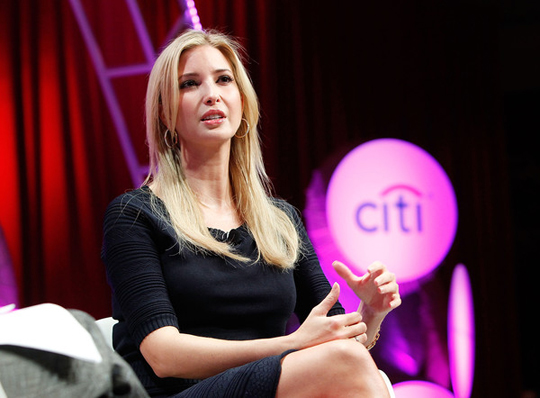
Ivanka

The biggest speech of Mr Trump's month-old presidency was the product of a 10-day effort with his top aides. While he unveiled no significant changes to policy, the tone of Mr Trump's speech was a far cry from his bleak "American carnage" inaugural address when he took office on January 20.

The Republican president dropped some of the fierce rhetoric that had been a staple of his first weeks in office. He called for national unity and avoided a repeat of his attacks on Democratic opponents and media organisations.

Polls conducted immediately after the speech showed a clear majority of Americans approved of the softer approach and aides described Trump as buoyed by the reception.

A senior White House official said Ivanka Trump made recommendations for the speech during a brainstorming session in the Oval Office on Sunday, helping her father decide on a new approach aimed at easing concerns over whether he had the right temperament to govern effectively.

"He had a lot of voices around him giving him ideas and suggestions that he incorporated, but he really set out to achieve that optimistic tone and that was something she was supportive of. She encouraged him to do that," one official said, speaking on condition of anonymity.

"She had a role," said another. "She helped set the tone."

Ivanka Trump also persuaded her father to speak favourably about affordable child care and paid family leave, policies she has long backed and which could draw support from Democrats in Congress, said another official with some knowledge of how the speech evolved.

"Her fingerprints are visible on the tone, but especially on those parts of it like maternity leave that matter to her," the official said.

'REACHING OUT'

Ivanka Trump, 35, the president's older daughter, has emerged as an influential informal adviser for her father, particularly on issues important to women and minorities.

After his election victory last November, she stepped away from her business interests in New York to move to Washington and is frequently seen at her father's events.

A White House official said Mr Trump was the principal author of the speech but had a lot of help in drafting it, including from his daughter.

Mr Trump made the final changes to his speech during a marathon session on Tuesday, working closely with Vice President Mike Pence, chief strategist Steve Bannon, chief of staff Reince Priebus and chief speechwriter Stephen Miller.

Ivanka Trump's husband, Jared Kushner, is a senior White House adviser with particular interest in trade deals and Middle East diplomacy.

The couple has been among the president's closest confidants since his election campaign, and Mr Kushner also helped in the drafting of the speech to Congress.

Others involved in the last round of deliberations were White House aides Hope Hicks, Kellyanne Conway and Sean Spicer. Ivanka Trump was not in the sessions on Tuesday.

Ivanka Trump accompanied her father to Dover Air Base in Delaware on February 1 to welcome home the remains of US Navy SEAL William "Ryan" Owens, who was killed in a raid on Al Qaeda in Yemen.

At the speech on Tuesday, Owens' widow, Carryn Owens, wept openly when Mr Trump led the crowd in applauding her husband's service. Standing next to her was Ivanka Trump.

Presidential historian Thomas Alan Schwartz of Vanderbilt University said it was hard to find a similar example in recent history of a presidential daughter having a big influence.

"It's a way of reaching out on social issues and social welfare issues or issues that sometimes the Republicans are less identified with," he said.

Comments

Add new comment

  • Coastaldigest.com reserves the right to delete or block any comments.
  • Coastaldigset.com is not responsible for its readers’ comments.
  • Comments that are abusive, incendiary or irrelevant are strictly prohibited.
  • Please use a genuine email ID and provide your name to avoid reject.
News Network
May 20,2020

May 20: The novel coronavirus is behaving differently in patients in northeast China who have contracted it recently compared with early cases, indicating it is changing as it spreads, a prominent doctor said.

China, which has largely brought the virus under control, has found new clusters of infections in the northeastern border provinces of Jilin and Heilongjiang in recent weeks, raising concern about a second wave.

Qiu Haibo, an expert in critical care medicine who is part of a National Health Commission expert group, said the incubation period of the virus in patients in the northeast was longer than that of patients in Wuhan, the central city, where the virus emerged late last year.

COVID-19 Pandemic Tracker: 15 countries with the highest number of coronavirus cases, deaths

"This causes a problem, as they don't have any symptoms. So when they gather with their families they don't care about this issue and we see family cluster infections," Qiu told state broadcaster CCTV in a programme broadcast late on Tuesday.

Patients in the northeastern clusters were also carrying the virus for longer than earlier cases in Wuhan, and they were taking longer to recover, as defined by a negative nucleic acid test, he said.

Patients in the northeast also rarely exhibited fever and tended to suffer damage to the lungs rather than across multiple organs, he said.

He said the virus found in the northeastern clusters was probably imported from abroad, which could account for the differences.

He did not say where he though they might have come from but both Jilin and Heilongjiang border Russia.

China reported five new coronavirus cases on Wednesday, down from six a day earlier.

Four of the new cases were local transmissions and one was imported by a traveller coming from abroad, the commission said in a statement, compared with three imported cases reported the previous day.

China's total number of coronavirus infections stands at 82,965, while the death toll 4,634. 

Comments

Add new comment

  • Coastaldigest.com reserves the right to delete or block any comments.
  • Coastaldigset.com is not responsible for its readers’ comments.
  • Comments that are abusive, incendiary or irrelevant are strictly prohibited.
  • Please use a genuine email ID and provide your name to avoid reject.
News Network
April 16,2020

Brussels/Amsterdam, Apr 16: As the novel coronavirus continues to wreak havoc in the western world since its outbreak in Wuhan last December, researchers believe that the Chinese leadership is trying to absolve President Xi Jinping by using a section of the western media to influence public opinion globally.

"There are clear indications that China is conducting activities in a persistent and systematic manner to influence public opinion-making, academia, think tanks and political decision-making among the member states of the Belt and Road Initiative (BRI) in general and western capital cities in particular," Siegfried O Wolf, Director of Research at Brussels-based think tank South Asia Democratic Front, said.

Some western media say some Chinese officials were secretly aware that they were facing a pandemic from the new coronavirus but allowed Wuhan to host a mass banquet for tens of thousands of people and millions began their annual trip home for the Lunar New Year celebrations.

The pandemic has since then affected 210 countries and territories around the world. Over 2 million people have been declared positive in which over 134,000 lost their lives.

"The frequency and extra-ordinary large scale of Chinese sponsored events in European political hubs, like in Brussels, and the subsequent media coverage can be seen as evidence for Beijing's public diplomacy efforts. However, the rising skepticism within the EU regarding Xi Jinping's development projects and the emerging questioning of Chinese sources funding Free Universities, like the one in Berlin, shows that this strategy produced mixed results so far," Wolf said.

He added, "However, one must also state that these efforts helped China to gain certain leverage among many non-Chinese media, western as well as non-western ones. Today, we can observe that China's political leadership tries to instrumentalise this influence for a major image campaign to distract from the fact that it carries the initial responsibility for the dramatic spread of COVID-19 by holding back key information."

Wolf also said that the current internal dynamics in China, like the shirking of responsibilities by the local authorities, are most-likely part of a twofold strategy. Firstly, there is the strategic component - namely, to reaffirm to the general public that the Communist Party of China is still in full control of the situation. The second strategic pillar is one of 'whitewashing'.

"Concretely, Beijing's obvious aim is to distract the domestic and international attention from the real, but hidden causes of the Coronavirus outbreak and its potential reputational and political consequences for Xi Jinping and his BRI," he stated.

Yoana Barakova, a Research Analyst at European Foundation for South Asian Studies (EFSAS), an Amsterdam-based think-tank, said, "The death of Dr. Li Wenliang, one of the very few medical professionals who tried to warn the world in December 2019 about the looming threat, sparked widespread condemnation around the international community in early February. Yet, little did he know that his legacy would continue much later after his demise, with the emboldened Chinese government trying to cover up its missteps through hardcore censorship after being exposed for undermining and underestimating the initial danger."

The researchers believe that the deterioration in press freedom under Jinping's regime has become more evident in recent days, with local authorities trying to control the state narrative by cosmetically placing media's focus on government's superficial attempts to tackle the crisis.

Comments

Add new comment

  • Coastaldigest.com reserves the right to delete or block any comments.
  • Coastaldigset.com is not responsible for its readers’ comments.
  • Comments that are abusive, incendiary or irrelevant are strictly prohibited.
  • Please use a genuine email ID and provide your name to avoid reject.
News Network
May 6,2020

Singapore, May 6: Oil prices slipped back Wednesday after two days of gains, although Brent crude remained above $30 a barrel, as renewed US-China tensions offset optimism about the easing of coronavirus lockdowns.

Brent, the international benchmark, fell 1.1 per cent to $30.63 a barrel in early Asian trade. On Tuesday, the contract surged 14 per cent and rose above $30 for the first time since mid-April.

US marker West Texas Intermediate slipped 1.9 per cent and was changing hands for $24.13 a barrel.

Oil markets have been battered as the virus strangled demand due to business closures and travel restrictions, with US crude falling into negative territory last month for the first time.

They started rallying strongly this week as countries from Europe to Asia ease curbs and economies start shuddering back to life.

But gains were capped Wednesday as dealers follow a brewing US-China row after Donald Trump hit out at Beijing over its handling of the outbreak, saying it began in a Wuhan lab, but so far offering no evidence.

"Traders are incredibly cautious this morning, weighing all the possible China responses," said Stephen Innes, chief global market strategist at AxiCorp.

"And the one that would hurt the most would be for China to reduce imports of US oil."

This week's rally was in part driven by a deal agreed between top producers to reduce output by almost 10 million barrels a day, which came into effect on May 1.

There have also been signs that the massive oversupply in the market is starting to ease as demand slowly comes back.

Energy data provider Genscape said earlier this week that stockpiles at the main US oil depot in Cushing, Oklahoma had increased by only 1.8 million barrels last week following weeks of major rises.

Comments

Add new comment

  • Coastaldigest.com reserves the right to delete or block any comments.
  • Coastaldigset.com is not responsible for its readers’ comments.
  • Comments that are abusive, incendiary or irrelevant are strictly prohibited.
  • Please use a genuine email ID and provide your name to avoid reject.