



Trump's revised travel ban blocks new visas for 6 Muslim-majority nations

March 7, 2017

Washington, Mar 7: President Donald Trump signed a new travel ban Monday that administration officials said they hope will end legal challenges over the matter by imposing a 90-day ban on the issuance of new visas for citizens of six majority-Muslim nations.
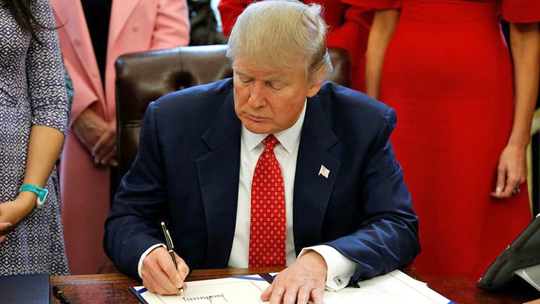
travelban

In addition, the nation's refugee program will be suspended for 120 days, and it will not accept more than 50,000 refugees in a year, down from the 110,000 cap set by the Obama administration.

Trump signed the new ban out of public view, according to White House officials. The order will not take effect until March 16, officials said.

The new guidelines mark a dramatic departure from Trump's original ban. They lay out a far more specific national security basis for the order, block the issuance of only new visas, and name just six of the seven countries included in the first executive order, omitting Iraq.

The order also details specific sets of people who would be able to apply for case-by-case waivers to the order, including those previously admitted to the United States for "a continuous period of work, study, or other long-term activity," those with "significant business or professional obligations" and those seeking to visit or live with family.

"This executive order responsibly provides a needed pause, so we can carefully review how we scrutinize people coming here from these countries of concern," Attorney General Jeff Sessions said in announcing that the order had been signed.

Even before the ink was dry, though, Democrats and civil liberties groups asserted that the new order was legally tainted in the same way as the first one: It was a thinly disguised Muslim ban.

"While the White House may have made changes to the ban, the intent to discriminate against Muslims remains clear," said New York Attorney General Eric Schneiderman, D, who had joined the legal fight against the first ban. "This doesn't just harm the families caught in the chaos of President Trump's draconian policies - it's diametrically opposed to our values, and makes us less safe."

Said Omar Jadwat, director of the ACLU's Immigrants' Rights Project: "The only way to actually fix the Muslim ban is not to have a Muslim ban. Instead, President Trump has recommitted himself to religious discrimination, and he can expect continued disapproval from both the courts and the people."

State Department, Homeland Security and Justice Department officials defended the new order as a necessary measure to improve public safety. They said the countries implicated - Iran, Sudan, Somalia, Libya, Syria and Yemen - were either state sponsors of terrorism, or their territories were so compromised that they were effectively safe havens for terrorist groups. Iraq was omitted, Secretary of State Rex Tillerson said, because it is an "important ally in the fight to defeat ISIS," and its leaders had agreed to implement new security measures.

A Department of Homeland Security official, speaking on the condition of anonymity on a call with reporters, said Iraq was "treated differently" in part because the country had agreed to "timely repatriation" of its citizens if they were ordered deported from the United States.

The new order provides other exceptions not contained explicitly in previous versions: for travelers from those countries who are legal permanent residents of the United States, dual nationals who use a passport from another country and those who have been granted asylum or refugee status. Anyone who holds a visa now should be able to get into the country without any problems, though those whose visas expire will have to reapply, officials said.

The order claims that since 2001, hundreds of people born abroad have been convicted of terrorism-related crimes in the United States, and that more than 300 people who entered the country as refugees were the subject of counterterrorism investigations. It cites two specific examples: Two Iraqi nationals who came to the United States as refugees in 2009, it says, were convicted of terrorism-related offenses, and in October 2014, a Somali native brought to the country as a child refugee was sentenced to 30 years in prison for plotting to detonate a bomb at a Christmas tree-lighting ceremony in Oregon. That man became a naturalized U.S. citizen.

"We cannot risk the prospect of malevolent actors using our immigration system to take American lives," Homeland Security Secretary John F. Kelly said.

U.S. officials declined to specify the countries of origin of the 300 refugees now being investigated in terrorism cases, and they declined to detail those people's current immigration status.

A Department of Homeland Security report assessing the terrorist threat posed by people from the seven countries covered by President Trump's original travel ban had cast doubt on the necessity of the executive order, concluding that citizenship was an "unreliable" threat indicator and that people from the affected countries have rarely been implicated in U.S.-based terrorism.

The Department of Homeland Security official, speaking on the condition of anonymity, criticized the report as being incomplete and not vetted with other agencies, and he asserted that the administration should not be pressed by the judiciary to unveil sensitive national security details to justify the ban.

"This is not something that the Department of Justice should have to represent to a federal district court judge," the official said.

The order represents an attempt by the Trump administration to tighten security requirements for travelers from nations that officials said represent a terrorism threat. A more sweeping attempt in January provoked mass protests across the country as travelers en route to the United States were detained at airports after the surprise order was announced. The State Department had provisionally revoked tens of thousands of visas all at once.

Officials sought to dismiss the idea that there would be any confusion surrounding the implementation of the new order. Officials said they delayed implementation so the government could go through the appropriate legal processes and ensure that no government employee would face "legal jeopardy" for enforcing the order.

"You should not see any chaos, so to speak, or alleged chaos, at airports. There aren't going to be folks stopped tonight from coming into the country because of this executive order. If they are, it's pursuant to our ordinary screening procedures," the Department of Homeland Security official said. "We're going to have a very smooth implementation period."

A federal district judge in Washington state first suspended the travel ban Feb. 3, and a three-judge panel of the U.S. Court of Appeals for the 9th Circuit later upheld that freeze.

That setback was a blow to the White House, which was criticized for failing to include lawmakers and stakeholders in its deliberations.

The revisions to the order will make it more defensible in court - limiting the number of people with standing to sue - though the changes might not allay all the concerns raised by judges across the country. The three-judge panel with the 9th Circuit Court of Appeals, for example, said that exempting green-card and current visa holders from the ban would not address their concern about U.S. citizens with an interest in noncitizens' travel.

The administration, too, will have to wrestle with comments by the president and top adviser Rudolph Giuliani that seemed to indicate the intent of the order was to ban Muslims from entering the United States, which could run afoul of the Establishment Clause of the First Amendment.

On the campaign trail, Trump called for a "total and complete shutdown of Muslims entering the United States." After the election, Giuliani, a former New York City mayor, said: "So when [Trump] first announced it, he said, 'Muslim ban.' He called me up. He said, 'Put a commission together. Show me the right way to do it legally.' "

A federal judge in Virginia referenced those comments in ordering the ban frozen with respect to Virginia residents and institutions, calling it "unrebutted evidence" that Trump's directive might violate the First Amendment.

Comments

Add new comment

  • Coastaldigest.com reserves the right to delete or block any comments.
  • Coastaldigset.com is not responsible for its readers’ comments.
  • Comments that are abusive, incendiary or irrelevant are strictly prohibited.
  • Please use a genuine email ID and provide your name to avoid reject.
Agencies
May 6,2020

Italian researchers have claimed that they have successfully developed a vaccine to contain coronavirus (COVID-19) which is likely to work on humans, a report said.

Luigi Aurisicchio, CEO of Takis, the firm developing the medication, said that a coronavirus candidate vaccine has neutralised the virus in human cells for the first time, the Arab News reported.

"This is the most advanced stage of testing of a candidate vaccine created in Italy. Human tests are expected after this summer," Aurisicchio was quoted as saying to Italian news agency ANSA.

"According to the Spallanzani Hospital, as far as we know we are the first in the world so far to have demonstrated neutralisation of the coronavirus by a vaccine. We expect this to happen in humans too," he added.

The researchers experimented with the vaccine on mice that had successfully developed antibodies that blocked the virus from infecting the cells. They further observed that the five vaccine candidates generated a large number of antibodies, and selected two with the best results.

All of the vaccine candidates currently being developed are based on the genetic material of DNA protein "spike", the molecular tip used by the coronavirus to enter human cells.

They are injected with the so-called "electroporation" technique, which consists of an intramuscular injection followed by a brief electrical impulse, helping the vaccine break into the cells and activating the immune system, the report said.

Researchers believe that this makes their vaccine particularly effective for generating functional antibodies against the "spike" protein, in particular in the lung cells, which are the most vulnerable to coronavirus.

"We are working hard for a vaccine coming from Italian research, with an all-Italian and innovative technology, tested in Italy and made available to everyone," Aurisicchio was quoted by the Arab News report.

"In order to reach this goal, we need the support of national and international institutions and partners who may help us speed up the process," he noted.

The total number of COVID-19 infections, fatalities and recoveries since the pandemic began has risen to 213,013 in the country.

Comments

Add new comment

  • Coastaldigest.com reserves the right to delete or block any comments.
  • Coastaldigset.com is not responsible for its readers’ comments.
  • Comments that are abusive, incendiary or irrelevant are strictly prohibited.
  • Please use a genuine email ID and provide your name to avoid reject.
News Network
February 26,2020

Feb 26: China’s massive travel restrictions, house-to-house checks, huge isolation wards and lockdowns of entire cities bought the world valuable time to prepare for the global spread of the new virus.

But with troubling outbreaks now emerging in Italy, South Korea and Iran, and U.S. health officials warning Tuesday it’s inevitable it will spread more widely in America, the question is: Did the world use that time wisely and is it ready for a potential pandemic?

“It’s not so much a question of if this will happen anymore, but rather more a question of exactly when this will happen — and how many people in this country will have severe illness,” said Dr. Nancy Messonnier of the U.S. Centers for Disease Control and Prevention.

Some countries are putting price caps on face masks to combat price gouging, while others are using loudspeakers on trucks to keep residents informed. In the United States and many other nations, public health officials are turning to guidelines written for pandemic flu and discussing the possibility of school closures, telecommuting and canceling events.

Countries could be doing even more: training hundreds of workers to trace the virus’ spread from person to person and planning to commandeer entire hospital wards or even entire hospitals, said Dr. Bruce Aylward, the World Health Organization’s envoy to China, briefing reporters Tuesday about lessons learned by the recently returned team of international scientists he led.

“Time is everything in this disease,” Aylward said. “Days make a difference with a disease like this.”

The U.S. National Institutes of Health’s infectious disease chief, Dr. Anthony Fauci, said the world is “teetering very, very close” to a pandemic. He credits China’s response for giving other nations some breathing room.

China locked down tens of millions of its citizens and other nations imposed travel restrictions, reducing the number of people who needed health checks or quarantines outside the Asian country.

It “gave us time to really brush off our pandemic preparedness plans and get ready for the kinds of things we have to do,” Fauci said. “And we’ve actually been quite successful because the travel-related cases, we’ve been able to identify, to isolate” and to track down those they came in contact with.

With no vaccine or medicine available yet, preparations are focused on what’s called “social distancing” — limiting opportunities for people to gather and spread the virus.

That played out in Italy this week. With cases climbing, authorities cut short the popular Venice Carnival and closed down Milan’s La Scala opera house. In Japan, Prime Minister Shinzo Abe called on companies to allow employees to work from home, while the Tokyo Marathon has been restricted to elite runners and other public events have been canceled.

Is the rest of the world ready?

In Africa, three-quarters of countries have a flu pandemic plan, but most are outdated, according to authors of a modeling study published last week in The Lancet medical journal. The slightly better news is that the African nations most connected to China by air travel — Egypt, Algeria and South Africa — also have the most prepared health systems on the continent.

Elsewhere, Thailand said it would establish special clinics to examine people with flu-like symptoms to detect infections early. Sri Lanka and Laos imposed price ceilings for face masks, while India restricted the export of personal protective equipment.

India’s health ministry has been framing step-by-step instructions to deal with sustained transmissions that will be circulated to the 250,000 village councils that are the most basic unit of the country’s sprawling administration.

Vietnam is using music videos on social media to reach the public. In Malaysia, loudspeakers on trucks blare information through the streets.

In Europe, portable pods set up at United Kingdom hospitals will be used to assess people suspected of infection while keeping them apart from others. France developed a quick test for the virus and has shared it with poorer nations. German authorities are stressing “sneezing etiquette” and Russia is screening people at airports, railway stations and those riding public transportation.

In the U.S., hospitals and emergency workers for years have practiced for a possible deadly, fast-spreading flu. Those drills helped the first hospitals to treat U.S. patients suffering from COVID-19, the disease caused by the virus.

Other hospitals are paying attention. The CDC has been talking to the American Hospital Association, which in turn communicates coronavirus news daily to its nearly 5,000 member hospitals. Hospitals are reviewing infection control measures, considering using telemedicine to keep potentially infectious patients from making unnecessary trips to the hospital and conserving dwindling supplies of masks and gloves.

What’s more, the CDC has held 17 different calls reaching more than 11,000 companies and organizations, including stadiums, universities, faith leaders, retailers and large corporations. U.S. health authorities are talking to city, county and state health departments about being ready to cancel mass gathering events, close schools and take other steps.

The CDC’s Messonnier said Tuesday she had contacted her children’s school district to ask about plans for using internet-based education should schools need to close temporarily, as some did in 2009 during an outbreak of H1N1 flu. She encouraged American parents to do the same, and to ask their employers whether they’ll be able to work from home.

“We want to make sure the American public is prepared,” Messonnier said.

How prepared are U.S. hospitals?

“It depends on caseload and location. I would suspect most hospitals are prepared to handle one to two cases, but if there is ongoing local transmission with many cases, most are likely not prepared just yet for a surge of patients and the ‘worried well,’” Dr. Jennifer Lighter, a pediatric infectious diseases specialist at NYU Langone in New York, said in an email.

In the U.S., a vaccine candidate is inching closer to first-step safety studies in people, as Moderna Inc. has delivered test doses to Fauci’s NIH institute. Some other companies say they have candidates that could begin testing in a few months. Still, even if those first safety studies show no red flags, specialists believe it would take at least a year to have something ready for widespread use. That’s longer than it took in 2009, during the H1N1 flu pandemic — because that time around, scientists only had to adjust regular flu vaccines, not start from scratch.

The head of the World Health Organization, Tedros Adhanom Ghebreyesus, said the U.N. health agency’s team in China found the fatality rate between 2% and 4% in the hard-hit city of Wuhan, the virus’ epicenter, and 0.7% elsewhere.

The world is “simply not ready,” said the WHO’s Aylward. “It can get ready very fast, but the big shift has to be in the mindset.”

Aylward advised other countries to do “really practical things” now to get ready.

Among them: Do you have hundreds of workers lined up and trained to trace the contacts of infected patients, or will you be training them after a cluster pops up?

Can you take over entire hospital wards, or even entire hospitals, to isolate patients?

Are hospitals buying ventilators and checking oxygen supplies?

Countries must improve testing capacity — and instructions so health workers know which travelers should be tested as the number of affected countries rises, said Johns Hopkins University emergency response specialist Lauren Sauer. She pointed to how Canada diagnosed the first traveler from Iran arriving there with COVID-19, before many other countries even considered adding Iran to the at-risk list.

If the disease does spread globally, everyone is likely to feel it, said Nancy Foster, a vice president of the American Hospital Association. Even those who aren’t ill may need to help friends and family in isolation or have their own health appointments delayed.

“There will be a lot of people affected even if they never become ill themselves,” she said.

Comments

Add new comment

  • Coastaldigest.com reserves the right to delete or block any comments.
  • Coastaldigset.com is not responsible for its readers’ comments.
  • Comments that are abusive, incendiary or irrelevant are strictly prohibited.
  • Please use a genuine email ID and provide your name to avoid reject.
News Network
April 24,2020

Washington, Apr 24: President Donald Trump has favoured a phased reopening of the US economy, devastated by the coronavirus pandemic, which has claimed nearly 50,000 lives and infected over eight lakh people in the country.

More than 95 per cent of the country's 330 million people are under stay-at-home order as a result of the social mitigation measures, including social distancing, being enforced till May 1.

Trump on Thursday indicated that the stay-at-home order might be extended beyond May 1, but vehemently advocated the need to gradually open up the economy.

In the past few weeks, more than 26 million Americans have filed for unemployment benefits and the figure is soon likely to cross 40 million.

Both the World Bank and the International Monetary Fund (IMF) have projected a negative growth in the US in 2020.

To keep America gaining momentum, every citizen needs to maintain the vigilance, and we all understand that very well we've gone over it many, many times this includes practising good hygiene, maintaining social distance, and the voluntary use of face covering, Trump said.

Safe and phased reopening of our economy -- it's very exciting, but it does not mean that we are letting down our guard at all in any way; on the contrary, continued diligence is an essential part of our strategy to get our country back to work to take our country back, he told reporters at his daily White House news conference on coronavirus.

The data and facts on the ground suggest that the US is making great progress, he said.

In 23 states, new cases have declined. In the peak week, 40 per cent of the American counties have seen a rapid decline in new cases. As many as 46 states report a drop in patients showing coronavirus-like symptoms, he said.

Trump said the US is very close to finding a vaccine for COVID-19.

We are very close to testing... when testing starts it takes a period of time but we will get it done, he said.

According to Vice President Mike Pence, data continues to show promising signs of progress in the New York Metro area, New Jersey, Connecticut, Detroit and New Orleans. All appear to be passed their peak and we are seeing consistent declines in hospitalisation and cases in regions across the country, he said.

Comments

Add new comment

  • Coastaldigest.com reserves the right to delete or block any comments.
  • Coastaldigset.com is not responsible for its readers’ comments.
  • Comments that are abusive, incendiary or irrelevant are strictly prohibited.
  • Please use a genuine email ID and provide your name to avoid reject.