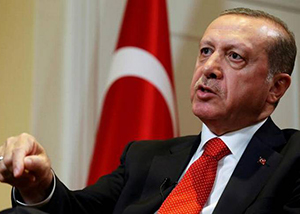
Turkish assembly passes crucial bill to boost Erdogan powers

January 22, 2017

Ankara, Jan 22: Turkey's parliament has approved a contentious constitutional reform package, paving the way for a referendum on a presidential system that would greatly expand the powers of President Recep Tayyip Erdogan's office.turkey

In an all-night session that ended early on Saturday, lawmakers voted in favor of a set of amendments presented by the ruling party, founded by Mr. Erdogan. The reform bill cleared the minimum threshold necessary to put the measures to a national referendum for final approval.

The vote took place with 488 lawmakers out of the 550-seat assembly in attendance. A total of 339 parliamentarians voted yes, 142 no, five cast empty ballots and two were ruled out as invalid.

People's decision: Yildrim

Turkish Prime Minister Binali Yildirim celebrated the result saying “we are now entrusting this to the people, its actual owners. Now it's the people's word. It is the people's decision.”

A public vote on the issue is expected as early as March 26, and no later than mid-April, according to officials of the ruling Justice and Development Party, or AKP.

Comments

Think Tank
 - 
Sunday, 22 Jan 2017

We are with ERDOGAN

Add new comment

  • Coastaldigest.com reserves the right to delete or block any comments.
  • Coastaldigset.com is not responsible for its readers’ comments.
  • Comments that are abusive, incendiary or irrelevant are strictly prohibited.
  • Please use a genuine email ID and provide your name to avoid reject.
News Network
May 8,2020

Washington, May 8: Four top Republican senators have urged US President Donald Trump to suspend all-new guest worker visas for 60 days and some of its categories, including the H-1B visa, for at least the next year or until unemployment figures return to normal levels in the country.

The unemployment figures in the US have reached an all-time high due to the coronavirus pandemic. The letter has been signed by Senators Ted Cruz, Tom Cotton, Chuck Grassley and Josh Hawley.

"As you know, more than 33 million Americans have filed for unemployment coverage just since mid-March, and approximately one-fifth of the American workforce is currently out of work. This is a stunning difference compared with the historically-low nationwide unemployment rate of just 3.5 per cent in February this year," they said in their letter to the president on Thursday.

The letter, dated May 7, specifically calls for suspension of all non-immigrant guest worker visas for the next 60 days, followed by a continued suspension of certain categories of new non-immigrant guest worker visas for a year or until the national unemployment figures return to normal levels.

"To protect unemployed Americans in the early stages of economic recovery, we urge you to suspend all non-immigrant guest worker visas for the next 60 days," the senators said.

Exceptions to this suspension should be rare, limited to time-sensitive industries such as agriculture and issued only on a case-by-case basis, when the employers can demonstrate that they have been unable to find Americans to take the jobs, the senators wrote.

After 60 days, the senators urged Trump to continue to suspend new non-immigrant guest workers for a year or until the national unemployment figures return to normal levels, whichever comes first.

"That suspension should, at a minimum, include H-2B visas (non-agricultural seasonal workers), H-1B visas (specialty occupation workers) and the Optional Practical Training (OPT) program (extension of foreign student visas after graduation). We also urge you to suspend the EB-5 immigrant visa program, effective immediately," the lawmakers wrote.

The H-1B work visa for foreign technology professionals is highly popular among Indians and a large number of Indians also opt for the EB-5 investors visa.

The senators argued that there is no reason why unemployed Americans and recent college graduates should have to compete in such a limited job market against an influx of additional H-1B workers, most of whom work in business, technology or STEM fields.

"Temporarily suspending the issuance of new H-1B visas would also protect the hundreds of thousands of H-1B workers and their families already working in the United States -- workers who could otherwise be subject to deportation if they are laid off for more than 60 days," they said.

"Of course, appropriate exceptions could also be crafted to the H-1B program suspension to allow for doctors, nurses and other healthcare professionals who wish to come to the United States to assist in combating the coronavirus pandemic," the senators wrote.

Additionally, the United States ought to suspend its Optional Practical Training (OPT) programme, which allows foreign students in the country to extend their stay after graduation for one to three years to get "experience in the field" by taking jobs here, they wrote.

In 2019, more than 223,000 former foreign students had their OPT applications approved or extended. While the merits of such a programme are subject to debate, there is certainly no reason to allow foreign students to stay for three additional years just to take jobs that would otherwise go to unemployed Americans as the country's economy recovers, the lawmakers said.

The senators also urged Trump to remove the EB-5 visa from the exemptions in his Presidential Proclamation issued on April 22, at least until real reforms are adopted.

The EB-5 programme has long been plagued by scandal and fraud, and criticised as effectively functioning as a pay-for-citizenship scheme in many cases. There is no reason that the programme should receive preferential treatment as opposed to other green card programmes for employment-based immigrants, the lawmakers said.

Comments

Add new comment

  • Coastaldigest.com reserves the right to delete or block any comments.
  • Coastaldigset.com is not responsible for its readers’ comments.
  • Comments that are abusive, incendiary or irrelevant are strictly prohibited.
  • Please use a genuine email ID and provide your name to avoid reject.
News Network
July 3,2020

Jul 3: China under President Xi Jinping has stepped up its "aggressive" foreign policy toward India and "resisted" efforts to clarify the Line of Actual Control that prevented a lasting peace from being realised, according to a report released by a US Congress appointed commission.

The armies of India and China have been locked in a bitter standoff at multiple locations in eastern Ladakh for the last seven weeks, and the tension escalated after 20 Indian soldiers were killed in a violent clash in the Galwan Valley on June 15.

“Under General Secretary of the Chinese Communist Party (CCP) Xi Jinping, Beijing has stepped up its aggressive foreign policy toward New Delhi. Since 2013, China has engaged in five major altercations with India along the Line of Actual Control (LAC),” said a brief issued by US-China Economic and Security Review Commission.

"Beijing and New Delhi have signed a series of agreements and committed to confidence-building measures to stabilise their border, but China has resisted efforts to clarify the LAC, preventing a lasting peace from being realised,” said the report and was prepared at the request of the Commission to support its deliberations.

Authored by Will Green, a Policy Analyst on the Security and Foreign Affairs Team at the Commission, the report says that the Chinese government is particularly fearful of India’s growing relationship with the United States and its allies and partners.

“The latest border clash is part of a broader pattern in which Beijing seeks to warn New Delhi against aligning with Washington,” it said.

After Xi assumed power in 2012, there was a significant increase in clashes, despite the fact that he met Prime Minister Narendra Modi several times and Beijing and New Delhi have agreed to a series of confidence-building mechanisms designed to mitigate tensions.

Prior to 2013, the last major border clash was in 1987. The 1950s and 1960s were a particularly tense period, culminating in 1962 with a war that left thousands of soldiers dead on both sides, according to the records of China's People's Liberation Army, the report said.

“The 2020 skirmish is in line with Beijing’s increasingly assertive foreign policy. The clash came as Beijing was aggressively pressing its other expansive sovereignty claims in the Indo-Pacific region, such as over Taiwan and in the South and East China seas,” it said.

China is engaged in hotly contested territorial disputes in both the South China Sea and the East China Sea. Beijing has built up and militarised many of the islands and reefs it controls in the region. Both areas are stated to be rich in minerals, oil and other natural resources and are vital to global trade.

China claims almost all of the South China Sea. Vietnam, the Philippines, Malaysia, Brunei and Taiwan have counter claims over the area.

Several weeks before the clash in the Galwan Valley, Chinese Defence Minister Wei Fenghe called on Beijing to “use fighting to promote stability” as the country’s external security environment worsened, a potential indication of China’s intent to proactively initiate military tensions with its neighbours to project an image of strength, the report said.

Comments

Add new comment

  • Coastaldigest.com reserves the right to delete or block any comments.
  • Coastaldigset.com is not responsible for its readers’ comments.
  • Comments that are abusive, incendiary or irrelevant are strictly prohibited.
  • Please use a genuine email ID and provide your name to avoid reject.
News Network
May 30,2020

May 30: Warning of the tightrope walk ahead as governments battle the coronavirus crisis, Nobel laureate Peter Charles Doherty has expressed concern about densely populated countries such as India relaxing lockdown norms while also describing a complete shutdown as “an economic and social impossibility”.

The Australian immunologist, who cautioned that the number of COVID-19 cases will rise in the coming days, said the earliest time frame for an effective vaccine “going into large numbers of people” is nine to 12 months.

"If all goes well with testing, we could know if some of the candidate vaccines are both safe and effective as early as September/October. Then, rolling a vaccine out will depend on the type of product and how quickly it can be made, put in vials and so forth," Doherty told PTI in an email interview from Melbourne.

The novel coronavirus, he added, does not change fast like influenza and, from what is known so far, “the same vaccine should work everywhere”.

Doherty, who is with the Department of Microbiology and Immunology at the Doherty Institute, University of Melbourne, won the Nobel Prize for Medicine in 1996 for his discovery of how the body’s immune system distinguishes virus-infected cells from normal ones.

Discussing the lockdown, he said, "If it was purely a matter of hard science, everywhere should stay locked down. But that’s pretty much an economic and social impossibility.”

The expectation, he said, is the numbers will rise and limiting spread will depend on people acting responsibly and the capacity for rapid response and extensive contact testing.

“And in a densely populated country like India I think that it will be very difficult," the scientist said.

Several countries, including India, began relaxing lockdown norms in mid-May despite the WHO’s warning about a second wave. India’s lockdown began on March 25 and has since been extended. The fourth phase ends on Sunday.

Asked whether there are any alternatives to a lockdown, the 79-year-old said, "There is no other option other than closing borders. South Korea, for example, conducted massive, intensive testing and contact tracing in a wealthy country with a very disciplined population. Otherwise, not till we have effective vaccines."

He added that he personally doesn’t see the point of closing borders for people coming in if there’s already a high incidence of disease in the community, “unless it’s to avoid the need to care for them and use scarce hospital beds".

According to Doherty, the coronavirus "is a new virus which has come straight out of nature".

“It (the virus) has moved so rapidly across the world because of people travelling on international planes as well as tourist ships," he added.

The immunologist also warned against the use of hydroxychloroquine to treat COVID-19, and said current and planned trials of the anti-malaria drug should be stopped.

“My understanding is that the use of the drug in severe disease is definitely contra-indicated, but it’s not yet clear whether, if taken under medical supervision, it could have some useful effect if taken early on, or as a preventive. Those trials just haven’t been done properly," Doherty noted.

The Indian Council of Medical Research (ICMR) has backed the use of hydroxychloroquine as a preventive against COVID-19 even after the WHO suspended clinical trials of the drug citing safety concerns.

Asked whether plasma therapy can be an effective treatment for COVID-19, Doherty said, "We lack good properly controlled trials but, especially if the plasma has been tested for antibody levels and there’s evidence of good activity, it could be helpful. If I had the disease and was offered plasma therapy I would certainly accept, but I would not take hydroxychloroquine."

Doherty is also very optimistic about herd immunity developing against the SARS-CoV-2 infection.

"We think that (herd immunity) will cut in and have an obvious effect when, say, 60 per cent of people have been infected. Best hope is to boost herd immunity with a vaccine," he stated.

Herd immunity is a form of indirect protection from infectious disease that occurs when a large percentage of a population has become immune to an infection, whether through vaccination or previous infections.

The number of COVID-19 cases have crossed 5.9 million and the fatalities 3,65,000, according to the Johns Hopkins University on Saturday. 

In India, the death toll has risen to 4,971 and the number of cases to 1,73,763, according to the Union Health Ministry on Saturday.

Several states, including Bihar, Uttar Pradesh, Madhya Pradesh, Jharkhand and Chhattisgarh, have reported a rise in number since lockdown norms were relaxed in early May and migrant workers reached home.

In Uttar Pradesh, for instance, the number of infections rose from around 3,000 on May 4 to 6,532 on May 26. Similarly, Bihar’s numbers increased from around 500 to over 2,700 in the period.


Comments

Add new comment

  • Coastaldigest.com reserves the right to delete or block any comments.
  • Coastaldigset.com is not responsible for its readers’ comments.
  • Comments that are abusive, incendiary or irrelevant are strictly prohibited.
  • Please use a genuine email ID and provide your name to avoid reject.