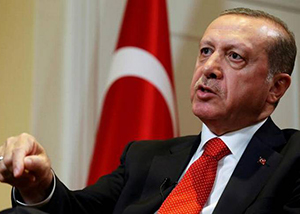
Turkish assembly passes crucial bill to boost Erdogan powers

January 22, 2017

Ankara, Jan 22: Turkey's parliament has approved a contentious constitutional reform package, paving the way for a referendum on a presidential system that would greatly expand the powers of President Recep Tayyip Erdogan's office.turkey

In an all-night session that ended early on Saturday, lawmakers voted in favor of a set of amendments presented by the ruling party, founded by Mr. Erdogan. The reform bill cleared the minimum threshold necessary to put the measures to a national referendum for final approval.

The vote took place with 488 lawmakers out of the 550-seat assembly in attendance. A total of 339 parliamentarians voted yes, 142 no, five cast empty ballots and two were ruled out as invalid.

People's decision: Yildrim

Turkish Prime Minister Binali Yildirim celebrated the result saying “we are now entrusting this to the people, its actual owners. Now it's the people's word. It is the people's decision.”

A public vote on the issue is expected as early as March 26, and no later than mid-April, according to officials of the ruling Justice and Development Party, or AKP.

Comments

Think Tank
 - 
Sunday, 22 Jan 2017

We are with ERDOGAN

Add new comment

  • Coastaldigest.com reserves the right to delete or block any comments.
  • Coastaldigset.com is not responsible for its readers’ comments.
  • Comments that are abusive, incendiary or irrelevant are strictly prohibited.
  • Please use a genuine email ID and provide your name to avoid reject.
News Network
February 12,2020

Feb 12: China on Wednesday reported another drop in the number of new cases of a viral infection and 97 more deaths, pushing the total dead past 1,100 as postal services worldwide said delivery was being affected by the cancellation of many flights to China.

The National Health Commission said 2,015 new cases had been reported over the last 24 hours, declining for a second day. The total number of cases in mainland China reached 44,653, although many experts say a large number of others infected have gone uncounted.

The additional deaths raised the mainland toll to 1,113. Two people have died elsewhere, one in Hong Kong and one in the Philippines.

In the port city of Tianjin, just southeast of Beijing, a cluster of cases has been traced to a department store in Baodi district. One-third of Tianjin’s 104 confirmed cases are in Baodi, the Xinhua state news agency reported.

A salesperson working in the store’s small home appliance section became the first individual in the cluster to be diagnosed on Jan. 31, Xinhua said. The store was already closed at that point, then disinfected on Feb. 1. Nevertheless, several more diagnoses soon followed.

The next to have their infections confirmed were also salespeople at the store. They had not visited Wuhan recently and, with the exception of one married couple, the patients worked in different sections of the store and did not know one another, according to Xinhua.

Japan’s Health Ministry said that 39 new cases have been confirmed on a cruise ship quarantined at Yokohama, bringing the total to 174 on the Diamond Princess.

The U.S. Postal Service said that it was “experiencing significant difficulties” in dispatching letters, parcels and express mail to China, including Hong Kong and Macau.

Both the U.S. and Singapore Post said in notes to their global counterparts that they are no longer accepting items destined for China, “until sufficient transport capacity becomes available.”

The Chinese mail service, China Post, said it was disinfecting postal offices, processing centers and vehicles to ensure the virus doesn’t spread via the mail and to protect staff.

It said the crisis is also impacting mail that transits China to other destinations including North Korea, Kazakhstan, Kyrgyzstan, Mongolia, Tajikistan, Turkmenistan, Uzbekistan and Vietnam.

The World Health Organization has named the disease caused by the virus as COVID-19, avoiding any animal or geographic designation to avoid stigmatization and to show the illness comes from a new coronavirus discovered in 2019.

The illness was first reported in December and connected to a food market in the central Chinese city of Wuhan, where the outbreak has largely been concentrated.

Zhong Nanshan, a leading Chinese epidemiologist, said that while the virus outbreak in China may peak this month, the situation at the center of the crisis remains more challenging.

“We still need more time of hard working in Wuhan,” he said, describing the isolation of infected patients there a priority.

“We have to stop more people from being infected,” he said. “The problem of human-to-human transmission has not yet been resolved.”

Without enough facilities to handle the number of cases, Wuhan has been building prefabricated hospitals and converting a gym and other large spaces to house patients and try to isolate them from others.

China’s official media reported Tuesday that the top health officials in Hubei province, of which Wuhan is the capital, have been relieved of their duties. No reasons were given, although the province’s initial response was deemed slow and ineffective. Speculation that higher-level officials could be sacked has simmered, but doing so could spark political infighting and be a tacit admission of responsibility.

The virus outbreak has become the latest political challenge for the party and its leader, Xi Jinping, who despite accruing more political power than any Chinese leader since Mao Zedong, has struggled to handle crises on multiple fronts. These include a sharply slowing domestic economy, the trade war with the U.S. and pushback on China’s increasingly aggressive foreign policies.

China is struggling to restart its economy after the annual Lunar New Year holiday was extended to try to curb the spread of the virus. About 60 million people are under virtual quarantine and many others are still working at home.

In Hong Kong, the diagnosis of four people living in an apartment building prompted worried comparisons with the deadly SARS pandemic of 17 years ago.

More than 100 people were evacuated from the building after a 62-year-old woman diagnosed with the virus was found living 10 floors directly below a man who was earlier confirmed with the virus.

Health officials called it a precautionary measure and sought to assuage fears of an epidemic, dismissing similarities to the SARS community outbreak at the Amoy Gardens housing estate in 2003.


Comments

Add new comment

  • Coastaldigest.com reserves the right to delete or block any comments.
  • Coastaldigset.com is not responsible for its readers’ comments.
  • Comments that are abusive, incendiary or irrelevant are strictly prohibited.
  • Please use a genuine email ID and provide your name to avoid reject.
News Network
May 6,2020

May 6: In a first, a Pakistani Hindu youth has become the first person from the minority community to join the Pakistan Air Force.

Rahul Dev has been recruited as a General Duty Pilot Officer, the Pakistan Air Force (PAF) said in a tweet.

Dev hails from Tharparkar district of Sindh province.

Sharing the picture of the young man, the PAF recently tweeted, "Good news during #COVID19 tense situation. Thar rocked again...Congratulations #RahulDev who hails from very remote village of Tharparkar has been selected as GD Pilot in #PAF."

Though Dev's exact age is not known, those inducted in PAF at his level are often around 20.

The official Radio Pakistan on Wednesday said it is "for the first time in Pakistan's history" that a Hindu youth has been recruited as a general duty pilot officer in PAF.

The Express Tribune in a report published on Wednesday said the induction showed that the PAF was breaking barriers.

Last year, Kainat Junaid became the first woman from Khyber-Pakthunkhwa province to have been selected for fighter pilot training.

Junaid not only secured the top position in PAF's test for General Duty Pilot, but also became Pakistan’s first female fighter pilot to serve the country alongside her father.

Her father Ahmed Junaid is a Squadron Leader in the PAF.

Comments

Add new comment

  • Coastaldigest.com reserves the right to delete or block any comments.
  • Coastaldigset.com is not responsible for its readers’ comments.
  • Comments that are abusive, incendiary or irrelevant are strictly prohibited.
  • Please use a genuine email ID and provide your name to avoid reject.
News Network
July 2,2020

Naypyitaw, Jul 2: A landslide at a jade mine in northern Myanmar has killed at least 113 people, officials say, warning the death toll is likely to rise further.

The incident took place early on Thursday in the jade-rich Hpakant area of Kachin state after a bout of heavy rainfall, the Myanmar Fire Services Department said on Facebook.

"The jade miners were smothered by a wave of mud," the statement said. "A total of 113 bodies have been found so far," it added, raising the death toll from at least 50.

Photos posted on the Facebook page showed a search and rescue team wading through a valley apparently flooded by the mudslide.

'No one could help them'

Maung Khaing, a 38-year-old miner from the area, said he saw a towering pile of waste that looked on the verge of collapse and was about to take a picture when people began shouting "run, run!"

"Within a minute, all the people at the bottom [of the hill] just disappeared," he told Reuters news agency by phone.

"I feel empty in my heart. I still have goosebumps ... There were people stuck in the mud shouting for help, but no one could help them."

Tar Lin Maung, a local official with the information ministry, said authorities had recovered more than 100 bodies.

"Other bodies are in the mud. The numbers are going to rise," he told Reuters.

Fatal landslides are common in the poorly regulated mines of Hpakant, the victims often from impoverished communities who risk their lives hunting the translucent green gemstone.

The government of Myanmar leader Aung San Suu Kyi pledged to clean up the industry when it took power in 2016, but activists say little has changed.

Official sales of jade in Myanmar were worth $750.4m in 2016-2017, according to data published by the government as part of the Extractive Industries Transparency Initiative.

But experts believe the true value of the industry, which mainly exports to China, is much larger.

Northern Myanmar's abundant natural resources - including jade, timber, gold and amber - have also helped finance both sides of a decades-long conflict between ethnic Kachin and the military.

The fight to control the mines and the revenues they bring frequently traps local civilians in the middle.

Comments

Add new comment

  • Coastaldigest.com reserves the right to delete or block any comments.
  • Coastaldigset.com is not responsible for its readers’ comments.
  • Comments that are abusive, incendiary or irrelevant are strictly prohibited.
  • Please use a genuine email ID and provide your name to avoid reject.