


Two journalists shot dead during Facebook Live broadcast

February 16, 2017

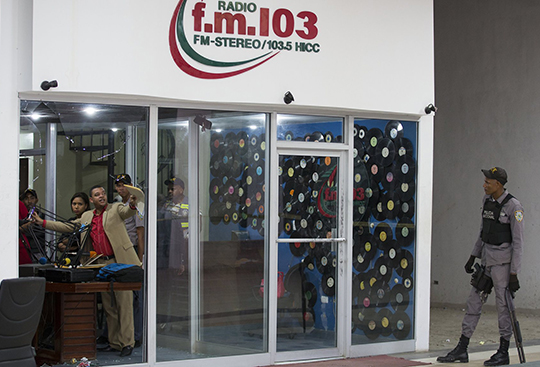
Santo Domingo, Feb 16: Two radio journalists have been killed in the Dominican Republic after gunmen opened fire during a news bulletin which was being broadcast on Facebook Live.
journo

Luís Manuel Medina, the presenter of the news programme Milenio Caliente – or Hot Millennium – was killed while on air on Tuesday morning. Producer and director Leo Martínez was shot dead in an adjacent office at the radio station FM 103.5.

Gunfire could be heard during the Facebook Live video, along with a woman yelling “Shots! Shots! Shots!” before the transmission abruptly cuts off.

The station secretary Dayaba Garcia was also injured in the attack and taken to hospital where she needed emergency surgery.

Police said the shooting occurred in San Pedro de Macorís, a small city 45 miles east of the capital, Santo Domingo. The radio station is located within a shopping mall.

Three men have been arrested, but none has been charged. Police say they do not yet have a motive.

Medina was also the official announcer of the Estrellas Orientales baseball team.

Milenio Caliente is a popular local radio programme recognised for its lively political analysis and social campaigns.

In recent weeks, Medina had repeatedly condemned pollution in Laguna Mallen, a protected lake in San Pedro.

Olivo de Leon, from the College of Journalism who knew both men, said the attack was unprecedented in the country's history. “For gunmen to open fire in a media outlet like this is unprecedented.

AdvertisementReport this ad
“The authorities must investigate to determine not just the killers but also the intellectual authors so that we know why they were murdered. Impunity in this case will generate fear among journalists, making them scared to speak out and do their jobs. The government must guarantee freedom of expression,” De Leon told the Guardian in a telephone interview from Santo Domingo.

While murders are rare, harassment and intimidation of journalists reporting on organised crime and corruption is fairly common in the Dominican Republic.

In recent years, reporters who spoke out against a controversial 2013 court ruling which stripped Dominicans of Haitian descent of their citizenship have received death threats and suffered vicious online harassment campaigns.

The last journalist to be killed in the country was Blas Olivo who was shot dead in April 2015. Police said Olvio, press director of the Dominican Agribusiness Association, was the victim of a bungled robbery, even though neither his car nor phone were stolen. The case remains ongoing.

Comments

Add new comment

  • Coastaldigest.com reserves the right to delete or block any comments.
  • Coastaldigset.com is not responsible for its readers’ comments.
  • Comments that are abusive, incendiary or irrelevant are strictly prohibited.
  • Please use a genuine email ID and provide your name to avoid reject.
News Network
July 25,2020

Madrid, Jul 25: Spain is witnessing a new surge in virus" coronavirus infections with nearly a thousand cases daily, a month after lifting the pandemic lockdown.

The country is reinstating both voluntary guidelines and mandatory restrictions that it had lifted on June 21, The Washington Post reported.

Spain on Wednesday reported over 224 outbreaks and 2,622 virus" coronavirus cases. According to a report in Washington Post, the new surge is attributed primarily to seasonal farmworkers, people attending family get-togethers and nightclub partyers.

On Thursday, the health ministry reported an additional 971 cases.

"The majority are related to fruit collection and also to the spaces where measures to avoid contact are relaxed," Spain Health Minister Salvador Illa told parliament. "We have to call on citizens to not lose respect for the virus not to be afraid of it, but not to lose respect for it either."

The government of Spain lifted all restrictions put in place to combat virus" coronavirus on June 21 and declared 'a new normal'. 

The virus" coronavirus pandemic till then had killed 24,000 people and infected more than 2,70,166.

Countries around the world are witnessing the second surge of virus" coronavirus. The resurgence could threaten the economic bounce Spain was hoping to get from vacationers eager for summer fun.

The surge in cases has been greatest in the northeastern region of Catalonia with more than 7,953 new confirmed cases since July 10.

Spain's National Epidemiological Survey has predicted that the rate of increase more than doubled in the past three weeks.

Meanwhile, the Catalan government reverted to pre-June 21 confinement rules in Barcelona and a dozen other municipalities in the metropolitan area, as well as in Figueras, Vilafant, La Noguera and Lleida.

Authorities have ordered bars and restaurants to limit indoor occupancy to 50 per cent, reduced sports to fewer than 10 people, closed night clubs and gyms and blocked some cultural activities.

The epidemiologist in charge of the region's biggest hospital warned in an interview last week with the Spanish daily El Pais that the situation in the agricultural hub of Lleida, located about 100 miles west of Barcelona, "had clearly gotten out of hand."

"Nobody foresaw that there would be a number of people coming from abroad to pick fruit in unfavourable conditions and that they might be infected," said epidemiologist Magda Campins of Vall d'Hebron in Barcelona. "And when the infections began to be detected, it was hard to keep tabs on the cases and their contacts because some of them, although they should have been in isolation, got away because they needed to earn money."

Catalonia's Department of Labour, Social Affairs and Family is using a hotel in Lleida to quarantine fruit workers who test positive for COVID-19 but are unable to isolate at home.

In the capital of Madrid, which was the epicentre during the pandemic's first wave in the spring, authorities reported 710 new cases in the past week. The use of face masks is widespread, but the region has shied away from making them mandatory in public.

Madrid's regional health secretary, Enrique Ruiz Escudero, defended that position while citing an uptick in infections in the under-40 age group. He told young people not to let down their guard.

"We can't take even one step backwards. Young people have to be aware of the responsibility they have," Ruiz Escudero said in a news conference Thursday. "I ask them to use the face mask and to maintain a safe distance."

Comments

Add new comment

  • Coastaldigest.com reserves the right to delete or block any comments.
  • Coastaldigset.com is not responsible for its readers’ comments.
  • Comments that are abusive, incendiary or irrelevant are strictly prohibited.
  • Please use a genuine email ID and provide your name to avoid reject.
Agencies
July 29,2020

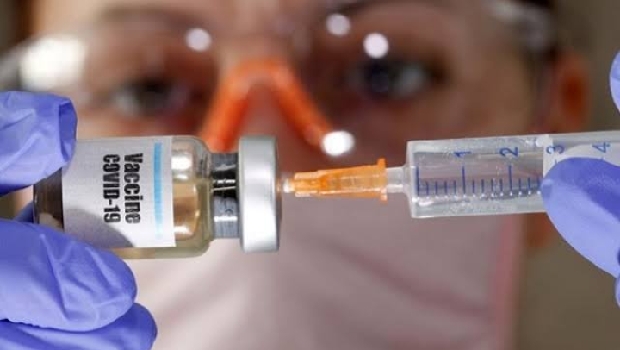
If everything goes as Russia’s expectation, it will be world’s first country to approve a coronavirus vaccine for widespread in the second week of August despite safety and efficacy concerns, according to a report. The adenoviral vector-based vaccine developed by Russian military and government researchers is currently in phase 2 trials.

According to a report from CNN, Russian officials are hoping to get approval for the COVID-19 vaccine developed by the Moscow-based Gamaleya Institute on Agust 10 or even before that. The officials told the outlet that the vaccine will be approved for public use with frontline healthcare workers receiving it first.

“It’s a Sputnik moment,” said Kirill Dmitriev, head of Russia’s sovereign wealth fund, which is financing Russian vaccine research, referring to the successful 1957 launch of the world’s first satellite by the Soviet Union, according to CNN.

“Americans were surprised when they heard Sputnik’s beeping. It’s the same with this vaccine. Russia will have got there first,” he was quoted as saying.

However, Russia is yet to release the scientific data on its coronavirus vaccine trials, hence, questions remain about the safety and efficacy of the vaccine, said the report. The vaccine is in the second phase of testing with developers planning to launch the phase 3 trials sometime after August 3.

Earlier, Interfax reported, citing Health Minister Mikhail Murashko, that the vaccine will be widely used in parallel with phase 3 trials. He said the country plans to vaccinate medics who are at high-risk for COVID-19 next month before clinical trials are completed.

Murashko added that individuals at higher risk of getting infected with the coronavirus such as older people or those with health conditions will also be prioritised for the vaccine, although he did not estimate or reveal when that would happen. The minister added 800 people will be recruited for the phase 3 trials.

Meanwhile, health officials were more cautious considering the fact that human testing of the vaccine is incomplete, and the state registration is expected to begin after August 3, reported The Moscow Times.

On Monday, Moderna and Pfizer announced the commencement of the final phase 3 trials of their candidate vaccines against the SARS-CoV-2 virus, which has so far claimed at least 654,477 lives and infected 16,514,500 people worldwide. 

Researchers will recruit up to 30,000 volunteers in separate trials both backed by the US government. India's first indigenous coronavirus vaccine, COVAXIN, is undergoing phase 1 human clinical trials across the country. More than 150 COVID-19 vaccines are being developed all over the world with at least six candidates already in late-stage clinical trials.

Comments

Add new comment

  • Coastaldigest.com reserves the right to delete or block any comments.
  • Coastaldigset.com is not responsible for its readers’ comments.
  • Comments that are abusive, incendiary or irrelevant are strictly prohibited.
  • Please use a genuine email ID and provide your name to avoid reject.
News Network
April 12,2020

Apr 12: India and other South Asian countries are likely to record their worst growth performance in four decades this year due to the coronavirus outbreak, the World Bank said on Sunday.

The South Asian region, comprising eight countries, is likely to show economic growth of 1.8 per cent to 2.8 per cent this year, the World Bank said in its South Asia Economic Focus report, well down from the 6.3 per cent it projected six months ago.

India's economy, the region's biggest, is expected to grow 1.5 per cent to 2.8 per cent in the fiscal year that started on April 1. The World Bank has estimated it will grow 4.8 per cent to 5 per cent in the fiscal year that ended on March 31.

"The green shoots of a rebound that were observable at the end of 2019 have been overtaken by the negative impacts of the global crisis," the World Bank report said.

Other than India, the World Bank forecast that Sri Lanka, Nepal, Bhutan and Bangladesh will also see sharp falls in economic growth.

Three other countries - Pakistan, Afghanistan and the Maldives - are expected to fall into recession, the World Bank said in the report, which was based on country-level data available as of April 7.

Measures taken to counter the coronavirus have disrupted supply chains across South Asia, which has recorded more than 13,000 cases so far - still lower than many parts of the world.

India's lockdown of 1.3 billion people has also left millions out of work, disrupted big and small businesses and forced an exodus of migrant workers from the cities to their homes in villages.

In the event of prolonged and broad national lockdowns, the report warned of a worst-case scenario in which the entire region would experience an economic contraction this year.

To minimize short-term economic pain, the Bank called for countries in the region to announce more fiscal and monetary steps to support unemployed migrant workers, as well as debt relief for businesses and individuals.

India has so far unveiled a $23 billion economic plan to offer direct cash transfers to millions of poor people hit by its lockdown. In neighbouring Pakistan, the government has announced a $6 billion plan to support the economy.

"The priority for all South Asian governments is to contain the virus spread and protect their people, especially the poorest who face considerable worse health and economic outcomes," said senior World Bank official Hartwig Schafer.

Comments

Add new comment

  • Coastaldigest.com reserves the right to delete or block any comments.
  • Coastaldigset.com is not responsible for its readers’ comments.
  • Comments that are abusive, incendiary or irrelevant are strictly prohibited.
  • Please use a genuine email ID and provide your name to avoid reject.