Two journalists shot dead during Facebook Live broadcast

February 16, 2017

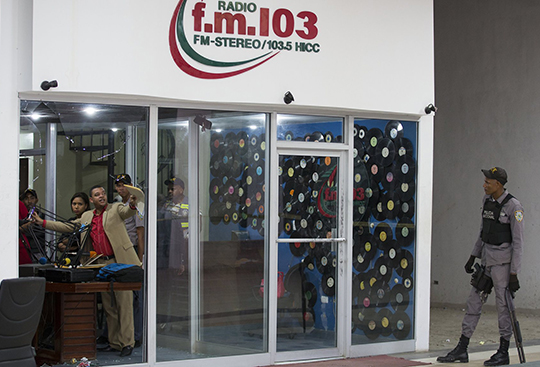
Santo Domingo, Feb 16: Two radio journalists have been killed in the Dominican Republic after gunmen opened fire during a news bulletin which was being broadcast on Facebook Live.

journo

Luís Manuel Medina, the presenter of the news programme Milenio Caliente – or Hot Millennium – was killed while on air on Tuesday morning. Producer and director Leo Martínez was shot dead in an adjacent office at the radio station FM 103.5.

Gunfire could be heard during the Facebook Live video, along with a woman yelling “Shots! Shots! Shots!” before the transmission abruptly cuts off.

The station secretary Dayaba Garcia was also injured in the attack and taken to hospital where she needed emergency surgery.

Police said the shooting occurred in San Pedro de Macorís, a small city 45 miles east of the capital, Santo Domingo. The radio station is located within a shopping mall.

Three men have been arrested, but none has been charged. Police say they do not yet have a motive.

Medina was also the official announcer of the Estrellas Orientales baseball team.

Milenio Caliente is a popular local radio programme recognised for its lively political analysis and social campaigns.

In recent weeks, Medina had repeatedly condemned pollution in Laguna Mallen, a protected lake in San Pedro.

Olivo de Leon, from the College of Journalism who knew both men, said the attack was unprecedented in the country's history. “For gunmen to open fire in a media outlet like this is unprecedented.

AdvertisementReport this ad
“The authorities must investigate to determine not just the killers but also the intellectual authors so that we know why they were murdered. Impunity in this case will generate fear among journalists, making them scared to speak out and do their jobs. The government must guarantee freedom of expression,” De Leon told the Guardian in a telephone interview from Santo Domingo.

While murders are rare, harassment and intimidation of journalists reporting on organised crime and corruption is fairly common in the Dominican Republic.

In recent years, reporters who spoke out against a controversial 2013 court ruling which stripped Dominicans of Haitian descent of their citizenship have received death threats and suffered vicious online harassment campaigns.

The last journalist to be killed in the country was Blas Olivo who was shot dead in April 2015. Police said Olvio, press director of the Dominican Agribusiness Association, was the victim of a bungled robbery, even though neither his car nor phone were stolen. The case remains ongoing.

Comments

Add new comment

  • Coastaldigest.com reserves the right to delete or block any comments.
  • Coastaldigset.com is not responsible for its readers’ comments.
  • Comments that are abusive, incendiary or irrelevant are strictly prohibited.
  • Please use a genuine email ID and provide your name to avoid reject.
News Network
March 21,2020

Rome, Mar 21: Italy on Friday reported a record 627 new deaths from the novel coronavirus, taking its overall toll past 4,000 as the pandemic gathered pace despite government efforts to halt its spread.

The total number of deaths was 4,032, with the number of infections reaching 47,021.

Italy's previous one-day record death toll was 475 on Wednesday.

The nation of 60 million now accounts for 36.6 percent of the world's coronavirus deaths.

Italy has seen more than 1,500 deaths from COVID-19 in the past three days alone.

Its current daily death rate is higher than that officially reported by China at the peak of its outbreak around Wuhan's Hubei province.

Comments

Add new comment

  • Coastaldigest.com reserves the right to delete or block any comments.
  • Coastaldigset.com is not responsible for its readers’ comments.
  • Comments that are abusive, incendiary or irrelevant are strictly prohibited.
  • Please use a genuine email ID and provide your name to avoid reject.
News Network
May 25,2020

Karachi, May 25: The pilot of the Pakistan International Airlines (PIA)'s crashed plane ignored three warnings from the air traffic controllers about the aircraft's altitude and speed before the landing, saying he was satisfied and would handle the situation, according to a report on Monday.

The national flag carrier's PK-8303 tragedy on Friday, in which 97 people were killed and two miraculously survived, is one of the most catastrophic aviation disasters in the country's history.

The Airbus A-320 from Lahore to Karachi was 15 nautical miles from the Jinnah International Airport, flying at an altitude of 10,000 feet above the ground instead of 7,000 when the Air Traffic Control (ATC) issued its first warning to lower the plane's altitude, Geo News quoted an ATC report as saying.

Instead of lowering the altitude, the pilot responded by saying that he was satisfied. When only 10 nautical miles were left till the airport, the plane was at an altitude of 7,000 feet instead of 3,000 feet, it said.

The ATC issued a second warning to the pilot to lower the plane's altitude. However, the pilot responded again by stating that he was satisfied and would handle the situation, saying he was ready for landing, the report said.

The report said that the plane had enough fuel to fly for two hours and 34 minutes, while its total flying time was recorded at one hour and 33 minutes.

Pakistani investigators are trying to find out if the crash is attributable to a pilot error or a technical glitch.

According to a report prepared by the country's Civil Aviation Authority (CAA), the plane's engines had scraped the runway thrice on the pilot's first attempt to land, causing friction and sparks recorded by the experts.

When the aircraft scraped the ground on the first failed attempt at landing, the engine's oil tank and fuel pump may have been damaged and started to leak, preventing the pilot from achieving the required thrust and speed to raise the aircraft to safety, the report said.

The pilot made a decision "on his own" to undertake a "go-around" after he failed to land the first time. It was only during the go-around that the ATC was informed that landing gear was not deploying, it said.

"The pilot was directed by the air traffic controller to take the aircraft to 3,000 feet, but he managed only 1,800. When the cockpit was reminded to go for the 3,000 feet level, the first officer said 'we are trying'," the report said.

Experts said that the failure to achieve the directed height indicates that the engines were not responding. The aircraft, thereafter, tilted and crashed suddenly.

The flight crashed at the Jinnah Garden area near Model Colony in Malir on Friday afternoon, minutes before its landing in Karachi's Jinnah International Airport. Eleven people on the ground were injured.

The probe team, headed by Air Commodore Muhammad Usman Ghani, President of the Aircraft Accident and Investigation Board, is expected to submit a full report in about three months.

According to the PIA's engineering and maintenance department, the last check of the plane was done on March 21 this year and it had flown from Muscat to Lahore a day before the crash.

In the wake of the COVID-19 pandemic, the Pakistan government had allowed the limited domestic flight operations from five major airports - Islamabad, Karachi, Lahore, Peshawar and Quetta - from May 16.

After the plane tragedy, the PIA has called off its domestic operation.

Comments

Add new comment

  • Coastaldigest.com reserves the right to delete or block any comments.
  • Coastaldigset.com is not responsible for its readers’ comments.
  • Comments that are abusive, incendiary or irrelevant are strictly prohibited.
  • Please use a genuine email ID and provide your name to avoid reject.
Agencies
July 1,2020

The ILO has warned that if another Covid-19 wave hits in the second half of 2020, there would be global working-hour loss of 11.9 percent - equivalent to the loss of 340 million full-time jobs.

According to the 5th edition of International Labour Organisation (ILO) Monitor: Covid-19 and the world of work, the recovery in the global labour market for the rest of the year will be uncertain and incomplete.

The report said that there was a 14 percent drop in global working hours during the second quarter of 2020, equivalent to the loss of 400 million full-time jobs.

The number of working hours lost across the world in the first half of 2020 was significantly worse than previously estimated. The highly uncertain recovery in the second half of the year will not be enough to go back to pre-pandemic levels even in the best scenario, the agency warned.

The baseline model – which assumes a rebound in economic activity in line with existing forecasts, the lifting of workplace restrictions and a recovery in consumption and investment – projects a decrease in working hours of 4.9 percent (equivalent to 140 million full-time jobs) compared to last quarter of 2019.

It says that in the pessimistic scenario, the situation in the second half of 2020 would remain almost as challenging as in the second quarter.

“Even if one assumes better-tailored policy responses – thanks to the lessons learned throughout the first half of the year – there would still be a global working-hour loss of 11.9 per cent at the end of 2020, or 340 million full-time jobs, relative to the fourth quarter of 2019,” it said.

The pessimistic scenario assumes a second pandemic wave and the return of restrictions that would significantly slow recovery. The optimistic scenario assumes that workers’ activities resume quickly, significantly boosting aggregate demand and job creation. With this exceptionally fast recovery, the global loss of working hours would fall to 1.2 per cent (34 million full-time jobs).

The agency said that under the three possible scenarios for recovery in the next six months, “none” sees the global job situation in better shape than it was before lockdown measures began.

“This is why we talk of an uncertain but incomplete recovery even in the best of scenarios for the second half of this year. So there is not going to be a simple or quick recovery,” ILO Director-General Guy Ryder said.

The new figures reflect the worsening situation in many regions over the past weeks, especially in developing economies. Regionally, working time losses for the second quarter were: Americas (18.3 percent), Europe and Central Asia (13.9 percent), Asia and the Pacific (13.5 percent), Arab States (13.2 percent), and Africa (12.1 percent).

The vast majority of the world’s workers (93 per cent) continue to live in countries with some sort of workplace closures, with the Americas experiencing the greatest restrictions.

During the first quarter of the year, an estimated 5.4 percent of global working hours (equivalent to 155 million full-time jobs) were lost relative to the fourth quarter of 2019. Working- hour losses for the second quarter of 2020 relative to the last quarter of 2019 are estimated to reach 14 per cent worldwide (equivalent to 400 million full-time jobs), with the largest reduction (18.3 per cent) occurring in the Americas.

The ILO Monitor also found that women workers have been disproportionately affected by the pandemic, creating a risk that some of the modest progress on gender equality made in recent decades will be lost, and that work-related gender inequality will be exacerbated.

The severe impact of Covid-19 on women workers relates to their over-representation in some of the economic sectors worst affected by the crisis, such as accommodation, food, sales and manufacturing.

Globally, almost 510 million or 40 percent of all employed women work in the four most affected sectors, compared to 36.6 percent of men, it said.

The report said that women also dominate in the domestic work and health and social care work sectors, where they are at greater risk of losing their income and of infection and transmission and are also less likely to have social protection.

The pre-pandemic unequal distribution of unpaid care work has also worsened during the crisis, exacerbated by the closure of schools and care services.

Even as countries have adopted policy measures with unprecedented speed and scope, the ILO Monitor highlights some key challenges ahead, including finding the right balance and sequencing of health, economic and social and policy interventions to produce optimal sustainable labour market outcomes; implementing and sustaining policy interventions at the necessary scale when resources are likely to be increasingly constrained and protecting and promoting the conditions of vulnerable, disadvantaged and hard-hit groups to make labour markets fairer and more equitable.

“The decisions we adopt now will echo in the years to come and beyond 2030. Although countries are at different stages of the pandemic and a lot has been done, we need to redouble our efforts if we want to come out of this crisis in a better shape than when it started,” Ryder said. 

Comments

Add new comment

  • Coastaldigest.com reserves the right to delete or block any comments.
  • Coastaldigset.com is not responsible for its readers’ comments.
  • Comments that are abusive, incendiary or irrelevant are strictly prohibited.
  • Please use a genuine email ID and provide your name to avoid reject.