


Two journalists shot dead during Facebook Live broadcast

February 16, 2017

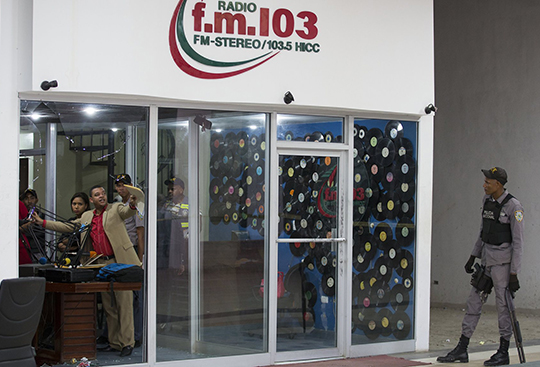
Santo Domingo, Feb 16: Two radio journalists have been killed in the Dominican Republic after gunmen opened fire during a news bulletin which was being broadcast on Facebook Live.
journo

Luís Manuel Medina, the presenter of the news programme Milenio Caliente – or Hot Millennium – was killed while on air on Tuesday morning. Producer and director Leo Martínez was shot dead in an adjacent office at the radio station FM 103.5.

Gunfire could be heard during the Facebook Live video, along with a woman yelling “Shots! Shots! Shots!” before the transmission abruptly cuts off.

The station secretary Dayaba Garcia was also injured in the attack and taken to hospital where she needed emergency surgery.

Police said the shooting occurred in San Pedro de Macorís, a small city 45 miles east of the capital, Santo Domingo. The radio station is located within a shopping mall.

Three men have been arrested, but none has been charged. Police say they do not yet have a motive.

Medina was also the official announcer of the Estrellas Orientales baseball team.

Milenio Caliente is a popular local radio programme recognised for its lively political analysis and social campaigns.

In recent weeks, Medina had repeatedly condemned pollution in Laguna Mallen, a protected lake in San Pedro.

Olivo de Leon, from the College of Journalism who knew both men, said the attack was unprecedented in the country's history. “For gunmen to open fire in a media outlet like this is unprecedented.

AdvertisementReport this ad
“The authorities must investigate to determine not just the killers but also the intellectual authors so that we know why they were murdered. Impunity in this case will generate fear among journalists, making them scared to speak out and do their jobs. The government must guarantee freedom of expression,” De Leon told the Guardian in a telephone interview from Santo Domingo.

While murders are rare, harassment and intimidation of journalists reporting on organised crime and corruption is fairly common in the Dominican Republic.

In recent years, reporters who spoke out against a controversial 2013 court ruling which stripped Dominicans of Haitian descent of their citizenship have received death threats and suffered vicious online harassment campaigns.

The last journalist to be killed in the country was Blas Olivo who was shot dead in April 2015. Police said Olvio, press director of the Dominican Agribusiness Association, was the victim of a bungled robbery, even though neither his car nor phone were stolen. The case remains ongoing.

Comments

Add new comment

  • Coastaldigest.com reserves the right to delete or block any comments.
  • Coastaldigset.com is not responsible for its readers’ comments.
  • Comments that are abusive, incendiary or irrelevant are strictly prohibited.
  • Please use a genuine email ID and provide your name to avoid reject.
News Network
June 5,2020

Karachi, Jun 5: Pakistan's coronavirus cases rose to 89,249 on Friday after a record 4,896 new infections were detected in the country, while the death toll due to COVID-19 has reached 1,838, according to the health ministry.

The Ministry of National Health Service said that 68 patients died in the last 24 hours, taking the death toll to 1,838, whereas another 31,198 people have recovered.

It was the third consecutive day when a record number of cases were reported in Pakistan after the Eid holidays and easing of lockdown restrictions at the end of May.

Sindh province reported 33,536 infections, Punjab 33,144, Khyber-Pakhtunkhwa 11,890, Balochistan 5,582, Islamabad 3,946, Gilgit-Baltistan 852 and Pakistan-occupied Kashmir 299.

The authorities have conducted 638,323 tests, including a record 22,812 tests in the last 24 hours, the ministry said.

Despite the spike in number of COVID-19 cases, both houses of parliament are scheduled to meet separately on Friday. The Senate session started this morning while the National Assembly will be held in the afternoon, Radio Pakistan reported.

Chairman Senate Sadiq Sanjrani and Speaker National Assembly Asad Qaiser at a meeting at the parliament house in Islamabad reviewed arrangements made for the two sessions.

Fumigation was also carried out in the parliament house for the safety of the lawmakers and staff.

Earlier, the Opposition rejected the idea of virtual meetings and insisted that the sessions be held in person, noting that it was an important session of parliament because the budget is expected to be presented in the National Assembly in the next week.

The novel coronavirus which first originated from China's Wuhan city in December last year has claimed 391,249 lives and has infected over 6 million people globally, according to Johns Hopkins University data.

Comments

Add new comment

  • Coastaldigest.com reserves the right to delete or block any comments.
  • Coastaldigset.com is not responsible for its readers’ comments.
  • Comments that are abusive, incendiary or irrelevant are strictly prohibited.
  • Please use a genuine email ID and provide your name to avoid reject.
News Network
July 1,2020

Jul 1: Hong Kong police moved swiftly on Wednesday against protesters gearing up for the first rally since the introduction of sweeping security legislation, making their first arrest under it and warning of punishment for pro-independence material.

Beijing on Tuesday unveiled the details of the much-anticipated law after weeks of uncertainty, pushing China's freest city and one of the world's most glittering financial hubs onto a more authoritarian path.

As hundreds of protesters gathered downtown for an annual rally marking the 23rd anniversary of the former British colony's handover to China, riot police used pepper spray to arrest at least two people, while one metro station closed.

Police, who earlier banned the rally, cited the law for the first time in confronting protesters and they also made their first arrest under it - a man holding a flag advocating independence.

"You are displaying flags or banners/chanting slogans/or conducting yourselves with an intent such as secession or subversion, which may constitute offences under the ... national security law," police said in a message displayed on a purple banner.

The law will punish crimes of secession, subversion, terrorism and collusion with foreign forces with up to life in prison, heralding a more authoritarian era for the Asian financial hub.

China's parliament adopted it in response to months of pro-democracy protests last year triggered by fears that Beijing was stifling the city's freedoms, guaranteed by a "one country, two systems" formula agreed when it returned to Chinese rule.

Authorities in Beijing and Hong Kong have repeatedly said the legislation is aimed at a few "troublemakers" and will not affect rights and freedoms, nor investor interests.

But critics fear it will crush the freedoms that are seen as key to Hong Kong's success as a financial centre.

"With the release of the full detail of the law, it should be clear to those in any doubt that this is not the Hong Kong they grew up in," said Hasnain Malik, head of equity research, Tellimer in Dubai.

"The difference is that U.S. and China relations are far worse and this could be used as a pretext to impede the role of Hong Kong as a finance hub."

In Beijing, Zhang Xiaoming, executive deputy director of Beijing's Hong Kong and Macau Affairs Office, told reporters suspects arrested by Beijing's new security office in Hong Kong could be tried on the mainland.

He said the mainland's national security office abided by Chinese law and that Hong Kong's legal system could not be expected to implement the laws of the mainland. Article 55 of the law states that Beijing's national security office in Hong Kong could exercise jurisdiction over "complex" or "serious" cases.

Mainland security agencies will also be based in Hong Kong officially for the first time, with powers that go beyond city laws.

"The law is a birthday gift to (Hong Kong) and will show its precious value in the future," Zhang said, adding the law would not be applied retroactively.

On July 1 last year, hundreds of protesters stormed and vandalised the city's legislature to protest against a now-scrapped bill that would have allowed extraditions to mainland China.

Those protests evolved into calls for greater democracy, paralysing parts of the city and paving the way for Beijing's imposition of the law this week.

'INEVITABLE'

Speaking at a flag-raising ceremony to mark the handover anniversary, the city's Beijing-backed leader, Carrie Lam, said the law was the most important development since the city's return to Chinese rule.

"It is also an inevitable and prompt decision to restore stability," Lam said at the same harbour-front venue where 23 years ago the last colonial governor, Chris Patten, a staunch critic of the security law, tearfully handed back Hong Kong to Chinese rule.

Some pro-Beijing officials and political commentators say the law is aimed at sealing Hong Kong's "second return" to the motherland after the first failed to bring residents to heel.

Luo Huining, the head of Beijing's top representative office in Hong Kong, said at the ceremony the law was a "common aspiration" of Hong Kong citizens.

Critics denounced the lack of transparency surrounding the details of the legislation until it was unveiled. It came into force at 11 p.m. (1500 GMT) on Tuesday.

Some pro-democracy activists gave up membership of their groups just before the law came into force, though calling for the campaign for democracy to go on offshore.

"I saw this morning there are celebrations for Hong Kong's handover, but to me it is a funeral, a funeral for 'one country two systems'," said democracy lawmaker Kwok Ka-ki.

Comments

Add new comment

  • Coastaldigest.com reserves the right to delete or block any comments.
  • Coastaldigset.com is not responsible for its readers’ comments.
  • Comments that are abusive, incendiary or irrelevant are strictly prohibited.
  • Please use a genuine email ID and provide your name to avoid reject.
News Network
February 24,2020

Beijing, Feb 24: The lockdown of Guo Jing's neighbourhood in Wuhan -- the city at the heart of China's new coronavirus epidemic -- came suddenly and without warning.

Unable to go out, the 29-year-old is now sealed inside her compound where she has to depend on online group-buying services to get food.

"Living for at least another month isn't an issue," Guo told news agency, explaining that she had her own stash of pickled vegetables and salted eggs.

But what scares her most is the lack of control -- first, the entire city was sealed off, and then residents were limited to exiting their compound once every three days.

Now even that has been taken away.

Guo is among some 11 million residents in Wuhan, a city in central Hubei province that has been under effective quarantine since January 23 as Chinese authorities race to contain the epidemic.

Since then, its people have faced a number of tightening controls over daily life as the death toll from the virus swelled to over 2,500 in China alone.

But the new rules this month barring residents from leaving their neighbourhoods are the most restrictive yet -- and for some, threaten their livelihoods.

"I still don't know where to buy things once we've finished eating what we have at home," said Pan Hongsheng, who lives with his wife and two children.

Some neighbourhoods have organised group-buying services, where supermarkets deliver orders in bulk.

But in Pan's community, "no one cares".

"The three-year-old doesn't even have any milk powder left," Pan told news agency, adding that he has been unable to send medicine to his in-laws -- both in their eighties -- as they live in a different area.

"I feel like a refugee."

The "closed management of neighbourhoods is bound to bring some inconvenience to the lives of the people", Qian Yuankun, vice secretary of Hubei's Communist Party committee, said at a press briefing last week.

Authorities on Monday allowed healthy non-residents of the city to leave if they never had contact with patients, but restrictions remained on those who live in Wuhan.

Demand for group-buying food delivery services has rocketed with the new restrictions, with supermarkets and neighbourhood committees scrambling to fill orders.

Most group-buying services operate through Chinese messaging app WeChat, which has ad-hoc chat groups for meat, vegetables, milk -- even "hot dry noodles", a famous Wuhan dish.

More sophisticated shops and compounds have their own mini-app inside WeChat, where residents can choose packages priced by weight before orders are sent in bulk to grocery stores.

In Guo's neighbourhood, for instance, a 6.5-kilogramme (14.3-pound) set of five vegetables, including potatoes and baby cabbage, costs 50 yuan ($7.11).

"You have no way to choose what you like to eat," Guo said. "You cannot have personal preferences anymore."

The group-buying model is also more difficult for smaller communities to adopt, as supermarkets have minimum order requirements for delivery.

"To be honest, there's nothing we can do," said Yang Nan, manager of Lao Cun Zhang supermarket, which requires a minimum of 30 orders.

"We only have four cars," she said, explaining that the store did not have the staff to handle smaller orders.

Another supermarket told AFP it capped its daily delivery load to 1,000 orders per day.

"Hiring staff is difficult," said Wang Xiuwen, who works at the store's logistics division, adding that they are wary about hiring too many outsiders for fear of infection.

Closing off communities has split the city into silos, with different neighbourhoods rolling out controls of varying intensity.

In some compounds, residents have easier access to food -- albeit a smaller selection than normal -- and one woman said her family pays delivery drivers to run grocery errands.

Her compound has not been sealed off either, the 24-year-old told AFP under condition of anonymity, though they are limited to one person leaving at a time.

Some districts have implemented their own rules, such as prohibiting supermarkets from selling to individuals, forcing neighbourhoods to buy in bulk or not at all.

"In the neighbourhood where I live, the reality is really terrible," said David Dai, who is based on the outskirts of Wuhan.

Though his apartment complex has organised group-buying, Dai said residents were unhappy with price and quality.

"A lot of tomatoes, a lot of onions -- they were already rotten," he told , estimating over a third of the food had to be thrown away.

His family must "totally depend" on themselves, added the 49-year-old, who has resorted to saving and drying turnip skins to add nutrients to future meals.

The uncertainty of not knowing when the controls will be lifted is also frustrating, said Ma Chen, a man in his 30s who lives alone.

"I have no way of knowing how much (food) I should buy."

Comments

Add new comment

  • Coastaldigest.com reserves the right to delete or block any comments.
  • Coastaldigset.com is not responsible for its readers’ comments.
  • Comments that are abusive, incendiary or irrelevant are strictly prohibited.
  • Please use a genuine email ID and provide your name to avoid reject.