


Two journalists shot dead during Facebook Live broadcast

February 16, 2017

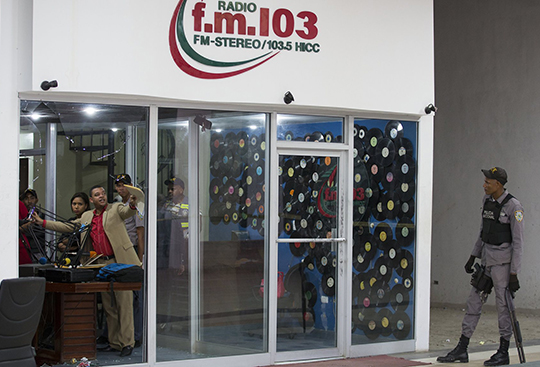
Santo Domingo, Feb 16: Two radio journalists have been killed in the Dominican Republic after gunmen opened fire during a news bulletin which was being broadcast on Facebook Live.
journo

Luís Manuel Medina, the presenter of the news programme Milenio Caliente – or Hot Millennium – was killed while on air on Tuesday morning. Producer and director Leo Martínez was shot dead in an adjacent office at the radio station FM 103.5.

Gunfire could be heard during the Facebook Live video, along with a woman yelling “Shots! Shots! Shots!” before the transmission abruptly cuts off.

The station secretary Dayaba Garcia was also injured in the attack and taken to hospital where she needed emergency surgery.

Police said the shooting occurred in San Pedro de Macorís, a small city 45 miles east of the capital, Santo Domingo. The radio station is located within a shopping mall.

Three men have been arrested, but none has been charged. Police say they do not yet have a motive.

Medina was also the official announcer of the Estrellas Orientales baseball team.

Milenio Caliente is a popular local radio programme recognised for its lively political analysis and social campaigns.

In recent weeks, Medina had repeatedly condemned pollution in Laguna Mallen, a protected lake in San Pedro.

Olivo de Leon, from the College of Journalism who knew both men, said the attack was unprecedented in the country's history. “For gunmen to open fire in a media outlet like this is unprecedented.

AdvertisementReport this ad
“The authorities must investigate to determine not just the killers but also the intellectual authors so that we know why they were murdered. Impunity in this case will generate fear among journalists, making them scared to speak out and do their jobs. The government must guarantee freedom of expression,” De Leon told the Guardian in a telephone interview from Santo Domingo.

While murders are rare, harassment and intimidation of journalists reporting on organised crime and corruption is fairly common in the Dominican Republic.

In recent years, reporters who spoke out against a controversial 2013 court ruling which stripped Dominicans of Haitian descent of their citizenship have received death threats and suffered vicious online harassment campaigns.

The last journalist to be killed in the country was Blas Olivo who was shot dead in April 2015. Police said Olvio, press director of the Dominican Agribusiness Association, was the victim of a bungled robbery, even though neither his car nor phone were stolen. The case remains ongoing.

Comments

Add new comment

  • Coastaldigest.com reserves the right to delete or block any comments.
  • Coastaldigset.com is not responsible for its readers’ comments.
  • Comments that are abusive, incendiary or irrelevant are strictly prohibited.
  • Please use a genuine email ID and provide your name to avoid reject.
News Network
June 26,2020

Washington, Jun 26: The US is reviewing its global deployment of forces to ensure it is postured appropriately to counter the People's Liberation Army, given the increasing threat posed by China to Asian countries like India, Malaysia, Indonesia, and the Philippines, Secretary of State Mike Pompeo said on Thursday.

Mr Pompeo made those remarks in response to a question during the virtual Brussels Forum 2020 of the German Marshall Fund.

"We're going to make sure we're postured appropriately to counter the PLA. We think that the challenge of our times, and we're going to make sure we have resources in place to do that," Mr Pompeo said.
 
The force posture review is being done at the direction of President Donald Trump, as part of which the US is reducing the number of its troops in Germany from about 52,000 to 25,000, he said.

Mike Pompeo said that the force posture would be dictated by the ground realities.

"In certain places there will be fewer American resources. There'll be other places - I just talked about the threat from the Chinese Communist Party, so now threats to India, threats to Vietnam, threats to Malaysia, Indonesia, South China Sea challenges, the Philippines," he said.

"To the extent that that changed, the difference in what the US decided to do impacts adversely a threat some place, it may be that other nations need to step up and take responsibility for their own defense in ways that they hadn't done previously. So, we want to do this in full consultation with all of our partners all around the world, and certainly our friends in Europe," Mr Pompeo said.

President Trump is being criticised for reducing troops from Germany. His critics say that this will increase the threat from Russia to Europe.

Mike Pompeo, however, did not agree with that argument.

It has been a long time since there has been a strategic review of our force posture all across the world. The US undertook that starting about 2.5 years ago, whether that was our forces in Africa, our forces in Asia, the force we have in the Middle East and in Europe, he said.

"We began to say these are often decisions that were made in a different time. Should we reallocate those a different way? Should we have a different composition of those forces? Everyone always wants to talk about ground troops. I get it. I was a young tank officer. You described that. There's nothing I like as much as a good M1 tank.

"But it's often the case that the capacity to deter Russia or other adversaries isn''t determined any longer by just having a bunch of folks garrisoned someplace. So, we really went to back fundamentally relook, what is the nature of the conflict, what''s the nature of the threat, and how should we allocate our resources, whether that''s our resources in the intelligence community, our resources from the Air Force or the Marines and Army," Mr Pompeo said.

Last week, Mike Pompeo criticised the Chinese Army for "escalating" the border tension with India and militarising the strategic South China Sea. He also described the ruling Communist Party of China (CPC) as a "rogue actor".

"Our broad set of allocation of security apparatus, our ability to counter cyber threats, how do we allocate them? What''s the best way to do this? And the decision that you see the president made with respect to Germany is an outcome from a collective set of decisions about how we''re going to posture our resources around the world," said the top American diplomat on Thursday.

Changes in force posture is being taken in consultations with allies and friends, Mr Pompeo said.

"President Trump has spoken to this. (Defense) Secretary (Mark) Esper will be in London today and in Brussels tomorrow. We''ll talk about our plan and how we''re thinking about delivering it," he said.

"But you should understand this, and I hope our European partners will understand this as well. When you see what we ultimately conclude, how we ultimately deliver on the statements of the president made, that they''re aimed squarely at what we believe to be democracies'' fundamental interest and certainly America's most fundamental interest," Mr Pompeo said.

Earlier this month, Mike Pompeo had said that China's actions, be it on the India border, or in Hong Kong or in the South China Sea, were part of the behaviour of the ruling Communist Party in Beijing in the recent past.

China has been fast expanding military and economic influence in the Indo-Pacific region, triggering concern in various countries of the region and beyond.

China is engaged in hotly contested territorial disputes in both the South China Sea and the East China Sea. Beijing has built up and militarised many of the islands and reefs it controls in the region. Both areas are stated to be rich in minerals, oil and other natural resources and are vital to global trade.

Comments

Add new comment

  • Coastaldigest.com reserves the right to delete or block any comments.
  • Coastaldigset.com is not responsible for its readers’ comments.
  • Comments that are abusive, incendiary or irrelevant are strictly prohibited.
  • Please use a genuine email ID and provide your name to avoid reject.
News Network
January 7,2020

Jan 7: Body of the senior Iranian military commander, Qasem Soleimani killed in a U.S. drone strike in Iraq last week, has arrived in his home town of Kerman in southeast Iran for burial, the official IRNA news agency said on Tuesday.

State TV broadcast live images of thousands of people in the streets of the town, many of them dressed in black, to mourn Soleimani's death.

Soleimani was widely seen as Iran’s second most powerful figure behind Supreme Leader Ayatollah Ali Khamenei, 80, who wept in grief along with hundreds of thousands of mourners who thronged the streets of Tehran for Soleimani’s funeral on Monday.

Khamenei led prayers at the funeral in the Iranian capital, pausing as his voice cracked with emotion. Soleimani, 62, was a national hero even to many who do not consider themselves supporters of Iran’s clerical rulers.

He was killed while leaving Baghdad airport last Friday. Mourners packed the streets, chanting: “Death to America!” - a show of national unity after anti-government protests in November in which many demonstrators were killed.

The crowd, which state media said numbered in the millions, recalled the masses gathered in 1989 for the funeral of the Islamic Republic’s founder, Ayatollah Ruhollah Khomeini.

The killing of Soleimani has prompted fears around the world of a broader regional conflict, as well as calls in the U.S. Congress for legislation to keep President Donald Trump from going to war against Iran.

Comments

Add new comment

  • Coastaldigest.com reserves the right to delete or block any comments.
  • Coastaldigset.com is not responsible for its readers’ comments.
  • Comments that are abusive, incendiary or irrelevant are strictly prohibited.
  • Please use a genuine email ID and provide your name to avoid reject.
Agencies
May 31,2020

Washington, May 31: US President Donald Trump said Saturday he will delay the G7 summit scheduled to take place in June and invite other countries -- including India and Russia -- to join the meeting.

"I don't feel that as a G7 it properly represents what's going on in the world. It's a very outdated group of countries," Trump told reporters on Air Force One.

He said he would like to invite Russia, South Korea, Australia and India to join an expanded summit in the fall.

It could happen in September, either before or after the UN General Assembly, Trump said, adding that "maybe I'll do it after the election."

Americans head to the polls in early November to choose a new president, with Trump keen for a return to normalcy after the coronavirus pandemic and a healthy economy as voters cast their ballots.

Describing the event as a "G-10 or G-11", Trump said he had "roughly" broached the topic with leaders of the four other countries.

Leaders from the Group of Seven, which the United States heads this year, had been scheduled to meet by videoconference in late June after COVID-19 scuttled plans to gather in-person at Camp David, the US presidential retreat outside Washington.

Trump created suspense last week, however, when he announced that he might hold the huge gathering in-person after all, "primarily at the White House" but also potentially parts of it at Camp David.

German Chancellor Angela Merkel became the first leader to decline the in-person invitation outright.

"Considering the overall pandemic situation, she cannot agree to her personal participation, to a journey to Washington," her spokesman said Saturday.

Her response followed ambivalent to positive reactions to the invitation from Britain, Canada and France.

The 65-year-old chancellor is the oldest G7 leader after Trump, who is 73. Japan's Shinzo Abe, also 65, is several months younger than Merkel. Their age puts them at higher risk from the coronavirus.

The G7 major advanced countries -- Britain, Canada, France, Germany, Italy, Japan and the United States -- hold annual meetings to discuss international economic coordination.

Russia was thrown out of what was the G8 in 2014 after it seized Ukraine's Black Sea peninsula of Crimea, an annexation never recognized by the international community.

The work of the G7 is now more important than ever as countries struggle to repair coronavirus-inflicted damage.

The White House had previously said the huge diplomatic gathering would be a "show of strength" when world economies are gradually reemerging from shutdowns.

The United States is the worst-hit country for COVID-19 infections, recording more than 1.7 million cases and over 103,680 deaths.

Comments

Add new comment

  • Coastaldigest.com reserves the right to delete or block any comments.
  • Coastaldigset.com is not responsible for its readers’ comments.
  • Comments that are abusive, incendiary or irrelevant are strictly prohibited.
  • Please use a genuine email ID and provide your name to avoid reject.