


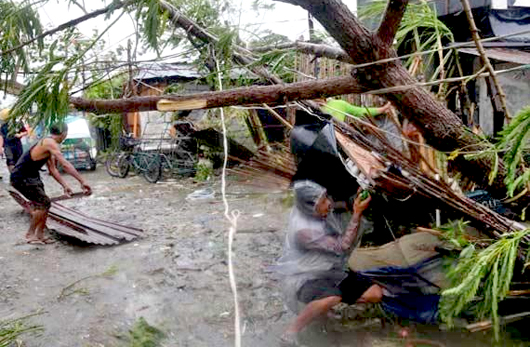
Typhoon power woes in Philippines as death toll hits 38

July 16, 2014

Typhoon Philippines

Manila, Jul 17: Millions of people in the Philippines endured a second sweltering day without power today after a ferocious typhoon paralysed the capital and tore down flimsy rural homes, claiming at least 38 lives.

Authorities expressed frustration as reports from badly damaged areas filtered in and the death toll from Typhoon Rammasun, the first major storm of the Southeast Asian archipelago's rainy season, was nearly doubled to 38.

"We still have to find out what exactly are the reasons a lot of our countrymen refuse to heed the warnings," National Disaster Risk Reduction and Management Council chief Alexander Pama told reporters.

As part of a "zero casualty" effort, the government evacuated nearly 400,000 people from the path of Rammasun and warned others to stay indoors.

But many of the people who died were outdoors, killed by falling trees, collapsing buildings and flying debris, according to the council's data.

Pama said the death toll could rise further, with mobile phone and other forms of communication still cut to some rural areas. He said at least eight people remained missing.

Rammasun, a Thai word for "Thunder God", swept in off the Pacific Ocean on Tuesday night, then brought wind gusts of up to 160 kilometres an hour across land to Manila and other heavily populated northern regions.

"It really scrambled whole towns, blowing down houses and toppling power lines," the chairman of the Philippine Red Cross, Richard Gordon, told AFP.

The typhoon cut electricity supplies to nearly all of Manila, a megacity of more than 12 million people, and surrounding urban areas.

Schools and government offices were closed throughout the capital, hundreds of flights suspended and the stock exchange closed.

The stock exchange and government offices re-opened today, but many schools remained closed partly because of the power problems.

The Manila Electric Company (Meralco), the country's largest power distributor which serves the capital and surrounding areas, said 1.9 million households still did not have power yesterday.

With the temperature in Manila expected to hit 30 degrees Celsius and the air thick with tropical moisture, Meralco could not give any estimate to frustrated residents when power would be restored.

Earlier:

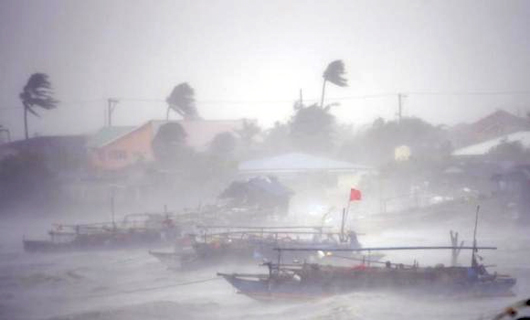
Typhoon kills 10, displaces 370,000 in Philippines
Typhoon Philippines

Manila, Jul 16: A typhoon killed at least 10 people as it churned across the Philippines and hit the capital, prompting the evacuation of almost more than 370,000 people, shutting financial markets, offices and schools, rescue officials said on Wednesday.

The eye of Typhoon Rammasun, the strongest storm to hit the country this year, passed to the south of Manila on Wednesday after cutting a path across the main island of Luzon, toppling trees and power lines and causing electrocutions and widespread blackouts.

Richard Gordon, chairman of the Philippine Red Cross, said there was minimal damage in the capital but staff were trying to rescue people trapped by fallen debris in Batangas City to the south where two people were electrocuted.

“We have not received reports of major flooding in Metro Manila because the typhoon did not bring rain, but the winds were strong,” he said.

The number of evacuated people had reached more than 370,000, mostly in the eastern province of Albay, the first to be hit by the typhoon, the disaster agency said.

Major roads across Luzon were impassable due to debris, fallen trees and electricity poles.

At least four southeastern provinces on Luzon declared, or were about to declare, a state of calamity, allowing the local governments to tap emergency relief funds.

The storm brought storm surges to Manila Bay and prompted disaster officials to evacuate slum-dwellers on the capital's outskirts.

Some 85 percent of areas serviced by the country's biggest power distributor, Manila Electric Co, in Luzon were without power and were unlikely to be back up within the day, a company spokesman said.

Parts of the Philippines are still recovering from Typhoon Haiyan, one of the biggest cyclones known to have made landfall anywhere. It killed more than 6,100 people last November in the central provinces, many in tsunami-like sea surges, and left millions homeless.

Rhea Catada, who works for Oxfam in Tacloban, which suffered the brunt of Haiyan, said thousands of people in tents and coastal villages had been evacuated to higher ground.

“They are scared because their experiences during Haiyan last year are still fresh,” she said. “Now they are evacuating voluntarily and leaving behind their belongings.”

Social Work Secretary Dinky Soliman said 5,335 families, or nearly 27,000 people, had been “affected” by the storm in Tacloban.

Some had returned to the Astrodome, where thousands sought shelter and dozens drowned during storm surges in the November disaster.

Tropical Storm Risk, which monitors cyclones, labelled Rammasun a category-two storm on a scale of one to five as it headed west into the South China Sea. Super typhoon Haiyan was category five.

A 25-year-old woman was killed when she was hit by a falling electricity pole as Rammasun hit the east coast on Tuesday, the Philippine disaster agency said. A pregnant woman was killed when a house wall collapsed in Lucena City in Quezon province south of the capital.

Trading at the Philippine Stock Exchange and Philippine Dealing System, used for foreign exchange trading, were suspended after government offices were ordered shut.

More than 200 international and domestic flights have been canceled.

A Singapore Airlines Boeing 777 suffered a hole on its left wing when wind gusts pushed the aircraft five meters across the tarmac at Manila airport, hitting equipment parked nearby, airport officials said.

Comments

Add new comment

  • Coastaldigest.com reserves the right to delete or block any comments.
  • Coastaldigset.com is not responsible for its readers’ comments.
  • Comments that are abusive, incendiary or irrelevant are strictly prohibited.
  • Please use a genuine email ID and provide your name to avoid reject.
Agencies
May 6,2020

Italian researchers have claimed that they have successfully developed a vaccine to contain coronavirus (COVID-19) which is likely to work on humans, a report said.

Luigi Aurisicchio, CEO of Takis, the firm developing the medication, said that a coronavirus candidate vaccine has neutralised the virus in human cells for the first time, the Arab News reported.

"This is the most advanced stage of testing of a candidate vaccine created in Italy. Human tests are expected after this summer," Aurisicchio was quoted as saying to Italian news agency ANSA.

"According to the Spallanzani Hospital, as far as we know we are the first in the world so far to have demonstrated neutralisation of the coronavirus by a vaccine. We expect this to happen in humans too," he added.

The researchers experimented with the vaccine on mice that had successfully developed antibodies that blocked the virus from infecting the cells. They further observed that the five vaccine candidates generated a large number of antibodies, and selected two with the best results.

All of the vaccine candidates currently being developed are based on the genetic material of DNA protein "spike", the molecular tip used by the coronavirus to enter human cells.

They are injected with the so-called "electroporation" technique, which consists of an intramuscular injection followed by a brief electrical impulse, helping the vaccine break into the cells and activating the immune system, the report said.

Researchers believe that this makes their vaccine particularly effective for generating functional antibodies against the "spike" protein, in particular in the lung cells, which are the most vulnerable to coronavirus.

"We are working hard for a vaccine coming from Italian research, with an all-Italian and innovative technology, tested in Italy and made available to everyone," Aurisicchio was quoted by the Arab News report.

"In order to reach this goal, we need the support of national and international institutions and partners who may help us speed up the process," he noted.

The total number of COVID-19 infections, fatalities and recoveries since the pandemic began has risen to 213,013 in the country.

Comments

Add new comment

  • Coastaldigest.com reserves the right to delete or block any comments.
  • Coastaldigset.com is not responsible for its readers’ comments.
  • Comments that are abusive, incendiary or irrelevant are strictly prohibited.
  • Please use a genuine email ID and provide your name to avoid reject.
Agencies
July 1,2020

The ILO has warned that if another Covid-19 wave hits in the second half of 2020, there would be global working-hour loss of 11.9 percent - equivalent to the loss of 340 million full-time jobs.

According to the 5th edition of International Labour Organisation (ILO) Monitor: Covid-19 and the world of work, the recovery in the global labour market for the rest of the year will be uncertain and incomplete.

The report said that there was a 14 percent drop in global working hours during the second quarter of 2020, equivalent to the loss of 400 million full-time jobs.

The number of working hours lost across the world in the first half of 2020 was significantly worse than previously estimated. The highly uncertain recovery in the second half of the year will not be enough to go back to pre-pandemic levels even in the best scenario, the agency warned.

The baseline model – which assumes a rebound in economic activity in line with existing forecasts, the lifting of workplace restrictions and a recovery in consumption and investment – projects a decrease in working hours of 4.9 percent (equivalent to 140 million full-time jobs) compared to last quarter of 2019.

It says that in the pessimistic scenario, the situation in the second half of 2020 would remain almost as challenging as in the second quarter.

“Even if one assumes better-tailored policy responses – thanks to the lessons learned throughout the first half of the year – there would still be a global working-hour loss of 11.9 per cent at the end of 2020, or 340 million full-time jobs, relative to the fourth quarter of 2019,” it said.

The pessimistic scenario assumes a second pandemic wave and the return of restrictions that would significantly slow recovery. The optimistic scenario assumes that workers’ activities resume quickly, significantly boosting aggregate demand and job creation. With this exceptionally fast recovery, the global loss of working hours would fall to 1.2 per cent (34 million full-time jobs).

The agency said that under the three possible scenarios for recovery in the next six months, “none” sees the global job situation in better shape than it was before lockdown measures began.

“This is why we talk of an uncertain but incomplete recovery even in the best of scenarios for the second half of this year. So there is not going to be a simple or quick recovery,” ILO Director-General Guy Ryder said.

The new figures reflect the worsening situation in many regions over the past weeks, especially in developing economies. Regionally, working time losses for the second quarter were: Americas (18.3 percent), Europe and Central Asia (13.9 percent), Asia and the Pacific (13.5 percent), Arab States (13.2 percent), and Africa (12.1 percent).

The vast majority of the world’s workers (93 per cent) continue to live in countries with some sort of workplace closures, with the Americas experiencing the greatest restrictions.

During the first quarter of the year, an estimated 5.4 percent of global working hours (equivalent to 155 million full-time jobs) were lost relative to the fourth quarter of 2019. Working- hour losses for the second quarter of 2020 relative to the last quarter of 2019 are estimated to reach 14 per cent worldwide (equivalent to 400 million full-time jobs), with the largest reduction (18.3 per cent) occurring in the Americas.

The ILO Monitor also found that women workers have been disproportionately affected by the pandemic, creating a risk that some of the modest progress on gender equality made in recent decades will be lost, and that work-related gender inequality will be exacerbated.

The severe impact of Covid-19 on women workers relates to their over-representation in some of the economic sectors worst affected by the crisis, such as accommodation, food, sales and manufacturing.

Globally, almost 510 million or 40 percent of all employed women work in the four most affected sectors, compared to 36.6 percent of men, it said.

The report said that women also dominate in the domestic work and health and social care work sectors, where they are at greater risk of losing their income and of infection and transmission and are also less likely to have social protection.

The pre-pandemic unequal distribution of unpaid care work has also worsened during the crisis, exacerbated by the closure of schools and care services.

Even as countries have adopted policy measures with unprecedented speed and scope, the ILO Monitor highlights some key challenges ahead, including finding the right balance and sequencing of health, economic and social and policy interventions to produce optimal sustainable labour market outcomes; implementing and sustaining policy interventions at the necessary scale when resources are likely to be increasingly constrained and protecting and promoting the conditions of vulnerable, disadvantaged and hard-hit groups to make labour markets fairer and more equitable.

“The decisions we adopt now will echo in the years to come and beyond 2030. Although countries are at different stages of the pandemic and a lot has been done, we need to redouble our efforts if we want to come out of this crisis in a better shape than when it started,” Ryder said. 

Comments

Add new comment

  • Coastaldigest.com reserves the right to delete or block any comments.
  • Coastaldigset.com is not responsible for its readers’ comments.
  • Comments that are abusive, incendiary or irrelevant are strictly prohibited.
  • Please use a genuine email ID and provide your name to avoid reject.
News Network
June 25,2020

Jun 25: Tencent Holdings Ltd.'s $40 billion surge this week and the recent ascent of Pinduoduo Inc. have reshuffled the ranking of China's richest people.

The country's largest game developer has surpassed Alibaba Group Holding Ltd. as Asia's most-valuable company, with its shares rising above HK$500 in intraday trading Wednesday for the first time. Pinduoduo, a Groupon-like shopping app also known as PDD, has more than doubled this year.

The rallies have propelled the wealth of their founders, with an added twist: Tencent's Pony Ma, worth $50 billion, has surpassed Jack Ma's $48 billion fortune, becoming China's richest person. And Colin Huang of PDD, whose net worth stands at $43 billion, has squeezed real estate mogul Hui Ka Yan of China Evergrande Group out of the top three earlier this year, according to the Bloomberg Billionaires Index.

The coronavirus pandemic has accelerated the digitization of the workplace and changed consumers' habits, boosting shares of many internet companies. Now tech tycoons are dominating the ranks of China's richest people. They occupy four of the top five spots: Ding Lei of Tencent peer NetEase Inc. follows China Evergrande's Hui.

‘Perform Strongly'

Tencent has come a long way since hitting a low in 2018, when China froze the approval process for new games. Since then, the stock has almost doubled, and last month the tech giant reported a 26 per cent jump in first-quarter revenue.

“Tencent's online games segment will probably perform strongly through the Covid-19 pandemic, and most of its other businesses are relatively unscathed,” said Vey-Sern Ling, a Bloomberg Intelligence analyst.

That has been a boon for Pony Ma, 48, who owns a 7 per cent stake in the company and pocketed about $757 million from selling some 14.6 million of his Tencent shares this year, data complied by Bloomberg show.

The native of China's southern Guangdong province studied computer science at Shenzhen University and was a software developer at a supplier of telecom services and products before co-founding Tencent with four others in the late 1990s. At the time, the company focused on instant-messaging services.

It has been a long comeback for Pony Ma. He overtook real estate tycoon Wang Jianlin as China's second-richest person in 2013 and topped Baidu Inc.'s Robin Li as the wealthiest in early 2014. Later that year, Alibaba went public in the U.S., catapulting Jack Ma's fortune.

Bloomberg Intelligence's Ling notes, however, that Tencent's jump this year has lagged behind some internet peers, especially those in e-commerce, games and online entertainment. Just consider: Tencent shares have climbed 31 per cent in 2020, while PDD's American depositary receipts have more than doubled. Alibaba, meanwhile, has advanced just 6.9 per cent.

Comments

Add new comment

  • Coastaldigest.com reserves the right to delete or block any comments.
  • Coastaldigset.com is not responsible for its readers’ comments.
  • Comments that are abusive, incendiary or irrelevant are strictly prohibited.
  • Please use a genuine email ID and provide your name to avoid reject.