


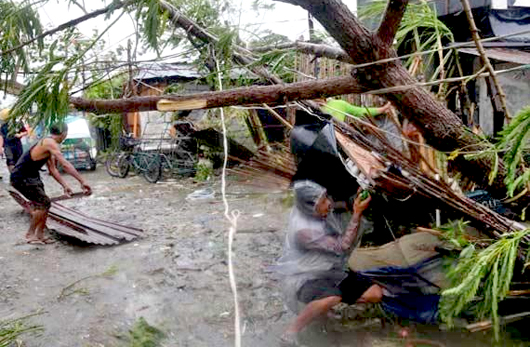
Typhoon power woes in Philippines as death toll hits 38

July 16, 2014

Typhoon Philippines

Manila, Jul 17: Millions of people in the Philippines endured a second sweltering day without power today after a ferocious typhoon paralysed the capital and tore down flimsy rural homes, claiming at least 38 lives.

Authorities expressed frustration as reports from badly damaged areas filtered in and the death toll from Typhoon Rammasun, the first major storm of the Southeast Asian archipelago's rainy season, was nearly doubled to 38.

"We still have to find out what exactly are the reasons a lot of our countrymen refuse to heed the warnings," National Disaster Risk Reduction and Management Council chief Alexander Pama told reporters.

As part of a "zero casualty" effort, the government evacuated nearly 400,000 people from the path of Rammasun and warned others to stay indoors.

But many of the people who died were outdoors, killed by falling trees, collapsing buildings and flying debris, according to the council's data.

Pama said the death toll could rise further, with mobile phone and other forms of communication still cut to some rural areas. He said at least eight people remained missing.

Rammasun, a Thai word for "Thunder God", swept in off the Pacific Ocean on Tuesday night, then brought wind gusts of up to 160 kilometres an hour across land to Manila and other heavily populated northern regions.

"It really scrambled whole towns, blowing down houses and toppling power lines," the chairman of the Philippine Red Cross, Richard Gordon, told AFP.

The typhoon cut electricity supplies to nearly all of Manila, a megacity of more than 12 million people, and surrounding urban areas.

Schools and government offices were closed throughout the capital, hundreds of flights suspended and the stock exchange closed.

The stock exchange and government offices re-opened today, but many schools remained closed partly because of the power problems.

The Manila Electric Company (Meralco), the country's largest power distributor which serves the capital and surrounding areas, said 1.9 million households still did not have power yesterday.

With the temperature in Manila expected to hit 30 degrees Celsius and the air thick with tropical moisture, Meralco could not give any estimate to frustrated residents when power would be restored.

Earlier:

Typhoon kills 10, displaces 370,000 in Philippines
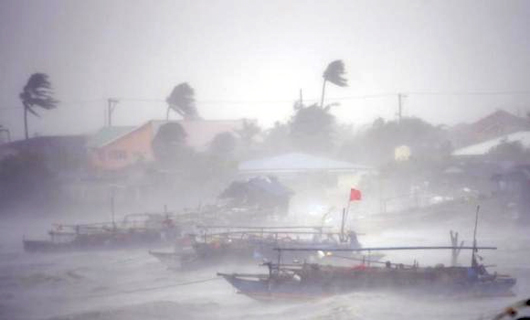
Typhoon Philippines

Manila, Jul 16: A typhoon killed at least 10 people as it churned across the Philippines and hit the capital, prompting the evacuation of almost more than 370,000 people, shutting financial markets, offices and schools, rescue officials said on Wednesday.

The eye of Typhoon Rammasun, the strongest storm to hit the country this year, passed to the south of Manila on Wednesday after cutting a path across the main island of Luzon, toppling trees and power lines and causing electrocutions and widespread blackouts.

Richard Gordon, chairman of the Philippine Red Cross, said there was minimal damage in the capital but staff were trying to rescue people trapped by fallen debris in Batangas City to the south where two people were electrocuted.

“We have not received reports of major flooding in Metro Manila because the typhoon did not bring rain, but the winds were strong,” he said.

The number of evacuated people had reached more than 370,000, mostly in the eastern province of Albay, the first to be hit by the typhoon, the disaster agency said.

Major roads across Luzon were impassable due to debris, fallen trees and electricity poles.

At least four southeastern provinces on Luzon declared, or were about to declare, a state of calamity, allowing the local governments to tap emergency relief funds.

The storm brought storm surges to Manila Bay and prompted disaster officials to evacuate slum-dwellers on the capital's outskirts.

Some 85 percent of areas serviced by the country's biggest power distributor, Manila Electric Co, in Luzon were without power and were unlikely to be back up within the day, a company spokesman said.

Parts of the Philippines are still recovering from Typhoon Haiyan, one of the biggest cyclones known to have made landfall anywhere. It killed more than 6,100 people last November in the central provinces, many in tsunami-like sea surges, and left millions homeless.

Rhea Catada, who works for Oxfam in Tacloban, which suffered the brunt of Haiyan, said thousands of people in tents and coastal villages had been evacuated to higher ground.

“They are scared because their experiences during Haiyan last year are still fresh,” she said. “Now they are evacuating voluntarily and leaving behind their belongings.”

Social Work Secretary Dinky Soliman said 5,335 families, or nearly 27,000 people, had been “affected” by the storm in Tacloban.

Some had returned to the Astrodome, where thousands sought shelter and dozens drowned during storm surges in the November disaster.

Tropical Storm Risk, which monitors cyclones, labelled Rammasun a category-two storm on a scale of one to five as it headed west into the South China Sea. Super typhoon Haiyan was category five.

A 25-year-old woman was killed when she was hit by a falling electricity pole as Rammasun hit the east coast on Tuesday, the Philippine disaster agency said. A pregnant woman was killed when a house wall collapsed in Lucena City in Quezon province south of the capital.

Trading at the Philippine Stock Exchange and Philippine Dealing System, used for foreign exchange trading, were suspended after government offices were ordered shut.

More than 200 international and domestic flights have been canceled.

A Singapore Airlines Boeing 777 suffered a hole on its left wing when wind gusts pushed the aircraft five meters across the tarmac at Manila airport, hitting equipment parked nearby, airport officials said.

Comments

Add new comment

  • Coastaldigest.com reserves the right to delete or block any comments.
  • Coastaldigset.com is not responsible for its readers’ comments.
  • Comments that are abusive, incendiary or irrelevant are strictly prohibited.
  • Please use a genuine email ID and provide your name to avoid reject.
News Network
January 23,2020

Jan 23: Pakistan's Prime Minister Imran Khan called on Wednesday for the United Nations to help mediate between nuclear armed India and Pakistan over the disputed territory of Kashmir.

"This is a potential flashpoint," Khan said during a media briefing at the annual meeting of the World Economic Forum in Davos, Switzerland, adding that it was time for the "international institutions ... specifically set up to stop this" to "come into action".

The Indian government in August revoked the constitutional autonomy of Indian-administered Kashmir, splitting the Muslim-majority region into two federal territories in a bid to integrate it fully with the rest of the country.

Kashmir is claimed in full by both India and Pakistan. The two countries have gone to war twice over it, and both rule parts of it. India's portion has been plagued by separatist violence since the late 1980s.

Khan said his biggest fear was how New Delhi would respond to ongoing protests in India over a citizenship law that many feel targets Muslims.

"We're not close to a conflict right now ... What if the protests get worse in India, and to distract attention from that, what if ..."

The prime minister said he had discussed the prospect of war between his country and India in a Tuesday meeting with US President Donald Trump. Trump later said he had offered to help mediate between the two countries.

Khan said Pakistan and the United States were closer in their approach to the Taliban armed rebellion in Afghanistan than they had been for many years. He said he had never seen a military solution to that conflict.

"Finally the position of the US is there should be negotiations and a peace plan."

In a separate on-stage conversation later on Wednesday, Khan said he had told Trump in their meeting that a war with Iran would be "a disaster for the world". Trump had not responded, Khan said.

Khan made some of his most straightforward comments when asked why Pakistan has been muted in defence of Uighurs in China.

China has been widely condemned for setting up complexes in remote Xinjiang province that Beijing describes as "vocational training centres" to stamp out ""extremism and give people new skills.

The United Nations says at least one million ethnic Uighurs and other Muslims have been detained.

When pressed on China's policies, Khan said Pakistan's relations with Beijing were too important for him to speak out publicly.

"China has helped us when we were at rock bottom. We are really grateful to the Chinese government, so we have decided that any issues we have had with China we will handle privately."

Comments

Add new comment

  • Coastaldigest.com reserves the right to delete or block any comments.
  • Coastaldigset.com is not responsible for its readers’ comments.
  • Comments that are abusive, incendiary or irrelevant are strictly prohibited.
  • Please use a genuine email ID and provide your name to avoid reject.
Agencies
July 15,2020

Huawei will be completely removed from the UK's 5G networks by the end of 2027, the UK government announced on Tuesday after a review by the country's National Cyber Security Centre (NCSC) on the impact of US sanctions against the Chinese telecommunications giant.

In the lead up to this complete removal of all Huawei kit from UK networks, there will be a total ban on the purchase of any new 5G kit after December 31, 2020.

The decision was taken at a meeting of the UK's National Security Council (NSC) chaired by Prime Minister Boris Johnson, in response to new US sanctions against the telecom major imposed in May which removed the firm's access to products which have been built based on US semiconductor technology.

5G will be transformative for our country, but only if we have confidence in the security and resilience of the infrastructure it is built upon, said Oliver Dowden, UK Secretary of State for Digital, Culture, Media and Sport (DCMS).

Following US sanctions against Huawei and updated technical advice from our cyber experts, the government has decided it necessary to ban Huawei from our 5G networks. No new kit is to be added from January 2021, and UK 5G networks will be Huawei free by the end of 2027. This decisive move provides the industry with the clarity and certainty it needs to get on with delivering 5G across the UK, he said.

The minister, who laid out the details of the UK's ban on Huawei in the House of Commons, said the government will now seek to legislate with a new Telecoms Security Bill to put in place the powers necessary to implement the tough new telecoms security framework.

By the time of the next election (2024) we will have implemented in law an irreversible path for the complete removal of Huawei equipment from our 5G networks, said Dowden.

The new law will give the government the national security powers to impose these new controls on high risk vendors and create extensive security duties on network operators to drive up standards, DCMS said.

Technical experts at the NCSC reviewed the consequences of the US sanctions and concluded that Huawei will need to do a major reconfiguration of its supply chain as it will no longer have access to the technology on which it currently relies and there are no alternatives which we have sufficient confidence in.

They found the new restrictions make it impossible to continue to guarantee the security of Huawei equipment in the future.

After a ban on the purchase of new Huawei kit for 5G from next year, the aim is to completely remove the Chinese vendor's influence on 5G networks across the UK by the end of 2027.

The DCMS said Tuesday's decision takes into account the UK's specific national circumstances and how the risks from these sanctions are manifested in the country.

The existing restrictions on Huawei in sensitive and critical parts of the network remain in place, it highlighted.

The DCMS said the US action also affects Huawei products used in the UK's full fibre broadband networks. However, the UK has managed Huawei's presence in the UK's fixed access networks since 2005 and we also need to avoid a situation where broadband operators are reliant on a single supplier for their equipment.

As a result, following security advice from experts, DCMS is advising full fibre operators to transition away from purchasing new Huawei equipment. A technical consultation will determine the transition timetable, but it is expect this period to last no longer than two years.

The government said its new approach strikes the right balance by recognising full fibre's established presence and supporting the connections that the public relies on, while fully addressing the security concerns.

It stressed that its new policy in relation to high risk vendors has not been designed around one company, one country or one threat but as an enduring and flexible policy that will enable the UK to manage the risks to the network, now and in the future.

Comments

Add new comment

  • Coastaldigest.com reserves the right to delete or block any comments.
  • Coastaldigset.com is not responsible for its readers’ comments.
  • Comments that are abusive, incendiary or irrelevant are strictly prohibited.
  • Please use a genuine email ID and provide your name to avoid reject.
Agencies
May 26,2020

UN, May 26: Countries could see a "second peak" of coronavirus cases during the first wave of the pandemic if lockdown restrictions were lifted too soon, the World Health Organization (WHO) has warned.

Mike Ryan, the WHO's head of emergencies, told a briefing on Monday that the world was "right in the middle of the first wave", the BBC reported.

He said because the disease was "still on the way up", countries need to be aware that "the disease can jump up at any time".

"We cannot make assumptions that just because the disease is on the way down now that it's going to keep going down," Ryan said.

There would be a number of months to prepare for a second peak, he added.

The stark warning comes as countries around the world start to gradually ease lockdown restrictions, allowing shops to reopen and larger groups of people to gather.

Experts have said that without a vaccine to give people immunity, infections could increase again when social-distancing measures are relaxed.

Ryan said countries where cases are declining should be using this time to develop effective trace-and-test regimes to "ensure that we continue on a downwards trajectory and we don't have an immediate second peak".

Also on Monday, Tedros Adhanom Ghebreyesus, WHO Director-General, said that a clinical trial of hydroxychloroquine (HCQ) on COVID-19 patients has come to "a temporary pause", while the safety data of the the anti-malaria drug was being reviewed.

According to the WHO chief, The Lancet medical journal on May 22 had published an observational study on HCQ and chloroquine and its effects on COVID-19 patients that have been hospitalized, reports Xinhua news agency.

The authors of the study reported that among patients receiving the drug, when used alone or with a macrolide, they estimated a higher mortality rate.

"The Executive Group of the Solidarity Trial, representing 10 of the participating countries, met on Saturday (May 23) and has agreed to review a comprehensive analysis and critical appraisal of all evidence available globally," Tedros said in a virtual press conference.

The developments come as the total number of global COVID-19 cases has increased to 5,508,904, with 346,508 deaths, according to the Johns Hopkins University.

Comments

Add new comment

  • Coastaldigest.com reserves the right to delete or block any comments.
  • Coastaldigset.com is not responsible for its readers’ comments.
  • Comments that are abusive, incendiary or irrelevant are strictly prohibited.
  • Please use a genuine email ID and provide your name to avoid reject.