


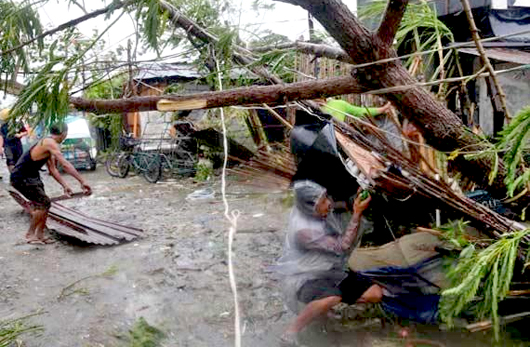
Typhoon power woes in Philippines as death toll hits 38

July 16, 2014

Typhoon Philippines

Manila, Jul 17: Millions of people in the Philippines endured a second sweltering day without power today after a ferocious typhoon paralysed the capital and tore down flimsy rural homes, claiming at least 38 lives.

Authorities expressed frustration as reports from badly damaged areas filtered in and the death toll from Typhoon Rammasun, the first major storm of the Southeast Asian archipelago's rainy season, was nearly doubled to 38.

"We still have to find out what exactly are the reasons a lot of our countrymen refuse to heed the warnings," National Disaster Risk Reduction and Management Council chief Alexander Pama told reporters.

As part of a "zero casualty" effort, the government evacuated nearly 400,000 people from the path of Rammasun and warned others to stay indoors.

But many of the people who died were outdoors, killed by falling trees, collapsing buildings and flying debris, according to the council's data.

Pama said the death toll could rise further, with mobile phone and other forms of communication still cut to some rural areas. He said at least eight people remained missing.

Rammasun, a Thai word for "Thunder God", swept in off the Pacific Ocean on Tuesday night, then brought wind gusts of up to 160 kilometres an hour across land to Manila and other heavily populated northern regions.

"It really scrambled whole towns, blowing down houses and toppling power lines," the chairman of the Philippine Red Cross, Richard Gordon, told AFP.

The typhoon cut electricity supplies to nearly all of Manila, a megacity of more than 12 million people, and surrounding urban areas.

Schools and government offices were closed throughout the capital, hundreds of flights suspended and the stock exchange closed.

The stock exchange and government offices re-opened today, but many schools remained closed partly because of the power problems.

The Manila Electric Company (Meralco), the country's largest power distributor which serves the capital and surrounding areas, said 1.9 million households still did not have power yesterday.

With the temperature in Manila expected to hit 30 degrees Celsius and the air thick with tropical moisture, Meralco could not give any estimate to frustrated residents when power would be restored.

Earlier:

Typhoon kills 10, displaces 370,000 in Philippines
Typhoon Philippines

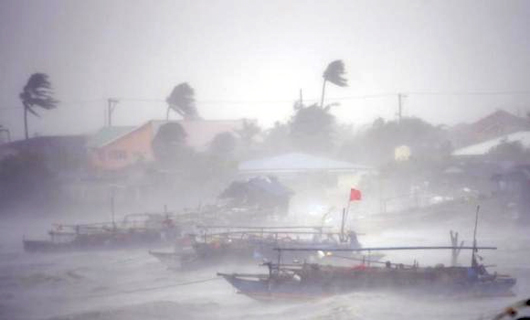
Manila, Jul 16: A typhoon killed at least 10 people as it churned across the Philippines and hit the capital, prompting the evacuation of almost more than 370,000 people, shutting financial markets, offices and schools, rescue officials said on Wednesday.

The eye of Typhoon Rammasun, the strongest storm to hit the country this year, passed to the south of Manila on Wednesday after cutting a path across the main island of Luzon, toppling trees and power lines and causing electrocutions and widespread blackouts.

Richard Gordon, chairman of the Philippine Red Cross, said there was minimal damage in the capital but staff were trying to rescue people trapped by fallen debris in Batangas City to the south where two people were electrocuted.

“We have not received reports of major flooding in Metro Manila because the typhoon did not bring rain, but the winds were strong,” he said.

The number of evacuated people had reached more than 370,000, mostly in the eastern province of Albay, the first to be hit by the typhoon, the disaster agency said.

Major roads across Luzon were impassable due to debris, fallen trees and electricity poles.

At least four southeastern provinces on Luzon declared, or were about to declare, a state of calamity, allowing the local governments to tap emergency relief funds.

The storm brought storm surges to Manila Bay and prompted disaster officials to evacuate slum-dwellers on the capital's outskirts.

Some 85 percent of areas serviced by the country's biggest power distributor, Manila Electric Co, in Luzon were without power and were unlikely to be back up within the day, a company spokesman said.

Parts of the Philippines are still recovering from Typhoon Haiyan, one of the biggest cyclones known to have made landfall anywhere. It killed more than 6,100 people last November in the central provinces, many in tsunami-like sea surges, and left millions homeless.

Rhea Catada, who works for Oxfam in Tacloban, which suffered the brunt of Haiyan, said thousands of people in tents and coastal villages had been evacuated to higher ground.

“They are scared because their experiences during Haiyan last year are still fresh,” she said. “Now they are evacuating voluntarily and leaving behind their belongings.”

Social Work Secretary Dinky Soliman said 5,335 families, or nearly 27,000 people, had been “affected” by the storm in Tacloban.

Some had returned to the Astrodome, where thousands sought shelter and dozens drowned during storm surges in the November disaster.

Tropical Storm Risk, which monitors cyclones, labelled Rammasun a category-two storm on a scale of one to five as it headed west into the South China Sea. Super typhoon Haiyan was category five.

A 25-year-old woman was killed when she was hit by a falling electricity pole as Rammasun hit the east coast on Tuesday, the Philippine disaster agency said. A pregnant woman was killed when a house wall collapsed in Lucena City in Quezon province south of the capital.

Trading at the Philippine Stock Exchange and Philippine Dealing System, used for foreign exchange trading, were suspended after government offices were ordered shut.

More than 200 international and domestic flights have been canceled.

A Singapore Airlines Boeing 777 suffered a hole on its left wing when wind gusts pushed the aircraft five meters across the tarmac at Manila airport, hitting equipment parked nearby, airport officials said.

Comments

Add new comment

  • Coastaldigest.com reserves the right to delete or block any comments.
  • Coastaldigset.com is not responsible for its readers’ comments.
  • Comments that are abusive, incendiary or irrelevant are strictly prohibited.
  • Please use a genuine email ID and provide your name to avoid reject.
News Network
June 19,2020

United Nations, Jun 19: Half of the world's children -- one billion every year -- are affected by physical, sexual or psychological violence, suffering injuries and death because countries have failed to follow established strategies to protect them, the first report of its kind from the UN has said, with experts noting that the coronavirus-related lockdowns have left far too many youngsters stuck with their abusers.

While nearly all countries (88 per cent) have laws in place to protect minors, less than half (47 per cent) say they strongly enforce them, said the Global Status Report on Preventing Violence Against Children 2020 launched on Thursday.

Because countries have failed to follow established strategies to protect children, about one billion are affected each year by physical, sexual or psychological violence, it said.

"There is never any excuse for violence against children," WHO Director-General Tedros Adhanom Ghebreyesus said.

"We have evidence-based tools to prevent it, which we urge all countries to implement. Protecting the health and well-being of children is central to protecting our collective health and well-being, now and for the future," he said.

The report -- launched by the World Health Organisation, the UNICEF, the UNESCO, the Special Representative of the UN Secretary-General on Violence against Children and the End Violence Partnership -- charted progress in 155 countries against the "INSPIRE" framework, a set of seven strategies for preventing and responding to violence against children.

The report signaled a clear need in all countries to scale up efforts to implement them. It included the first ever global homicide estimates specifically for children under 18 years of age -- previous estimates were based on data that included 18 to 19-year olds.

According to the findings, in 2017, around 40,000 children were victims of homicide.

"Violence against children has always been pervasive, and now things could be getting much worse," UNICEF Executive Director Henrietta Fore said.

"Lockdowns, school closures and movement restrictions have left far too many children stuck with their abusers, without the safe space that school would normally offer. It is urgent to scale up efforts to protect children during these times and beyond, including by designating social service workers as essential and strengthening child helplines," she said.

UNESCO Director-General Audrey Azoulay said during the COVID-19 pandemic, and the related school closures, "we have seen a rise in violence and hate online – and this includes bullying".

"Now, as schools begin to re-open, children are expressing their fears about going back to school. It is our collective responsibility to ensure that schools are safe environments for all children. We need to think and act collectively to stop violence at school and in our societies at large," Azoulay said.

Stay-at-home measures including school closures have limited the usual sources of support for families and individuals such as friends, extended family or professionals.

This further erodes victims’ ability to successfully cope with crises and the new routines of daily life. Spikes in calls to helplines for child abuse and intimate partner violence have been observed, the report said.

While online communities have become central to maintain many children's learning, support and play, an increase in harmful online behaviors including cyberbullying, risky online behavior and sexual exploitation have been identified.

“Whilst this report was being finalised, confinement measures and the disrupted provision of already limited child protection services exacerbated the vulnerability of children to various forms of violence," said Najat Maalla M’jid, Special Representative of the UN Secretary-General on Violence against Children.

Of the INSPIRE strategies, only access to schools through enrolment showed the most progress with 54 per cent of the countries reporting that a sufficient number of children in need were being reached in this way.

Between 32 per cent and 37 per cent of the countries considered that victims of violence could access support services, while 26 per cent of the countries provided programmes on parent and caregiver support; 21 per cent of the countries had programmes to change harmful norms; and 15 per cent of the countries had modifications to provide safe physical environments for children, the report said.

Although a majority of countries (83 per cent) have national data on violence against children, only 21 per cent used these to set baselines and national targets to prevent and respond to violence against children, it added.

The report said about 80 per cent of countries have national plans of action and policies but only one-fifth have plans that are fully funded or have measurable targets. A lack of funding combined with inadequate professional capacity are likely contributing factors and a reason why implementation has been slow.

"Ending violence against children is the right thing to do, a smart investment to make - and it's possible. We can and must create a world where every child can thrive," Howard Taylor of the End Violence Partnership said.

Comments

Add new comment

  • Coastaldigest.com reserves the right to delete or block any comments.
  • Coastaldigset.com is not responsible for its readers’ comments.
  • Comments that are abusive, incendiary or irrelevant are strictly prohibited.
  • Please use a genuine email ID and provide your name to avoid reject.
News Network
April 8,2020

Washington, Apr 8: President Donald Trump has threatened to put a "very powerful" hold on US' funding to the World Health Organization, accusing the UN agency of being "very China centric" and criticising it for having "missed the call" in its response to the coronavirus pandemic.

Trump slammed the global health agency for its early guidance aimed at countering the international spread of the coronavirus.

"We're going to put a hold on money spent to the WHO. We're going to put a very powerful hold on it and we're going to see. It's a great thing if it works. But when they call every shot wrong, that's no good," Trump told reporters at his daily White House news conference on Tuesday.

The Geneva-headquartered World Health Organization (WHO), receives vast amounts of money from the United States.

"We pay for a majority or the biggest portion of their money. They actually criticized and disagreed with my travel ban at the time I did it. They were wrong. They've been wrong about a lot of things. They had a lot of information early and they didn't want to - they're very - they seem to be very China centric," Trump said.

The president said his administration was going to look into the US funding to the WHO.

"We give a majority of the money that they get, and it's much more than the USD 58 million. USD 58 million is a small portion of what they've got over the years. Sometimes they get much more than that. Sometimes it's for programs that they're doing, and-it's much bigger numbers. If the programmes are good, that's great as far as we're concerned," he said.

"But we want to look into it, WHO, because they called it wrong. They (WHO) called it wrong. They missed the call. They could've called it months earlier. They would have known and they should have known and they probably did know. So, we'll be looking into that very carefully, and we're going to put a hold on money spent to the WHO," Trump said.

Meanwhile, Senator Jim Risch, chairman of Senate Foreign Relations Committee, called for an independent investigation into the WHO's handling of the COVID-19 response.

"The WHO has failed not only the American people, it has failed the world with its flagrant mishandling of the response to COVID-19," said Risch.

WHO Director general Tedros Adhanom Ghebreyesus' apparent unwillingness to hold the Chinese Communist Party to even the minimum standard of global health and transparency hindered the world's ability to blunt the spread of this pandemic, he said.

"It is completely unacceptable that the world's global health organization has become a political puppet of the Chinese government," he alleged, adding that "an independent investigation into the WHO's handling of the COVID-19 response is imperative."

The United States is the largest contributor to the WHO.

"Our valuable tax payer dollars should go towards investments to prevent the spread of disease, not to aid and abet cover-ups that cost lives and isolate portions of the world's population on political grounds, as has been the case with Taiwan," Senator Risch said.

A bipartisan group of nearly two dozen lawmakers announced Tuesday to introduce a resolution to defund the WHO until Ghebreyesus resigns and an international commission investigates the organisation's role in covering up the Chinese Communist Party's failed COVID-19 response.

"The WHO helped the Chinese Communist Party hide the threat of COVID-19 from the world and now more than 10,000 Americans are dead, a number that is expected to rise dramatically in the coming weeks," Congressman Guy Reschenthaler alleged.

"The United States is the largest contributor to WHO. It is not right that Americans' hard-earned tax dollars are being used to propagate China's lies and hide information that could have saved lives. This bill will hold the WHO accountable for their negligence and deceit," he asserted.

The United States' intelligence community has reported that the Chinese government hid the threat of COVID-19 and, as a result, made it difficult for the rest of the world to respond early, appropriately and aggressively, said Congressman Fred Keller.

"For reasons beyond understanding, the WHO acted as a silent partner in this effort instead of protecting the lives of millions across the world, including hundreds of thousands of American citizens. Our hard-earned tax dollars should not go to a global organization more concerned with not offending the Chinese government than providing accurate information and protecting innocent lives," Keller said.

Senator Marco Rubio accused the Chinese Communist Party of using WHO "to mislead the world."

"The organisation's leadership is either complicit or dangerously incompetent. I will work with the Trump Administration to ensure that WHO is independent and has not been compromised by the CCP before we continue our current funding, he added.

According to Johns Hopkins University, there are over 1.43 million confirmed coronavirus cases across the world and over 82,000 people have died due to the disease. The US has nearly 400,000 infections, the highest in the world.

Comments

Add new comment

  • Coastaldigest.com reserves the right to delete or block any comments.
  • Coastaldigset.com is not responsible for its readers’ comments.
  • Comments that are abusive, incendiary or irrelevant are strictly prohibited.
  • Please use a genuine email ID and provide your name to avoid reject.
News Network
February 24,2020

Beijing, Feb 24: The lockdown of Guo Jing's neighbourhood in Wuhan -- the city at the heart of China's new coronavirus epidemic -- came suddenly and without warning.

Unable to go out, the 29-year-old is now sealed inside her compound where she has to depend on online group-buying services to get food.

"Living for at least another month isn't an issue," Guo told news agency, explaining that she had her own stash of pickled vegetables and salted eggs.

But what scares her most is the lack of control -- first, the entire city was sealed off, and then residents were limited to exiting their compound once every three days.

Now even that has been taken away.

Guo is among some 11 million residents in Wuhan, a city in central Hubei province that has been under effective quarantine since January 23 as Chinese authorities race to contain the epidemic.

Since then, its people have faced a number of tightening controls over daily life as the death toll from the virus swelled to over 2,500 in China alone.

But the new rules this month barring residents from leaving their neighbourhoods are the most restrictive yet -- and for some, threaten their livelihoods.

"I still don't know where to buy things once we've finished eating what we have at home," said Pan Hongsheng, who lives with his wife and two children.

Some neighbourhoods have organised group-buying services, where supermarkets deliver orders in bulk.

But in Pan's community, "no one cares".

"The three-year-old doesn't even have any milk powder left," Pan told news agency, adding that he has been unable to send medicine to his in-laws -- both in their eighties -- as they live in a different area.

"I feel like a refugee."

The "closed management of neighbourhoods is bound to bring some inconvenience to the lives of the people", Qian Yuankun, vice secretary of Hubei's Communist Party committee, said at a press briefing last week.

Authorities on Monday allowed healthy non-residents of the city to leave if they never had contact with patients, but restrictions remained on those who live in Wuhan.

Demand for group-buying food delivery services has rocketed with the new restrictions, with supermarkets and neighbourhood committees scrambling to fill orders.

Most group-buying services operate through Chinese messaging app WeChat, which has ad-hoc chat groups for meat, vegetables, milk -- even "hot dry noodles", a famous Wuhan dish.

More sophisticated shops and compounds have their own mini-app inside WeChat, where residents can choose packages priced by weight before orders are sent in bulk to grocery stores.

In Guo's neighbourhood, for instance, a 6.5-kilogramme (14.3-pound) set of five vegetables, including potatoes and baby cabbage, costs 50 yuan ($7.11).

"You have no way to choose what you like to eat," Guo said. "You cannot have personal preferences anymore."

The group-buying model is also more difficult for smaller communities to adopt, as supermarkets have minimum order requirements for delivery.

"To be honest, there's nothing we can do," said Yang Nan, manager of Lao Cun Zhang supermarket, which requires a minimum of 30 orders.

"We only have four cars," she said, explaining that the store did not have the staff to handle smaller orders.

Another supermarket told AFP it capped its daily delivery load to 1,000 orders per day.

"Hiring staff is difficult," said Wang Xiuwen, who works at the store's logistics division, adding that they are wary about hiring too many outsiders for fear of infection.

Closing off communities has split the city into silos, with different neighbourhoods rolling out controls of varying intensity.

In some compounds, residents have easier access to food -- albeit a smaller selection than normal -- and one woman said her family pays delivery drivers to run grocery errands.

Her compound has not been sealed off either, the 24-year-old told AFP under condition of anonymity, though they are limited to one person leaving at a time.

Some districts have implemented their own rules, such as prohibiting supermarkets from selling to individuals, forcing neighbourhoods to buy in bulk or not at all.

"In the neighbourhood where I live, the reality is really terrible," said David Dai, who is based on the outskirts of Wuhan.

Though his apartment complex has organised group-buying, Dai said residents were unhappy with price and quality.

"A lot of tomatoes, a lot of onions -- they were already rotten," he told , estimating over a third of the food had to be thrown away.

His family must "totally depend" on themselves, added the 49-year-old, who has resorted to saving and drying turnip skins to add nutrients to future meals.

The uncertainty of not knowing when the controls will be lifted is also frustrating, said Ma Chen, a man in his 30s who lives alone.

"I have no way of knowing how much (food) I should buy."

Comments

Add new comment

  • Coastaldigest.com reserves the right to delete or block any comments.
  • Coastaldigset.com is not responsible for its readers’ comments.
  • Comments that are abusive, incendiary or irrelevant are strictly prohibited.
  • Please use a genuine email ID and provide your name to avoid reject.