


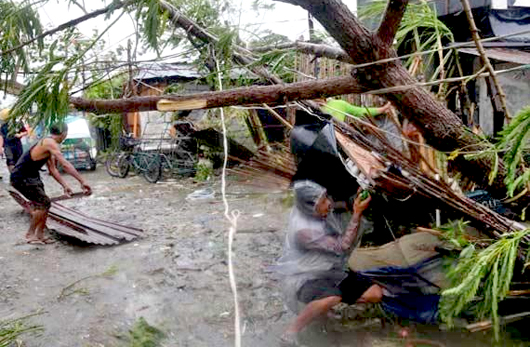
Typhoon power woes in Philippines as death toll hits 38

July 16, 2014

Typhoon Philippines

Manila, Jul 17: Millions of people in the Philippines endured a second sweltering day without power today after a ferocious typhoon paralysed the capital and tore down flimsy rural homes, claiming at least 38 lives.

Authorities expressed frustration as reports from badly damaged areas filtered in and the death toll from Typhoon Rammasun, the first major storm of the Southeast Asian archipelago's rainy season, was nearly doubled to 38.

"We still have to find out what exactly are the reasons a lot of our countrymen refuse to heed the warnings," National Disaster Risk Reduction and Management Council chief Alexander Pama told reporters.

As part of a "zero casualty" effort, the government evacuated nearly 400,000 people from the path of Rammasun and warned others to stay indoors.

But many of the people who died were outdoors, killed by falling trees, collapsing buildings and flying debris, according to the council's data.

Pama said the death toll could rise further, with mobile phone and other forms of communication still cut to some rural areas. He said at least eight people remained missing.

Rammasun, a Thai word for "Thunder God", swept in off the Pacific Ocean on Tuesday night, then brought wind gusts of up to 160 kilometres an hour across land to Manila and other heavily populated northern regions.

"It really scrambled whole towns, blowing down houses and toppling power lines," the chairman of the Philippine Red Cross, Richard Gordon, told AFP.

The typhoon cut electricity supplies to nearly all of Manila, a megacity of more than 12 million people, and surrounding urban areas.

Schools and government offices were closed throughout the capital, hundreds of flights suspended and the stock exchange closed.

The stock exchange and government offices re-opened today, but many schools remained closed partly because of the power problems.

The Manila Electric Company (Meralco), the country's largest power distributor which serves the capital and surrounding areas, said 1.9 million households still did not have power yesterday.

With the temperature in Manila expected to hit 30 degrees Celsius and the air thick with tropical moisture, Meralco could not give any estimate to frustrated residents when power would be restored.

Earlier:

Typhoon kills 10, displaces 370,000 in Philippines
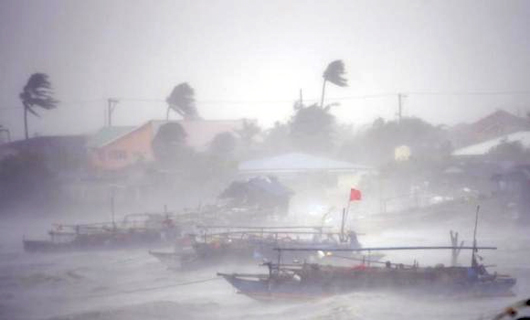
Typhoon Philippines

Manila, Jul 16: A typhoon killed at least 10 people as it churned across the Philippines and hit the capital, prompting the evacuation of almost more than 370,000 people, shutting financial markets, offices and schools, rescue officials said on Wednesday.

The eye of Typhoon Rammasun, the strongest storm to hit the country this year, passed to the south of Manila on Wednesday after cutting a path across the main island of Luzon, toppling trees and power lines and causing electrocutions and widespread blackouts.

Richard Gordon, chairman of the Philippine Red Cross, said there was minimal damage in the capital but staff were trying to rescue people trapped by fallen debris in Batangas City to the south where two people were electrocuted.

“We have not received reports of major flooding in Metro Manila because the typhoon did not bring rain, but the winds were strong,” he said.

The number of evacuated people had reached more than 370,000, mostly in the eastern province of Albay, the first to be hit by the typhoon, the disaster agency said.

Major roads across Luzon were impassable due to debris, fallen trees and electricity poles.

At least four southeastern provinces on Luzon declared, or were about to declare, a state of calamity, allowing the local governments to tap emergency relief funds.

The storm brought storm surges to Manila Bay and prompted disaster officials to evacuate slum-dwellers on the capital's outskirts.

Some 85 percent of areas serviced by the country's biggest power distributor, Manila Electric Co, in Luzon were without power and were unlikely to be back up within the day, a company spokesman said.

Parts of the Philippines are still recovering from Typhoon Haiyan, one of the biggest cyclones known to have made landfall anywhere. It killed more than 6,100 people last November in the central provinces, many in tsunami-like sea surges, and left millions homeless.

Rhea Catada, who works for Oxfam in Tacloban, which suffered the brunt of Haiyan, said thousands of people in tents and coastal villages had been evacuated to higher ground.

“They are scared because their experiences during Haiyan last year are still fresh,” she said. “Now they are evacuating voluntarily and leaving behind their belongings.”

Social Work Secretary Dinky Soliman said 5,335 families, or nearly 27,000 people, had been “affected” by the storm in Tacloban.

Some had returned to the Astrodome, where thousands sought shelter and dozens drowned during storm surges in the November disaster.

Tropical Storm Risk, which monitors cyclones, labelled Rammasun a category-two storm on a scale of one to five as it headed west into the South China Sea. Super typhoon Haiyan was category five.

A 25-year-old woman was killed when she was hit by a falling electricity pole as Rammasun hit the east coast on Tuesday, the Philippine disaster agency said. A pregnant woman was killed when a house wall collapsed in Lucena City in Quezon province south of the capital.

Trading at the Philippine Stock Exchange and Philippine Dealing System, used for foreign exchange trading, were suspended after government offices were ordered shut.

More than 200 international and domestic flights have been canceled.

A Singapore Airlines Boeing 777 suffered a hole on its left wing when wind gusts pushed the aircraft five meters across the tarmac at Manila airport, hitting equipment parked nearby, airport officials said.

Comments

Add new comment

  • Coastaldigest.com reserves the right to delete or block any comments.
  • Coastaldigset.com is not responsible for its readers’ comments.
  • Comments that are abusive, incendiary or irrelevant are strictly prohibited.
  • Please use a genuine email ID and provide your name to avoid reject.
News Network
March 25,2020

Hubei, Mar 25: As a bus departed from its terminus at Hankou Railway Station at 5:25 am Wednesday morning, Wuhan started to resume bus service after nine weeks of lockdown.

Apart from a driver, a safety supervisor was also on each bus, whose duty was to make sure all passengers are healthy.
"For those who do not use smartphones, they should bring with them a health certificate issued by the health authorities," said Zhou Jingjing, a safety supervisor aboard bus No. 511 departing from the Wuchang Railway Station complex.
The once hardest-hit city in central China's Hubei Province during the COVID-19 outbreak took unprecedented traffic restrictions on Jan 23. All of its public transport and all outbound flights and trains had been suspended in an attempt to contain the virus within the region.

Comments

Add new comment

  • Coastaldigest.com reserves the right to delete or block any comments.
  • Coastaldigset.com is not responsible for its readers’ comments.
  • Comments that are abusive, incendiary or irrelevant are strictly prohibited.
  • Please use a genuine email ID and provide your name to avoid reject.
News Network
June 4,2020

Jun 4: A malaria drug President Donald Trump took to try to prevent COVID-19 proved ineffective for that in the first large, high-quality study to test it in people in close contact with someone with the disease.

Results published Wednesday by the New England Journal of Medicine show that hydroxychloroquine was no better than placebo pills at preventing illness from the coronavirus.

The drug did not seem to cause serious harm, though -- about 40% on it had side effects, mostly mild stomach problems.

 “We were disappointed. We would have liked for this to work,” said the study leader, Dr. David Boulware, an infectious disease specialist at the University of Minnesota.

“But our objective was to answer the question and to conduct a high-quality study,” because the evidence on the drug so far has been inconclusive, he said.

Hydroxychloroquine and a similar drug, chloroquine, have been the subject of much debate since Trump started promoting them in March.

Hydroxychloroquine has long been used for malaria, lupus, and rheumatoid arthritis, but no large studies have shown it or chloroquine to be safe or effective for much sicker patients with coronavirus, and some studies have suggested the drugs may do harm.

Trump took a two-week course of hydroxychloroquine, along with zinc and Vitamin D, after two staffers tested positive for COVID-19, and had no ill effects, according to results of his latest physical released by his doctor Wednesday.

Federal regulators have warned against hydroxychloroquine's use except in hospitals and formal studies because of the risk of side effects, especially heart rhythm problems.

Boulware's study involved 821 people in the United States and Canada living with someone diagnosed with COVID-19 or at high risk of getting it because of their job -- doctors, nurses, ambulance workers who had significant exposure to a sick patient while not wearing full protective gear.

They were randomly assigned to get either the nutrient folate as a placebo or hydroxychloroquine for five days, starting within four days of their exposure. Neither they nor others involved in the research knew who was getting which pills.

After 14 days in the study, 12 per cent on the drug developed COVID-19 symptoms versus 14 per cent in the placebo group, but the difference is so small it could have occurred by chance, Boulware said.

“There's basically no effect. It does not prevent infection,” he said of the drug. Even if it were to give some slim advantage, “we'd want a much larger effect” to justify its use and risk of side effects for preventing illness, he said.

Results were no different among a subgroup of participants who were taking zinc or vitamin C, which some people believe might help make hydroxychloroquine more effective or fight the coronavirus.

There are some big caveats: The study enrolled people through the Internet and social media, relying on them to report their own symptoms rather than having them tracked in a formal way by doctors.

Participants were not all tested for the coronavirus but were diagnosed as COVID-19 cases based on symptoms in many cases. And not all took their medicines as directed.

The results “are more provocative than definitive,” and the drug may yet have prevention benefits if tried sooner or in a different way, Dr. Myron Cohen of the University of North Carolina at Chapel Hill wrote in a commentary in the journal.

Others were glad to see a study that had a comparison group and good scientific methods after so many weaker reports on hydroxychloroquine.

“This fits with everything else we've seen so far which suggests that it's not beneficial," said Dr. Peter Bach, director of a health policy center at Memorial Sloan Kettering Cancer Center in New York.

This study was in younger relatively healthy people, but the results “would make me very discouraged about trying to use this in older people” who are most vulnerable to serious illness from the coronavirus, Bach said.

“If it does work, it doesn't work very well.” Dr. Dan Culver, a lung specialist at the Cleveland Clinic, said there's still a chance that giving the drug sooner than four days after someone's exposure to the virus may help prevent illness.

But the study “takes 'home run' off the table” as far as hopes for the drug, he said.

The study was mostly funded by David Baszucki, founder of Roblox, a California-based game software company, and other private donors and the Minnesota university.

Boulware also is leading a study testing hydroxychloroquine for treating COVID-19. The study is finished and results are being analyzed now.

On Tuesday, the journal Lancet posted an “expression of concern” about a study it published earlier this month of nearly 15,000 COVID-19 patients on the malaria drugs that tied their use to a higher risk of dying in the hospital or developing a heartbeat problem.

Scientists have raised serious questions about the database used for that study, and its authors have launched an independent audit.

That work had a big impact: the World Health Organization suspended use of hydroxychloroquine in a study it is leading, and French officials stopped the drug's use in hospitals. On Wednesday, the WHO said experts who reviewed safety information decided that its study could resume.

Comments

Add new comment

  • Coastaldigest.com reserves the right to delete or block any comments.
  • Coastaldigset.com is not responsible for its readers’ comments.
  • Comments that are abusive, incendiary or irrelevant are strictly prohibited.
  • Please use a genuine email ID and provide your name to avoid reject.
Agencies
July 24,2020

The total number of global coronavirus cases has topped 15.4 million, while the deaths have increased to over 631,000, according to the Johns Hopkins University.

As of Friday morning, the total number of cases stood at 15,439,456, while the fatalities rose to 631,926, the University's Center for Systems Science and Engineering (CSSE) revealed in its latest update.

The US accounted for the world's highest number of infections and fatalities at 4,034,831 and 144,242, respectively, according to the CSSE.

Brazil came in the second place with 2,287,475 infections and 84,082 deaths.

In terms of cases, India ranks third (1,238,798), and is followed by Russia (793,720), South Africa (408,052), Peru (371,096), Mexico (370,712), Chile (334,683), the UK (298,721), Iran (284,034), Spain (270,166), Pakistan (269,191), Saudi Arabia (260,394), Italy (245,338), Turkey (223,315), Colombia (218,428), France (216,667), Bangladesh (216,110), Germany (204,881), Argentina (148,027), Canada (114,398), Qatar (108,244) and Iraq (102,226), the CSSE figures showed.

The other countries with over 10,000 deaths are the UK (45,639), Mexico (41,908), Italy (35,092), France (30,185), India (29,861), Spain (28,429), Iran (15,074), Peru (17,654) and Russia (12,873).

Comments

Add new comment

  • Coastaldigest.com reserves the right to delete or block any comments.
  • Coastaldigset.com is not responsible for its readers’ comments.
  • Comments that are abusive, incendiary or irrelevant are strictly prohibited.
  • Please use a genuine email ID and provide your name to avoid reject.