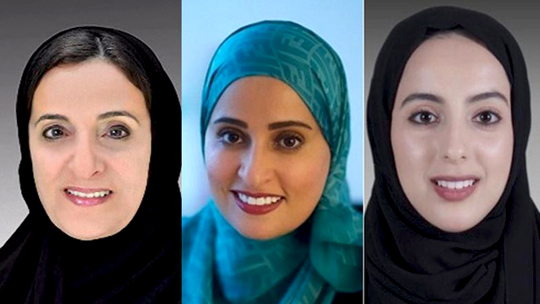
UAE announces ministers for state ministers for happiness, tolerance, youth

February 11, 2016

Dubai, Feb 11: It sounds a bit New Age, but the United Arab Emirates has just appointed state ministers for happiness, tolerance and youth.

ministers

Minister of Tolerance Sheikha Lubna Al-Qassimi, Minister of Happiness Ohood Al-Roumi, Minister for Youth Affairs Shama Al-Mazroui

Sheikh Mohammed bin Rashid al-Maktoum, the UAE prime minister who is also the ruler of Dubai, announced the new lineup on Wednesday via his official Twitter account.

It is apparently part of a move to show the government is offering more than simply providing basic services for its citizens.

"Happiness in our nation is not a wish .. but there will be plans, projects and programs and indicators .. and it will be part of the work of all our ministries .. and a part of our way of life," Sheikh Mohammed tweeted.

The job went to Ohood Al Roumi, who will continue her existing role as director-general of the prime minister’s office. She was one of seven women named to posts in the new 29-member Cabinet.

"The new cabinet focuses on the future, youth, happiness, developing education and combating climate change," tweeted the 66-year-old prime minister, who is also the Emirati vice president and ruler of Dubai.

Sheikha Lubna al-Qassimi, the former development and international cooperation minister, was made state minister for tolerance.

Twenty-two year old, Western-educated Shama al-Mazroui was made state minister for youth affairs.

The United Arab Emirates, which has one of the highest levels of GDP per capita in the Arab world, is seen as a haven of stability in a region beset by turmoil and where public devotion to the rulers is high and little dissent is tolerated.

It is home to the glitzy emirate of Dubai, which transformed from a desert backwater to a global financial hub, where thousands of Arab expatriates flock to seek professional and entpreneurial opportunities not available in as much supply in other unstable Arab countries.

Sheikh Mohammed had announced earlier this week plans to outsource most government tasks to the private sector and cuts to the number of ministries.

The announcement came as energy-rich Gulf Arab states have been hit by low oil prices, encouraging them to streamline institutions and attract more foreign investment.

The cabinet lineup left the same figures in the critical portfolios of finance, economy, energy, defence and foreign affairs.

"The new lineup is a new stage whose headline is the future ... the youth ... happiness ... developing education ... and dealing with climate change to protect our environment," Sheikh Mohammed said.

Comments

preetha
 - 
Saturday, 13 Feb 2016

A good move to have a minister for happiness, which is lacking in this world, only if we are happy we can radiate happiness to others .
A good move
stay blessed

Add new comment

  • Coastaldigest.com reserves the right to delete or block any comments.
  • Coastaldigset.com is not responsible for its readers’ comments.
  • Comments that are abusive, incendiary or irrelevant are strictly prohibited.
  • Please use a genuine email ID and provide your name to avoid reject.
News Network
March 31,2020

Mar 30: the UAE Cabinet approved a series of new initiatives, foremost among which was the automatic extension of residence permits expiring from March 1.

The residence visas would be extended for a renewable period of three months without any fees to ease the economic impact of the Covid-19 crisis on residents, official news agency WAM reported.

The Cabinet has also waived the administrative fines associated with infractions on the services provided by the Federal Authority of Identity and Citizenship, starting April 1 and lasting for a renewable period of three months.

The initiatives also entail granting a temporary license to use digital solutions for remotely notarising and completing judicial transactions.

Government services expiring from March 1 will also be extended from April 1 for a renewable period of three months. The decision applies to all federal government services, including documents, permits, licenses and commercial registers.

The UAE has introduced a slew of initiatives to control the spread of the Covid-19 virus, including the online renewal of driving licences and vehicle’s registration cards.

The country’s telecom regulator, Telecommunications Regulatory Authority (TRA), also issued a directive that no mobile service with expired ID documents will be disconnected or suspended in the UAE.

The UAE has reported a total of 611 Covid-19 infections and five related deaths in the country.

A national sterilisation programme is underway that will continue until Saturday April 4, concluding on the morning of Sunday, April 5.

Carried out daily from 8pm until 6am the following morning, the programme will include the disinfection of private and public facilities.

Comments

Add new comment

  • Coastaldigest.com reserves the right to delete or block any comments.
  • Coastaldigset.com is not responsible for its readers’ comments.
  • Comments that are abusive, incendiary or irrelevant are strictly prohibited.
  • Please use a genuine email ID and provide your name to avoid reject.
Ram Puniyani
February 10,2020

Noam Chomsky is one of the leading peace workers in the world. In the wake of America’s attack on Vietnam, he brought out his classic formulation, ‘manufacturing consent’. The phrase explains the state manipulating public opinion to have the public approve of it policies—in this case, the attack of the American state on Vietnam, which was then struggling to free itself from French colonial rule.

In India, we are witness to manufactured hate against religious minorities. This hatred serves to enhance polarisation in society, which undermines India’s democracy and Constitution and promotes support for a Hindu nation. Hate is being manufactured through multiple mechanisms. For example, it manifests in violence against religious minorities. Some recent ghastly expressions of this manufactured hate was the massive communal violence witnessed in Mumbai (1992-93), Gujarat (2002), Kandhamal (2008) and Muzaffarnagar (2013). Its other manifestation was in the form of lynching of those accused of having killed a cow or consumed beef. A parallel phenomenon is the brutal flogging, often to death, of Dalits who deal with animal carcasses or leather.

Yet another form of this was seen when Shambhulal Regar, indoctrinated by the propaganda of Hindu nationalists, burned alive Afrazul Khan and shot the video of the heinous act. For his brutality, he was praised by many. Regar was incited into the act by the propaganda around love jihad. Lately, we have the same phenomenon of manufactured hate taking on even more dastardly proportions as youth related to Hindu nationalist organisations have been caught using pistols, while police authorities look on.

Anurag Thakur, a BJP minster in the central government recently incited a crowd in Delhi to complete his chant of what should happen to ‘traitors of the country...” with a “they should be shot”. Just two days later, a youth brought a pistol to the site of a protest at Jamia Millia Islamia university and shouted “take Azaadi!” and fired it. One bullet hit a student of Jamia. This happened on 30 January, the day Nathuram Godse had shot Mahatma Gandhi in 1948. A few days later, another youth fired near the site of protests against the CAA and NRC at Shaheen Bagh. Soon after, he said that in India, “only Hindus will rule”.

What is very obvious is that the shootings by those associated with Hindu nationalist organisations are the culmination of a long campaign of spreading hate against religious minorities in India in general and against Muslims in particular. The present phase is the outcome of a long and sustained hate campaign, the beginning of which lies in nationalism in the name of religion; Muslim nationalism and Hindu nationalism. This sectarian nationalism picked up the communal view of history and the communal historiography which the British introduced in order to pursue their ‘divide and rule’ policy.

In India what became part of “social common sense” was that Muslim kings had destroyed Hindu temples, that Islam was spread by force, and that it is a foreign religion, and so on. Campaigns, such as the one for a temple dedicated to the Hindu god Rama to be built at the site where the Babri masjid once stood, further deepened the idea of a Muslim as a “temple-destroyer”. Aurangzeb, Tipu Sultan and other Muslim kings were tarnished as the ones who spread Islam by force in the subcontinent. The tragic Partition, which was primarily due to British policies, and was well-supported by communal streams also, was entirely attributed to Muslims. The Kashmir conflict, which is the outcome of regional, ethnic and other historical issues, coupled with the American policy of supporting Pakistan’s ambitions of regional hegemony, (which also fostered the birth of Al-Qaeda), was also attributed to the Muslims.

With recurring incidents of communal violence, these falsehoods went on going deeper into the social thinking. Violence itself led to ghettoisation of Muslims and further broke inter-community social bonds. On the one hand, a ghettoised community is cut off from others and on the other hand the victims come to be presented as culprits. The percolation of this hate through word-of-mouth propaganda, media and re-writing of school curricula, had a strong impact on social attitudes towards the minorities.

In the last couple of decades, the process of manufacturing hate has been intensified by the social media platforms which are being cleverly used by the communal forces. Swati Chaturvedi’s book, I Am a Troll: Inside the Secret World of the BJP’s Digital Army, tells us how the BJP used social media to spread hate. Whatapp University became the source of understanding for large sections of society and hate for the ‘Other’, went up by leaps and bounds. To add on to this process, the phenomenon of fake news was shrewdly deployed to intensify divisiveness.

Currently, the Shaheen Bagh movement is a big uniting force for the country; but it is being demonised as a gathering of ‘anti-nationals’. Another BJP leader has said that these protesters will indulge in crimes like rape. This has intensified the prevalent hate.

While there is a general dominance of hate, the likes of Shambhulal Regar and the Jamia shooter do get taken in by the incitement and act out the violence that is constantly hinted at. The deeper issue involved is the prevalence of hate, misconceptions and biases, which have become the part of social thinking.

These misconceptions are undoing the amity between different religious communities which was built during the freedom movement. They are undoing the fraternity which emerged with the process of India as a nation in the making. The processes which brought these communities together broadly drew from Gandhi, Bhagat Singh and Ambedkar. It is these values which need to be rooted again in the society. The communal forces have resorted to false propaganda against the minorities, and that needs to be undone with sincerity.

Combating those foundational misconceptions which create hatred is a massive task which needs to be taken up by the social organisations and political parties which have faith in the Indian Constitution and values of freedom movement. It needs to be done right away as a priority issue in with a focus on cultivating Indian fraternity yet again.


Comments

Add new comment

  • Coastaldigest.com reserves the right to delete or block any comments.
  • Coastaldigset.com is not responsible for its readers’ comments.
  • Comments that are abusive, incendiary or irrelevant are strictly prohibited.
  • Please use a genuine email ID and provide your name to avoid reject.
News Network
May 15,2020

Bengaluru, May 15 Reformed underworld don N Muthappa Rai died battling cancer at a private hospital here on Friday, hospital sources said.

Rai, 68, was suffering from brain cancer for the past one year and was admitted at Manipal Hospital on Old Airport Road, where he died at 2.30 am, the sources said. Rai is survived by two sons.

Born into a Tulu-speaking Bunt family in Dakshina Kannada''s Puttur town, Rai entered the crime world at a very young age.

Karnataka police issued arrest warrants against Rai in eight cases, including murder and conspiracy.

In 2002, Rai was deported to India from the United Arab Emirates. On arrival, he was questioned by various investigation agencies such as the Central Bureau of Investigation (CBI), Research and Analysis Wing (RAW) and Intelligence Bureau (IB), and by the Karnataka police. He was later acquitted due to the lack of evidences.

In his reformed years, Rai founded charitable organisation ''Jaya Karnataka''.

Rai has appeared in Tulu film ''Kanchilda Baale'' in 2011 and Kannada film ''Katari Veera Surasundarangi'' in 2012.

Bollywood director Ram Gopal Varma wanted to make a movie based on Rai''s life. The film roped in actor Vivek Oberoi for the lead role and was shot in Bengaluru, Mangaluru, Mumbai, Dubai and London. However, it has not been released due to production delays.

Rai was enthusiastic about the film and even celebrated his birthday with Varma and Oberoi.

After his cancer diagnosis, Rai withdrew from public life and resigned from Jaya Karnataka.

His last rites are likely to be performed at Bidadi on Friday, family sources said.

Comments

Add new comment

  • Coastaldigest.com reserves the right to delete or block any comments.
  • Coastaldigset.com is not responsible for its readers’ comments.
  • Comments that are abusive, incendiary or irrelevant are strictly prohibited.
  • Please use a genuine email ID and provide your name to avoid reject.