


UAE announces ministers for state ministers for happiness, tolerance, youth

February 11, 2016

Dubai, Feb 11: It sounds a bit New Age, but the United Arab Emirates has just appointed state ministers for happiness, tolerance and youth.
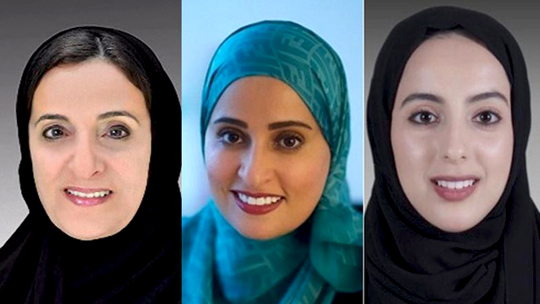
ministers

Minister of Tolerance Sheikha Lubna Al-Qassimi, Minister of Happiness Ohood Al-Roumi, Minister for Youth Affairs Shama Al-Mazroui

Sheikh Mohammed bin Rashid al-Maktoum, the UAE prime minister who is also the ruler of Dubai, announced the new lineup on Wednesday via his official Twitter account.

It is apparently part of a move to show the government is offering more than simply providing basic services for its citizens.

"Happiness in our nation is not a wish .. but there will be plans, projects and programs and indicators .. and it will be part of the work of all our ministries .. and a part of our way of life," Sheikh Mohammed tweeted.

The job went to Ohood Al Roumi, who will continue her existing role as director-general of the prime minister’s office. She was one of seven women named to posts in the new 29-member Cabinet.

"The new cabinet focuses on the future, youth, happiness, developing education and combating climate change," tweeted the 66-year-old prime minister, who is also the Emirati vice president and ruler of Dubai.

Sheikha Lubna al-Qassimi, the former development and international cooperation minister, was made state minister for tolerance.

Twenty-two year old, Western-educated Shama al-Mazroui was made state minister for youth affairs.

The United Arab Emirates, which has one of the highest levels of GDP per capita in the Arab world, is seen as a haven of stability in a region beset by turmoil and where public devotion to the rulers is high and little dissent is tolerated.

It is home to the glitzy emirate of Dubai, which transformed from a desert backwater to a global financial hub, where thousands of Arab expatriates flock to seek professional and entpreneurial opportunities not available in as much supply in other unstable Arab countries.

Sheikh Mohammed had announced earlier this week plans to outsource most government tasks to the private sector and cuts to the number of ministries.

The announcement came as energy-rich Gulf Arab states have been hit by low oil prices, encouraging them to streamline institutions and attract more foreign investment.

The cabinet lineup left the same figures in the critical portfolios of finance, economy, energy, defence and foreign affairs.

"The new lineup is a new stage whose headline is the future ... the youth ... happiness ... developing education ... and dealing with climate change to protect our environment," Sheikh Mohammed said.

Comments

preetha
 - 
Saturday, 13 Feb 2016

A good move to have a minister for happiness, which is lacking in this world, only if we are happy we can radiate happiness to others .
A good move
stay blessed

Add new comment

  • Coastaldigest.com reserves the right to delete or block any comments.
  • Coastaldigset.com is not responsible for its readers’ comments.
  • Comments that are abusive, incendiary or irrelevant are strictly prohibited.
  • Please use a genuine email ID and provide your name to avoid reject.
Agencies
May 8,2020

Washington D.C., May 8: The prime time for brain development in a child's life is the first year, where the infant spends most of the time asleep. It is the time when neural connections form and sensory memories are encoded.

However, when sleep is disrupted, as occurs more often among children with autism, brain development may be affected, too.

New research led by the University of Washington finds that sleep problems in a baby's first 12 months may not only precede an autism diagnosis but also may be associated with altered growth trajectory in a key part of the brain, the hippocampus.

The study, which was published in the American Journal of Psychiatry, researchers report that in a sample of more than 400 taken of 6- to 12-month-old infants, those who were later diagnosed with autism were more likely to have had difficulty falling asleep.

It also states that this sleep difficulty was associated with altered growth trajectories in the hippocampus.

"The hippocampus is critical for learning and memory, and changes in the size of the hippocampus have been associated with poor sleep in adults and older children.

As many as 80 per cent of the children with autism spectrum disorder have sleep problems," said Annette Estes, director of the UW Autism Center and senior author of the study.

"In our clinical experience, parents have a lot of concerns about their children's sleep, and in our work on early autism intervention, we observed that sleep problems were holding children and families back," added Estes, who is also a UW professor of speech and hearing sciences.

"It could be that altered sleep is part-and-parcel of autism for some children. One clue is that behavioural interventions to improve sleep don't work for all children with autism, even when their parents are doing everything just right. This suggests that there may be a biological component to sleep problems for some children with autism," said Estes.

To consider links among sleep, brain development, and autism, researchers at the IBIS Network looked at MRI scans of 432 infants, surveyed parents about sleep patterns, and measured cognitive functioning using a standardized assessment.

At the outset of the study, infants were classified according to their risk for developing autism: Those who were at higher risk of developing autism -- about two-thirds of the study sample -- had an older sibling who had already been diagnosed.

Infant siblings of children with autism have a 20 per cent chance of developing autism spectrum disorder -- a much higher risk than children in the general population.

In the current study, 127 of the 432 infants were identified as "low risk" at the time the MRI scans were taken because they had no family history of autism.

They later evaluated all the participants at 24 months of age to determine whether they had developed autism. Of the roughly 300 children originally considered "high familial risk," 71 were diagnosed with autism spectrum disorder at that age.

Problems with sleep were more common among the infants later diagnosed with an autism spectrum disorder, as were larger hippocampi. No other subcortical brain structures were affected, including the amygdala, which is responsible for certain emotions and aspects of memory, or the thalamus, a signal transmitter from the spinal cord to the cerebral cortex.

The authors note that while parents reported more sleep difficulties among infants who developed autism compared to those who did not, the differences were very subtle and only observed when looking at group averages across hundreds of infants.

Sleep patterns in the first years of life change rapidly as infants transition from sleeping around the clock to a more adult-like sleep/wake cycle. Until further research is completed, Estes said, it is not possible to interpret challenges with sleep as an early sign of increased risk for autism.

Comments

Add new comment

  • Coastaldigest.com reserves the right to delete or block any comments.
  • Coastaldigset.com is not responsible for its readers’ comments.
  • Comments that are abusive, incendiary or irrelevant are strictly prohibited.
  • Please use a genuine email ID and provide your name to avoid reject.
News Network
March 21,2020

Bengaluru, Mar 21: Central Crime Branch (CCB) sleuths have nabbed a three-member Irani gang, including a woman and recovered from them 1 kg 33 gram stolen gold chains worth about Rs 40 lakh.

City Police Commissioner Bhaskar Rao told newsmen here on Saturday that the arrested were identified as Abujar, Abdul Hussain and Ms. Jenia, all hailed from Bhopal in Madhya Pradesh.

He said that the culprits, who had been arrested on similar theft cases, were out on bail and continued their criminal activities. They were involved in more than 23 cases.

Comments

Add new comment

  • Coastaldigest.com reserves the right to delete or block any comments.
  • Coastaldigset.com is not responsible for its readers’ comments.
  • Comments that are abusive, incendiary or irrelevant are strictly prohibited.
  • Please use a genuine email ID and provide your name to avoid reject.
coastaldigest.com news network
May 31,2020

Bengaluru, May 31: With places of worship expected to reopen on June 8, the Karnataka State Minorities Commission has released guidelines for mosques and dargahs, that include social distancing, temperature testing and compulsory hand washing.

Abdul Azeem, commission chairman said, "Everyone will have to maintain one-metre distance and carry their prayer mats. They will all be scanned and Farz prayers will be held for 10-15 minutes. Friday prayers should be completed within 20 minutes."

Distribution of tabarukh, shaking hands, and overcrowding inside mosques will not be allowed.  The Muzrai department also issued guidelines for temples, like mandatory face masks, sanitisation of sanctum sanctorum and thermal screening.

In a letter, the Hindu Religious Institutions and Charitable Endowment Department mentioned that while temple authorities and devotees should wear masks, priests, helpers and workers are exempt, in the core area of the temple.

"Devotees should be scanned using infrared thermometers at the temple entrance, and must be given hand sanitiser. The temple trust is expected to bear the expenses," it added.

Comments

Add new comment

  • Coastaldigest.com reserves the right to delete or block any comments.
  • Coastaldigset.com is not responsible for its readers’ comments.
  • Comments that are abusive, incendiary or irrelevant are strictly prohibited.
  • Please use a genuine email ID and provide your name to avoid reject.