


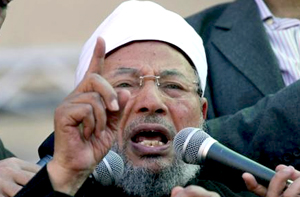
UAE summons Qatar envoy over Al Qaradawi

February 3, 2014

UAE_summons_QatarDubai, Feb 3: The UAE Foreign Ministry on Sunday said it had summoned Fares Al Nuaimi, Qatar’s ambassador to the UAE, to protest its inaction on stopping a cleric from continuing to insult the UAE.

Dr Anwar Mohammad Gargash, Minister of State for Foreign Affairs, expressed the UAE Government’s “extreme resentment” over Yousuf Al Qaradawi’s statement against the UAE that was aired on Qatari state TV, WAM reported.

“We have held back so that our neighbour can clearly reject such insult, extend sufficient clarifications and guarantee that such provocation and defamation will not recur.

"While the UAE fully respects the freedom of speech, it condemns any talk that incites hatred and violence. Unfortunately, calmness and restraint did not draw the right response from our brothers in Qatar,” Gargash said.

The Egyptian-born Al Qaradawi, speaking live on Qatari state TV from a Doha mosque, criticised the UAE for supporting the current Egyptian government. He claimed that the UAE “has always been opposed to Islamic rule”.

He was talking about the developments in Egypt that followed the ouster of former president Mohammad Mursi last July by a popular uprising.

Al Qaradawi said the new Egyptian administration was “ruling against Allah’s will” and that Mursi must be reinstated to realise a government by Islamic rule.

Gargash condemned the comments and wrote on his official twitter account it was “shameful that we allow Al Qaradawi to continue his insults of the UAE and ties [that bind] the peoples of the Arabian Gulf.”

Gargash said: “We endeavoured to contain the issue out of our interest in relations between the two sisterly countries and to abort discord and sedition instigated by that cleric in his campaign against the UAE. But, we wee forced to take this unprecedented step in our Gulf relationship, given our brothers in Qatar did not reject that their media and religious outlets be used to attack neighbours and sisterly countries.”

Gargash stressed it was unacceptable by all means that dignity of the UAE, its leaders and people as well as its time-honoured values be harmed under any execuses.

Condemning Egypt’s recent blasts, the UAE called for action to counter terror.

Shaikh Abdullah Bin Zayed, Foreign Minister, expressed the UAE solidarity with the government of Egypt. He also renewed UAE’s stance on standing by Egypt in fighting extremism and terrorism.

Shaikh Abdullah urged the countries that oppose terrorism to stand by the Egyptian government “in the face of this terrorist organisation and what it stands and calls for”.

“The terrorist organisation’s continued acts of terror and killing in Egypt require a swift action by all to eliminate these criminal acts which are carried out under the guise of Islam and which are rejected by Islam and Muslims.”

Qatar’s foreign minister has said that Al Qaradawi do not reflect Qatar’s foreign policy.

In an interview to Qatar Television on Friday evening, Khalid Bin Mohammad Al Atiyyah said: “The foreign policy of Qatar is expressed and conveyed only through the official channels of the state. Qatar’s policy is not expressed or conveyed by the media or platforms here and there. What was said by Shaikh Yousuf Al Qaradawi does not reflect the foreign policy of the state of Qatar. We do have full love and respect for our brothers in the UAE. Relations between Qatar and the UAE are strategic and the security of the UAE is at the same time the security of Qatar.”

His statement came days after the UAE called upon Qatar to stop Al Qaradawi from continuing to insult the UAE.

Dr Abdul Khaleq Abdullah, a leading political analyst, said the UAE’s unprecedented move showed its extreme dissatisfaction with Doha over its failure to rein in Al Qaradawi.

“It seems that Qatar was more interested in Al Qaradawi than its relations with the UAE, which hit back prompted by its self-confidence and pride,” Dr Abdullah said, citing similar firm stands in the case of Canada and Turkey.

Comments

Add new comment

  • Coastaldigest.com reserves the right to delete or block any comments.
  • Coastaldigset.com is not responsible for its readers’ comments.
  • Comments that are abusive, incendiary or irrelevant are strictly prohibited.
  • Please use a genuine email ID and provide your name to avoid reject.
News Network
April 5,2020

Beirut, Apr 5: The novel coronavirus has put global trade on hold, placed half of the world population in confinement and has the potential to topple governments and reshape diplomatic relations.

The United Nations has appealed for ceasefires in all the major conflicts rocking the planet, with its chief Antonio Guterres on Friday warning "the worst is yet to come". But it remains unclear what the pandemic's impact will be on the multiple wars roiling the Middle East.

Here is an overview of the impact so far on the conflicts in Syria, Yemen, Libya and Iraq:

The COVID-19 outbreak turned into a pandemic just as a ceasefire reached by the two main foreign power brokers in Syria's nine-year-old war -- Russia and Turkey -- was taking effect.

The three million people living in the ceasefire zone, in the country's northwestern region of Idlib, had little hope the deal would hold.

Yet fears the coronavirus could spread like wildfire across the devastated country appear to have given the truce an extended lease of life.

According to the Syrian Observatory for Human Rights, the month of March saw the lowest civilian death toll since the conflict started in 2011, with 103 deaths.

The ability of the multiple administrations in Syria -- the Damascus government, the autonomous Kurdish administration in the northeast and the jihadist-led alliance that runs Idlib -- to manage the coronavirus threat is key to their credibility.

"This epidemic is a way for Damascus to show that the Syrian state is efficient and all territories should be returned under its governance," analyst Fabrice Balanche said.

However the pandemic and the global mobilisation it requires could precipitate the departure of US-led troops from Syria and neighbouring Iraq.

This in turn could create a vacuum in which the Islamic State jihadist group, still reeling from the demise of its "caliphate" a year ago, could seek to step up its attacks.

The Yemeni government and the Huthi rebels initially responded positively to the UN appeal for a ceasefire, as did neighbouring Saudi Arabia, which leads a military coalition in support of the government.

That rare glimmer of hope in the five-year-old conflict was short-lived however and last week Saudi air defences intercepted ballistic missiles over Riyadh and a border city fired by the Iran-backed rebels.

The Saudi-led coalition retaliated by striking Huthi targets in the rebel-held capital Sanaa on Monday.

Talks have repeatedly faltered but the UN envoy Martin Griffiths is holding daily consultations in a bid to clinch a nationwide ceasefire.

More flare-ups in Yemen could compound a humanitarian crisis often described as the worst in the world and invite a coronavirus outbreak of catastrophic proportions.

In a country where the health infrastructure has collapsed, where water is a rare commodity and where 24 million people require humanitarian assistance, the population fears being wiped out if a ceasefire doesn't allow for adequate aid.

"People will end up dying on the streets, bodies will be rotting in the open," said Mohammed Omar, a taxi driver in the Red Sea port city of Hodeida.

Much like Yemen, the main protagonists in the Libyan conflict initially welcomed the UN ceasefire call but swiftly resumed hostilities.

Fierce fighting has rocked the south of the capital Tripoli in recent days, suggesting the risk of a major coronavirus outbreak is not enough to make guns fall silent.

Turkey has recently played a key role in the conflict, throwing its weight behind the UN-recognised Government of National Accord.

Fabrice Balanche predicted that accelerated Western disengagement from Middle East conflicts could limit Turkish support to the GNA.

That could eventually favour forces loyal to eastern-based strongman Khalifa Haftar, who launched an assault on Tripoli one year ago and has the backing of Russia, Egypt and the United Arab Emirates.

Western countries have been hit hardest by the pandemic, which could prompt them to divert both military resources and peace-brokering capacity from foreign conflicts.

A report by the International Crisis Group said European officials had reported that efforts to secure a ceasefire in Libya were no longer receiving high-level attention due to the pandemic.

Iraq is no longer gripped by fully-fledged conflict but it remains vulnerable to an IS resurgence in some regions and its two main foreign backers are at each other's throats.

Iran and the United States are two of the countries most affected by the coronavirus but there has been no sign of any let-up in their battle for influence that has largely played out on Iraqi soil.

With most non-US troops in the coalition now gone and some bases evacuated, American personnel are now regrouped in a handful of locations in Iraq.

Washington has deployed Patriot air defence missiles, prompting fears of a fresh escalation with Tehran, whose proxies it blames for a spate of rocket attacks on bases housing US troops.

Comments

Add new comment

  • Coastaldigest.com reserves the right to delete or block any comments.
  • Coastaldigset.com is not responsible for its readers’ comments.
  • Comments that are abusive, incendiary or irrelevant are strictly prohibited.
  • Please use a genuine email ID and provide your name to avoid reject.
News Network
April 16,2020

Dubai, Apr 16: Most of the patients who have fully recovered from Covid-19 in the UAE followed healthy behaviours that helped strengthen their immune systems, said Dr Farida Al Hosani, Official Spokesperson for the UAE Health Sector.

Dr Al Hosani made the remarks during the UAE Government's regular briefing on the latest developments related to the spread of coronavirus in the country, which was held on Wednesday in Abu Dhabi.

During the briefing, Dr Al Hosani spoke about the precautionary measures that aimed to prevent the spread of the virus.

Ammar Al Muaini, Official Spokesperson of the National Programme for Happiness and Quality of Life, also explained the outcomes of the National Mental Health Programme.

During the briefing, Dr Al Hosani affirmed that recorded cases in the country, especially recoveries, were related to key factors and reasons.

"In most cases of recoveries, we noticed that they have followed several daily health behaviours, such as doing exercise, eating a healthy diet, strengthening the immune system, and maintaining an ideal weight, as well as abstaining from bad habits, such as smoking and unhealthy eating. The psychological aspect is also important, and it is necessary to support the mental health of individuals, along with their physical health," she said.

"These practices, which we always emphasise and promote, will help raise a person's immunity and resistance to diseases, in addition to medicines, and can speed up the process of recovering from disease," she added.

Dr Al Hosani also talked about the importance of not being complacent if one's temperature rises. "We highlight the importance of periodic temperature checks for family members at home. This step is one of the health measures that we are encouraging.

"Everyone who has a high temperature must contact the nearest health centre or hospital or go to a drive-through testing centre because personal health is linked to the health of those around us and we are responsible for it. There is no room for hesitation in protecting our families," she stressed.

Dr Al Hosani highlighted the importance of covering the nose and mouth, whether by wearing surgical, paper or cloth masks, or any other covering or clothing.

"This procedure is important for everyone leaving home to avoiding the transmission of any infection and preserving the safety of everyone, along with leaving a safe physical distance between people in public places, markets and workplaces, and following the precautions," she explained.

Regarding high temperatures and their relationship to the coronavirus, Dr. Al Hosani said: "All studies that attempt to understand the relationship between the virus and climate have not been able to confirm that higher temperatures will help kill the virus. We are continuing to monitor the results of these studies."

Al Muaini explained the details and developments of the national campaign, titled, 'Don't Worry,' which aims to support the mental health of community members.

"The UAE Government, represented by the National Programme for Happiness and Quality of Life, has launched, under the current circumstances, the national campaign, titled, 'Don't Worry,' that aims to provide psychological support to members of society facing the repercussions of the novel coronavirus, in line with relevant national efforts," Al Muaini said.

"The campaign reflects the directives of His Highness Sheikh Mohammed bin Rashid Al Maktoum, Vice President and Prime Minister of the UAE and Ruler of Dubai, and His Highness Sheikh Mohamed bin Zayed Al Nahyan, Crown Prince of Abu Dhabi and Deputy Supreme Commander of the UAE Armed Forces, affirming that quality of life is a high priority, and health is the most important pillar of quality of human and society," Al Muaini added.

Al Muaini stated that the phrase, 'Don't Worry,' is profound in its meaning, according to His Highness Sheikh Mohamed bin Zayed, and reassures everyone that everything will be fine. "Today, the concept of health is not limited to physical health, but it also includes mental health. During this period, and due to the social, professional, and educational changes that directly affect our lives, we need to support and enhance our mental health to overcome these challenges," he  added.

Al Muaini said that over 50 specialists, psychologists and social workers are voluntarily participating in the national campaign to serve the country, which includes three main components focusing on providing psychological support to all members of society, especially as this type of support is one of the necessary community needs during the current circumstances.

The first component, 'Let's Support Together,' aims to answer enquiries regarding psychological challenges, provide educational advice, and support individuals in facing challenges, through daily live broadcasts on the social media networks of the National Programme for Happiness and Quality of Life, @HappyUAE. Two events are broadcast every day, with the first being at 17:30 in English and the second at 20:30 in Arabic to benefit all segments of society.

Al Muaini explained that the number of live broadcasts on the programme's social media accounts has reached 30 and covers various topics, including psychological care for senior citizens, psychological care for children, psychological support for working mothers, and how to address anxiety and psychological concerns.

According to scientific studies, fear and anxiety are among the strongest influences that weaken human immunity, and, therefore, it is necessary to learn about how to deal with them. The duration of each broadcast is one hour, attracting some 250,000 views each.

Al Muaini explained that the second component of the campaign is the hosting of closed virtual sessions, entitled, 'Let's Talk Together,' which aim to provide psychosocial support to specific groups of society, to enable them to talk to each other in a safe environment to discuss the psychological challenges they are facing.

The programme has organised over eight closed psychological support sessions to maintain the privacy of participants, under the supervision of certified physicians and psychologists. Some 300 people have participated and some sessions were held for those under quarantine, including working mothers, school and university students, and doctors working in the first line of defence.

Some 300,000 people watched "Let's Reassure Each Other" programme Al Muaini noted that the third component of the campaign, titled, "Let's Reassure Each Other," focuses on raising awareness of the importance of psychological resilience and promoting its importance to society. The programme has so far posted more than 21 video clips containing messages of support and reassurance to the community.

The number of people who watched the programme reached some 300,000 viewers.

Al Muaini stressed that the campaign is an effective interactive platform available on a daily basis, to provide psychological support to all segments of society at a time when people require reassurance and psychological support to overcome the current crisis. The campaign hosted doctors working in the first line of defence and their enquiries were answered directly. A group of people under quarantine was also involved in the closed support sessions, which were also popular with participating doctors.

Comments

Add new comment

  • Coastaldigest.com reserves the right to delete or block any comments.
  • Coastaldigset.com is not responsible for its readers’ comments.
  • Comments that are abusive, incendiary or irrelevant are strictly prohibited.
  • Please use a genuine email ID and provide your name to avoid reject.
News Network
April 23,2020

Riyadh, Apr 22: In an extraordinary initiative, the government of the Kingdom of Saudi Arabia has decided to facilitate the travel of expatriates who have an exit and reentry visa or final exit visa to return to their countries.

This is in line with the order of Custodian of the Two Holy Mosques King Salman, according to the Saudi Press Agency.

According to the initiative, called “Auda” (return), expatriates can apply seeking permission for travel to their countries through the Absher portal of the ministry.

Announcing this, Saudi's Ministry of Interior said that the initiative will be implemented in cooperation with a number of relevant government agencies.

Requests for travel from expatriates will be received and approved in coordination with the relevant authorities to complete their travel procedures on board international flights.

As per the initiative, a text message will be sent to the beneficiary stating the travel date, ticket number and reservation details, and by which the beneficiary can obtain his travel ticket and complete the travel procedures.

Clarifying the procedures for the travel, the ministry said that the applicant shall select the icon (Auda) after visiting the Absher portal and fill the following fields: iqama (residency permit) number, date of birth, mobile number, departure city and airport of arrival.

It is not mandatory for the expatriate to have his own Absher account for availing of the service, the ministry said, adding that this facility is to enable expatriates to benefit from this initiative.

The departure will be through the following airports: King Khalid International Airport in Riyadh, King Abdulaziz International Airport in Jeddah, Prince Muhammad International Airport in Madinah, and King Fahd International Airport in Dammam.

Those expatriates who are outside these cities can benefit from the service through entering airport of departure after completion of their travel procedures in sufficient period of time.

Comments

Add new comment

  • Coastaldigest.com reserves the right to delete or block any comments.
  • Coastaldigset.com is not responsible for its readers’ comments.
  • Comments that are abusive, incendiary or irrelevant are strictly prohibited.
  • Please use a genuine email ID and provide your name to avoid reject.