



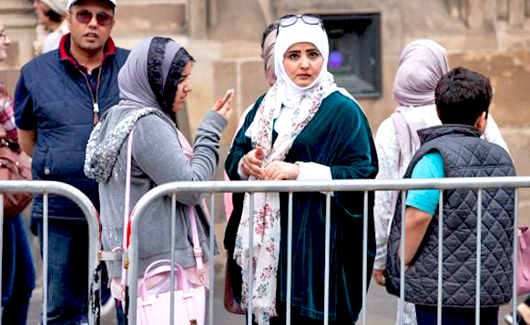
UK Muslims face worst job discrimination of any minority group, according to research

November 30, 2014

UK Muslims

London, Nov 30: Muslims are facing the worst job discrimination of any minority group in Britain, according to new research which found that they had the lowest chance of being in work or in a managerial role.

Muslim men were up to 76 per cent less likely to have a job of any kind compared to white, male British Christians of the same age and with the same qualifications. And Muslim women were up to 65 per cent less likely to be employed than white Christian counterparts.

Muslims were the most disadvantaged in terms of employment prospects out of 14 ethno-religious groupings in the UK, researchers Dr Nabil Khattab and Professor Ron Johnston found using data from the Office for National Statistics' Labour Force Survey of more than half a million people. Skin colour made little difference to the figures.

Nabil Khattab, of Bristol University, said the situation was "likely to stem from placing Muslims collectively at the lowest stratum within the country's racial or ethno-cultural system due to growing Islamophobia and hostility against them.

"They are perceived as disloyal and as a threat rather than just as a disadvantaged minority," he added. "Within this climate, many employers will be discouraged from employing qualified Muslims, especially if there are others from their own groups or others from less threatening groups who can fill these jobs."

Khattab said the "penalties" for being Muslim got worse when applying for better-paid managerial or professional jobs.

"If this persists, it could have long-term implications for the cohesion of the UK's multi-ethnic, multicultural society. The exclusion of well-qualified black and Muslim individuals could undermine their willingness to integrate in the wider society," he said.

For women, Muslim Pakistanis and a "Muslim other" group were 65 per cent less likely to have a job, with Muslim Indians 55 per cent, Muslim Bangladeshis 51 per cent and white Muslims 43 per cent less likely. For men, the "Muslim other" group was 76 per cent less likely to be in work, followed by Muslim

Bangladeshis (66 per cent), white Muslims (64 per cent), Muslim Pakistanis (59 per cent) and Muslim Indians (37 per cent), the Social Science Journal study found.

White British men and women of no religion were, respectively, 20 and 25 per cent less likely to have a job than Christians. Black Christians with Caribbean origins were 54 per cent and 48 per cent less likely.

The only ethno-religious group with better work prospects than white British Christians were British Jews, with women and men 29 and 15 per cent more likely to be employed.

Of those in work, the researchers found only 23 per cent and 27 per cent of Muslim Bangladeshis and Muslim Pakistanis, respectively, had a salaried job. White British Jews had the highest rates, with 64 per cent in salaried jobs, followed by Hindu Indians and white Christian Irish on 53 and 51 per cent respectively. White British Christians, white British of no religion and black Christian Africans were all above 40 per cent.

Khattab added: "The main components of this discrimination are skin colour and culture or religion. But colour is dynamic, which means white colour can be valued in one case, but devalued when associated with Muslims. Equally, having a dark skin colour - Hindu Indians, for example - is not always associated with any significant penalty."

Comments

Add new comment

  • Coastaldigest.com reserves the right to delete or block any comments.
  • Coastaldigset.com is not responsible for its readers’ comments.
  • Comments that are abusive, incendiary or irrelevant are strictly prohibited.
  • Please use a genuine email ID and provide your name to avoid reject.
News Network
May 20,2020

London, May 20: The current physical distancing guidelines of 6 feet may be insufficient to prevent COVID-19 transmission, according to a study which says a mild cough in low wind speeds can propel saliva droplets by as much as 18 feet.

Researchers, including those from the University of Nicosia in Cyprus, said a good baseline for studying the airborne transmission of viruses, like the one behind the COVID-19 pandemic, is a deeper understanding of how particles travel through the air when people cough.

In the study, published in the journal Physics of Fluids, they said even with a slight breeze of about four kilometres per hour (kph), saliva travels 18 feet in 5 seconds.

"The droplet cloud will affect both adults and children of different heights," said study co-author Dimitris Drikakis from the University of Nicosia.

According to the scientists, shorter adults and children could be at higher risk if they are located within the trajectory of the saliva droplets.

They said saliva is a complex fluid, which travels suspended in a bulk of surrounding air released by a cough, adding that many factors affect how saliva droplets travel in the air.

These factors, the study noted, include the size and number of droplets, how they interact with one another and the surrounding air as they disperse and evaporate, how heat and mass are transferred, and the humidity and temperature of the surrounding air.

In the study, the scientists created a computer simulation to examine the state of every saliva droplet moving through the air in front of a coughing person.

The model considered the effects of humidity, dispersion force, interactions of molecules of saliva and air, and how the droplets change from liquid to vapour and evaporate, along with a grid representing the space in front of a coughing person.

Each grid, the scientists said, holds information about variables like pressure, fluid velocity, temperature, droplet mass, and droplet position.

The study analysed the fates of nearly 1,008 simulated saliva droplets, and solved as many as 3.7 million equations.

"The purpose of the mathematical modelling and simulation is to take into account all the real coupling or interaction mechanisms that may take place between the main bulk fluid flow and the saliva droplets, and between the saliva droplets themselves," explained Talib Dbouk, another co-author of the study.

However, the researchers added that further studies are needed to determine the effect of ground surface temperature on the behaviour of saliva in air.

They also believe that indoor environments, especially ones with air conditioning, may significantly affect the particle movement through air.

This work is important since it concerns safety distance guidelines, and advances the understanding of the transmission of airborne diseases, Drikakis said.

Comments

Add new comment

  • Coastaldigest.com reserves the right to delete or block any comments.
  • Coastaldigset.com is not responsible for its readers’ comments.
  • Comments that are abusive, incendiary or irrelevant are strictly prohibited.
  • Please use a genuine email ID and provide your name to avoid reject.
Agencies
February 18,2020

British lawmaker Debbie Abrahams' e-Business visa was revoked as she was involved in anti-India activities and the cancellation was conveyed to her on February 14, government sources said on Tuesday.

Asserting that the grant, rejection or revocation of a visa or electronic travel authorisation is the sovereign right of a country, the sources said Abrahams was issued an e-Business visa on October 7 last year which was valid till October 5, 2020 for attending business meetings.

"Her e-Business visa was revoked on February 14, 2020 on account of her indulging in activities which went against India's national interest. The rejection of the e-Business visa was intimated to her on February 14," a source said.

Abrahams, who chairs a British parliamentary group on Kashmir, was denied entry into India upon her arrival at the New Delhi airport on Monday.

Government officials had said on Monday also that she was informed in advance that her e-visa had been cancelled.

Comments

Add new comment

  • Coastaldigest.com reserves the right to delete or block any comments.
  • Coastaldigset.com is not responsible for its readers’ comments.
  • Comments that are abusive, incendiary or irrelevant are strictly prohibited.
  • Please use a genuine email ID and provide your name to avoid reject.
News Network
June 13,2020

Mexico City, Jun 13: The number of people, who have died of COVID-19 in Mexico, has risen by 544 to 16,448 within the past 24 hours, Jose Luis Alomia, the director of epidemiology at the Health Ministry, said.

He also said on late Friday that the number of confirmed coronavirus cases had increased by 5,222 to 139,196 within the same period of time.

A day earlier, the Latin American nation has recorded 4,790 new confirmed cases of the coronavirus, with 587 fatalities.

The World Health Organization declared the COVID-19 outbreak a pandemic on March 11. To date, more than 7.6 million people have been infected with the coronavirus worldwide, with over 425,000 fatalities, according to Johns Hopkins University.

Comments

Add new comment

  • Coastaldigest.com reserves the right to delete or block any comments.
  • Coastaldigset.com is not responsible for its readers’ comments.
  • Comments that are abusive, incendiary or irrelevant are strictly prohibited.
  • Please use a genuine email ID and provide your name to avoid reject.