


UK Parliament Attack: 5 Dead, Nearly 40 Injured in 'Strike At The Heart' Of London

March 23, 2017

London, Mar 23: An assailant fatally stabbed a police officer at the gates to Britain's Parliament compound Wednesday after plowing a vehicle through terrified pedestrians along a landmark bridge. The attacker was shot and killed by police, but not before claiming a total of four lives in what appeared to be Europe's latest high-profile terrorist attack.
london

In a late night statement, the London Metropolitan police said that they believed they knew who the attacker was, but did not provide a name. They also said that their "working assumption" is that he was "inspired by international terrorism."

Police said the man traced a deadly path across the Westminster Bridge, running down people with an SUV, then ramming the vehicle into the fence encircling Parliament. At least 40 people were reported injured.

Finally, the attacker charged with a knife at officers stationed at the iron gates leading to the Parliament grounds, authorities said. The police named the fallen officer as Keith Palmer and said that he was unarmed.

The dead and injured were left scattered on some of London's most famous streets.

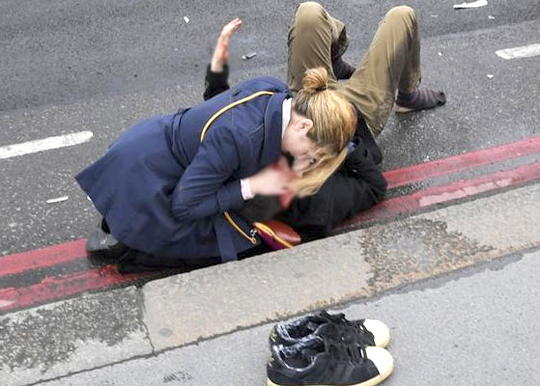
Crumpled bodies lay on the Westminster Bridge over the River Thames, including at least two people killed. Outside Parliament, a Foreign Office minister - covered in the blood of the stabbed police officer - tried in vain to save his life.

"The location of this attack was no accident," said British Prime Minister Theresa May on Wednesday evening, after chairing COBRA, the government's emergency committee. "The terrorist chose to strike at the heart of our capital city, where people of all nationalities, religions and cultures come together to celebrate the values of liberty, democracy and freedom of speech."

But she said that "any attempt to defeat those values through violence and terror is doomed to failure. Tomorrow morning, Parliament will meet as normal," she said.

The scene at Parliament earlier in the day was one of confusion while the Parliament chambers and offices were put on full lockdown for more than two hours.

"This is a day that we planned for but hoped would never happen. Sadly, it has now become a reality," said the assistant Metropolitan Police commissioner, Mark Rowley, outside Scotland Yard's headquarters.

As he spoke, the bells of Big Ben tolled six times to mark the hour.

Even before full details emerged, the apparent attacks and chaos were certain to raise security levels in London and other Western capitals and bring further scrutiny on counterterrorism measures.

"We are treating this as a terrorist incident until we know otherwise," said a Twitter message from London Metropolitan Police.

The attack occurred on Parliament's busiest day of the week, when the prime minister appears for her weekly questions session and the House of Commons is packed with visitors.

The Palace of Westminster, the ancient seat of the British Parliament, is surrounded by heavy security, with high walls, armed officers and metal detectors. But just outside the compound are busy roads packed with cars and pedestrians.

The attack - a low-tech, high-profile assault on the most potent symbol of British democracy - fits the profile of earlier strikes in major European capitals that have raised threat levels across the continent in recent years.

It was apparently carried out by a lone assailant who used easily available weapons to attack and kill victims in a busy, public setting.

British security officials have taken pride in their record of disrupting such attacks even as assailants in continental Europe have slipped through. But they have also acknowledged that their track record would not stay pristine, and that an attack was inevitable.

When it happened, it was shocking nonetheless. Cellphones captured scenes of carnage amid some of London's most renowned landmarks.

The target - Westminster - was heavily guarded. But the weapons of choice - an SUV and a knife - made the attack one of the most difficult kinds to prevent, requiring the assailant neither to acquire illegal weapons nor to plot with other conspirators.

Rowley said investigators believe that just one assailant carried out the attack, but he encouraged the public to remain vigilant.

Britain has been on high alert for terrorist attacks for several years. But until Wednesday, the country had been spared the sort of mass-casualty attacks that have afflicted France, Belgium and Germany since 2015.

Among those providing emergency aid was Tobias Ellwood, a senior official at the Foreign Office and a British military veteran. Photos showed Ellwood's face streaked with blood after attempting to revive a police officer who had been stabbed just inside the gates of the parliamentary compound.

French Prime Minister Bernard Cazeneuve said that among those wounded in the vehicle attack were members of a group of French students. News media in France reported that three of the students, on a school trip from a high school in Brittany, were in serious condition and that their parents were being flown to London immediately.

In Washington, White House press secretary Sean Spicer said President Trump has been briefed on the London attack and spoke by phone with Prime Minister May.

"We condemn today's attack in Westminster," Spicer told reporters. He pledged "the full support of the U.S. government in responding to the attack and bringing to justice those who are responsible."

Raffaello Pantucci, director of international security studies at the Royal United Services Institute think tank, said the rapid response suggested that police "were expecting that an attack was highly likely for some time."

Images from the bridge showed a man dressed in a suit lying on his back, his legs splayed to either side, as pedestrians huddled around him administering first aid. The shoe was off his right foot, and blood stained the sidewalk beneath his left.

In another image, a woman with long blond hair and running shoes lay in a pool of blood on the bridge's sidewalk. Blood stained the corner of her mouth as another pedestrian cradled her head.

Other photos showed people sitting on the sidewalk looking dazed amid broken glass and bits of automotive debris, with Big Ben looming beyond.

A spokesman for the Port of London Authority said a woman was pulled alive from the River Thames, and he confirmed reports that she had serious injuries.

As police investigated, much of the activity in the area around Westminster came to a standstill.

A nearby hospital was put on lockdown and the London Eye - the enormous Ferris wheel above the River Thames - was stopped and visitors were slowly let off hours later. Those who were locked inside the Eye's capsules at the time of the attack were kept there, hovering above as emergency responders swarmed the scene below.

A witness, Kirsten Hurrell, 70, said she first heard the crash of a car hitting the fence outside parliament before hearing noises that could have been gunshots.

"There was a lot of steam from the car," Hurrell told the Guardian newspaper. "I thought it might explode."

The U.S. Department of Homeland Security said it was in "close contact with our British counterparts to monitor the tragic events and to support the ongoing investigation." It noted that U.S. security threat levels remained unchanged.

A year ago to the day, attackers carried out three coordinated suicide bombings in Belgium, killing 32 civilians and injuring more than 300 others in two blasts at Brussels Airport and one at a metro station in the Belgian capital. The Islamic State claimed responsibility for the attacks, in which three perpetrators were also killed.

As the aftermath of the attack unfolded in London, the Welsh Assembly and the Scottish Parliament both suspended their sessions. Scottish lawmakers had been due to debate legislation authorizing a new referendum on independence.

Specialists said the London attack Wednesday appeared to be in line with an emerging model of strikes involving simple, everyday instruments but carried out in locations sure to draw global attention.

"Terrorists rely on a lot of people watching - it can be even better than having a lot of people dead," said Frank Foley, a scholar of terrorism and counterterrorism at the Department of War Studies at King's College London.

Within a few hours of the attack, there were signs that normalcy was returning to London.

At the London Eye near the Westminster Bridge, a large crowd of tourists gathered by the ferris wheel.

Charles Thompson, a 21-year-old chef from Canada, wondered if there would be more attacks. "Usually its a chain-reaction thing," he said.

His friend, Enrique Cooper, a 32-year-old officer manager originally from Italy, said he would not let the day's violence change his view of London. "I'm here all the time," he said. "You can't let something like this ruin your perspective."

Comments

Add new comment

  • Coastaldigest.com reserves the right to delete or block any comments.
  • Coastaldigset.com is not responsible for its readers’ comments.
  • Comments that are abusive, incendiary or irrelevant are strictly prohibited.
  • Please use a genuine email ID and provide your name to avoid reject.
Agencies
May 8,2020

United Nations, May 8: UN Secretary-General Antonio Guterres said Friday the coronavirus pandemic keeps unleashing a tsunami of hate and xenophobia, scapegoating and scare-mongering. 

The UN chief said anti-foreigner sentiment has surged online and in the streets, anti-Semitic conspiracy theories have spread, and COVID-19-related anti-Muslim attacks have occurred. 

Guterres said migrants and refugees have been vilified as a source of the virus -- and then denied access to medical treatment. 

With older persons among the most vulnerable, contemptible memes have emerged suggesting they are also the most expendable, he said. 

And journalists, whistleblowers, health professionals, aid workers and human rights defenders are being targeted simply for doing their jobs. 

Guterres appealed for an all-out effort to end hate speech globally. The secretary-general called on political leaders to show solidarity with all people, on educational institutions to focus on digital literacy at a time when extremists are seeking to prey on captive and potentially despairing audiences. 

He called on the media, especially social media, to remove racist, misogynist and other harmful content, on civil society to strengthen their outreach to vulnerable people, and on religious figures to serve as models of mutual respect. 

And I ask everyone, everywhere, to stand up against hate, treat each other with dignity and take every opportunity to spread kindness, Guterres said.

The secretary-general stressed that COVID-19 does not care who we are, where we live, what we believe or about any other distinction. His global appeal to address and counter COVID-19-related hate speech follows his April 23 message calling the coronarivus pandemic a human crisis that is fast becoming a human rights crisis. 

Guterres said then that the pandemic has seen disproportionate effects on certain communities, the rise of hate speech, the targeting of vulnerable groups, and the risks of heavy-handed security responses undermining the health response. 

With rising ethno-nationalism, populism, authoritarianism and a push back against human rights in some countries, the crisis can provide a pretext to adopt repressive measures for purposes unrelated to the pandemic, he warned.

In February, Guterres issued a call to action to countries, businesses and people to help renew and revive human rights across the globe, laying out a seven-point plan amid concerns about climate change, conflict and repression.

Comments

Add new comment

  • Coastaldigest.com reserves the right to delete or block any comments.
  • Coastaldigset.com is not responsible for its readers’ comments.
  • Comments that are abusive, incendiary or irrelevant are strictly prohibited.
  • Please use a genuine email ID and provide your name to avoid reject.
Agencies
February 4,2020

As the deadly coronavirus has spread worldwide, it has carried with it xenophobia -- and Asian communities around the world are finding themselves subject to suspicion and fear.

When a patient on Australia's Gold Coast refused to shake the hand of her surgeon Rhea Liang, citing the virus that has killed hundreds, the medic's first response was shock.

But after tweeting about the incident and receiving a flood of responses, the respected doctor learned her experience was all too common.

There has been a spike in reports of anti-Chinese rhetoric directed at people of Asian origin, regardless of whether they have ever visited the centre of the epidemic or been in contact with the virus.

Chinese tourists have reportedly been spat at in the Italian city of Venice, a family in Turin was accused of carrying the disease, and mothers in Milan have used social media to call for children to be kept away from Chinese classmates.

In Canada, a white man was filmed telling a Chinese-Canadian woman "you dropped your coronavirus" in the parking lot of a local mall.

In Malaysia, a petition to "bar Chinese people from entering our beloved country" received almost 500,000 signatures in one week.

The incidents are part of what the Australasian College for Emergency Medicine has described as "misinformation" which it says is fuelling "racial profiling" where "deeply distressing assumptions are being made about 'Chinese' or 'Asian-looking' people." Disease has long been accompanied by suspicions of foreigners -- from Irish immigrants being targeted in the Typhoid Mary panic of 1900s America to Nepali peacekeepers being accused of bringing cholera to earthquake-struck Haiti in the last decade.

"It's a common phenomenon," said Rob Grenfell, director of health and biosecurity for Australia's science and research agency CSIRO.

"With outbreaks and epidemics along human history, we've always tried to vilify certain subsets of the population," he said, comparing the behaviour to 1300s plague-ridden medieval Europe, where foreigners and religious groups were often blamed.

"Sure it emerged in China," he said of the coronavirus, "but that's no reason to actually vilify Chinese people." In a commentary for the British Medical Journal, doctor Abraar Karan warned this behaviour could discourage people with symptoms from coming forward.

Claire Hooker, a health lecturer at the University of Sydney, said the responses from governments may have compounded prejudice.

The World Health Organisation has warned against "measures that unnecessarily interfere with international travel and trade", but this has not stopped scores of countries from introducing travel bans.

The tiny Pacific nation of Micronesia has banned its citizens from visiting mainland China altogether.

"Travel bans respond largely to people's fears," said Hooker, and while sometimes warranted, they often "have the effect of cementing an association between Chinese people and scary viruses".

Abbey Shi, a Shanghai-born student in Sydney, said the attitude shown by some of her peers has "become almost an attack on students who are Chinese".

While Australia's conservative government has banished its citizens returning from Wuhan -- the central Chinese city at the epicentre of the virus -- to a remote island for quarantine, thousands of students still stuck in China risk their studies being torpedoed.

"Right now it looks like they have to miss the semester's start and potentially the whole year, because of the way the courses are set up," Shi said.

According to Hooker, studies in Toronto on the impact of Severe Acute Respiratory Syndrome, or SARS -- another global coronavirus outbreak in 2002 -- showed the impact of xenophobic sentiment often lasted much longer than the public health scare.

"While there may be a cessation of direct forms of racism as news about the disease dies down, it takes quite a bit of time for economic recovery and people continue to feel unsafe," she said.

People may not rush back to Chinese businesses or restaurants, and may even heed some of the more outlandish viral social media disinformation -- such as one popular post imploring people to avoid eating noodles for their own safety.

"In one sense you might think the effects lasted from the last coronavirus to this one because the representation as China being a place where diseases come from has been persistent," Hooker said.

Comments

Add new comment

  • Coastaldigest.com reserves the right to delete or block any comments.
  • Coastaldigset.com is not responsible for its readers’ comments.
  • Comments that are abusive, incendiary or irrelevant are strictly prohibited.
  • Please use a genuine email ID and provide your name to avoid reject.
June 25,2020

Islamabad, Jun 25: The coronavirus cases in Pakistan crossed the 192,000-mark after 4,044 new Covid-19 infections were detected in the last 24 hours, the health ministry said on Thursday.

According to the Ministry of National Health Services, 148 more people died due to the deadly virus in the country, taking the death toll to 3,903.

With the detection of 4,044 new cases in the last 24 hours, the coronavirus tally in the country now stands at 192,970, it said.

Sindh reported a maximum number of 74,070 infections, followed by 71,191 in Punjab, 23,887 in Khyber-Pakhtunkhwa, 11,710 in Islamabad, 9,817 in Balochistan, 1,365 in Gilgit-Baltistan and 930 in Pakistan-occupied Kashmir.

A total of 81,307 patients have recovered so far from the disease.

Health authorities have so far conducted 1,171,976 coronavirus tests, including 21,835 in the last 24 hours.

Comments

Add new comment

  • Coastaldigest.com reserves the right to delete or block any comments.
  • Coastaldigset.com is not responsible for its readers’ comments.
  • Comments that are abusive, incendiary or irrelevant are strictly prohibited.
  • Please use a genuine email ID and provide your name to avoid reject.