



UK unveils Brexit plan, keen on stronger trade ties with India

February 3, 2017

London, Feb 3: The UK government on Thursday unveiled a policy document on its negotiating plans for quitting the 28-nation European Union under a mutually beneficial deal which cites India as among the key countries on its target list for stronger trade ties post-Brexit.
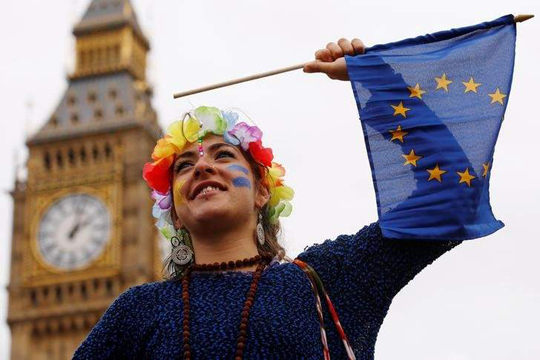
brexit

"We approach the negotiation to come in a spirit of good will and working to an outcome in our mutual benefit," David Davis, minister for exiting the European Union (EU), told the House of Commons, adding that Britain's "best days are yet to come".

"I will not be throwing people out of Britain," he added, in reference to a question about the rights of EU citizens based in the UK following Brexit.

Davis said the government will publish another White Paper before the Great Repeal Bill, which will formally mark Britain's intention to break from the laws governing the EU after the June 2016 referendum in favour of Brexit.

"We have started discussions on future trade ties with countries like Australia, New Zealand and India," the UK government wrote in its White Paper.

"This department will lead the UK's ambitions for deepening trade and investment relations with the wider world. Many countries including China, Brazil, and the Gulf States have already expressed their interest in enhancing their trading relationships with us," it said.

Around 3 million EU citizens are waiting to find out if they can remain in the UK, along with up to two million British citizens in other EU member states, following last June's EU referendum.

The White Paper effectively spells out in detail British Prime Minister Theresa May's 12 "principles" including migration control and "taking control of our own laws" unveiled in a major speech last month.

It confirms that the final Brexit deal will be presented before Parliament for ratification and that the UK would pursue a fresh tariff-free trade agreement with the EU after an exit from the common single market.

"After we have left the EU, we want to ensure that we can take advantage of the opportunity to negotiate our own preferential trade agreements around the world," the document said.

May's foreword to the White Paper is made up of extracts from her Lancaster House speech on January 17, in which she said that forging a new partnership with Europe and a "stronger, fairer, more global" Britain would be "the legacy of our time, the prize towards which we work, the destination at which we arrive once the negotiation is done".

The document, which provides the UK Parliament and the

country with a "clear vision" of what the government is seeking to achieve in negotiating the UK's exit from, and new partnership with, the EU, comes a day after British MPs voted in favour of May invoking Article 50 of the Lisbon to trigger the two-year timeline to negotiate a new deal as a non-member of the bloc.

MPs backed the European Union (Notification) Bill by 498 votes to 114 last night, with 47 Opposition Labour party rebels voting against.

The bill will now face more debate before it can become law.

MPs will discuss the bill in more detail next week when it reaches the committee stage in the Commons, and Labour has vowed to force through amendments.

Exit talks with the EU are expected to last up to two years, with the UK predicted to leave the 28-member organisation in 2019.

Comments

Add new comment

  • Coastaldigest.com reserves the right to delete or block any comments.
  • Coastaldigset.com is not responsible for its readers’ comments.
  • Comments that are abusive, incendiary or irrelevant are strictly prohibited.
  • Please use a genuine email ID and provide your name to avoid reject.
Agencies
July 7,2020

Washington, Jul 7: The US military "will continue to stand strong” in relationship to a conflict between India and China or anywhere else, a top White House official said on Monday, after the navy deployed two aircraft carriers to the South China Sea to boost its presence in the region.

"The message is clear. We're not going to stand by and let China or anyone else take the reins in terms of being the most powerful, dominant force, whether it's in that region or over here,” White House Chief of Staff Mark Meadows told Fox News.

“And the message is clear. Our military might stands strong and will continue to stand strong, whether it's in relationship to a conflict between India and China or anywhere else,” Meadows said in response to a question.

He was told that India banned Chinese apps because Indian soldiers were killed by Chinese troops last month and asked what's mission of the two aircraft carriers - the Ronald Reagan and the Nimitz - and what's America's mission.

The troops of India and China are locked in an eight-week standoff in several areas in eastern Ladakh including Pangong Tso, Galwan Valley and Gogra Hot Spring. The situation deteriorated last month following the Galwan Valley clashes that left 20 Indian Army personnel dead as the two sides significantly bolstered their deployments in most areas along the LAC.

The Chinese military on Monday began withdrawing troops from the Galwan Valley and Gogra Hot Spring after National Security Advisor Ajit Doval and Chinese Foreign Minister Wang Yi held lengthy talks on Sunday. Doval and Wang are also the special representatives on the India-China boundary talks.

The United States has sent two of its aircraft carriers to the South China Sea. “Our mission is to make sure that the world knows that we still have the preeminent fighting force on the face of the globe,” Meadows said.

President Donald Trump has invested more in the US military, more in not only the hardware, but the men and women who serve so sacrificially each and every day, he said. “He (Trump) continues to do so,” he added.

China is engaged in hotly contested territorial disputes in both the South China Sea and the East China Sea. Beijing has built up and militarised many of the islands and reefs it controls in the region. Both areas are stated to be rich in minerals, oil and other natural resources and are vital to global trade.

China claims almost all of the South China Sea. Vietnam, the Philippines, Malaysia, Brunei and Taiwan have counter claims over the area.

Appearing on the same Fox News on Monday talk show with host Brian Kilmeade, influential Republican Senator Tom Cotton said that the US aircraft carriers are headed to the South China Sea to thwart off any Chinese misadventure against Taiwan or other countries in the region.

"That's one of the reasons why we have those aircraft carrier groups in the South China Sea. I mean, look what China did in the southwest. It's essentially invaded India over the last few weeks and killed Indian soldiers,” Cotton said.

"No country on China's periphery, right now, is safe from Chinese aggression. All those countries want a close relationship with the United States. We ought to have one,” Cotton said.

Comments

Add new comment

  • Coastaldigest.com reserves the right to delete or block any comments.
  • Coastaldigset.com is not responsible for its readers’ comments.
  • Comments that are abusive, incendiary or irrelevant are strictly prohibited.
  • Please use a genuine email ID and provide your name to avoid reject.
News Network
April 17,2020

Paris, Apr 17: The number of coronavirus-related deaths in France has increased by 753 to 17,920 over the past 24 hours, with the total case count now standing at 108,847, Jerome Salomon, the head of the state health agency, said on Thursday.

On Wednesday, the country reported a total of 106,206 cases, including a record 1,438 new fatalities. Salomon specified that it was not the daily death toll, as the data had been compiled over the last three-day weekend.

"The total number of victims since March 1 is 17,920," Salomon said at a briefing on Thursday.
He noted that 11,060 of them had died in hospitals, and 6,860 others in social and medical-social facilities.

President Emmanuel Macron on Monday extended nationwide movement restrictions, which had been introduced due to the epidemic, until May 11. Afterwards, the country is set to gradually reopen kindergartens, schools and universities.

Comments

Add new comment

  • Coastaldigest.com reserves the right to delete or block any comments.
  • Coastaldigset.com is not responsible for its readers’ comments.
  • Comments that are abusive, incendiary or irrelevant are strictly prohibited.
  • Please use a genuine email ID and provide your name to avoid reject.
News Network
June 4,2020

Jun 4: A malaria drug President Donald Trump took to try to prevent COVID-19 proved ineffective for that in the first large, high-quality study to test it in people in close contact with someone with the disease.

Results published Wednesday by the New England Journal of Medicine show that hydroxychloroquine was no better than placebo pills at preventing illness from the coronavirus.

The drug did not seem to cause serious harm, though -- about 40% on it had side effects, mostly mild stomach problems.

 “We were disappointed. We would have liked for this to work,” said the study leader, Dr. David Boulware, an infectious disease specialist at the University of Minnesota.

“But our objective was to answer the question and to conduct a high-quality study,” because the evidence on the drug so far has been inconclusive, he said.

Hydroxychloroquine and a similar drug, chloroquine, have been the subject of much debate since Trump started promoting them in March.

Hydroxychloroquine has long been used for malaria, lupus, and rheumatoid arthritis, but no large studies have shown it or chloroquine to be safe or effective for much sicker patients with coronavirus, and some studies have suggested the drugs may do harm.

Trump took a two-week course of hydroxychloroquine, along with zinc and Vitamin D, after two staffers tested positive for COVID-19, and had no ill effects, according to results of his latest physical released by his doctor Wednesday.

Federal regulators have warned against hydroxychloroquine's use except in hospitals and formal studies because of the risk of side effects, especially heart rhythm problems.

Boulware's study involved 821 people in the United States and Canada living with someone diagnosed with COVID-19 or at high risk of getting it because of their job -- doctors, nurses, ambulance workers who had significant exposure to a sick patient while not wearing full protective gear.

They were randomly assigned to get either the nutrient folate as a placebo or hydroxychloroquine for five days, starting within four days of their exposure. Neither they nor others involved in the research knew who was getting which pills.

After 14 days in the study, 12 per cent on the drug developed COVID-19 symptoms versus 14 per cent in the placebo group, but the difference is so small it could have occurred by chance, Boulware said.

“There's basically no effect. It does not prevent infection,” he said of the drug. Even if it were to give some slim advantage, “we'd want a much larger effect” to justify its use and risk of side effects for preventing illness, he said.

Results were no different among a subgroup of participants who were taking zinc or vitamin C, which some people believe might help make hydroxychloroquine more effective or fight the coronavirus.

There are some big caveats: The study enrolled people through the Internet and social media, relying on them to report their own symptoms rather than having them tracked in a formal way by doctors.

Participants were not all tested for the coronavirus but were diagnosed as COVID-19 cases based on symptoms in many cases. And not all took their medicines as directed.

The results “are more provocative than definitive,” and the drug may yet have prevention benefits if tried sooner or in a different way, Dr. Myron Cohen of the University of North Carolina at Chapel Hill wrote in a commentary in the journal.

Others were glad to see a study that had a comparison group and good scientific methods after so many weaker reports on hydroxychloroquine.

“This fits with everything else we've seen so far which suggests that it's not beneficial," said Dr. Peter Bach, director of a health policy center at Memorial Sloan Kettering Cancer Center in New York.

This study was in younger relatively healthy people, but the results “would make me very discouraged about trying to use this in older people” who are most vulnerable to serious illness from the coronavirus, Bach said.

“If it does work, it doesn't work very well.” Dr. Dan Culver, a lung specialist at the Cleveland Clinic, said there's still a chance that giving the drug sooner than four days after someone's exposure to the virus may help prevent illness.

But the study “takes 'home run' off the table” as far as hopes for the drug, he said.

The study was mostly funded by David Baszucki, founder of Roblox, a California-based game software company, and other private donors and the Minnesota university.

Boulware also is leading a study testing hydroxychloroquine for treating COVID-19. The study is finished and results are being analyzed now.

On Tuesday, the journal Lancet posted an “expression of concern” about a study it published earlier this month of nearly 15,000 COVID-19 patients on the malaria drugs that tied their use to a higher risk of dying in the hospital or developing a heartbeat problem.

Scientists have raised serious questions about the database used for that study, and its authors have launched an independent audit.

That work had a big impact: the World Health Organization suspended use of hydroxychloroquine in a study it is leading, and French officials stopped the drug's use in hospitals. On Wednesday, the WHO said experts who reviewed safety information decided that its study could resume.

Comments

Add new comment

  • Coastaldigest.com reserves the right to delete or block any comments.
  • Coastaldigset.com is not responsible for its readers’ comments.
  • Comments that are abusive, incendiary or irrelevant are strictly prohibited.
  • Please use a genuine email ID and provide your name to avoid reject.