


UN demands end to Israeli settlements after US abstains

December 24, 2016

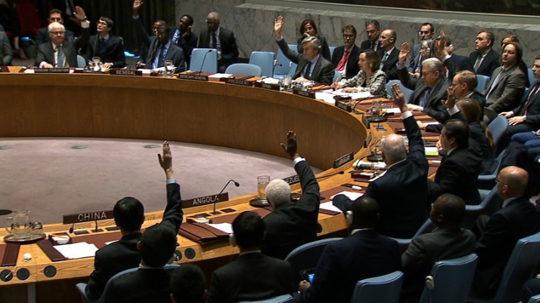
United Nations, Dec 24: The UN Security Council has demanded that Israel halt settlements in Palestinian territory, after the United States refrained from vetoing a resolution condemning its closest Middle East ally.
UN

In a rare and momentous step, the United States instead abstained, enabling the adoption of the first UN resolution since 1979 to condemn Israel over its settlement policy.

Applause broke out in the chamber after the text was passed with support from all remaining members of the 15-member council.

The landmark move by the Security Council yesterday came despite an effort led by Israel and backed by US President-elect Donald Trump to block the text.

Trump reacted after the vote in a tweet, vowing: "As to the UN, things will be different after Jan 20th."

Ambassador Samantha Power said the US abstention stemmed from concerns that the expansion of the Jewish outposts was threatening the two-state solution aimed at achieving peace by creating a Palestinian state alongside Israel.

"We do not believe that outside parties can impose a solution that has not been negotiated by the two parties, nor can we unilaterally recognize a future Palestinian state," said Power.

"But it is precisely our commitment to Israel's security that makes the United States believe that we cannot stand in the way of this resolution as we seek to preserve a chance of attaining our longstanding objective of two states living side by side in peace and security," she said.

"The settlement problem has gotten so much worse that it is now putting at risk the very viability of that two-state solution," said Power.

Israeli settlements are seen as a major stumbling block to peace efforts, as they are built on land the Palestinians see as part of their future state.

Palestinian President Mahmud Abbas's office said the vote was "a big blow" to Israeli policy and a show of "strong support for the two-state solution."

The United Nations maintains that settlements are illegal, but UN officials have reported a surge in construction over the past months.

Some 430,000 Israeli settlers currently live in the West Bank and a further 200,000 Israelis live in east Jerusalem, which the Palestinians see as the capital of their future state.

The resolution demands that "Israel immediately and completely cease all settlement activities in the occupied Palestinian territory, including East Jerusalem."

It states that Israeli settlements have "no legal validity" and are "dangerously imperiling the viability of the two-state solution."

Israeli Ambassador Danny Danon criticized the administration of President Barack Obama for not vetoing "this disgraceful resolution."

"I have no doubt that the new US administration and the incoming UN secretary general will usher in a new era in terms of the UN's relationship with Israel," said Danon.

Comments

Add new comment

  • Coastaldigest.com reserves the right to delete or block any comments.
  • Coastaldigset.com is not responsible for its readers’ comments.
  • Comments that are abusive, incendiary or irrelevant are strictly prohibited.
  • Please use a genuine email ID and provide your name to avoid reject.
News Network
March 28,2020

Washington, Mar 28: The world is in the face of a devastating impact due to the coronavirus pandemic and has clearly entered a recession, the International Monetary Fund said on Friday, but projected a recovery next year.

"We have reassessed the prospects for growth for 2020 and 2021. It is now clear that we have entered a recession as bad or worse than in 2009. We do project recovery in 2021," IMF Managing Director Kristalina Georgieva told reporters at a news conference.

Georgieva was addressing the press after a meeting of governing body of the IMF, the International Monetary and Financial Committee. Representing 189 members, the body met virtually to discuss the unprecedented challenge posed to the world by COVID-19.

The key to recovery in 2021, she said, is only if the international community succeeds in containing the virus everywhere and prevent liquidity problems from becoming a solvency issue.

"The US is in recession, as is the rest of the advanced economies of the world. And in a big chunk of developed and emerging markets in developing economies. How severe? We are working now on our projections for 2020, Georgieva said in response to a question.

The new projections are expected in the next few weeks.

Stressing that while containment is the main reason for the economy to stand still and get into a recession, she said containment is very necessary to come out of this period and step in to recovery. "Until the virus is not contained, it would be very difficult to go to the lives we love."

"A key concern about a long-lasting impact of the sudden stop of the world economy is the risk of a wave of bankruptcies and layoffs that not only can undermine the recovery. But can erode the fabric of our societies," the IMF chief said.

To avoid this from happening, many countries have taken far-reaching measures to address the health crisis and to cushion its impact on the economy, both on the monetary and on the fiscal side, she said.

The IMF chief said 81 emergency financing requests, including 50 from lower-income countries, have been received. She said current estimate for the overall financial needs of emerging markets is 2.5 trillion dollars.

"We believe this is on the lower end. We do know that their own reserves and domestic resources will not be sufficient," she added.

The G-20, a day earlier, reported fiscal measures totalling some 5 trillion dollars or over 6 per cent of the global GDP.

Responding to another question, Georgieva said the IMF is projecting recession for 2020.

"We do expect it to be quite deep and we are very much urging countries to step up containment measures aggressively so we can shorten the duration of this period of time when the economy is in standstill," she said.

"And also to apply well-targeted measures, primarily focusing on the health system to absorb that enormous stress that comes from coronavirus. And on people, businesses and the financial system, I am very pleased to say that when we went through countries' responses, that sense of targeted fiscal measures is there and are also very impressive to see the size of these measures," she added.

"Countries are doing all they can on the fiscal and on the monetary front. We have heard from our members' very impressive decisions taken over the last days," the IMF chief said.

"We also want to caution that as we are responding now, we want to make the recession as possibly short and not too deep. We also want to think about what is going to follow the recovery and make sure that we are putting forward measures that can be supportive in this regard," she said.

Comments

Add new comment

  • Coastaldigest.com reserves the right to delete or block any comments.
  • Coastaldigset.com is not responsible for its readers’ comments.
  • Comments that are abusive, incendiary or irrelevant are strictly prohibited.
  • Please use a genuine email ID and provide your name to avoid reject.
News Network
February 19,2020

Washington, Feb 19: US President Donald Trump has said he is "saving the big deal" with India for later and he "does not know" if it will be done before the presidential election in November, clearly indicating that a major bilateral trade deal during his visit to Delhi next week might not be on the cards.

"We can have a trade deal with India. But I'm really saving the big deal for later," he told reporters at Joint Base Andrews Tuesday afternoon (local time).

The US and India could sign a "trade package" during the visit, according to media reports.

Asked whether he expects a trade deal with India before the visit, Trump said, "We're doing a very big trade deal with India. We'll have it. I don't know if it'll be done before the election, but we'll have a very big deal with India."

US Trade Representative Robert Lighthizer, the point-person for trade negotiations with India, is likely to not accompany Trump to India, sources said. However, officials have not ruled it out altogether.

In an apparent dissatisfaction over US-India trade ties, Trump said, "We're not treated very well by India." But he praised Prime Minister Narendra Modi and said he is looking forward to his visit to India.

"I happen to like Prime Minister Modi a lot," Trump said.

"He told me we'll have seven million people between the airport and the event. And the stadium, I understand, is sort of semi under construction, but it's going to be the largest stadium in the world. So it's going to be very exciting... I hope you all enjoy it," he told reporters.

Meanwhile, the US-India Strategic and Partnership Forum (USISPF) in a report said the latest quarterly data depict continuation of overall positive bilateral trade trends. The third quarter data reflects some downslide in growth rates.

"It may be due to several reasons, including the unexpected economic slowdown in India's economic growth, impact of US-China trade war, GSP withdrawal from the US side and retaliatory tariffs on specific US goods from the Indian side," USISPF said.

According to the report, the data available for the first three quarters of 2019 (January-September) pulled the overall growth rate in cumulative bilateral trade down to 4.5 percent from 8.4 percent registered for the first two quarters.

Goods and services trade performance in third quarter was dismal at -2.3 percent, in contrast with the impressive 9.6 percent growth witnessed for the first two quarters of the year; while trade in services was up two percent goods trade dropped five percent, the report said.

The cumulative US-India trade in goods and services (USD 110.9 billion) for the first three quarters of 2019 increased 4.5 percent with US exports and imports growing at four percent and five percent respectively.

The US exported USD 45.3 billion worth of goods and services to India in the first three quarters 2019, up 4 percent from the corresponding period in the previous year; and the US imported USD 65.6 billion worth of goods and services from India, up five percent from the previous year's USD 62.5 billion level for the same period, it said.

The USISPF has projected that the total bilateral trade can touch USD 238 billion by 2025 if the current 7.5 percent average annual rate of growth sustains; however, higher growth rates can result in bilateral trade in the range of USD 283 billion and USD 327 billion.

The US remains the top trading partner for India in terms of trade in goods and services, followed by China. While the bilateral trade between US and India is approximately 62 percent in goods and 38 percent in services, the bilateral trade between India and China is dominated by goods.

China had a huge trade surplus of USD 58 billion with India, indicating Beijing's strength in the Indian market, especially in sectors, such as electronics, machinery, organic chemicals, plastics and medical devices.

The US goods exports to India, in comparison, were mainly concentrated in mineral fuels, precious stones, and aircraft. The US faces tough competition with China in the Indian market in areas such as electronics, machinery, organic chemicals and medical devices.

Comments

Add new comment

  • Coastaldigest.com reserves the right to delete or block any comments.
  • Coastaldigset.com is not responsible for its readers’ comments.
  • Comments that are abusive, incendiary or irrelevant are strictly prohibited.
  • Please use a genuine email ID and provide your name to avoid reject.
News Network
May 19,2020

May 19: A Chinese laboratory has been developing a drug it believes has the power to bring the coronavirus pandemic to a halt.

The outbreak first emerged in China late last year before spreading across the world, prompting an international race to find treatments and vaccines.

A drug being tested by scientists at China's prestigious Peking University could not only shorten the recovery time for those infected, but even offer short-term immunity from the virus, researchers say.

Sunney Xie, director of the university's Beijing Advanced Innovation Center for Genomics, told AFP that the drug has been successful at the animal testing stage.

"When we injected neutralising antibodies into infected mice, after five days the viral load was reduced by a factor of 2,500," said Xie.

"That means this potential drug has (a) therapeutic effect."

The drug uses neutralising antibodies -- produced by the human immune system to prevent the virus infecting cells -- which Xie's team isolated from the blood of 60 recovered patients.

A study on the team's research, published Sunday in the scientific journal Cell, suggests that using the antibodies provides a potential "cure" for the disease and shortens recovery time.

Xie said his team had been working "day and night" searching for the antibody.

"Our expertise is single-cell genomics rather than immunology or virology. When we realised that the single-cell genomic approach can effectively find the neutralising antibody we were thrilled."

He added that the drug should be ready for use later this year and in time for any potential winter outbreak of the virus, which has infected 4.8 million people around the world and killed more than 315,000.

"Planning for the clinical trial is underway," said Xie, adding it will be carried out in Australia and other countries since cases have dwindled in China, offering fewer human guinea pigs for testing.

"The hope is these neutralised antibodies can become a specialised drug that would stop the pandemic," he said.

China already has five potential coronavirus vaccines at the human trial stage, a health official said last week.

But the World Health Organization has warned that developing a vaccine could take 12 to 18 months.

Scientists have also pointed to the potential benefits of plasma -- a blood fluid -- from recovered individuals who have developed antibodies to the virus enabling the body's defences to attack it.

More than 700 patients have received plasma therapy in China, a process which authorities said showed "very good therapeutic effects".

"However, it (plasma) is limited in supply," Xie said, noting that the 14 neutralising antibodies used in their drug could be put into mass production quickly.

Using antibodies in drug treatments is not a new approach, and it has been successful in treating several other viruses such as HIV, Ebola and Middle East Respiratory Syndrome (MERS).

Xie said his researchers had "an early start" since the outbreak started in China before spreading to other countries.

Ebola drug Remdesivir was considered a hopeful early treatment for COVID-19 -- clinical trials in the US showed it shortened the recovery time in some patients by a third -- but the difference in mortality rate was not significant.

The new drug could even offer short-term protection against the virus.

The study showed that if the neutralising antibody was injected before the mice were infected with the virus, the mice stayed free of infection and no virus was detected.

This may offer temporary protection for medical workers for a few weeks, which Xie said they are hoping to "extend to a few months".

More than 100 vaccines for COVID-19 are in the works globally, but as the process of vaccine development is more demanding, Xie is hoping that the new drug could be a faster and more efficient way to stop the global march of the coronavirus.

"We would be able to stop the pandemic with an effective drug, even without a vaccine," he said.

Comments

Add new comment

  • Coastaldigest.com reserves the right to delete or block any comments.
  • Coastaldigset.com is not responsible for its readers’ comments.
  • Comments that are abusive, incendiary or irrelevant are strictly prohibited.
  • Please use a genuine email ID and provide your name to avoid reject.