


UN demands end to Israeli settlements after US abstains

December 24, 2016

United Nations, Dec 24: The UN Security Council has demanded that Israel halt settlements in Palestinian territory, after the United States refrained from vetoing a resolution condemning its closest Middle East ally.
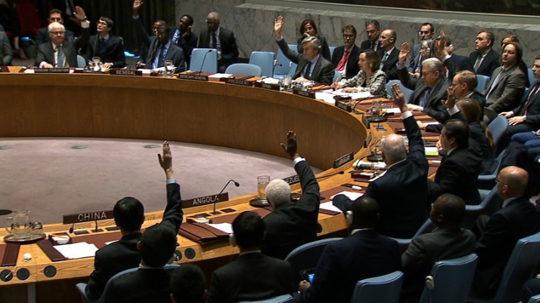
UN

In a rare and momentous step, the United States instead abstained, enabling the adoption of the first UN resolution since 1979 to condemn Israel over its settlement policy.

Applause broke out in the chamber after the text was passed with support from all remaining members of the 15-member council.

The landmark move by the Security Council yesterday came despite an effort led by Israel and backed by US President-elect Donald Trump to block the text.

Trump reacted after the vote in a tweet, vowing: "As to the UN, things will be different after Jan 20th."

Ambassador Samantha Power said the US abstention stemmed from concerns that the expansion of the Jewish outposts was threatening the two-state solution aimed at achieving peace by creating a Palestinian state alongside Israel.

"We do not believe that outside parties can impose a solution that has not been negotiated by the two parties, nor can we unilaterally recognize a future Palestinian state," said Power.

"But it is precisely our commitment to Israel's security that makes the United States believe that we cannot stand in the way of this resolution as we seek to preserve a chance of attaining our longstanding objective of two states living side by side in peace and security," she said.

"The settlement problem has gotten so much worse that it is now putting at risk the very viability of that two-state solution," said Power.

Israeli settlements are seen as a major stumbling block to peace efforts, as they are built on land the Palestinians see as part of their future state.

Palestinian President Mahmud Abbas's office said the vote was "a big blow" to Israeli policy and a show of "strong support for the two-state solution."

The United Nations maintains that settlements are illegal, but UN officials have reported a surge in construction over the past months.

Some 430,000 Israeli settlers currently live in the West Bank and a further 200,000 Israelis live in east Jerusalem, which the Palestinians see as the capital of their future state.

The resolution demands that "Israel immediately and completely cease all settlement activities in the occupied Palestinian territory, including East Jerusalem."

It states that Israeli settlements have "no legal validity" and are "dangerously imperiling the viability of the two-state solution."

Israeli Ambassador Danny Danon criticized the administration of President Barack Obama for not vetoing "this disgraceful resolution."

"I have no doubt that the new US administration and the incoming UN secretary general will usher in a new era in terms of the UN's relationship with Israel," said Danon.

Comments

Add new comment

  • Coastaldigest.com reserves the right to delete or block any comments.
  • Coastaldigset.com is not responsible for its readers’ comments.
  • Comments that are abusive, incendiary or irrelevant are strictly prohibited.
  • Please use a genuine email ID and provide your name to avoid reject.
News Network
May 30,2020

Washington, May 30: President Donald Trump said Friday he would strip several of Hong Kong's special privileges with the United States and bar some Chinese students from US universities in anger over Beijing's bid to exert control in the financial hub.

In a day of concerted action, the United States and Britain also raised alarm at the UN Security Council over a controversial new security law for Hong Kong, angering Beijing which said the issue had no place at the world body.

In a White House appearance that Trump had teased for a day, the US president attacked China over its treatment of the former British colony, saying it was "diminishing the city's longstanding and proud status."

"This is a tragedy for the people of Hong Kong, the people of China and indeed the people of the world," Trump said.

Trump also said he was terminating the US relationship with the World Health Organization, which he has accused of pro-China bias in its management of the coronavirus crisis.

But Trump was light on specifics and notably avoided personal criticism of President Xi Jinping, with whom he has boasted of having a friendship even as the two powers feud over a rising range of issues.

"I am directing my administration to begin the process of eliminating policy that gives Hong Kong different and special treatment," Trump said.

"This will affect the full range of agreements, from our extradition treaty to our export controls on dual-use technologies and more, with few exceptions," he said.

Secretary of State Mike Pompeo on Wednesday informed Congress that the Trump administration would no longer consider Hong Kong to be separate under US law, but it was up to Trump to spell out the consequences.

China this week pressed ahead on a law that would ban subversion and other perceived offenses against its rule in Hong Kong, which was rocked by months of massive pro-democracy protests last year.

US restricts students

In one move that could have long-reaching consequences, Trump issued an order to ban graduate students from US universities who are connected to China's military.

"For years, the government of China has conducted elicit espionage to steal our industrial secrets, of which there are many," Trump said.

Hawkish Republicans have been clamoring to kick out Chinese students enrolled in sensitive fields. The FBI in February said it was investigating 1,000 cases of Chinese economic espionage and technological theft.

But any move to deter students is unwelcome for US universities, which rely increasingly on tuition from foreigners and have already been hit hard by the COVID-19 shutdown.

China has been the top source of foreign students to the United States for the past decade with nearly 370,000 Chinese at US universities, although Trump's order will not directly affect undergraduates.

Critics say Trump has been eager to fan outrage about China to deflect attention from his own handling of the coronavirus pandemic that has killed more than 100,000 people in the United States, the highest number of deaths of any country.

Chuck Schumer, the top Democrat in the Senate, called Trump's announcement "just pathetic."

Eliot Engel, a Democrat who heads the House Foreign Affairs Committee, noted that Trump treaded lightly on Hong Kong during last year's protests as he sought a trade deal with Xi.

"Now, the president wants to shift the blame for his failures onto China, so he's doing the right thing for the wrong reason," Engel said.

Trump's order could also trigger retaliation. China in March expelled US journalists after the Trump administration tightened visa rules for staff at Chinese state media.

Clash at UN

The United States and Britain earlier in the day urged China to reconsider the Hong Kong law during talks at the UN Security Council, where China wields a veto -- making any formal session, let alone action against Beijing, impossible.

The Western allies raised Hong Kong in an informal, closed-door videoconference where China cannot block the agenda.

They said China was violating an international commitment as the 1984 handover agreement with Britain, in which Beijing promised to maintain the financial hub's separate system until at least 2047, was registered with the United Nations.

"The United States is resolute, and calls upon all UN members states to join us in demanding that the PRC immediately reverse course and honor its international legal commitments to this institution and to the Hong Kong people," said US Ambassador Kelly Craft, referring to the People's Republic of China.  

China demanded that the United States and Britain "immediately stop interfering in Hong Kong affairs," saying the law did not fall under the Security Council's mandate.

"Any attempt to use Hong Kong to interfere in China's internal matters is doomed to fail," warned a statement from China's UN mission.

"There was no consensus, no formal discussion in the Security Council, and the US and the UK's move came to nothing," it said.

Comments

Add new comment

  • Coastaldigest.com reserves the right to delete or block any comments.
  • Coastaldigset.com is not responsible for its readers’ comments.
  • Comments that are abusive, incendiary or irrelevant are strictly prohibited.
  • Please use a genuine email ID and provide your name to avoid reject.
News Network
July 1,2020

Jul 1: Hong Kong police moved swiftly on Wednesday against protesters gearing up for the first rally since the introduction of sweeping security legislation, making their first arrest under it and warning of punishment for pro-independence material.

Beijing on Tuesday unveiled the details of the much-anticipated law after weeks of uncertainty, pushing China's freest city and one of the world's most glittering financial hubs onto a more authoritarian path.

As hundreds of protesters gathered downtown for an annual rally marking the 23rd anniversary of the former British colony's handover to China, riot police used pepper spray to arrest at least two people, while one metro station closed.

Police, who earlier banned the rally, cited the law for the first time in confronting protesters and they also made their first arrest under it - a man holding a flag advocating independence.

"You are displaying flags or banners/chanting slogans/or conducting yourselves with an intent such as secession or subversion, which may constitute offences under the ... national security law," police said in a message displayed on a purple banner.

The law will punish crimes of secession, subversion, terrorism and collusion with foreign forces with up to life in prison, heralding a more authoritarian era for the Asian financial hub.

China's parliament adopted it in response to months of pro-democracy protests last year triggered by fears that Beijing was stifling the city's freedoms, guaranteed by a "one country, two systems" formula agreed when it returned to Chinese rule.

Authorities in Beijing and Hong Kong have repeatedly said the legislation is aimed at a few "troublemakers" and will not affect rights and freedoms, nor investor interests.

But critics fear it will crush the freedoms that are seen as key to Hong Kong's success as a financial centre.

"With the release of the full detail of the law, it should be clear to those in any doubt that this is not the Hong Kong they grew up in," said Hasnain Malik, head of equity research, Tellimer in Dubai.

"The difference is that U.S. and China relations are far worse and this could be used as a pretext to impede the role of Hong Kong as a finance hub."

In Beijing, Zhang Xiaoming, executive deputy director of Beijing's Hong Kong and Macau Affairs Office, told reporters suspects arrested by Beijing's new security office in Hong Kong could be tried on the mainland.

He said the mainland's national security office abided by Chinese law and that Hong Kong's legal system could not be expected to implement the laws of the mainland. Article 55 of the law states that Beijing's national security office in Hong Kong could exercise jurisdiction over "complex" or "serious" cases.

Mainland security agencies will also be based in Hong Kong officially for the first time, with powers that go beyond city laws.

"The law is a birthday gift to (Hong Kong) and will show its precious value in the future," Zhang said, adding the law would not be applied retroactively.

On July 1 last year, hundreds of protesters stormed and vandalised the city's legislature to protest against a now-scrapped bill that would have allowed extraditions to mainland China.

Those protests evolved into calls for greater democracy, paralysing parts of the city and paving the way for Beijing's imposition of the law this week.

'INEVITABLE'

Speaking at a flag-raising ceremony to mark the handover anniversary, the city's Beijing-backed leader, Carrie Lam, said the law was the most important development since the city's return to Chinese rule.

"It is also an inevitable and prompt decision to restore stability," Lam said at the same harbour-front venue where 23 years ago the last colonial governor, Chris Patten, a staunch critic of the security law, tearfully handed back Hong Kong to Chinese rule.

Some pro-Beijing officials and political commentators say the law is aimed at sealing Hong Kong's "second return" to the motherland after the first failed to bring residents to heel.

Luo Huining, the head of Beijing's top representative office in Hong Kong, said at the ceremony the law was a "common aspiration" of Hong Kong citizens.

Critics denounced the lack of transparency surrounding the details of the legislation until it was unveiled. It came into force at 11 p.m. (1500 GMT) on Tuesday.

Some pro-democracy activists gave up membership of their groups just before the law came into force, though calling for the campaign for democracy to go on offshore.

"I saw this morning there are celebrations for Hong Kong's handover, but to me it is a funeral, a funeral for 'one country two systems'," said democracy lawmaker Kwok Ka-ki.

Comments

Add new comment

  • Coastaldigest.com reserves the right to delete or block any comments.
  • Coastaldigset.com is not responsible for its readers’ comments.
  • Comments that are abusive, incendiary or irrelevant are strictly prohibited.
  • Please use a genuine email ID and provide your name to avoid reject.
Agencies
January 25,2020

Pentagon, Jan 25: Thirty-four US troops had been diagnosed with concussions and traumatic brain injury (TBI) as a result of the January 8 Iranian missile attack on two military bases in Iraq housing American soldiers, the Pentagon said.

"Eight service members who were previously transported to Germany have been brought to the US, they would continue to receive treatment in the US either at Walter Reed or their home bases," Pentagon spokesman Jonathan Hoffman told the media on Friday.

Hoffman said that nine service members were still undergoing treatment in Germany, and the rest of the 17 injured troops have already returned to duty in Iraq, reports Xinhua news agency.

Lat week, the US military had said that 11 service members were treated for concussion symptoms due to the missile attacks.

Hoffman noted that the symptoms "are late developing and manifested over a period of time".

In retaliation for the killing of Iranian Major General Qasem Soleimani in an American drone attack on January 3 in Baghdad, Tehran launched over 13 ballistic missiles on the two military bases in Anbar and near the city of Erbil.

US military initially said that no casualty was reported from the Iranian attack. President Donald Trump then downplayed the seriousness of those injures.

"I heard that they had headaches and a couple of other things, but I would say and I can report that it's not very serious," Trump told reporters on Wednesday at a press conference in Davos, Switzerland.

More than 5,000 US troops are deployed in Iraq to support the country's forces in the battle against Islamic State militants.

Comments

Add new comment

  • Coastaldigest.com reserves the right to delete or block any comments.
  • Coastaldigset.com is not responsible for its readers’ comments.
  • Comments that are abusive, incendiary or irrelevant are strictly prohibited.
  • Please use a genuine email ID and provide your name to avoid reject.