


Upbeat Afridi regains Twenty20 captaincy

September 17, 2014

Karachi, Sep 17: Shahid Afridi returned as Pakistan’s Twenty20 captain on Tuesday and then announced that he was looking forward to leading a team of “lion-hearted cricketers” to international laurels including the next T20 World Cup in 2016.
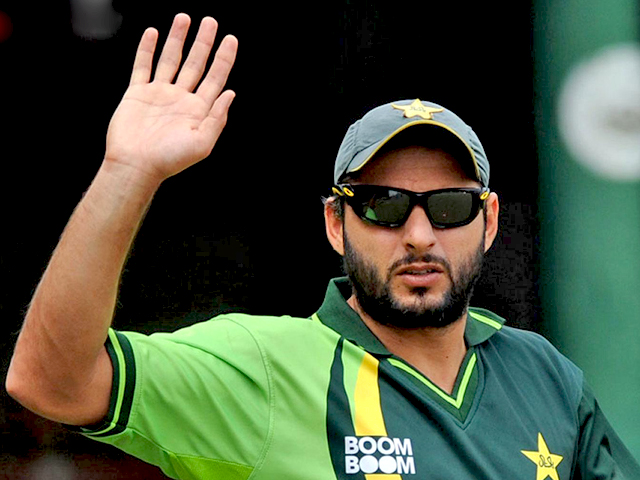
AfridiThe flamboyant all-rounder has replaced Mohammad Hafeez, who stepped down as skipper earlier this year after Pakistan failed to reach the T20 World Cup semi-finals in Bangladesh.

In addition, the Pakistan Cricket Board (PCB) has reaffirmed that Misbah-ul-Haq will continue to captain Pakistan in Tests and One-day Internationals till next year’s ICC World Cup in Australia and New Zealand.

“In line with my policy of taking decisions democratically I consulted Cricket Committee and my Board members before announcing these decisions. I wish both Afridi and Misbah very good luck in their upcoming assignments,” PCB chairman Shaharyar Khan said in the statement.

Chosen ahead of young contender Sohaib Maqsood primarily because of his vast experience, Afridi stressed that he would lead by example and put the country’s underachieving Twenty20 team on the victory path.

“I’m honoured to get national captaincy again,” he told ‘The News’ in an interview soon after PCB announced that Afridi has been installed as the T20 captain till the 2016 edition of the Twenty20 World Cup.

“It’s an exciting responsibility and the fact that the team management is backing my completely gives me great confidence,” he said.

Afridi made it clear that as captain he would not live with “chicken-hearted” players and would instead support boys exhibiting a “lion-hearted approach”.

“As (Twenty20) captain my message to the players would be simple: don’t be scared of failure,” he said.

“There is no place for chicken-hearted players in the Twenty20 format. You need a lion-hearted approach and that’s what I intend to promote in our team,” he added.

Pakistan reached the final of the inaugural Twenty20 World Cup in South Africa and then went on to win the coveted title two years later in England. But since then Pakistan’s performance graph in the tournament has dipped.

Afridi believes that unlike the past when Pakistan were among few teams with plenty of expertise in the slam-bang format, other sides have really caught up.

“Winning Twenty20 matches isn’t easy for us anymore,” he said. “Other teams have gradually learned how to flourish in this format and have hence improved.”

But Afridi was quick to make it clear that under his command Pakistan would be one of the major contenders for the T20 World Cup in 2016.

“We have a good Twenty20 team and all we need is to show that killer instinct needed to win major tournaments,” he said.

Afridi was Pakistan’s hero in their title-winning triumph in 2009 when he produced match-winning performances in the semifinal and final.

But his personal stats have taken a hit in recent times and Afridi is fully aware of it.

“I need to regain my form both with the bat and ball,” he said. “As captain I know that I will have to lead by example because that’s the only way you can get the best out of the players.”

Afridi, 34, was forced to give up captaincy in the summer of 2011 following a public spat with team coach Waqar Younis and the then PCB chairman Ijaz Butt.

Butt is long gone but Waqar is back in the saddle as national coach. However, Afridi is certain that what happened in 2011 following Pakistan’s World Cup semi-final defeat against India would not get repeated in the future.

“What happened in the past stays in the past,” he said. “I would want to focus on the present and as far as Vicky bhai (Waqar) is concerned I must say that he is a changed man and I’m enjoying working with him,” he added.

During his previous stint as captain, Afridi captained Pakistan in 19 Twenty20 Internationals between August 2009 and April 2011. Pakistan won eight and lost 11 matches under his captaincy.

He is one of the most capped players in the Twenty20 format and also one of its most accomplished. In 74 appearances, Afridi has accumulated 1112 runs at an average of 19.17 and a strike rate of 144.04. He has also bagged 77 wickets at 22.61. Over the last 12 months, he has taken 10 wickets at an average of 26.80 in 11 matches and scored 173 runs at a strike rate of 150.

Afridi will begin his latest stint as captain with a one-off Twenty20 International against Australia in Dubai on October 5.

Comments

Add new comment

  • Coastaldigest.com reserves the right to delete or block any comments.
  • Coastaldigset.com is not responsible for its readers’ comments.
  • Comments that are abusive, incendiary or irrelevant are strictly prohibited.
  • Please use a genuine email ID and provide your name to avoid reject.
News Network
May 15,2020

New Delhi, May 15: Former England skipper David Gower feels Sourav Ganguly has the right "political skills" to lead the ICC one day and he has already displayed that as BCCI president, which is a "far tougher job".

The elegant left-hander is very impressed with Ganguly's leadership abilities and believes that he has what it takes to head the global body in the future.

"One thing I have learnt over the years is that if you are going to run BCCI, you need to be many, many things. Having a reputation like he (Ganguly) has is a very good start, but you need to be a very deft politician.

"You need to have control of a million different things," Gower said ahead of "Q20", a unique chat show for the fans presented by 'GloFans'.

Gower reckons being president of the BCCI is the toughest job imaginable in world cricket.

"And of course, you need to be responsible for a game that is followed by, I mean, should we say a billion people here in India," he said.

"We all know about the immense following for cricket in India. So it is indeed a wonderful thing to behold. Sourav has the toughest task imaginable in charge of BCCI, but so far I would say the signs are very good.

"He has listened, given his own opinion and has pulled strings gently," he said.

Political skills are a must in administration and that's where Gower finds his fellow left-hander ticking all the boxes.

"He is a very, very good man and has those political skills. He has the right attitude and can keep things together and will do good job. And if you do a good job as BCCI chief in the future, who knows?

"But I would actually say the more important job, to be honest, is running BCCI. Being head of ICC is an honour, there is a lot that can be done by ICC, but actually look at the rankings, look at where the power is heading up. BCCI is definitely the bigger job," he said.

On the cricketing front, Gower believes World Test Championship has given the format much-needed context.

"The idea of this World Test Championship has come about for one very simple reason that people are worried about the survival of Tests. Back in the seventies, eighties, I don't think we needed context to be fair.

"Test cricket was very much more obviously the most important format and if there was anything to be judged by, it was the performances in Test matches both as an individual and as a team.

Comments

Add new comment

  • Coastaldigest.com reserves the right to delete or block any comments.
  • Coastaldigset.com is not responsible for its readers’ comments.
  • Comments that are abusive, incendiary or irrelevant are strictly prohibited.
  • Please use a genuine email ID and provide your name to avoid reject.
Agencies
July 21,2020

New Delhi, Jul 21: With the T20 World Cup's postponement clearing the decks for a full-fledged IPL, the glitzy event's Governing Council will meet in a week or 10 days' time to plan its next course of action, eyeing UAE as the host this year.

An IPL between September and early November has been made possible by the ICC's decision on Monday to postpone the T20 World Cup in Australia, scheduled for October-November, due to the COVID-19 pandemic.

"The IPL GC will meet within a week or 10 days and all decisions (including final schedule) will be taken there. As of now, the plan is to have a full fledged IPL comprising 60 games and most likely in the UAE," Patel told PTI.

Asked about the main challenges in conducting the event in current scenario, Patel added: "Just the operational side of it. Whether you do it here or outside, it doesn't matter (with no crowds)."

The franchisees had already been working on their plans for the IPL even before the ICC announcement.

With majority of the Indian players not having access to grounds amid the pandemic, teams will need at least three to four weeks to get them match ready.

Foreign players will fly in directly to the UAE from their respective countries.

"Our players will need at least three to four weeks of training, if not more. We will finalise all our plans once the BCCI announces the dates. It looks like the IPL will be in the UAE and we are ready for that," a team owner told PTI.

Since India tour Australia for a four-Test series right after the IPL, training of the Test players is also an important issue.

Test specialists like Cheteshwar Pujara and Hanuma Vihari, who are not part of the IPL, are likely to train for the eagerly-awaited series in a bio-secure environment at the newly-renovated Motera Stadium in Ahmedabad during the time of the IPL.

A few fringe players are expected to join them at Motera along with the Indian team's support staff, which is free during the IPL.

Work from home has become the norm amid the pandemic, therefore, there is a possibility that IPL commentary will happen from the comfort of the living room, a safer and cost effective-option considering the likes of Sunil Gavaskar, who is 71, are involved.

The viewership is expected to be a record one with people craving for live cricket, something KXIP co-owner Ness Wadia has said.

However, it remains to be seen how much the broadcasters and teams are able to attract from the sponsors in the current financial climate.

More moot points and questions ahead of the IPL GC meeting:

1) More double headers expected (original schedule had only five double headers).

2) BCCI will need to provide a Standard Operating Procedure to IPL teams even though they will have their own SOPs in place.

3) Will the BCCI compensate teams for not being able to generate gate money this year?

4) Will there be virtual commentary from Star Sports? It was seen in the recent 3TC event in South Africa with the likes of Aakash Chopra, Deep Dasgupta and Irfan Pathan commentating from home.

Comments

Add new comment

  • Coastaldigest.com reserves the right to delete or block any comments.
  • Coastaldigset.com is not responsible for its readers’ comments.
  • Comments that are abusive, incendiary or irrelevant are strictly prohibited.
  • Please use a genuine email ID and provide your name to avoid reject.
News Network
July 6,2020

New Delhi, Jul 6: India's cricket chief Sourav Ganguly says improved fitness standards and a change in culture have led to the country developing one of the world's best pace attacks.

Spearheads Mohammed Shami and Jasprit Bumrah are part of a battery of five formidable quick bowlers that have helped change India's traditional reliance on spin bowling.

"You know culture has changed in India that we can be good fast bowlers," Ganguly said in a chat hosted on the Board of Control for Cricket in India (BCCI) Twitter feed.

"Fitness regimes, fitness standards not only just among fast bowlers but also among the batters, that has changed enormously. That has made everyone understand and believe that we are fit, we are strong and we can also bowl fast like the others did."

The West Indies dominated world cricket in the 1970s and 1980s led by a fearsome pace attack that included all-time greats such as Michael Holding, Andy Roberts, Malcolm Marshall and Joel Garner.

Recently Indian quicks have risen to the top in world cricket with Shami, Bumrah, Ishant Sharma, Umesh Yadav and Bhuvneshwar Kumar in a deadly arsenal.

"The West Indies in my generation were naturally strong," the former India captain said.

"We Indians were never such naturally strong... but we worked hard to get strong. But I think it is the change in culture as well that is very important."

Shami last month claimed that the current Indian pace attack may be the best in Test history.

"You and everyone else in the world will agree to this -- that no team has ever had five fast bowlers together as a package," said Shami.

"Not just now, in the history of cricket, this might be the best fast-bowling unit in the world."

Shami took 13 wickets during India's 3-0 home Test sweep over South Africa last year, while Bumrah has claimed 68 scalps in 14 Tests since his debut.

Comments

Add new comment

  • Coastaldigest.com reserves the right to delete or block any comments.
  • Coastaldigset.com is not responsible for its readers’ comments.
  • Comments that are abusive, incendiary or irrelevant are strictly prohibited.
  • Please use a genuine email ID and provide your name to avoid reject.