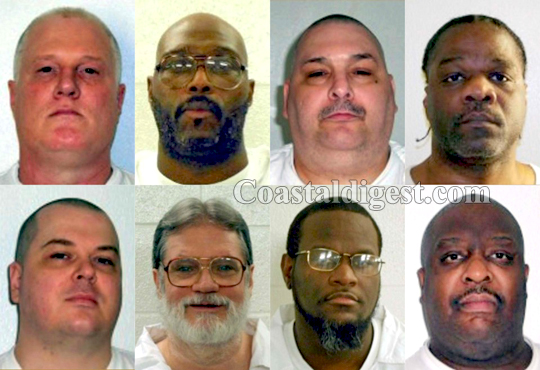
US: Arkansas carries out first of its planned executions

April 21, 2017

Washington, Apr 21: The US state of Arkansas carried out its first execution in nearly a decade, the state's attorney general said, proceeding despite criticism that its controversial plan to execute several prisoners by the end of the month was rushed.

Arkansas

Ledell Lee, 51, was put to death late last night after the US Supreme Court rejected eleventh-hour requests to stay the execution. He received injections of three drugs, including one that has sparked sharp legal debate.

Another day of intense legal wrangling kept Lee alive until just before his death warrant expired at midnight. The nation's top court as well as a US district court issued temporary execution stays as they analyzed the case -- but ultimately all were lifted.

"Tonight the lawful sentence of a jury which has been upheld by the courts through decades of challenges has been carried out," Arkansas Attorney General Leslie Rutledge said in a statement released after the execution, the state's first since 2005.

Three more men are currently slated to die before the end of April. The state originally scheduled an unprecedented eight executions within an 11-day window, but several are now tied up in the courts. The Arkansas governor has said the execution schedule is necessary, as the state's supply of a controversial sedative will expire at the end of the month.

Many of the legal clashes over Arkansas's plan focus on use of the drug midazolam, a sedative meant to render a condemned person unconscious before other drugs stop the heart. Critics say it does not always adequately sedate prisoners, potentially causing undue suffering.

Comments

Add new comment

  • Coastaldigest.com reserves the right to delete or block any comments.
  • Coastaldigset.com is not responsible for its readers’ comments.
  • Comments that are abusive, incendiary or irrelevant are strictly prohibited.
  • Please use a genuine email ID and provide your name to avoid reject.
News Network
March 23,2020

Singapore, Mar 23: Oil prices fell at the open in Asia on Monday after a trillion-dollar Senate proposal to help the coronavirus-hit American economy was defeated and death tolls soared across Europe and the US.

US benchmark West Texas Intermediate initially tumbled more than three percent but then pulled back some ground to trade 1.5 percent lower, at $22 a barrel.

Brent crude, the international benchmark, fell 4.9 percent to $25 a barrel.

Prices have fallen to multi-year lows in recent weeks as lockdowns and travel restrictions to fight the virus hit demand, and top producers Saudi Arabia and Russia engage in a price war.

The latest drop came after a trillion-dollar Senate proposal to rescue the US economy was defeated after receiving zero support from Democrats, and with five Republicans absent from the chamber because of virus-related quarantines.

The bill had proposed funding for American families, thousands of shuttered or suffering businesses and the nation's critically under-equipped hospitals.

Coronavirus deaths soared across Europe and the United States at the weekend despite heightened restrictions.

The death toll from the virus -- which has upended lives and closed businesses and schools across the planet -- surged to more than 14,300 Sunday, according to an AFP tally.

AxiCorp chief markets strategist Stephen Innes said that "total demand devastation" had set it.

"Oil markets collapsed out of the gate this morning as prices react... to stringent containment lockdown measures," he said.

Comments

Add new comment

  • Coastaldigest.com reserves the right to delete or block any comments.
  • Coastaldigset.com is not responsible for its readers’ comments.
  • Comments that are abusive, incendiary or irrelevant are strictly prohibited.
  • Please use a genuine email ID and provide your name to avoid reject.
Agencies
January 20,2020

For the first time in the 15 years of the Global Risks Report, the climate change and environment risk has occupied all the top five slots.

According to the 15th edition of the World Economic Forum's (WEF) Global Risks Report, the top five risks in terms of likelihood are extreme weather, climate action failure, natural disasters, biodiversity loss and human-made environmental disasters. They all fall in the one category of climate change and related environmental disasters.

WEF President Borge Brende said the world was feeling long-mounting and interconnected risks.

The report also points to how citizens are protesting across the world as discontent rises with failed systems that are creating inequality. The citizens' discontent had hardened with systems that had failed to promote advancement, it said.

"Disapproval of how governments are addressing profound economic and social issues has sparked protests throughout the world, potentially weakening the ability of governments to take decisive action should a downturn occur. Without economic and social stability, countries could lack the financial resources, fiscal margin, political capital or social support needed to confront key global risks," it said.

Listing the grim scenario, Borge said the global economy was faced with "synchronised slowdown", the past five years had been the warmest on record and cyber attacks were expected to increase this year.

The report warns that while the myriad risks were rising, time was running out on how to prevent them.

Borge said the growing palpability of shared economic, environmental and societal risks indicated that the horizon had shortened for preventing "or even mitigating" some of the direst consequences of global risks.

"It's sobering that in the face of this development, when the challenges before us demand immediate collective action, fractures within the global community appear to only be widening," he said.

The report points to grave concern about the consequences of continued environmental degradation, including the record pace of species decline.

Pointing to an unsettled geopolitical environment, the report said today's risk landscape was one in which new centres of power and influence were forming and old alliance structures and global institutions were being tested.

"While these changes can create openings for new partnership structures in the immediate term, they are putting stress on systems of coordination and challenging norms around shared responsibility. Unless stakeholders adapt multilateral mechanisms for this turbulent period, the risks that were once on the horizon will continue to arrive," it said.

Calling it a "an unsettled world", the WEF report notes that powerful economic, demographic and technological forces were shaping a new balance of power. "The result is an unsettled geopolitical landscape in which states are increasingly viewing opportunities and challenges through unilateral lenses," it said.

"What were once givens regarding alliance structures and multilateral systems no longer hold as states question the value of long-standing frameworks, adopt more nationalist postures in pursuit of individual agendas and weigh the potential geopolitical consequences of economic decoupling. Beyond the risk of conflict, if stakeholders concentrate on immediate geo-strategic advantage and fail to re-imagine or adapt mechanisms for coordination during this unsettled period, opportunities for action on key priorities may slip away," the WEF said.

In a chapter on risks to economic stability and social cohesion, it said a challenging economic climate might persist this year and members of the multi-stakeholder community saw "economic confrontations" and "domestic political polarisation" as the top risks in 2020.

The report also warned of downward pressure on the global economy from macroeconomic fragilities and financial inequality. These pressures continued to intensify in 2019, increasing the risk of economic stagnation.

Low trade barriers, fiscal prudence and strong global investment, once seen as fundamentals for economic growth, are fraying as leaders advance nationalist policies. The margins for monetary and fiscal stimuli are also narrower than before the 2008-2009 financial crisis, creating uncertainty about how well countercyclical policies will work.

The strategic partners for the WEF report included Marsh & McLennan and Zurich Insurance Group. The academic advisers were National University of Singapore, Oxford Martin School, University of Oxford and Wharton Risk Management and Decision Processes Center, University of Pennsylvania.


Comments

Add new comment

  • Coastaldigest.com reserves the right to delete or block any comments.
  • Coastaldigset.com is not responsible for its readers’ comments.
  • Comments that are abusive, incendiary or irrelevant are strictly prohibited.
  • Please use a genuine email ID and provide your name to avoid reject.
Agencies
June 7,2020

Boston, Jun 7: Dozens of scientists doing research funded by Mark Zuckerberg say Facebook should not be letting President Donald Trump use of the social media platform to spread both misinformation and incendiary statements.

The researchers, including 60 professors at leading US research institutions, wrote a letter to the Facebook CEO on Saturday asking that he consider stricter policies on misinformation and incendiary language that harms people," especially during the current turmoil over racial injustice.

The letter calls the spread of deliberate misinformation and divisive language the researchers' goal of using technology to prevent and eradicate disease, improving childhood education and reform the criminal justice system.

The researchers' mission "is antithetical to some of the stances that Facebook has been taking, so we're encouraging them to be more on the side of truth and on the right side of history as we've said in the letter, said Debora Marks of Harvard Medical School, one of three professors who organized the letter.

The other organisers are Martin Kampmann of the University of California-San Francisco and Jason Shepherd of the University of Utah.

All have grants from a Chan Zuckerberg Initiative program working to prevent, cure and treat neurodegenerative disorders including Alzheimer's and Parkinson's disease. The initiative is run by Zuckerberg and his wife, Priscilla Chan.

They said the letter had more than 160 signatories. Shepherd said about 10% are employees of Chan Zuckerberg foundations.

The letter objects specifically to Zuckerberg's decision not to at least flag as a violation of Facebook's community standards Trump's post that stated when the looting starts, the shooting starts after unrest in Minneapolis over the videotaped killing of George Floyd, a black man, by a white police officer.

The letter's authors called the post a clear statement of inciting violence.

Twitter had both flagged and demoted a Trump tweet using the same language.

The Associated Press emailed the Chan Zuckerberg Initiative press office for comment. It did not immediately respond.

Some Facebook employees have publicly objected to Zuckerberg's refusal to take down or label misleading or incendiary posts by Trump or other politicians. But Zuckerberg who controls a majority of voting shares in the company has so far refused.

On Friday, Zuckerberg said in a post that he would review potential options for handling violating or partially-violating content aside from the binary leave-it-up or take-it-down decisions I know many of you think we should have labeled the President's posts in some way last week, he wrote.

"Our current policy is that if content is actually inciting violence, then the right mitigation is to take that content down not let people continue seeing it behind a flag. There is no exception to this policy for politicians or newsworthiness.

Comments

Add new comment

  • Coastaldigest.com reserves the right to delete or block any comments.
  • Coastaldigset.com is not responsible for its readers’ comments.
  • Comments that are abusive, incendiary or irrelevant are strictly prohibited.
  • Please use a genuine email ID and provide your name to avoid reject.