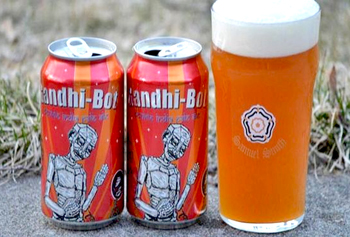
U.S. beer-maker to pull 'Gandhi-Bot' brand after complaints

January 24, 2015

Gandhi-Bot

Jan 24: A U.S. microbrewery said on Friday it will stop using the name and image of the late Indian leader Mohandas Gandhi on one of its beers after complaints it was offensive to the Indian community.

New England Brewing Company of Connecticut had been marketing its India pale ale under the name “Gandhi-Bot,” with a label and cartoon image depicting a robot version of Gandhi. Gandhi, known as Mahatma or "great soul," is widely revered around the globe for leading India to independence from Britain through non-violent resistance.

"After careful consideration we feel that renaming Gandhi-Bot is the right move (the beer will remain the same)," the brewing company said in a statement. "Taking these steps will allow us to express our support for the Indian-American community while also limiting any economic losses."

The company said it made the decision to rebrand the beer following meetings with Indian-American business owners, temple leaders and state officials, including Glastonbury State Representative Prasad Srinivasan.

The company had apologized earlier this month after complaints the beer label was offensive.

Srinivasan said he was glad that brewer was rebranding the ale. "Our sensitivity on this important issue has been addressed and I am looking forward to the early release of their renamed and re-branded product,” he said.

Comments

Add new comment

  • Coastaldigest.com reserves the right to delete or block any comments.
  • Coastaldigset.com is not responsible for its readers’ comments.
  • Comments that are abusive, incendiary or irrelevant are strictly prohibited.
  • Please use a genuine email ID and provide your name to avoid reject.
News Network
February 24,2020

Beijing, Feb 24: The lockdown of Guo Jing's neighbourhood in Wuhan -- the city at the heart of China's new coronavirus epidemic -- came suddenly and without warning.

Unable to go out, the 29-year-old is now sealed inside her compound where she has to depend on online group-buying services to get food.

"Living for at least another month isn't an issue," Guo told news agency, explaining that she had her own stash of pickled vegetables and salted eggs.

But what scares her most is the lack of control -- first, the entire city was sealed off, and then residents were limited to exiting their compound once every three days.

Now even that has been taken away.

Guo is among some 11 million residents in Wuhan, a city in central Hubei province that has been under effective quarantine since January 23 as Chinese authorities race to contain the epidemic.

Since then, its people have faced a number of tightening controls over daily life as the death toll from the virus swelled to over 2,500 in China alone.

But the new rules this month barring residents from leaving their neighbourhoods are the most restrictive yet -- and for some, threaten their livelihoods.

"I still don't know where to buy things once we've finished eating what we have at home," said Pan Hongsheng, who lives with his wife and two children.

Some neighbourhoods have organised group-buying services, where supermarkets deliver orders in bulk.

But in Pan's community, "no one cares".

"The three-year-old doesn't even have any milk powder left," Pan told news agency, adding that he has been unable to send medicine to his in-laws -- both in their eighties -- as they live in a different area.

"I feel like a refugee."

The "closed management of neighbourhoods is bound to bring some inconvenience to the lives of the people", Qian Yuankun, vice secretary of Hubei's Communist Party committee, said at a press briefing last week.

Authorities on Monday allowed healthy non-residents of the city to leave if they never had contact with patients, but restrictions remained on those who live in Wuhan.

Demand for group-buying food delivery services has rocketed with the new restrictions, with supermarkets and neighbourhood committees scrambling to fill orders.

Most group-buying services operate through Chinese messaging app WeChat, which has ad-hoc chat groups for meat, vegetables, milk -- even "hot dry noodles", a famous Wuhan dish.

More sophisticated shops and compounds have their own mini-app inside WeChat, where residents can choose packages priced by weight before orders are sent in bulk to grocery stores.

In Guo's neighbourhood, for instance, a 6.5-kilogramme (14.3-pound) set of five vegetables, including potatoes and baby cabbage, costs 50 yuan ($7.11).

"You have no way to choose what you like to eat," Guo said. "You cannot have personal preferences anymore."

The group-buying model is also more difficult for smaller communities to adopt, as supermarkets have minimum order requirements for delivery.

"To be honest, there's nothing we can do," said Yang Nan, manager of Lao Cun Zhang supermarket, which requires a minimum of 30 orders.

"We only have four cars," she said, explaining that the store did not have the staff to handle smaller orders.

Another supermarket told AFP it capped its daily delivery load to 1,000 orders per day.

"Hiring staff is difficult," said Wang Xiuwen, who works at the store's logistics division, adding that they are wary about hiring too many outsiders for fear of infection.

Closing off communities has split the city into silos, with different neighbourhoods rolling out controls of varying intensity.

In some compounds, residents have easier access to food -- albeit a smaller selection than normal -- and one woman said her family pays delivery drivers to run grocery errands.

Her compound has not been sealed off either, the 24-year-old told AFP under condition of anonymity, though they are limited to one person leaving at a time.

Some districts have implemented their own rules, such as prohibiting supermarkets from selling to individuals, forcing neighbourhoods to buy in bulk or not at all.

"In the neighbourhood where I live, the reality is really terrible," said David Dai, who is based on the outskirts of Wuhan.

Though his apartment complex has organised group-buying, Dai said residents were unhappy with price and quality.

"A lot of tomatoes, a lot of onions -- they were already rotten," he told , estimating over a third of the food had to be thrown away.

His family must "totally depend" on themselves, added the 49-year-old, who has resorted to saving and drying turnip skins to add nutrients to future meals.

The uncertainty of not knowing when the controls will be lifted is also frustrating, said Ma Chen, a man in his 30s who lives alone.

"I have no way of knowing how much (food) I should buy."

Comments

Add new comment

  • Coastaldigest.com reserves the right to delete or block any comments.
  • Coastaldigset.com is not responsible for its readers’ comments.
  • Comments that are abusive, incendiary or irrelevant are strictly prohibited.
  • Please use a genuine email ID and provide your name to avoid reject.
Agencies
May 10,2020

Paris, May 10: The number of coronavirus cases worldwide topped four million as some of the hardest-hit countries readied Sunday to lift lockdown restrictions despite concern about a second wave of infections.

Governments around the world are trying to stop the spread of the deadly disease while scrambling for ways to relieve pressure on their economies, which are facing a historic downturn with millions pushed into unemployment.

Despite the intense political pressure to reopen, nations are also keen to avoid second waves of infections that could overwhelm healthcare systems, with reminders over the weekend of the threat posed by the virus.

In the United States, media reported Saturday that the nation's top infectious disease expert, Anthony Fauci, was among three members of the White House coronavirus task force who will self-isolate after potential exposure.

And in South Korea, the capital Seoul shut all bars and clubs on Saturday as more than 50 cases were linked to a man who tested positive after spending time in one of the city's busiest nightlife districts.

Despite the risks, some governments in hard-hit Europe have said are signs of progress that justify cautious steps towards normality.

Officials in France on Saturday said the day's death toll of 80 was the lowest since early April, while nursing home fatalities also fell sharply as the nation prepared to relax curbs on public movement imposed eight weeks ago.

The easing, to begin Monday, has brought mixed reactions.

"I've been scared to death" about the reopening, said Maya Flandin, a bookshop manager from Lyon. "It's a big responsibility to have to protect my staff and my customers."

French health officials have warned that social distancing must be kept up even as restrictions are eased.

In Spain, about half the population will be allowed out on Monday for limited socialisation, and restaurants will be able to offer some outdoor service as the country begins a phased transition set to last through June.

With lingering fears of a resurgence, authorities excluded Madrid and Barcelona -- two COVID-19 hotspots -- from the first phase.

Belgium is also easing some restrictions on Monday, and in some parts of Germany, bars and restaurants reopened on Saturday with further easing set for Monday.

In Britain, Prime Minister Boris Johnson is expected Sunday to lay out a plan for the nation to emerge out of its current lockdown.

Media reports have suggested that Britain may introduce a mandatory 14-day quarantine for international arrivals to stop the spread of the virus.

Global economic figures are pointing to the most acute downturn in nearly a century, with businesses forced to shut and supply lines badly disrupted, and pressure is growing on leaders around the world to find a way out as the worldwide death toll topped 277,000 and infections crossed four million.

In the United States, the country with the highest death toll and where more than 20 million people have lost their jobs, President Donald Trump has insisted that next year would be "phenomenal" for the economy, urging reopening despite the virus still claiming well over 1,000 lives daily in the country.

The scale of the challenge was brought in sharp focus over the weekend as US media reported that top disease expert Anthony Fauci, who has become the trusted face of the government response to the pandemic, is going to self-isolate after possible exposure to an infected White House staffer.

Fauci told CNN that he will undergo a "modified quarantine" as he had not been in close proximity to the staffer, the network reported. He will remain at home teleworking, and will wear a mask for two weeks.

Robert Redfield, the director of the Centers for Disease Control and Prevention, and Stephen Hahn, the commissioner of the Food and Drug Administration, will also self-isolate, CNN added.

All three will still testify at Tuesday's Senate coronavirus hearing, with Redfield and Hahn participating via video link, according to Senator Lamar Alexander, chairman of the chamber's health committee.

It is believed Fauci will attend wearing a mask, CNN reported.

President Trump has faced sharp criticism from his predecessor Barack Obama, who said on a leaked tape that Trump's handling of the crisis was an "absolute chaotic disaster".

With people wearying of being indoors and under economic pressure, anti-lockdown protests have been held in a number of countries in recent weeks, with some demonstrators arguing that such restrictions violate their rights and others promoting conspiracy theories about the pandemic.

Ten people were arrested and a police officer injured in Melbourne, Australia, on Sunday in the latest such protest, where around 150 people gathered to demand an end to the shutdown.

Participants were promoting a number of conspiracy theories, such as linking 5G cellular communications to the disease.

Australian chief medical officer Brendan Murphy said there was "a lot of very silly misinformation out there", including the 5G allegation.

"I have unfortunately received a lot of communication from these conspiracy theorists myself," he said.

"It is complete nonsense. 5G has got nothing at all to do with coronavirus."

Comments

Add new comment

  • Coastaldigest.com reserves the right to delete or block any comments.
  • Coastaldigset.com is not responsible for its readers’ comments.
  • Comments that are abusive, incendiary or irrelevant are strictly prohibited.
  • Please use a genuine email ID and provide your name to avoid reject.
Agencies
August 7,2020

Russia boasts that it's about to become the first country to approve a Covid-19 vaccine, with mass vaccinations planned as early as October using shots that are yet to complete clinical trials -- and scientists worldwide are sounding the alarm that the headlong rush could backfire.

Moscow sees a Sputnik-like propaganda victory, recalling the Soviet Union's launch of the world's first satellite in 1957.

But the experimental Covid-19 shots began first-in-human testing on a few dozen people less than two months ago, and there's no published scientific evidence yet backing Russia's late entry to the global vaccine race, much less explaining why it should be considered a front-runner.

“I'm worried that Russia is cutting corners so that the vaccine that will come out may be not just ineffective, but also unsafe,” said Lawrence Gostin, a global public health law expert at Georgetown University. “It doesn't work that way... Trials come first. That's really important.”

According to Kirill Dmitriev, head of Russia's Direct Investment Fund that bankrolled the effort, a vaccine developed by the Gamaleya research institute in Moscow may be approved in days, before scientists complete what's called a Phase 3 study.

That final-stage study, usually involving tens of thousands of people, is the only way to prove if an experimental vaccine is safe and really works.

Health Minister Mikhail Murashko said members of “risk groups,” such as medical workers, may be offered the vaccine this month.

He didn't clarify whether they would be part of the Phase 3 study that is said to be completed after the vaccine receives “conditional approval.”

Deputy Prime Minister Tatyana Golikova promised to start “industrial production” in September, and Murashko said mass vaccination may begin as early as October.

Dr Anthony Fauci, the top US infectious disease specialist, questioned the fast-track approach last week.

“I do hope that the Chinese and the Russians are actually testing a vaccine before they are administering the vaccine to anyone, because claims of having a vaccine ready to distribute before you do testing I think is problematic at best," he said.

Questions about this vaccine candidate come after the US, Britain and Canada last month accused Russia of using hackers to steal vaccine research from Western labs.

Delivering a vaccine first is a matter of national prestige for the Kremlin as it tries to assert the image of Russia as a global power capable of competing with the US and China.

The notion of being “the first in the world” dominated state news coverage of the effort, with government officials praising reports of the first-step testing.

In April, President Vladimir Putin ordered state officials to shorten the time of clinical trials for a variety of drugs, including potential coronavirus vaccines.

According to Russia's Association of Clinical Trials Organizations, the order set “an unattainable bar” for scientists who, as a result, "joined in on the mad race, hoping to please those at power.”

The association first raised concern in late May, when professor Alexander Gintsburg, head of the Gamaleya institute, said he and other researchers tried the vaccine on themselves.

The move was a “crude violation of the very foundations of clinical research, Russian law and universally accepted international regulations" the group said in an open letter to the government, urging scientists and health officials to adhere to clinical research standards.

But a month later, the Health Ministry authorized clinical trials of the Gamaleya product, with what appeared to be another ethical issue.

Human studies started June 17 among 76 volunteers. Half were injected with a vaccine in liquid form and the other half with a vaccine that came as soluble powder.

Some in the first half were recruited from the military, which raised concerns that servicemen may have been pressured to participate.

Some experts said their desire to perform well would affect the findings. “It's no coincidence media reports we see about the trials among the military said no one had any side effects, while the (other group) reported some," said Vasily Vlassov, a public health expert with Moscow's Higher School of Economics.

As the trials were declared completed and looming regulatory approval was announced last week, questions arose about the vaccine's safety and effectiveness.

Government assurances the drug produced the desired immune response and caused no significant side effects were hardly convincing without published scientific data describing the findings.

The World Health Organization said all vaccine candidates should go through full stages of testing before being rolled out.

“There are established practices and there are guidelines out,” WHO spokesman Christian Lindmeier said Tuesday.

“Between finding or having a clue of maybe having a vaccine that works, and having gone through all the stages, is a big difference.”

Offering an unsafe compound to medical workers on the front lines of the outbreak could make things worse, Georgetown's Gostin said, adding: “What if the vaccine started killing them or making them very ill?”

Vaccines that are not properly tested can cause harm in many ways — from a negative impact on health to creating a false sense of security or undermining trust in vaccinations, said Thomas Bollyky, director of the global health program at the Council on Foreign Relations. 

Comments

Add new comment

  • Coastaldigest.com reserves the right to delete or block any comments.
  • Coastaldigset.com is not responsible for its readers’ comments.
  • Comments that are abusive, incendiary or irrelevant are strictly prohibited.
  • Please use a genuine email ID and provide your name to avoid reject.