



US judge temporarily blocks Trump's travel ban nationwide

February 4, 2017

Seattle, Feb 4: A U.S. judge on Friday temporarily blocked President Donald Trump's ban on travelers and immigrants from seven predominantly Muslim countries, siding with two states that urged a nationwide hold on the executive order that has launched legal battles across the country.
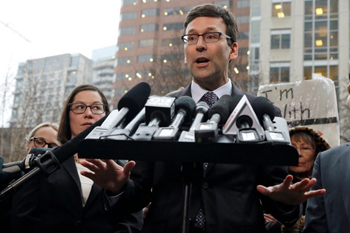
judgeU.S. District Judge James Robart in Seattle ruled that Washington state and Minnesota had standing to challenge Trump's order, which government lawyers disputed, and said they showed their case was likely to succeed.

“The state has met its burden in demonstrating immediate and irreparable injury,” Robart said.

Trump's order last week sparked protests nationwide and confusion at airports as some travelers were detained. The White House has argued that it will make the country safer.

It wasn't immediately clear what happens next for people who had waited years to receive visas to come to America. The Department of Homeland Security wouldn't comment, but the State Department had previously ordered visas from the seven countries revoked.

Washington became the first state to sue over the order that temporarily bans travel for people from Iran, Iraq, Syria, Sudan, Somalia, Libya and Yemen and suspends the U.S. refugee programme.

State Attorney General Bob Ferguson said the travel ban significantly harms residents and effectively mandates discrimination. Minnesota joined the lawsuit two days later.

After the ruling, Mr. Ferguson said people from the affected countries can now apply for entry to the U.S.

“Judge Robart's decision, effective immediately ... puts a halt to President Trump's unconstitutional and unlawful executive order,” Mr. Ferguson said. “The law is a powerful thing it has the ability to hold everybody accountable to it, and that includes the President of the United States.”

Gillian M. Christensen, a spokeswoman for the Department of Homeland Security, said the agency doesn't comment on pending litigation. The judge's ruling could be appealed the 9th U.S. Circuit Court of Appeals.

Federal attorneys had argued that Congress gave the President authority to make decisions on national security and immigrant entry.

The two states won a temporary restraining order while the court considers the lawsuit, which aims to permanently block Trump's order. Court challenges have been filed nationwide from states and advocacy groups.

In court, Washington Solicitor General Noah Purcell said the focus of the state's legal challenge was the way the President's order targeted Islam.

Mr. Trump has called for a ban on Muslims entering the country, and the travel ban was an effort to make good on that campaign promise, Ms. Purcell told the judge.

“Do you see a distinction between campaign statements and the executive order,” Judge Robart asked. “I think it's a bit of a reach to say the President is anti-Muslim based on what he said in New Hampshire in June.”

Ms. Purcell said there was an “overwhelming amount of evidence” to show that the order was directed at the Muslim religion, which is unconstitutional.

When the judge questioned the federal government's lawyer, Michelle Bennett, he repeatedly questioned the rationale behind the order.

Judge Robart, who was appointed the federal bench by President George W. Bush, asked if there had been any terrorist attacks by people from the seven counties listed in Mr. Trump's order since 9/11. Bennett said she didn't know.

“The answer is none,” Judge Robart said. “You're here arguing we have to protect from these individuals from these countries, and there's no support for that.”

Ms. Bennett argued that the states can't sue on behalf of citizens and the states have failed to show the order is causing irreparable harm.

Judge Robart disagreed.

“The state has met its burden of demonstrating immediate and irreparable injury,” he said. “I find the TRO is in the public interest.”

Up to 60,000 foreigners from the seven majority-Muslim countries had their visas canceled because of the executive order, the State Department said on Friday.

That figure contradicts a statement from a Justice Department lawyer on the same day during a court hearing in Virginia about the ban. The lawyer in that case said about 100,000 visas had been revoked.

The State Department clarified that the higher figure includes diplomatic and other visas that were actually exempted from the travel ban, as well as expired visas.

Mr. Ferguson, a Democrat, said the order is harming Washington residents, businesses and its education system.

Washington-based businesses Amazon, Expedia and Microsoft support the state's efforts to stop the order. They say it's hurting their operations, too.

Lawyers for Washington state said another hearing was expected in the next few weeks.

Comments

Add new comment

  • Coastaldigest.com reserves the right to delete or block any comments.
  • Coastaldigset.com is not responsible for its readers’ comments.
  • Comments that are abusive, incendiary or irrelevant are strictly prohibited.
  • Please use a genuine email ID and provide your name to avoid reject.
News Network
February 22,2020

Johannesburg, Feb 22: To meet shortage of skilled nursing staff, private hospitals in South Africa are recruiting senior Indian nurses for their good work ethics and ability to become efficient trainers for the local staff, according to a media report.

A report at a 2018 jobs summit indicated that the country had a shortage of more than 47,000 nurses.

The shortage of the skilled nursing staff has been attributed to several factors, including preference of highly qualified nurses to emigrate or take up contract employment in countries such as the UK, the United Aarb Emirates, Saudi Arabia or New Zealand for want of higher salaries, a report in the weekly Business Times said.

Mediclinic, one of South Africa's largest private hospital groups, confirmed that it is recruiting 150 nurses from India this year.

“To supplement our training, as an internal strategy, we will continue to recruit senior registered nurses from India,” a Mediclinic spokesperson told the Business Times.

Mediclinic started recruiting nurses from India in 2005 but could not provide details about how many among the more than 8,800 nurses it employs at its hospitals are from India.

Another company, Life Healthcare SA, said it employed 135 Indian nurses between 2008 and 2014.

Top managements at the hospital groups lauded senior Indian nurses as being very efficient trainers for local staff.

“But we find that many of them prefer coming here on short-term contracts due to family commitments," a hospital executive said on the basis of anonymity.

The official said that the few who apply for long-term positions are usually young newly-qualified nurses, which is not the group in demand.

“They work hard, with a patient-oriented work ethic, and do not have the nine-to-five approach of many local nurses, especially those who are unionised," the official said.

“We would be very happy to take in more nursing staff from India," the official added.

Comments

Add new comment

  • Coastaldigest.com reserves the right to delete or block any comments.
  • Coastaldigset.com is not responsible for its readers’ comments.
  • Comments that are abusive, incendiary or irrelevant are strictly prohibited.
  • Please use a genuine email ID and provide your name to avoid reject.
News Network
April 6,2020

Tokyo, April 6: Japan Prime Minister Shinzo Abe is planning to declare a state of emergency in view of the surging cases of coronavirus in the country, especially in Tokyo and other large cities, government sources said on Monday.

Pressure had been mounting on Abe to make the declaration amid a spurt in COVID-19 cases recently, with calls for the move from Tokyo Governor Yuriko Koike and the Japan Medical Association intensifying, Xinhua news agency reported.

The Tokyo metropolitan government, along with healthcare specialists, said that the number of hospital beds available for coronavirus patients will soon reach capacity, with the health ministry rapidly trying to secure more beds.

Adding to pressure on the government to demonstrably bolster its preventive and countermeasures to the spread of the virus, a panel of government experts warned recently that the country's healthcare system could collapse if coronavirus cases continue to spike.

The healthcare system in Tokyo and four other prefectures are under increased strain and "drastic countermeasures need to be taken as quickly as possible," the experts said.

As of Sunday, 143 new cases of COVID-19 were recorded in Tokyo, a record daily high for the capital, bringing the total to 1,034, with Japan's health ministry and local governments adding that nationwide cases rose to 3,531 as of Sunday afternoon.

Comments

Add new comment

  • Coastaldigest.com reserves the right to delete or block any comments.
  • Coastaldigset.com is not responsible for its readers’ comments.
  • Comments that are abusive, incendiary or irrelevant are strictly prohibited.
  • Please use a genuine email ID and provide your name to avoid reject.
Agencies
May 26,2020

UN, May 26: Countries could see a "second peak" of coronavirus cases during the first wave of the pandemic if lockdown restrictions were lifted too soon, the World Health Organization (WHO) has warned.

Mike Ryan, the WHO's head of emergencies, told a briefing on Monday that the world was "right in the middle of the first wave", the BBC reported.

He said because the disease was "still on the way up", countries need to be aware that "the disease can jump up at any time".

"We cannot make assumptions that just because the disease is on the way down now that it's going to keep going down," Ryan said.

There would be a number of months to prepare for a second peak, he added.

The stark warning comes as countries around the world start to gradually ease lockdown restrictions, allowing shops to reopen and larger groups of people to gather.

Experts have said that without a vaccine to give people immunity, infections could increase again when social-distancing measures are relaxed.

Ryan said countries where cases are declining should be using this time to develop effective trace-and-test regimes to "ensure that we continue on a downwards trajectory and we don't have an immediate second peak".

Also on Monday, Tedros Adhanom Ghebreyesus, WHO Director-General, said that a clinical trial of hydroxychloroquine (HCQ) on COVID-19 patients has come to "a temporary pause", while the safety data of the the anti-malaria drug was being reviewed.

According to the WHO chief, The Lancet medical journal on May 22 had published an observational study on HCQ and chloroquine and its effects on COVID-19 patients that have been hospitalized, reports Xinhua news agency.

The authors of the study reported that among patients receiving the drug, when used alone or with a macrolide, they estimated a higher mortality rate.

"The Executive Group of the Solidarity Trial, representing 10 of the participating countries, met on Saturday (May 23) and has agreed to review a comprehensive analysis and critical appraisal of all evidence available globally," Tedros said in a virtual press conference.

The developments come as the total number of global COVID-19 cases has increased to 5,508,904, with 346,508 deaths, according to the Johns Hopkins University.

Comments

Add new comment

  • Coastaldigest.com reserves the right to delete or block any comments.
  • Coastaldigset.com is not responsible for its readers’ comments.
  • Comments that are abusive, incendiary or irrelevant are strictly prohibited.
  • Please use a genuine email ID and provide your name to avoid reject.