


US museum to return 'stolen' artwork bought from Indian dealer

April 5, 2015

Boston, Apr 5: One of the US' prestigious art museums will hand over to American authorities a rare mid-19th century Tanjore portrait bought from notorious art dealer Subhash Kapoor accused of trafficking stolen antiquities from India.

The Peabody Essex Museum in Massachusetts yesterday announced that it will hand over the Indian artwork to the Department of Homeland Security as part of the government's ongoing investigation into an alleged international art fraud enterprise.
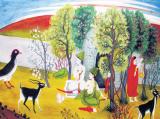
US museumThe artwork titled 'Maharaja Serfoji II of Tanjavur and his son Shivaji II' was purchased by the Museum from Kapoor's New York gallery in 2006 for USD 35,000, the Boston Globe reported.

The Peabody Essex is the second US museum to voluntarily agree to relinquish a work of art linked to the dealer.

Earlier this week, the Honolulu Museum of Art returned seven pieces purchased from Kapoor following a probe during which it emerged that the objects had been stolen from temples and ancient Buddhist sites in India and brought to the US illegally.

Kapoor was arrested in 2011 in Germany on charges of trafficking in looted Indian antiquities. He was extradited to India and is awaiting trial. He has pleaded not guilty.

Peabody Essex Museum director Dan L Monroe said the allegations of Kapoor's art trafficking have created "shock waves" around the world.

"It involves a substantial number of art museums, and they're not just in the US," he said, adding that he knew of 18 museums with pieces linked to Kapoor in their collections.

Monroe said the the Museum has been working with Homeland Security Investigations, a division of the federal department, since Kapoor's arrest at the airport in Frankfurt in 2011.

"We took a proactive role to notify the Department of Homeland Security of all works we had through gift or purchase from Kapoor," said Monroe.

Monroe said Kapoor first established his relationship with the Peabody Essex by donating works to the collection.

"He made several gifts to the museum and then eventually offered works for purchase," Monroe said.

He said the Peabody-Essex collection still has "six or seven" of Kapoors works, which federal investigators have told the museum do not appear to have been improperly acquired.

Luis Martinez, a public affairs officer with the Bureau of Immigration and Customs Enforcement, said the investigation known as Operation Hidden Idol has already recovered approximately 1,000 items, worth an estimated USD 150 million, linked to Kapoor, the daily reported.

While some of the works are more recent, many are much older, including a second-century BC pillar sculpture valued at nearly USD 18 million and a 2,000-year-old terra cotta rattle.

"It is the largest seizure that HSI has made from an individual," said Martinez, who added that investigators have identified approximately 2,000 pieces linked to Kapoor that they suspect were looted.

He noted that many of the works are in museums and private collections. "A lot of these museums are victims themselves," he said.

Comments

Add new comment

  • Coastaldigest.com reserves the right to delete or block any comments.
  • Coastaldigset.com is not responsible for its readers’ comments.
  • Comments that are abusive, incendiary or irrelevant are strictly prohibited.
  • Please use a genuine email ID and provide your name to avoid reject.
News Network
February 22,2020

Feb 22: A 20-year-old Chinese woman from Wuhan, the epicentre of the coronavirus outbreak, travelled 400 miles(675 km) north to Anyang where she infected five relatives, without ever showing signs of infection, Chinese scientists reported on Friday, offering new evidence that the virus can be spread asymptomatically.

The case study, published in the Journal of the American Medical Association, offered clues about how the coronavirus is spreading, and suggested why it may be difficult to stop.

"Scientists have been asking if you can have this infection and not be ill? The answer is apparently, yes," said Dr. William Schaffner, an infectious disease expert at Vanderbilt University Medical Center, who was not involved in the study.

China has reported a total of 75,567 cases of the virus known as COVID-19 to the World Health Organization (WHO) including 2,239 deaths, and the virus has already spread to 26 countries and territories outside of mainland China.

Researchers have reported sporadic accounts of individuals without any symptoms spreading the virus. What's different in this study is that it offers a natural lab experiment of sorts, Schaffner said.

"You had this patient from Wuhan where the virus is, travelling to where the virus wasn't. She remained asymptomatic and infected a bunch of family members and you had a group of physicians who immediately seized on the moment and tested everyone."

According to the report by Dr Meiyun Wang of the People's Hospital of Zhengzhou University and colleagues, the woman travelled from Wuhan to Anyang on Jan. 10 and visited several relatives. When they started getting sick, doctors isolated the woman and tested her for coronavirus. Initially, the young woman tested negative for the virus, but a follow-up test was positive.

All five of her relatives developed COVID-19 pneumonia, but as of Feb. 11, the young woman still had not developed any symptoms, her chest CT remained normal and she had no fever, stomach or respiratory symptoms, such as cough or sore throat.

Scientists in the study said if the findings are replicated, "the prevention of COVID-19 infection could prove challenging."

Key questions now, Schaffner said, are how often does this kind of transmission occur and when during the asymptomatic period does a person test positive for the virus.

Comments

Add new comment

  • Coastaldigest.com reserves the right to delete or block any comments.
  • Coastaldigset.com is not responsible for its readers’ comments.
  • Comments that are abusive, incendiary or irrelevant are strictly prohibited.
  • Please use a genuine email ID and provide your name to avoid reject.
Agencies
June 13,2020

Washington, Jun 13: America's first-ever Hindu lawmaker Tulsi Gabbard has said that in this chaotic time, one can find certainty, strength, and peace in Bhagavad Gita.

In her message during a virtual commencement address, the 39-year-old Congresswoman from Hawaii said that it is a chaotic time and no one can say with certainty what tomorrow looks like.

"... but we find certainty, strength, and peace in the practice of Bhakti Yoga and Karma Yoga taught to us by Krishna in the Bhagavad Gita," Tulsi Gabbard told the 'Class of 2020 for Hindu students''.

Her address came amidst protests in the US against the killing of African-American George Floyd by a white police officer in Minneapolis.

The country has been swept by protests since George Floyd's custodial death on May 25 with thousands of people mounting pressure for changes to the law enforcement practices.

The first-ever virtual Hindu commencement was organised by the Hindu Students Council on June 7, which drew thousands of viewers on Facebook and YouTube Live, all coming together in solidarity during the ongoing COVID-19 crisis.

According to Johns Hopkins Coronavirus Resource Center, the contagion has infected over 76,00,000 people and killed more than 4,25,000 across the world. The US is the worst affected country with over 2.04 million cases and more than 1,14,000 deaths.

The COVID-19, which originated in China''s Wuhan city in December last year, has also battered the world economy with the International Monetary Fund saying that the global economy is bound to suffer a "severe recession".

Scientists are racing against time to find a vaccine or medicine for its treatment.

Hundreds of graduates from the US, Canada, the UK, India and Australia attended to commemorate their graduation in a unique way - by celebrating their shared Hindu values.

Professor Subhash Kak served as the ceremony's Grand Marshall.

"As you think about this new chapter in your lives, ask yourself what is my purpose in life? It is a deep question that if you can recognise now that your purpose is to serve God and God''s children, practicing Karma Yoga, then you can lead a truly successful life," Tulsi Gabbard said.

"Success is not defined by temporary material things, trinkets, glittery objects or accomplishments - but a deeply successful and happy life centered around service," she added.

The Iraq war veteran ended her presidential campaign in March and offered her full support to former vice president Joe Biden, 77, who is all set to challenge Republican incumbent Donald Trump, 73, in November elections.

The commencement address focused heavily on themes from the Bhagavad Gita, a timeless historical text that many Hindus consider their moral framework.

Professor Kak, Regent Professor at Oklahoma State University and 2019 Padma Shri recipient, read out the names of the graduating students.

"I exhort you - the graduating students - to be the leaders of the new world where education is less of the mind of a vessel to be filled with information (usually forgotten after the semester is over), and more of a flame that is lit as envisioned by our Vedic sages," he said.

The student speakers were from many university campuses, including the Massachusetts Institute of Technology, Princeton, and Stanford.

Listen to the latest songs, only on JioSaavn.com

The programme included offerings of Hindu prayers, recitation of a traditional graduation message from the Upanishads, and a symbolic conferral of degrees to high school and college graduate.

Founded in 1990, Hindu Students Council is North America''s largest pan-Hindu youth organisation. 

Comments

Add new comment

  • Coastaldigest.com reserves the right to delete or block any comments.
  • Coastaldigset.com is not responsible for its readers’ comments.
  • Comments that are abusive, incendiary or irrelevant are strictly prohibited.
  • Please use a genuine email ID and provide your name to avoid reject.
News Network
March 29,2020

Beijing, Mar 29: In a rare display of public anger in China, dozens of people in central Hubei province, the epicentre of the coronavirus outbreak till recently, attacked official vehicles after they were stopped from crossing a bridge and travel to neighbouring Jiangxi after the lifting of the lockdown.
Hubei province with over 56 million people was kept under lockdown from January 23 as part of aggressive measures to bring down COVID-19 cases which rapidly spread in the area.

Videos on Chinese social media on Friday showed unprecedented scenes of police from Hubei and Jiangxi clashing on the bridge connecting the two provinces over barricades erected from stopping Hubei people from moving out over fears of coronavirus spreading.

Policemen from both sides argued over how to verify if people were allowed to enter Jiangxi, according to local media reports.

It was a major relief for millions of people in Hubei province, when the Chinese government which kept it under lockdown lifted the restrictions on travel.

The government will permit people from the province to travel if they hold a green health code, meaning no contact with any infected or suspected COVID-19 cases.

But people of Hubei to their shock on Friday found roadblocks on the 1st Yangtze River Bridge that separates Huangmei county in Hubei erected by Huangmei county of Jiangxi province.

In local media reports, witnesses were quoted as saying that Huangmei police in Jiujiang erected roadblocks on the bridge to stop people from Hubei from crossing it, a move they alleged stigmatised them.

Video footage shared online showed rows of police armed with riot shields holding back the crowds, while members of the public could be seen damaging and even overturning police vehicles.

In a clip published by the Huanggang city government, which administers Huangmei, the county's Communist Party chief Ma Yanzhou could be heard speaking to the people through a loud hailer, warning them that by gathering in a large group they were increasing their chances of contracting the virus, Hong Kong-based South China Morning Post reported.

While it is unclear exactly how the clash started, police from the two sides published separate official statements online, which were quickly deleted, it said.

The incident underlines the problems China faces as it seeks a return to normalcy after months of lockdown, the Post said.

After the incident, the governments of Huangmei and Jiujiang on Friday issued a joint statement saying they had agreed to remove the barriers set up to restrict travel during the lockdown, and also to recognise each other's health screening codes to make it easier for people in good health to get to where they needed to be, the Post report said.

An article by the ruling Communist Party of China (CPC) mouthpiece, People''s Daily acknowledged the problems in getting the country back on its feet.

"In the past few days, all walks of life have called for governments to accept workers from Hubei," it said.

"However, it is undeniable that some places, intentionally or not, have set up obstacles for Hubei migrant workers to return to their posts and hold prejudices against them."

Comments

Add new comment

  • Coastaldigest.com reserves the right to delete or block any comments.
  • Coastaldigset.com is not responsible for its readers’ comments.
  • Comments that are abusive, incendiary or irrelevant are strictly prohibited.
  • Please use a genuine email ID and provide your name to avoid reject.