


US museum to return 'stolen' artwork bought from Indian dealer

April 5, 2015

Boston, Apr 5: One of the US' prestigious art museums will hand over to American authorities a rare mid-19th century Tanjore portrait bought from notorious art dealer Subhash Kapoor accused of trafficking stolen antiquities from India.

The Peabody Essex Museum in Massachusetts yesterday announced that it will hand over the Indian artwork to the Department of Homeland Security as part of the government's ongoing investigation into an alleged international art fraud enterprise.
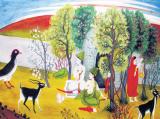
US museumThe artwork titled 'Maharaja Serfoji II of Tanjavur and his son Shivaji II' was purchased by the Museum from Kapoor's New York gallery in 2006 for USD 35,000, the Boston Globe reported.

The Peabody Essex is the second US museum to voluntarily agree to relinquish a work of art linked to the dealer.

Earlier this week, the Honolulu Museum of Art returned seven pieces purchased from Kapoor following a probe during which it emerged that the objects had been stolen from temples and ancient Buddhist sites in India and brought to the US illegally.

Kapoor was arrested in 2011 in Germany on charges of trafficking in looted Indian antiquities. He was extradited to India and is awaiting trial. He has pleaded not guilty.

Peabody Essex Museum director Dan L Monroe said the allegations of Kapoor's art trafficking have created "shock waves" around the world.

"It involves a substantial number of art museums, and they're not just in the US," he said, adding that he knew of 18 museums with pieces linked to Kapoor in their collections.

Monroe said the the Museum has been working with Homeland Security Investigations, a division of the federal department, since Kapoor's arrest at the airport in Frankfurt in 2011.

"We took a proactive role to notify the Department of Homeland Security of all works we had through gift or purchase from Kapoor," said Monroe.

Monroe said Kapoor first established his relationship with the Peabody Essex by donating works to the collection.

"He made several gifts to the museum and then eventually offered works for purchase," Monroe said.

He said the Peabody-Essex collection still has "six or seven" of Kapoors works, which federal investigators have told the museum do not appear to have been improperly acquired.

Luis Martinez, a public affairs officer with the Bureau of Immigration and Customs Enforcement, said the investigation known as Operation Hidden Idol has already recovered approximately 1,000 items, worth an estimated USD 150 million, linked to Kapoor, the daily reported.

While some of the works are more recent, many are much older, including a second-century BC pillar sculpture valued at nearly USD 18 million and a 2,000-year-old terra cotta rattle.

"It is the largest seizure that HSI has made from an individual," said Martinez, who added that investigators have identified approximately 2,000 pieces linked to Kapoor that they suspect were looted.

He noted that many of the works are in museums and private collections. "A lot of these museums are victims themselves," he said.

Comments

Add new comment

  • Coastaldigest.com reserves the right to delete or block any comments.
  • Coastaldigset.com is not responsible for its readers’ comments.
  • Comments that are abusive, incendiary or irrelevant are strictly prohibited.
  • Please use a genuine email ID and provide your name to avoid reject.
Agencies
January 9,2020

Washington, Jan 9: The U.S. and Iran stepped back from the brink of possible war Wednesday as President Donald Trump signaled he would not retaliate militarily for Iran's missile strikes on Iraqi bases housing U.S. troops. No one was harmed in the strikes, but U.S. forces in the region remained on high alert.

Speaking from the White House, Trump seemed intent on deescalating the crisis, which spiralled after he authorized the assassination of Iran's top general, Qassem Soleimani. Iran responded overnight by firing more than a dozen missiles at two installations in Iraq, its most direct assault on America since the 1979 seizure of the U.S. Embassy in Tehran.

Trump's takeaway was that “Iran appears to be standing down, which is a good thing for all parties concerned and a very good thing for the world.”

The region remained on edge, however, and American troops including a quick-reaction force dispatched over the weekend were on high alert. Hours after Trump spoke, an ‘incoming’ siren went off in Baghdad's Green Zone after what seemed to be small rockets “impacted” the diplomatic area, a Western official said. There were no reports of casualties.

Iran's Supreme Leader Ayatollah Ali Khamenei said the overnight strike was not necessarily the totality of Iran's response. “Last night they received a slap,” Khamenei said. “These military actions are not sufficient (for revenge). What is important is that the corrupt presence of America in this region comes to an end.”

The strikes had pushed Tehran and Washington perilously close to all-out conflict and left the world waiting to see whether the American president would respond with more military force. Trump, in his nine-minute, televised address, spoke of a robust U.S. military with missiles that are “big, powerful, accurate, lethal and fast.'' But then he added: “We do not want to use it."

Iran for days had been promising to respond forcefully to Soleimani's killing, but its limited strike on two bases--one in the northern Iraqi city of Irbil and the other at Ain al-Asad in western Iraq--appeared to signal that it too was uninterested in a wider clash with the U.S. Foreign minister Mohammad Javad Zarif tweeted that the country had “concluded proportionate measures in self-defence.”

Trump said the U.S. was “ready to embrace peace with all who seek it.” That marked a sharp change in tone from his warning a day earlier that “if Iran does anything that they shouldn't be doing, they're going to be suffering the consequences, and very strongly.”

Trump opened his remarks at the White House by reiterating his promise that “Iran will never be allowed to have a nuclear weapon.” Iran had announced in the wake of Soleimani's killing that it would no longer comply with any of the limits on uranium enrichment in the 2015 nuclear deal crafted to keep it from building a nuclear device.

The president, who had earlier pulled the U.S. out of the deal, seized on the moment of calm to call for negotiations toward a new agreement that would do more to limit Iran's ballistic missile programmes and constrain regional proxy campaigns like those led by Soleimani.

Trump spoke of new sanctions on Iran, but it was not immediately clear what those would be.

Comments

Add new comment

  • Coastaldigest.com reserves the right to delete or block any comments.
  • Coastaldigset.com is not responsible for its readers’ comments.
  • Comments that are abusive, incendiary or irrelevant are strictly prohibited.
  • Please use a genuine email ID and provide your name to avoid reject.
News Network
April 26,2020

Apr 26: The Chinese city of Wuhan, where the global coronavirus pandemic began, now has no remaining cases in its hospitals, a health official told reporters on Sunday.

"The latest news is that by April 26, the number of new coronavirus patients in Wuhan was at zero, thanks to the joint efforts of Wuhan and medical staff from around the country," National Health Commission spokesman Mi Feng said at a briefing.

The city had reported 46,452 cases, 56% of the national total. It saw 3,869 fatalities, or 84% of China's total.

Comments

Add new comment

  • Coastaldigest.com reserves the right to delete or block any comments.
  • Coastaldigset.com is not responsible for its readers’ comments.
  • Comments that are abusive, incendiary or irrelevant are strictly prohibited.
  • Please use a genuine email ID and provide your name to avoid reject.
Agencies
July 28,2020

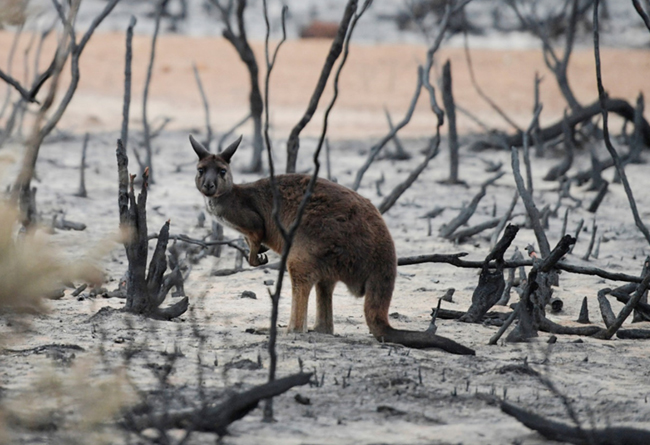
Sydney, Jul 28: Nearly 3 billion koalas, kangaroos and other native Australian animals were killed or displaced by bushfires in 2019 and 2020, a study by the World Wide Fund for Nature (WWF) said on Tuesday, triple the group's earlier estimates.

Some 143 million mammals, 2.46 billion reptiles, 180 million birds and 51 million frogs were impacted by the country's worst bushfires in decades, the WWF said.

When the fires were still blazing, the WWF estimated the number of affected animals at 1.25 billion. The fires destroyed more than 11 million hectares (37 million acres) across the Australian southeast, equal to about half the area of the United Kingdom.

"This ranks as one of the worst wildlife disasters in modern history," said WWF-Australia Chief Executive Officer Dermot O'Gorman in a statement.

The project leader Lily Van Eeden, from the University of Sydney, said the research was the first continent-wide analysis of animals impacted by the bushfires, and "other nations can build upon this research to improve understanding of bushfire impacts everywhere".

The total number included animals which were displaced because of destroyed habitats and now faced lack of food and shelter or the prospect of moving to habitat that was already occupied.

The main reason for raising the number of animal casualties was that researchers had now assessed the total affected area, rather than focusing on the most affected states, they said.

After years of drought made the Australian bush unusually dry, the country battled one of its worst bushfire seasons ever from September 2019 to March 2020, resulting in 34 human deaths and nearly 3,000 homes lost.

Comments

Add new comment

  • Coastaldigest.com reserves the right to delete or block any comments.
  • Coastaldigset.com is not responsible for its readers’ comments.
  • Comments that are abusive, incendiary or irrelevant are strictly prohibited.
  • Please use a genuine email ID and provide your name to avoid reject.