



US objects to Pakistan's nuke threats against India

October 1, 2016

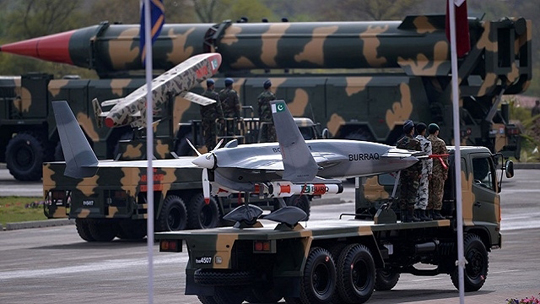
Washington, Oct 1: The United States has strongly objected to threats of nuclear warfare made by Pakistan against India and has conveyed its displeasure to that country in this regard.
pak

"We made that (American objection on nuclear threat) clear to them (Pakistan). Repeatedly," a senior State Department official said.

The official who spoke on condition of anonymity, however, would not reveal the level at which the message was conveyed to Pakistan.

"It is very concerning. It is a serious thing," the official said when asked about Pakistan Defence Minister Khawaja Asif's assertions, twice in the last 15 days, that his country could use nuclear weapons against India.

"We will destroy India if it dares to impose war on us," Asif had told a Pakistani news channel in his latest interview. "Pakistan army is fully prepared to answer any misadventure of India."

"We have not made atomic device to display in a showcase. If a such a situation arises we will use it (nuclear weapons) and eliminate India," Asif had said.

The statements raised eyebrows in the Obama Administration and is seen as "irresponsible" behaviour by top Pakistani leadership.

In a tacit acknowledgement that it has concerns over the safety of nuclear weapons in Pakistan, the official said the US is closely monitoring the safety and security of those weapons of mass destruction.

"The safety of these weapons is always a concern for us. So we are always monitoring it, regardless of what they said on this particular occasion," said the State Department official.

Meanwhile, Deputy State Department Spokesman Mark Toner told reporters at his daily news conference that nuclear-capable states have "a very clear responsibility to exercise restraint regarding nuclear weapons and missile capabilities".

The United States, meanwhile, continued to urge both India and Pakistan to take steps to de-escalate tension following the Uri terror attack that has claimed the lives of 19 Indian soldiers.

"At the same time we have made it very clear that what happened in the Indian army base (Uri) is an act of terror," the senior State Department official said. According to another official of the department, "everyone knows" where the perpetrators of the Uri terrorist attack came from.

At his news conference, Toner said the US continues to follow the situation on the ground very closely.

"From our perspective, we urge calm and restraint by both sides. We understand that the Pakistani and Indian militaries have been in communication and we believe that continued communication between them is important to reduce tensions.

"I think we certainly don't want to see any kind of escalation and certainly any kind of break in that communication. We have repeatedly and consistently expressed our concerns regarding the danger that cross-border terrorism poses for the region, and that certainly includes the recent attacks - terrorist attacks in Uri," he said.

"We continue to urge actions to combat and de-escalate - and delegitimise terrorist groups like Lashkar-e-Taiba, Haqqani Network, as well as Jaish-e-Mohammad," Toner said.

Comments

Add new comment

  • Coastaldigest.com reserves the right to delete or block any comments.
  • Coastaldigset.com is not responsible for its readers’ comments.
  • Comments that are abusive, incendiary or irrelevant are strictly prohibited.
  • Please use a genuine email ID and provide your name to avoid reject.
News Network
January 19,2020

President Donald Trump gave a new justification for killing Qassim Suleimani, telling a gathering of Republican donors that the top Iranian general was "saying bad things about our country" before the strike, which led to his decision to authorise his killing. "How much are we going to listen to?" Trump said on Friday, according to remarks from a fundraiser obtained by CNN.

With his typical dramatic flourish, Trump recounted the scene as he monitored the strikes from the White House Situation Room when Suleimani was killed. The president spoke in a ballroom at his Mar-a-Lago club in Palm Beach, Florida, at a Republican event that raised $10 million for Trump's 2020 campaign.

The January 3 killing of Suleimani prompted Iran to retaliate with missile strikes against US forces in Iraq days later and almost triggered a broad war between the two countries. "They're together sir," Trump said military officials told him. "Sir, they have two minutes and 11 seconds. No emotion. Two minutes and 11 seconds to live, sir. They're in the car, they're in an armoured vehicle. Sir, they have approximately one minute to live, sir. Thirty seconds. Ten, 9, 8 ...'"

"Then all of a sudden, boom," he said. "They're gone, sir. Cutting off, I said, where is this guy?" Trump continued. "That was the last I heard from him". It was the most detailed account that Trump has given of the drone strike, which has drawn criticism from some US lawmakers because neither the president nor his advisers have provided public information to back up their statements that Suleimani presented an "imminent" threat to US.

Trump's comments came a day after he warned Iran's supreme leader Ayatollah Ali Khamenei to be "very careful with his words". According to Trump, Khamenei's speech on Friday, in which he attacked the "vicious" US and described UK, France and Germany as "America's lackeys", was a mistake.

Comments

Add new comment

  • Coastaldigest.com reserves the right to delete or block any comments.
  • Coastaldigset.com is not responsible for its readers’ comments.
  • Comments that are abusive, incendiary or irrelevant are strictly prohibited.
  • Please use a genuine email ID and provide your name to avoid reject.
Agencies
February 4,2020

As the deadly coronavirus has spread worldwide, it has carried with it xenophobia -- and Asian communities around the world are finding themselves subject to suspicion and fear.

When a patient on Australia's Gold Coast refused to shake the hand of her surgeon Rhea Liang, citing the virus that has killed hundreds, the medic's first response was shock.

But after tweeting about the incident and receiving a flood of responses, the respected doctor learned her experience was all too common.

There has been a spike in reports of anti-Chinese rhetoric directed at people of Asian origin, regardless of whether they have ever visited the centre of the epidemic or been in contact with the virus.

Chinese tourists have reportedly been spat at in the Italian city of Venice, a family in Turin was accused of carrying the disease, and mothers in Milan have used social media to call for children to be kept away from Chinese classmates.

In Canada, a white man was filmed telling a Chinese-Canadian woman "you dropped your coronavirus" in the parking lot of a local mall.

In Malaysia, a petition to "bar Chinese people from entering our beloved country" received almost 500,000 signatures in one week.

The incidents are part of what the Australasian College for Emergency Medicine has described as "misinformation" which it says is fuelling "racial profiling" where "deeply distressing assumptions are being made about 'Chinese' or 'Asian-looking' people." Disease has long been accompanied by suspicions of foreigners -- from Irish immigrants being targeted in the Typhoid Mary panic of 1900s America to Nepali peacekeepers being accused of bringing cholera to earthquake-struck Haiti in the last decade.

"It's a common phenomenon," said Rob Grenfell, director of health and biosecurity for Australia's science and research agency CSIRO.

"With outbreaks and epidemics along human history, we've always tried to vilify certain subsets of the population," he said, comparing the behaviour to 1300s plague-ridden medieval Europe, where foreigners and religious groups were often blamed.

"Sure it emerged in China," he said of the coronavirus, "but that's no reason to actually vilify Chinese people." In a commentary for the British Medical Journal, doctor Abraar Karan warned this behaviour could discourage people with symptoms from coming forward.

Claire Hooker, a health lecturer at the University of Sydney, said the responses from governments may have compounded prejudice.

The World Health Organisation has warned against "measures that unnecessarily interfere with international travel and trade", but this has not stopped scores of countries from introducing travel bans.

The tiny Pacific nation of Micronesia has banned its citizens from visiting mainland China altogether.

"Travel bans respond largely to people's fears," said Hooker, and while sometimes warranted, they often "have the effect of cementing an association between Chinese people and scary viruses".

Abbey Shi, a Shanghai-born student in Sydney, said the attitude shown by some of her peers has "become almost an attack on students who are Chinese".

While Australia's conservative government has banished its citizens returning from Wuhan -- the central Chinese city at the epicentre of the virus -- to a remote island for quarantine, thousands of students still stuck in China risk their studies being torpedoed.

"Right now it looks like they have to miss the semester's start and potentially the whole year, because of the way the courses are set up," Shi said.

According to Hooker, studies in Toronto on the impact of Severe Acute Respiratory Syndrome, or SARS -- another global coronavirus outbreak in 2002 -- showed the impact of xenophobic sentiment often lasted much longer than the public health scare.

"While there may be a cessation of direct forms of racism as news about the disease dies down, it takes quite a bit of time for economic recovery and people continue to feel unsafe," she said.

People may not rush back to Chinese businesses or restaurants, and may even heed some of the more outlandish viral social media disinformation -- such as one popular post imploring people to avoid eating noodles for their own safety.

"In one sense you might think the effects lasted from the last coronavirus to this one because the representation as China being a place where diseases come from has been persistent," Hooker said.

Comments

Add new comment

  • Coastaldigest.com reserves the right to delete or block any comments.
  • Coastaldigset.com is not responsible for its readers’ comments.
  • Comments that are abusive, incendiary or irrelevant are strictly prohibited.
  • Please use a genuine email ID and provide your name to avoid reject.
March 27,2020

London, Mar 27:  British Prime Minister Boris Johnson said Friday he has tested positive for the new coronavirus, but remains in charge of the U.K.'s response to the outbreak.

Johnson's office said he was tested on the advice of the chief medical officer after showing mild symptoms.

It said Johnson is self-isolating at his 10 Downing St. residence and continuing to lead the country's response to COVID-19.

In a video message, Johnson said he had a temperature and a persistent cough.

Over the last 24 hours I have developed mild symptoms and tested positive for coronavirus.

I am now self-isolating, but I will continue to lead the government’s response via video-conference as we fight this virus.

Together we will beat this. #StayHomeSaveLives pic.twitter.com/9Te6aFP0Ri

— Boris Johnson #StayHomeSaveLives (@BorisJohnson) March 27, 2020
"Be in no doubt that I can continue, thanks to the wizardry of modern technology, to communicate with all my top team, to lead the national fightback against coronavirus."

Earlier this week Britain’s Prince Charles announced that he had tested positive for the virus.

Comments

Add new comment

  • Coastaldigest.com reserves the right to delete or block any comments.
  • Coastaldigset.com is not responsible for its readers’ comments.
  • Comments that are abusive, incendiary or irrelevant are strictly prohibited.
  • Please use a genuine email ID and provide your name to avoid reject.