


US presidency under Trump to boost strategic ties with India

November 9, 2016

Washington, Nov 9: US presidency under Donald Trump, a confessed big fan of India and Prime Minister Narendra Modi, is most likely to boost Indo-US strategic relationship with a special emphasis on defence ties and counter-terrorism cooperation.trumpp copy
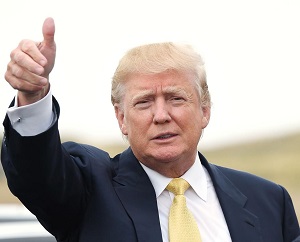
Trump, 70, had recently described India as "a key, and key strategic ally" and looks forward to deepening the diplomatic and military cooperation that is the shared interest of both countries.

The billionaire businessman who has lauded economic policies of Modi had said he wants to work with him.

At an event in New Jersey less than a month from now, Trump had promised to the Indian-American community in him India would find a true friend at the White House.

"I am a big fan of Hindu and I am a big fan of India. If I am elected president, the Indian and Hindu community would have a true friend at the White House," he had said at an event organised by the Hindu Republican Coalition.

Trump said he appreciated "great friend India in the fight against radical Islamic terrorism."

India has experienced firsthand "brutality of terror" in the past "including the mayhem in Mumbai," he said and described the 2008 Mumbai terror attack and that on Indian Parliament in 2001 as "absolutely outrageous" and terrible.

"We will defeat radical Islamic terrorism. We will stand soldier-to-soldier in this fight. This is so important in the age of ISIS," he said.

"India's is the world's largest democracy and is a natural ally of the US. Under a Trump Administration, we are going to become even better friends. In fact, I will take the word even out because we are going to be best friends. I look forward to working with Prime Minister Modi, who has been very energetic in reforming the economy and bureaucracy. Great man. I applaud him," he said.

"I look forward to doing some serious bureaucratic trimming right here in the US, believe me we need it most," Trump said.

"Your great Prime Minister has been a pro-growth leader for India. He has simplified the tax code, cut the taxes and the economy is strong growing at 7 per cent year. Excellent," he said.

On the eve of the November 8 general elections, a key military advisor to the Trump said that India will have an important role to play in the Trump Administration's Asia Pacific policy of "peace through strength."

"This is a country that shares our values, this is a country that shares a lot of geo-political interest and I think, his (Trump's) work is going to be continuing the tradition of Bush Administration which made a lot of progress in that regard," Alexander Gray, a military advisor and author of several of the ambitious defence policies of Trump, said.

"We (a Trump Administration) would be looking to strengthen not just the cultural and economic aspect, but also on the defence side there is so much common ground with India. At a time when India's foreign policy is changing because of China and Pakistan, because of Islamic terrorism, we need to be there to greet them with open arms. I think, the Trump Administration is ready to do that," Gray said.

Comments

Add new comment

  • Coastaldigest.com reserves the right to delete or block any comments.
  • Coastaldigset.com is not responsible for its readers’ comments.
  • Comments that are abusive, incendiary or irrelevant are strictly prohibited.
  • Please use a genuine email ID and provide your name to avoid reject.
News Network
April 15,2020

Wuhan, Apr 15: In the six days after top Chinese officials secretly determined they likely were facing a pandemic from a new coronavirus, the city of Wuhan at the epicenter of the disease hosted a mass banquet for tens of thousands of people; millions began traveling through for Lunar New Year celebrations.

President Xi Jinping warned the public on the seventh day, Janaury 20. But by that time, more than 3,000 people had been infected during almost a week of public silence, according to internal documents obtained by The Associated Press and expert estimates based on retrospective infection data.

That delay from Jan 14 to Jan. 20 was neither the first mistake made by Chinese officials at all levels in confronting the outbreak, nor the longest lag, as governments around the world have dragged their feet for weeks and even months in addressing the virus.

But the delay by the first country to face the new coronavirus came at a critical time — the beginning of the outbreak. China's attempt to walk a line between alerting the public and avoiding panic set the stage for a pandemic that has infected almost 2 million people and taken more than 126,000 lives.

A This is tremendous, a said Zuo-Feng Zhang, an epidemiologist at the University of California, Los Angeles. If they took action six days earlier, there would have been much fewer patients and medical facilities would have been sufficient. We might have avoided the collapse of Wuhan's medical system.

Other experts noted that the Chinese government may have waited on warning the public to stave off hysteria, and that it did act quickly in private during that time.

But the six-day delay by China's leaders in Beijing came on top of almost two weeks during which the national Center for Disease Control did not register any cases from local officials, internal bulletins obtained by the AP confirm. Yet during that time, from Jan 5 to Jan 17, hundreds of patients were appearing in hospitals not just in Wuhan but across the country.

It's uncertain whether it was local officials who failed to report cases or national officials who failed to record them. It's also not clear exactly what officials knew at the time in Wuhan, which only opened back up last week with restrictions after its quarantine.

But what is clear, experts say, is that China's rigid controls on information, bureaucratic hurdles and a reluctance to send bad news up the chain of command muffled early warnings. The punishment of eight doctors for rumor-mongering, broadcast on national television on Jan. 2, sent a chill through the city's hospitals.

Doctors in Wuhan were afraid, said Dali Yang, a professor of Chinese politics at the University of Chicago. It was truly intimidation of an entire profession. Without these internal reports, it took the first case outside China, in Thailand on Jan 13, to galvanize leaders in Beijing into recognising the possible pandemic before them. It was only then that they launched a nationwide plan to find cases distributing CDC-sanctioned test kits, easing the criteria for confirming cases and ordering health officials to screen patients, all without telling the public.

The Chinese government has repeatedly denied suppressing information in the early days, saying it immediately reported the outbreak to the World Health Organization.

Allegations of a cover-up or lack of transparency in China are groundless, said foreign ministry spokesman Zhao Lijian at a Thursday press conference.

The documents show that the head of China's National Health Commission, Ma Xiaowei, laid out a grim assessment of the situation on Jan. 14 in a confidential teleconference with provincial health officials.

A memo states that the teleconference was held to convey instructions on the coronavirus from President Xi Jinping, Premier Li Keqiang and Vice Premier Sun Chunlan, but does not specify what those instructions were.

The epidemic situation is still severe and complex, the most severe challenge since SARS in 2003, and is likely to develop into a major public health event, the memo cites Ma as saying.

The National Health Commission is the top medical agency in the country. In a faxed statement, the Commission said it had organised the teleconference because of the case reported in Thailand and the possibility of the virus spreading during New Year travel. It added that China had published information on the outbreak in an open, transparent, responsible and timely manner," in accordance with important instructions repeatedly issued by President Xi.

The documents come from an anonymous source in the medical field who did not want to be named for fear of retribution. The AP confirmed the contents with two other sources in public health familiar with the teleconference. Some of the memo's contents also appeared in a public notice about the teleconference, stripped of key details and published in February.

Under a section titled sober understanding of the situation, the memo said that clustered cases suggest that human-to-human transmission is possible. It singled out the case in Thailand, saying that the situation had changed significantly because of the possible spread of the virus abroad.

With the coming of the Spring Festival, many people will be traveling, and the risk of transmission and spread is high, the memo continued.

Comments

Add new comment

  • Coastaldigest.com reserves the right to delete or block any comments.
  • Coastaldigset.com is not responsible for its readers’ comments.
  • Comments that are abusive, incendiary or irrelevant are strictly prohibited.
  • Please use a genuine email ID and provide your name to avoid reject.
News Network
May 8,2020

New York, May 8: An Indian-American father and daughter, both doctors in New Jersey, have died due to the COVID-19, with Governor Phil Murphy describing their demise as “particularly tough" and hailed them for dedicating their lives for others.

Satyender Dev Khanna, 78, was a surgeon who served both on staff and as the head of the surgical departments for multiple hospitals across New Jersey for decades.

Priya Khanna, 43, was a double board-certified in both internal medicine and nephrology. She was Chief of Residents at Union Hospital, now part of RWJ Barnabas Health.

"Dr Satyender Dev Khanna and Dr Priya Khanna were father and daughter. They both dedicated their lives to helping others. This is a family dedicated to health and medicine. Our words cannot amply express our condolences," New Jersey Governor Murphy tweeted on Thursday.

“Both dedicated their lives to helping others and we lost both of them to COVID-19,” Murphy said during a press conference on Thursday, saying their demise is a "particularly tough one.”

Satyender passed away at the Clara Maass Medical Center where he had worked for more than 35 years.

Murphy described him as a "pioneering doctor” who was one of the first surgeons to perform laparoscopic surgery in the state. He is being remembered by colleagues as a “gentle and caring physician."

“And for a doctor, I'm not one, but I would bet, I don't think there could be a more fitting way to be remembered, or a nurse or a healthcare worker of any kind,” Murphy said, adding that the doctor had a passion for bicycling, and he often found peace from the hustle of the hospital in biking along the Jersey Shore.

Priya did all of her medical training in New Jersey and then did her fellowship in nephrology in South Jersey with the Cooper Health System. Like her father, she too worked at Clara Maass, where she died.

She was also Medical Director at two dialysis centres in Essex County and “took pride” in teaching the next generation of doctors, Murphy said, adding that the ICU physician who cared for Priya Khanna was trained and taught by her as well.

Follow live developments on the coronavirus pandemic here

“Priya will be remembered as a caring and selfless person who put others first. And even while in the hospital, fighting her own battle, she continued to check up on her mom and dad and her family,” Murphy said.

“This is a family, by the way, dedicated to health and medicine,” he said.

The governor spoke with Satyender's wife Komlish Khanna, who is a paediatrician. The couple has two more daughters - Sugandha Khanna, an emergency medicine physician and Anisha Khanna, a paediatrician.

“Unbelievable. Our words cannot amply express our condolences nor, I am sure, can they express the pain that the Khanna family is feeling. But I hope that the fact that our entire state mourns with them is some small comfort. And we mourn everyone we have lost. We commit in their memory to saving as many lives as we can,” Murphy said.

Comments

Add new comment

  • Coastaldigest.com reserves the right to delete or block any comments.
  • Coastaldigset.com is not responsible for its readers’ comments.
  • Comments that are abusive, incendiary or irrelevant are strictly prohibited.
  • Please use a genuine email ID and provide your name to avoid reject.
Agencies
February 4,2020

The death toll in China's coronavirus rose sharply to 425 with 64 deaths on Monday alone while 3,235 new confirmed cases were reported, taking the number of those infected with the deadly disease to 20,438, Chinese health authorities said on Tuesday.

The 64 people who died on Monday were all from the Hubei province, the epicentre of the virus, China's National Health Commission said.

Also, 3,235 new confirmed cases of novel coronavirus infection were reported, a big increase in a day.

Another 5,072 new suspected cases were reported on Monday, said the commission, adding that 492 patients became seriously ill.

The commission said that 2,788 patients remained in severe condition and 23,214 people were suspected of being infected with the virus, a pointer that it is increasingly turning virulent.

The overall confirmed cases on the Chinese mainland had reached 20,438 by the end of Monday, the commission said, noting that a total of 425 people had died of the disease.

A total of 632 people had been discharged from hospital after recovery, state-run Xinhua news agency reported As the virus spreads from human to human, 221,015 close contacts had been traced, with 171,329 others still under medical observation.

By the end of Monday, 15 confirmed cases had been reported in Hong Kong, eight in the Macao and 10 in Taiwan.

The Philippines reported the first overseas death from the virus on Sunday while 148 cases have been reported from abroad.

India has reported three cases of the coronavirus. All the three patients from Kerala recently returned from the affected Wuhan city.

Currently, 647 Indians and seven Maldivians who have been evacuated from Wuhan and Hubei are in 14-day quarantine at a medical camp in Manesar, near Delhi.

As the virus continued to spread at an alarming rate, Chinese President Xi Jinping on Monday warned officials of punishment if they shirked responsibility in tackling the virus outbreak.

On Monday, China has opened a 1,000-bed hospital built in record nine days in Wuhan city and started trials for new drug to contain the virus and is set to open another 1,300 bed hospital next to it on Wednesday.

The ruling Communist Party of China on Monday held its political bureau meeting presided by President Xi to review the steps being taken on various fronts to halt the spread of the deadly virus.

The outcome of the epidemic prevention and control directly affects people's lives and health, the overall economic and social stability and the country's opening-up, Xi said.

"Those who disobey the unified command or shirk off responsibilities will be punished," Xi was quoted as saying by the state-run Xinhua news agency.

Xi said that the party and government leaders supervising them would also be held accountable in severe cases.

Chinese armament firms, including those building aircraft carrier and military aircraft, have postponed planned work in order to concentrate on controlling the risk of coronavirus, state-run Global Times reported.

Noted Chinese health expert Zhong Nanshan has said that based on the fresh evidence, the novel coronavirus, which is spreading rapidly in China and the world, may reach its peak in the next 10 to 14 days, contrary to earlier estimates of climaxing sooner.

This means that the cases would drastically increase in the next two weeks before slowing down.

Also, China has begun clinical trials to test a drug to treat the patients of the coronavirus which till now has no cure.

Currently, patients are being treated with a combination of antivirals and other measures, as scientists race to find a vaccine.

Some reports said drugs to treat HIV too was being tried to treat the patients.

The experimental antiviral drug, Remdesivir, to be tested in field trials is developed by US-based Gilead Sciences. It is aimed at treating infectious diseases such as Ebola and SARS, South China Morning Post reported.

It was given to the first US patient last week - a 35-year-old man whose condition appeared to improve within a day, it said.

Comments

Add new comment

  • Coastaldigest.com reserves the right to delete or block any comments.
  • Coastaldigset.com is not responsible for its readers’ comments.
  • Comments that are abusive, incendiary or irrelevant are strictly prohibited.
  • Please use a genuine email ID and provide your name to avoid reject.