



US Senate Confirms Nikki Haley For US Ambassador To The UN With Huge Margin

January 25, 2017

Washington, Jan 25: The Senate confirmed President Donald Trump's pick for US ambassador to the United Nations by a decisive margin on Tuesday as Republican-led committees paved the way for three more of his Cabinet nominees to be approved just days into the new administration. South Carolina Governor Nikki Haley won strong support for the UN post despite her lack of foreign policy experience. Senators voted 96-4 on Ms Haley's nomination. Senator Bob Corker of Tennessee, the Republican chairman of the Foreign Relations Committee, said Ms Haley is a proven leader who will be a "fierce advocate" at the UN for American interests.
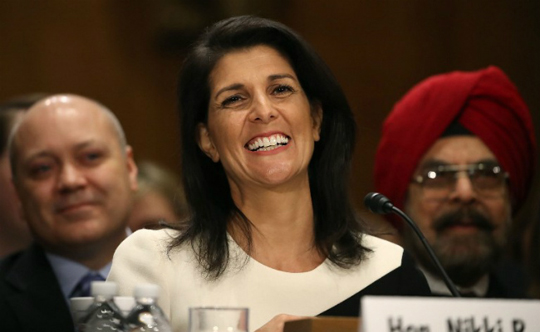
nikkihaley

But not everyone was sold. Senator Chris Coons, D-Del., said Ms Haley didn't convince him that she'll serve effectively. The US ambassador to the international body should be an expert on international affairs, Mr Coons said, "not someone who will be learning on the job."

A Senate vote is expected soon on Mr Trump's choice for secretary of state, former Exxon Mobil CEO Rex Tillerson. The Foreign Relations Committee narrowly approved his nomination Monday, 11-10. No Democrats on the panel voted for Mr Tillerson.

Mr Tillerson's bid got a key boost when Senator Joe Manchin, D-W.Va, announced his support Tuesday. Mr Manchin, who faces re-election in 2018 in a state that backed Mr Trump heavily in the presidential election, said Mr Tillerson's extensive business career "will bring a unique perspective to the State Department."

The vote on Ms Haley capped a day when the GOP-led panels endorsed Mr Trump's choices to lead the Transportation, Housing, and Commerce departments. Yet congressional Republicans criticized Democrats for not moving quickly enough on all of the president's selections.

Senator Dianne Feinstein of California, the top Democrat on the Senate Judiciary Committee, forced a one-week delay - until January 31 - of the committee's vote on Mr Trump's attorney general nominee, Senator Jeff Sessions.

Ms Feinstein said senators "owe it" to the more than 1 million women who marched in Washington and other locations on Saturday to be careful in considering Sessions' nomination and his willingness to protect equal rights. She also said the committee received 188 pages of new material that needs to be reviewed. Committee rules allow any member of the panel to delay a vote.

Deliberations over two of Mr Trump's picks turned testy as both nominees faced questions from Democrats over their personal finances. Rep. Tom Price, R-Ga., the president's choice for health secretary, defended his decision to invest in health care companies as he testified before the Senate Finance Committee.

Panel staffers found Mr Price undervalued around 400,000 shares of stock in Australian drug company Innate Immunotherapeutics that he purchased last August. He reported the shares were valued at $50,000 to $100,000, but those shares were worth up to $250,000. Mr Price blamed a "clerical error" and answered "no" when Sen. Ron Wyden, D-Ore., asked if he'd used poor judgment.

Senator Bernie Sanders, I-Vt., said Mr Trump's nominee for budget director, South Carolina Rep. Mick Mulvaney, should be disqualified because he failed to pay more than $15,000 in payroll taxes for a babysitter more than a decade ago. Mr Mulvaney said he discovered the unpaid taxes while preparing for the nominating process. He has since paid the taxes.

Mr Trump's choice for education secretary, Betsy DeVos, is also being scrutinised by Democrats about her qualifications, political donations and longtime work advocating for charter schools and school choice in her home state of Michigan.

Sen. Gary Peters, D-Mich., delivered a withering critique of DeVos on Tuesday, saying he has no confidence she will fully support traditional public schools and students.

The Senate Commerce Committee approved by voice votes Mr Trump's choices of conservative billionaire investor Wilbur Ross to run the Commerce Department and Elaine Chao to lead the Transportation Department.

Mr Ross has specialized in buying distressed companies that still have a potential for delivering profits. He has known Mr Trump for more than 20 years, was an early supporter of his presidential campaign and served as an economic policy adviser to Mr Trump's team.

Ms Chao, an experienced Washington hand, was labor secretary in President George W Bush's administration and deputy transportation secretary under President George HW Bush. She is also the wife of Senate Majority Leader Mitch McConnell of Kentucky.

Ms Chao is expected to play a major role in Mr Trump's effort to fulfill his campaign promise to generate $1 trillion in infrastructure investment.

Ben Carson, nominated to lead the Department of Housing and Urban Development, won unanimous approval from the Senate Banking, Housing and Urban Affairs Committee. The former Republican presidential candidate and celebrated neurosurgeon would lead a sprawling agency with 8,300 employees and a budget of about $47 billion.

Senator Michael Crapo of Idaho, the committee's Republican chairman, praised Carson and said the department "will benefit from having a secretary with a different perspective and a diverse background." Sen. Sherrod Brown of Ohio, the panel's top Democrat, said he had reservations but welcomed Carson's promises to address lead hazards in public housing.

Comments

Add new comment

  • Coastaldigest.com reserves the right to delete or block any comments.
  • Coastaldigset.com is not responsible for its readers’ comments.
  • Comments that are abusive, incendiary or irrelevant are strictly prohibited.
  • Please use a genuine email ID and provide your name to avoid reject.
News Network
March 3,2020

Mar 3: Just hours after the ending of a week-long “reduction” in violence that was crucial for Donald Trump’s peace deal in Afghanistan, the Taliban struck again: On Monday, they killed three people and injured about a dozen at a football match in Khost province. This resumption of violence will not surprise anyone actually invested in peace for that troubled country. The point of the U.S.-Taliban deal was never peace. It was to try and cover up an ignominious exit for the U.S., driven by an election-bound president who feels no responsibility toward that country or to the broader region.

Seen from South Asia, every point we know about in the agreement is a concession by Trump to the Taliban. Most importantly, it completes a long-term effort by the U.S. to delegitimize the elected government in Kabul — and, by extension, Afghanistan’s constitution. Afghanistan’s president is already balking at releasing 5,000 Taliban prisoners before intra-Afghan talks can begin — a provision that his government did not approve.

One particularly cringe-worthy aspect: The agreement refers to the Taliban throughout  as “the Islamic Emirate of Afghanistan that is not recognized by the United States as a state and is known as the Taliban.” This unwieldy nomenclature validates the Taliban’s claim to be a government equivalent to the one in Kabul, just not the one recognised at the moment by the U.S. When read together with the second part of the agreement, which binds the U.S. to not “intervene in [Afghanistan’s] domestic affairs,” the point is obvious: The Taliban is not interested in peace, but in ensuring that support for its rivals is forbidden, and its path to Kabul is cleared.

All that the U.S. has effectively gotten in return is the Taliban’s assurance that it will not allow the soil of Afghanistan to be used against the “U.S. and its allies.” True, the U.S. under Trump has shown a disturbing willingness to trust solemn assurances from autocrats; but its apparent belief in promises made by a murderous theocratic movement is even more ridiculous. Especially as the Taliban made much the same promise to an Assistant Secretary of State about Osama bin Laden while he was in the country plotting 9/11.

Nobody in the region is pleased with this agreement except for the Taliban and their backers in the Pakistani military. India has consistently held that the legitimate government in Kabul must be the basic anchor of any peace plan. Ordinary Afghans, unsurprisingly, long for peace — but they are, by all accounts, deeply skeptical about how this deal will get them there. The brave activists of the Afghan Women’s Network are worried that intra-Afghan talks will take place without adequate representation of the country’s women — who have, after all, the most to lose from a return to Taliban rule.

But the Pakistani military establishment is not hiding its glee. One retired general tweeted: “Big victory for Afghan Taliban as historic accord signed… Forced Americans to negotiate an accord from the position of parity. Setback for India.” Pakistan’s army, the Taliban’s biggest backer, longs to re-install a friendly Islamist regime in Kabul — and it has correctly estimated that, after being abandoned by Trump, the Afghan government will have sharply reduced bargaining power in any intra-Afghan peace talks. A deal with the Taliban that fails also to include its backers in the Pakistani military is meaningless.

India, meanwhile, will not see this deal as a positive for regional peace or its relationship with the U.S. It comes barely a week after Trump’s India visit, which made it painfully clear that shared strategic concerns are the only thing keeping the countries together. New Delhi remembers that India is not, on paper, a U.S. “ally.” In that respect, an intensification of terrorism targeting India, as happened the last time the U.S. withdrew from the region, would not even be a violation of Trump’s agreement. One possible outcome: Over time the government in New Delhi, which has resolutely sought to keep its ties with Kabul primarily political, may have to step up security cooperation. Nobody knows where that would lead.

The irresponsible concessions made by the U.S. in this agreement will likely disrupt South Asia for years to come, and endanger its own relationship with India going forward. But worst of all, this deal abandons those in Afghanistan who, under the shadow of war, tried to develop, for the first time, institutions that work for all Afghans. No amount of sanctimony about “ending America’s longest war” should obscure the danger and immorality of this sort of exit.

Comments

Add new comment

  • Coastaldigest.com reserves the right to delete or block any comments.
  • Coastaldigset.com is not responsible for its readers’ comments.
  • Comments that are abusive, incendiary or irrelevant are strictly prohibited.
  • Please use a genuine email ID and provide your name to avoid reject.
Agencies
July 18,2020

Days after Twitter accounts of several billionaires were hacked to engineer a crypto scam, Twitter on Saturday said it is embarrassed, disappointed and, more than anything, sorry for what happened with some of its high-profile users as attackers successfully manipulated its employees and used their credentials to access internal systems, including getting through the two-factor protections.

In the first detailed summary of the "social engineering attack" via a crypto scam that hit at least 130 users this week, Twitter said for 45 of those accounts, the attackers were able to initiate a password reset, login to the account and send Tweets.

"We are continuing our forensic review of all of the accounts to confirm all actions that may have been taken. In addition, we believe they may have attempted to sell some of the usernames," the micro-blogging platform said in a statement.

For up to eight of the Twitter accounts involved, the attackers took the additional step of downloading the account's information via "Your Twitter Data" tool.

This is a tool that is meant to provide an account owner with a summary of their Twitter account details and activity.

"We are reaching out directly to any account owner where we know this to be true. None of the eight were verified accounts," said Twitter.

The company said the attackers were not able to view previous account passwords, as those are not stored in plain text or available through the tools used in the attack.

"Attackers were able to view personal information including email addresses and phone numbers, which are displayed to some users of our internal support tools," informed Twitter.

In cases where an account was taken over by the attacker, they may have been able to view additional information, Twitter added, saying its forensic investigation of these activities was still ongoing.

"We are actively working on communicating directly with the account-holders that were impacted".

The company said it will soon restore access for all account owners who may still be locked out as a result of the remediation efforts.

The New York Times reported on Friday that the Twitter crypto scam can be traced back to a group of hackers who congregate online at OGusers.com, a username-swapping community where people buy and sell coveted online handles.

The report said that the Twitter hack is not from Russian, Chinese or North Korean hackers but was done by a group of young people, "one of whom says he lives at home with his mother".

Comments

Add new comment

  • Coastaldigest.com reserves the right to delete or block any comments.
  • Coastaldigset.com is not responsible for its readers’ comments.
  • Comments that are abusive, incendiary or irrelevant are strictly prohibited.
  • Please use a genuine email ID and provide your name to avoid reject.
News Network
March 11,2020

Rome, Mar 11: Italy has recorded its deadliest day of the coronavirus crisis despite locking down the entire country, as New York deployed the National Guard to contain a disease that has sown worldwide panic.

The hardest-hit country in Europe said its death toll from the COVID-19 virus had risen Tuesday by a third to 631, with the surging epidemic taking its toll on global sporting, cultural and political events.

While authorities in China, where the outbreak began, have declared it "basically curbed", cases are multiplying around the world, sparking panic buying in shops, and wild swings on financial markets.

China remains the hardest-hit overall with more than 80,000 cases and over 3,000 deaths, out of a global total of 117,339 cases and 4,251 deaths across 107 countries and territories, according to an AFP tally.

The virus is infecting all walks of life, including politics, with US Democratic presidential hopefuls Bernie Sanders and Joe Biden both cancelling campaign rallies and British health minister Nadine Dorries saying she had tested positive.

And amid criticism of the US authorities' response, New York deployed the National Guard for the first time during the crisis to help contain the spread of the disease from an infection-hit suburb.

There have been 173 confirmed cases in New York state, including 108 in Westchester County, home to New Rochelle where the majority of infections have been detected.

"It is a dramatic action, but it is the largest cluster in the country. This is literally a matter of life and death," said state governor Andrew Cuomo.

"People are scared, it's an unusual situation to be in," Miles Goldberg, who runs a New Rochelle bar, told AFP.

"It makes people nervous to be around others, it makes people nervous to get inside into businesses and such," he said.

In an unprecedented move, Italian Prime Minister Giuseppe Conte has told the 60 million residents of his country they should travel only for the most urgent work or health reasons.

And while squares in Milan and Rome were emptied of their usual bustle and traffic, some residents appeared uncertain if they were even allowed to leave their homes for everyday tasks like shopping.

The virus has battered tourism around the world, as people scrap travel plans, and a restaurant owner in Florence in northern Italy said that the impact on business had been catastrophic.

"We hope that we will see the end of it, because from around 140 covers a day, this afternoon, we've gone down to 20-25," Agostino Ferrara told AFP.

Pope Francis also seemed to muddy the waters, holding a mass in which he urged priests to go out and visit the sick -- something Conte has specifically discouraged.

Sporting events continued to fall victim to the virus as authorities urge people to avoid large gatherings.

Arsenal's game at Manchester City was postponed after players from the London club were put into quarantine, making it the first Premier League fixture to be called off because of the virus.

The virus has sparked doubts about the Olympics due to open in Tokyo on July 24 and the traditional flame lighting ceremony in Greece is set to be held without spectators.

In the United States, organisers rescheduled the two-week Coachella music festival for October.

The virus and the response to the crisis has prompted pandemonium on global markets with volatility not seen since the world financial crisis in 2008.

After suffering its worst session in more than 11 years at the beginning of the week, the Dow Jones Index in New York bounced back significantly, rising five percent on Tuesday.

Politicians around the world have scrambled to put together emergency packages to ease the significant financial hardships the virus is expected to cause for households and businesses.

US President Donald Trump, who is relying on a strong economy to boost his re-election hopes, promised to announce "major" economic measures on Tuesday.

The biggest item on his wish list is a cut in payroll taxes. But even allies in Congress and reportedly some aides in the White House are sceptical, questioning the cost.

Italy prepared Tuesday to let families skip mortgage and some tax payments while Japan unveiled a second emergency package to tackle economic woes stemming from the outbreak, including $15 billion in loan programmes to support small businesses.

Analysts warned of further volatility ahead however.

"It's like winding up a rubber band. The more you wind it, when you let go, the more it pops," said LBBW's Karl Haeling.

"A lot of the uncertainty goes to the root of the virus itself."

Comments

Add new comment

  • Coastaldigest.com reserves the right to delete or block any comments.
  • Coastaldigset.com is not responsible for its readers’ comments.
  • Comments that are abusive, incendiary or irrelevant are strictly prohibited.
  • Please use a genuine email ID and provide your name to avoid reject.