



US Senate Confirms Nikki Haley For US Ambassador To The UN With Huge Margin

January 25, 2017

Washington, Jan 25: The Senate confirmed President Donald Trump's pick for US ambassador to the United Nations by a decisive margin on Tuesday as Republican-led committees paved the way for three more of his Cabinet nominees to be approved just days into the new administration. South Carolina Governor Nikki Haley won strong support for the UN post despite her lack of foreign policy experience. Senators voted 96-4 on Ms Haley's nomination. Senator Bob Corker of Tennessee, the Republican chairman of the Foreign Relations Committee, said Ms Haley is a proven leader who will be a "fierce advocate" at the UN for American interests.
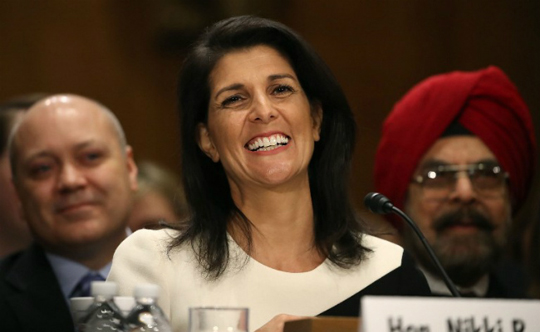
nikkihaley

But not everyone was sold. Senator Chris Coons, D-Del., said Ms Haley didn't convince him that she'll serve effectively. The US ambassador to the international body should be an expert on international affairs, Mr Coons said, "not someone who will be learning on the job."

A Senate vote is expected soon on Mr Trump's choice for secretary of state, former Exxon Mobil CEO Rex Tillerson. The Foreign Relations Committee narrowly approved his nomination Monday, 11-10. No Democrats on the panel voted for Mr Tillerson.

Mr Tillerson's bid got a key boost when Senator Joe Manchin, D-W.Va, announced his support Tuesday. Mr Manchin, who faces re-election in 2018 in a state that backed Mr Trump heavily in the presidential election, said Mr Tillerson's extensive business career "will bring a unique perspective to the State Department."

The vote on Ms Haley capped a day when the GOP-led panels endorsed Mr Trump's choices to lead the Transportation, Housing, and Commerce departments. Yet congressional Republicans criticized Democrats for not moving quickly enough on all of the president's selections.

Senator Dianne Feinstein of California, the top Democrat on the Senate Judiciary Committee, forced a one-week delay - until January 31 - of the committee's vote on Mr Trump's attorney general nominee, Senator Jeff Sessions.

Ms Feinstein said senators "owe it" to the more than 1 million women who marched in Washington and other locations on Saturday to be careful in considering Sessions' nomination and his willingness to protect equal rights. She also said the committee received 188 pages of new material that needs to be reviewed. Committee rules allow any member of the panel to delay a vote.

Deliberations over two of Mr Trump's picks turned testy as both nominees faced questions from Democrats over their personal finances. Rep. Tom Price, R-Ga., the president's choice for health secretary, defended his decision to invest in health care companies as he testified before the Senate Finance Committee.

Panel staffers found Mr Price undervalued around 400,000 shares of stock in Australian drug company Innate Immunotherapeutics that he purchased last August. He reported the shares were valued at $50,000 to $100,000, but those shares were worth up to $250,000. Mr Price blamed a "clerical error" and answered "no" when Sen. Ron Wyden, D-Ore., asked if he'd used poor judgment.

Senator Bernie Sanders, I-Vt., said Mr Trump's nominee for budget director, South Carolina Rep. Mick Mulvaney, should be disqualified because he failed to pay more than $15,000 in payroll taxes for a babysitter more than a decade ago. Mr Mulvaney said he discovered the unpaid taxes while preparing for the nominating process. He has since paid the taxes.

Mr Trump's choice for education secretary, Betsy DeVos, is also being scrutinised by Democrats about her qualifications, political donations and longtime work advocating for charter schools and school choice in her home state of Michigan.

Sen. Gary Peters, D-Mich., delivered a withering critique of DeVos on Tuesday, saying he has no confidence she will fully support traditional public schools and students.

The Senate Commerce Committee approved by voice votes Mr Trump's choices of conservative billionaire investor Wilbur Ross to run the Commerce Department and Elaine Chao to lead the Transportation Department.

Mr Ross has specialized in buying distressed companies that still have a potential for delivering profits. He has known Mr Trump for more than 20 years, was an early supporter of his presidential campaign and served as an economic policy adviser to Mr Trump's team.

Ms Chao, an experienced Washington hand, was labor secretary in President George W Bush's administration and deputy transportation secretary under President George HW Bush. She is also the wife of Senate Majority Leader Mitch McConnell of Kentucky.

Ms Chao is expected to play a major role in Mr Trump's effort to fulfill his campaign promise to generate $1 trillion in infrastructure investment.

Ben Carson, nominated to lead the Department of Housing and Urban Development, won unanimous approval from the Senate Banking, Housing and Urban Affairs Committee. The former Republican presidential candidate and celebrated neurosurgeon would lead a sprawling agency with 8,300 employees and a budget of about $47 billion.

Senator Michael Crapo of Idaho, the committee's Republican chairman, praised Carson and said the department "will benefit from having a secretary with a different perspective and a diverse background." Sen. Sherrod Brown of Ohio, the panel's top Democrat, said he had reservations but welcomed Carson's promises to address lead hazards in public housing.

Comments

Add new comment

  • Coastaldigest.com reserves the right to delete or block any comments.
  • Coastaldigset.com is not responsible for its readers’ comments.
  • Comments that are abusive, incendiary or irrelevant are strictly prohibited.
  • Please use a genuine email ID and provide your name to avoid reject.
News Network
April 26,2020

Apr 26: The remarkable story of an airman who overcame prejudice to become one of only a handful of Indian fighter pilots in the First World War has emerged in newly-released archive files by the UK's Commonwealth War Graves Commission (CWGC).

Lieutenant Shri Krishna Chanda Welinkar is one of the thousands of moving stories from the war preserved in family correspondence and being brought alive as part of a digitisation project.

The never-before-published files contain thousands of letters, pictures and other papers sent between the Commission and the next of the kin of First World War dead.

Among them is the story of Welinkar, who hailed from Bombay in colonial India. After much hardship and discrimination, he eventually became a pilot and went missing while on patrol over the skies above the Western Front in June 1918.

His family had to wait nearly three years before they finally knew for certain that he had died, and his grave was located.

“For everyone who died in the First World War, there was inevitably a partner, parent or child back home who had questions. The heartbreaking letters in CWGC's archive give us an insight into what it was like for those families trying to come to terms with their loss,” said Andrew Fetherston, chief archivist for CWGC.

“They are stories that show desperate searches for closure, former enemies uniting and, on many occasions, the sad realisation that a missing loved one would always remain so. We are pleased to be able to make this invaluable piece of World War history accessible to a new generation and help deepen our understanding of how the First World War impacted those who were left behind,” he said.

Welinkar was one of the 1.3 million Indians who answered the call to fight for the British Empire. Nearly 74,000 never saw their homeland again and are remembered today in cemeteries and memorials throughout the world, including France, Belgium, the Middle East and Africa.

Welinkar was a well-educated man studying at Cambridge University. He trained to become an aviator in Middlesex and wished to join the Royal Flying Corps, later known as the Royal Air Force.

Upon attempting to enlist, Welinkar encountered the same prejudices as his other fellow Indian airmen and was encouraged to become an air mechanic instead.

He was eventually given a commission in the Royal Flying Corps as an Officer. In 1918, he was posted to France and patrolled the skies above the Western Front.

In June 1918, Lieutenant Welinkar embarked on what would be his final patrol; he did not return and was reported missing. His fate remained unknown for many months afterwards.

The newly-released e-files chronicle the remarkable discovery of Welinkar and his final resting place long after the war had ended. Colonel Barton, who knew Welinkar, acted on behalf of his mother and helped find her missing son. They spoke to former enemies and honed their search to the grave of an unidentified man, buried by the Germans as “Oberleutnant S.C. Wumkar” in a grave in Rouvroy, Belgium.

The body was later moved and reinterred in Hangard Communal Cemetery Extension but it wasn't until the vital clue, found in the original German burial records in February 1921, that it was confirmed beyond doubt this grave was of Welinkar's.

In May 1921, Colonel Barton, on behalf of Welinkar's mother, requested that a Commission headstone be placed on the grave with the following personal inscription: “To the Honoured Memory of One of the Empire's Bravest Sons”.

This records – known as Enquiry Files – are part of a collection of nearly 3,000 files which have never been made available to the public before. Nearly half have been digitised so far, alongside a previously unreleased collection of more than 16,000 photographs held in negatives in the Commission's archive.

The files, internally referred to simply as E-Files, contain correspondence between the CWGC and the next of kin of the war dead. They often contain letters, typed memos between Commission staff and on occasion photos, maps and diagrams.

CWGC only holds an enquiry file for a small proportion of the 1.7 million people it commemorates from the Commonwealth. Today it is only possible to release those surviving records from the First World War because correspondence with families of Second World War casualties often involves people still alive today and cannot be made public for many years, due to the UK's data protection rules.

To date, more than 1,300 of the surviving 3,000 First World War enquiry files have been digitised.

The CWGC commemorates the 1.7 million Commonwealth servicemen and women who died during the two World Wars. It also holds and updates an extensive and accessible records archive, while operating over 23,000 locations in more than 150 countries and territories.

Comments

Add new comment

  • Coastaldigest.com reserves the right to delete or block any comments.
  • Coastaldigset.com is not responsible for its readers’ comments.
  • Comments that are abusive, incendiary or irrelevant are strictly prohibited.
  • Please use a genuine email ID and provide your name to avoid reject.
News Network
February 19,2020

London, Feb 19: UK Home Secretary Priti Patel today announced the launch of the Britain's new points-based visa system, aimed at attracting the "brightest and the best" from the world, including from India, and cutting down numbers of cheap, low-skilled workers coming to the country.

The new system will come into force from January 1, 2021 at the end of the transition period after the UK's exit from the European Union (EU) last month, which will formally end free movement of people within the economic bloc for the UK as a non-member.

The new post-Brexit system, which will apply equally to the EU and non-EU countries like India, is based on assigning points for specific skills, qualifications, salaries and professions, with visas only awarded to those who gain enough points.

"Today is a historic moment for the whole country. We're ending free movement, taking back control of our borders and delivering on the people's priorities by introducing a new UK points-based immigration system, which will bring overall migration numbers down," said Ms Patel, the senior-most Indian-origin Cabinet minister.

"We will attract the brightest and the best from around the globe, boosting the economy and our communities, and unleash this country's full potential," Ms Patel, in charge of the UK's visa and immigration system, said.

The UK Home Office said the new system is a direct response to the 2016 referendum in favour of Brexit, which was seen as a vote to end the country's reliance on cheap migrant labour and reduce overall levels of migration with tighter security.

"The new single global system will treat the EU and non-EU citizens equally. It will give top priority to those with the highest skills and the greatest talents, including scientists, engineers and academics," the Home Office said.

The Global Talent Scheme, a fast-track visa to be in operation from Friday, will also apply to the EU citizens from next year to allow highly-skilled scientists and researchers to come to the UK without a job offer.

Professor Alice Gast, President of Imperial College London, said: "British science is global. The new post-study work and Global Talent visas will help us to attract the world's brightest students and researchers, wherever they come from."

"From the race to develop a coronavirus vaccine to clean energy, British science's international collaborations drive innovation and excellence."

The government said the points threshold for the new system will be carefully set to attract the talent the UK needs. Skilled workers will need to meet a number of relevant criteria, including specific skills and the ability to speak English, to be able to work in the UK. All applicants will be required to have a job offer and, in line with the Migration Advisory Committee''s (MAC) recommendations, the minimum salary threshold will be set at 25,600 pounds - lower than the previous 30,000 pounds level for Tier 2 work visas.

The new points-based system will also expand the skills threshold for skilled workers.

Those looking to live and work in the UK will need to be qualified up to A-level or equivalent, rather than degree-level under the current system. This will provide greater flexibility and ensure UK business has access to a wide pool of skilled workers, the Home Office said.

In line with the British Prime Minister Boris Johnson's manifesto commitment in the December 2019 General Election, there will be no specific route for low-skilled workers.

"It is estimated 70 per cent of the existing EU workforce would not meet the requirements of the skilled worker route, which will help to bring overall numbers down in future," the Home Office said.

Student visa routes will also be points-based and be opened up to EU citizens from next year.

Those wishing to study in the UK will need to demonstrate that they have an offer from an approved educational institution, that they can support themselves financially and that they speak English.

To address the specific labour concerns of the agricultural sector reliant on seasonal workers from the EU, the Seasonal Workers Pilot will be expanded in time for the 2020 harvest from 2,500 to 10,000 places.

EU citizens and other non-visa nationals will not require a visa to enter the UK when visiting the UK for up to six months.

However, the use of national identity cards will be phased out for travel to the UK and the Home Office highlighted that as part of its post-Brexit offer, those EU citizens resident in the UK by December 31 2020 can still apply to settle in the UK through the EU Settlement Scheme until June 2021.

Comments

Add new comment

  • Coastaldigest.com reserves the right to delete or block any comments.
  • Coastaldigset.com is not responsible for its readers’ comments.
  • Comments that are abusive, incendiary or irrelevant are strictly prohibited.
  • Please use a genuine email ID and provide your name to avoid reject.
News Network
May 29,2020

Washington, May 29: US President Donald Trump while speaking with reporters at the White House on Thursday said that he is more liked in India than the media in his own country --the United States.

"I know. And they like me in India. I think they like me in India certainly more than the media likes me in this country, " Trump told reporters at his Oval office.

"And I like Modi (Prime Minister Narendra Modi). I like your prime minister a lot. He's a great gentleman. A great gentleman," he added further while briefing the reporters.

But when asked over ties between India and China, the US President said, "They have a big conflict going with India and China. Two countries with 1.4 billion people. Two countries with very powerful militaries. And India is not happy, and probably China is not happy."

Reiterating his offer to mediate between India and China on the border issue, Trump said that he spoke to Prime Minister Narendra Modi, who is not in "good mood" about the ongoing situation with Beijing.

However, informed sources from the Ministry of External Affairs told ANI on Friday that there has been no recent contact between Prime Minister Modi and the US President. The last conversation between them took place on April 4, 2020, on the subject of hydroxychloroquine.

Asked about his Wednesday's tweet regarding his offer to mediate between India and China, Trump said, "I would do that. If they (China and India) thought it would help." However, Trump did not clarify when did he speak to Modi.

Trump on Wednesday tweeted that he is "ready, willing and able to mediate" between India and China."We have informed both India and China that the United States is ready, willing and able to mediate or arbitrate their now raging border dispute," the US President said.

In response to Trump's mediation offer, India said on Thursday that it is engaged with the Chinese side to resolve the border issue peacefully.

India's Ministry of External Affairs spokesperson Anurag Srivastava said that the two sides have established mechanisms both at military and diplomatic levels to resolve situations that may arise in border areas peacefully through dialogue and "continue to remain engaged through these channels."

Indian and Chinese field commanders have been holding talks on de-escalating the tensions.

China has also struck a conciliatory tone on the border issue with India, saying the two countries pose no threat to each other and should resolve their differences through communication, while not allowing them to overshadow bilateral relations.

"We should never let differences overshadow our relations. We should resolve differences through communication. China and India should be good neighbours of harmonious coexistence and good partners to move forward hand in hand," said Chinese Ambassador to India, Sun Weidong, on Wednesday.

The tensions escalated between India and China following a number of confrontations between soldiers of both armies.

Troops of India and China were engaged in two face-offs in Eastern Ladakh and North Sikkim along the disputed Line of Actual Control (LAC), where troops from both sides suffered injuries early this month.

Studies over the anti-malarial drug, which is believed to cure the highly contagious coronavirus, have shown side-effects, according to the Centers for Disease Control and Prevention and the World Health Organisation. But Trump continues to defend his decision to take hydroxychloroquine saying he believes that it gives an additional level of safety.

Comments

Add new comment

  • Coastaldigest.com reserves the right to delete or block any comments.
  • Coastaldigset.com is not responsible for its readers’ comments.
  • Comments that are abusive, incendiary or irrelevant are strictly prohibited.
  • Please use a genuine email ID and provide your name to avoid reject.