



US Senate Confirms Nikki Haley For US Ambassador To The UN With Huge Margin

January 25, 2017

Washington, Jan 25: The Senate confirmed President Donald Trump's pick for US ambassador to the United Nations by a decisive margin on Tuesday as Republican-led committees paved the way for three more of his Cabinet nominees to be approved just days into the new administration. South Carolina Governor Nikki Haley won strong support for the UN post despite her lack of foreign policy experience. Senators voted 96-4 on Ms Haley's nomination. Senator Bob Corker of Tennessee, the Republican chairman of the Foreign Relations Committee, said Ms Haley is a proven leader who will be a "fierce advocate" at the UN for American interests.
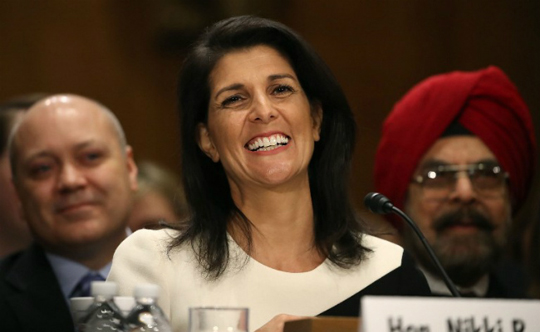
nikkihaley

But not everyone was sold. Senator Chris Coons, D-Del., said Ms Haley didn't convince him that she'll serve effectively. The US ambassador to the international body should be an expert on international affairs, Mr Coons said, "not someone who will be learning on the job."

A Senate vote is expected soon on Mr Trump's choice for secretary of state, former Exxon Mobil CEO Rex Tillerson. The Foreign Relations Committee narrowly approved his nomination Monday, 11-10. No Democrats on the panel voted for Mr Tillerson.

Mr Tillerson's bid got a key boost when Senator Joe Manchin, D-W.Va, announced his support Tuesday. Mr Manchin, who faces re-election in 2018 in a state that backed Mr Trump heavily in the presidential election, said Mr Tillerson's extensive business career "will bring a unique perspective to the State Department."

The vote on Ms Haley capped a day when the GOP-led panels endorsed Mr Trump's choices to lead the Transportation, Housing, and Commerce departments. Yet congressional Republicans criticized Democrats for not moving quickly enough on all of the president's selections.

Senator Dianne Feinstein of California, the top Democrat on the Senate Judiciary Committee, forced a one-week delay - until January 31 - of the committee's vote on Mr Trump's attorney general nominee, Senator Jeff Sessions.

Ms Feinstein said senators "owe it" to the more than 1 million women who marched in Washington and other locations on Saturday to be careful in considering Sessions' nomination and his willingness to protect equal rights. She also said the committee received 188 pages of new material that needs to be reviewed. Committee rules allow any member of the panel to delay a vote.

Deliberations over two of Mr Trump's picks turned testy as both nominees faced questions from Democrats over their personal finances. Rep. Tom Price, R-Ga., the president's choice for health secretary, defended his decision to invest in health care companies as he testified before the Senate Finance Committee.

Panel staffers found Mr Price undervalued around 400,000 shares of stock in Australian drug company Innate Immunotherapeutics that he purchased last August. He reported the shares were valued at $50,000 to $100,000, but those shares were worth up to $250,000. Mr Price blamed a "clerical error" and answered "no" when Sen. Ron Wyden, D-Ore., asked if he'd used poor judgment.

Senator Bernie Sanders, I-Vt., said Mr Trump's nominee for budget director, South Carolina Rep. Mick Mulvaney, should be disqualified because he failed to pay more than $15,000 in payroll taxes for a babysitter more than a decade ago. Mr Mulvaney said he discovered the unpaid taxes while preparing for the nominating process. He has since paid the taxes.

Mr Trump's choice for education secretary, Betsy DeVos, is also being scrutinised by Democrats about her qualifications, political donations and longtime work advocating for charter schools and school choice in her home state of Michigan.

Sen. Gary Peters, D-Mich., delivered a withering critique of DeVos on Tuesday, saying he has no confidence she will fully support traditional public schools and students.

The Senate Commerce Committee approved by voice votes Mr Trump's choices of conservative billionaire investor Wilbur Ross to run the Commerce Department and Elaine Chao to lead the Transportation Department.

Mr Ross has specialized in buying distressed companies that still have a potential for delivering profits. He has known Mr Trump for more than 20 years, was an early supporter of his presidential campaign and served as an economic policy adviser to Mr Trump's team.

Ms Chao, an experienced Washington hand, was labor secretary in President George W Bush's administration and deputy transportation secretary under President George HW Bush. She is also the wife of Senate Majority Leader Mitch McConnell of Kentucky.

Ms Chao is expected to play a major role in Mr Trump's effort to fulfill his campaign promise to generate $1 trillion in infrastructure investment.

Ben Carson, nominated to lead the Department of Housing and Urban Development, won unanimous approval from the Senate Banking, Housing and Urban Affairs Committee. The former Republican presidential candidate and celebrated neurosurgeon would lead a sprawling agency with 8,300 employees and a budget of about $47 billion.

Senator Michael Crapo of Idaho, the committee's Republican chairman, praised Carson and said the department "will benefit from having a secretary with a different perspective and a diverse background." Sen. Sherrod Brown of Ohio, the panel's top Democrat, said he had reservations but welcomed Carson's promises to address lead hazards in public housing.

Comments

Add new comment

  • Coastaldigest.com reserves the right to delete or block any comments.
  • Coastaldigset.com is not responsible for its readers’ comments.
  • Comments that are abusive, incendiary or irrelevant are strictly prohibited.
  • Please use a genuine email ID and provide your name to avoid reject.
Agencies
July 2,2020

Moscow, Jul 2: Russian voters approved changes to the constitution that will allow President Vladimir Putin to hold power until 2036, but the weeklong plebiscite that concluded Wednesday was tarnished by widespread reports of pressure on voters and other irregularities.

With most of the nation's polls closed and 20% of precincts counted, 72% voted for the constitutional amendments, according to election officials.

For the first time in Russia, polls were kept open for a week to bolster turnout without increasing crowds casting ballots amid the coronavirus pandemic a provision that Kremlin critics denounced as an extra tool to manipulate the outcome.

A massive propaganda campaign and the opposition's failure to mount a coordinated challenge helped Putin get the result he wanted, but the plebiscite could end up eroding his position because of the unconventional methods used to boost participation and the dubious legal basis for the balloting.

By the time polls closed in Moscow and most other parts of Western Russia, the overall turnout was at 65%, according to election officials. In some regions, almost 90% of eligible voters cast ballots.

On Russia's easternmost Chukchi Peninsula, nine hours ahead of Moscow, officials quickly announced full preliminary results showing 80% of voters supported the amendments, and in other parts of the Far East, they said over 70% of voters backed the changes.

Kremlin critics and independent election observers questioned the turnout figures.

We look at neighboring regions, and anomalies are obvious there are regions where the turnout is artificially (boosted), there are regions where it is more or less real, Grigory Melkonyants, co-chair of the independent election monitoring group Golos, told The Associated Press.

Putin voted at a Moscow polling station, dutifully showing his passport to the election worker. His face was uncovered, unlike most of the other voters who were offered free masks at the entrance.

The vote completes a convoluted saga that began in January, when Putin first proposed the constitutional changes.

He offered to broaden the powers of parliament and redistribute authority among the branches of government, stoking speculation he might seek to become parliamentary speaker or chairman of the State Council when his presidential term ends in 2024.

His intentions became clear only hours before a vote in parliament, when legislator Valentina Tereshkova, a Soviet-era cosmonaut who was the first woman in space in 1963, proposed letting him run two more times.

The amendments, which also emphasize the primacy of Russian law over international norms, outlaw same-sex marriages and mention a belief in God as a core value, were quickly passed by the Kremlin-controlled legislature.

Putin, who has been in power for more than two decades longer than any other Kremlin leader since Soviet dictator Josef Stalin said he would decide later whether to run again in 2024.

He argued that resetting the term count was necessary to keep his lieutenants focused on their work instead of darting their eyes in search for possible successors.

Analyst Gleb Pavlovsky, a former Kremlin political consultant, said Putin's push to hold the vote despite the fact that Russia has thousands of new coronavirus infections each day reflected his potential vulnerabilities.

Putin lacks confidence in his inner circle and he's worried about the future, Pavlovsky said.

He wants an irrefutable proof of public support.

Even though the parliament's approval was enough to make it law, the 67-year-old Russian president put his constitutional plan to voters to showcase his broad support and add a democratic veneer to the changes.

But then the coronavirus pandemic engulfed Russia, forcing him to postpone the April 22 plebiscite.

The delay made Putin's campaign blitz lose momentum and left his constitutional reform plan hanging as the damage from the virus mounted and public discontent grew.

Plummeting incomes and rising unemployment during the outbreak have dented his approval ratings, which sank to 59%, the lowest level since he came to power, according to the Levada Center, Russia's top independent pollster.

Moscow-based political analyst Ekaterina Schulmann said the Kremlin had faced a difficult dilemma: Holding the vote sooner would have brought accusations of jeopardizing public health for political ends, while delaying it raised the risks of defeat.

Holding it in the autumn would have been too risky, she said.

In Moscow, several activists briefly lay on Red Square, forming the number 2036 with their bodies in protest before police stopped them.

Some others in Moscow and St. Petersburg staged one-person pickets and police didn't intervene.

Several hundred opposition supporters rallied in central Moscow to protest the changes, defying a ban on public gatherings imposed for the coronavirus outbreak. Police didn't intervene and even handed masks to the participants.

Authorities mounted a sweeping effort to persuade teachers, doctors, workers at public sector enterprises and others who are paid by the state to cast ballots. Reports surfaced from across the vast country of managers coercing people to vote.

The Kremlin has used other tactics to boost turnout and support for the amendments.

Comments

Add new comment

  • Coastaldigest.com reserves the right to delete or block any comments.
  • Coastaldigset.com is not responsible for its readers’ comments.
  • Comments that are abusive, incendiary or irrelevant are strictly prohibited.
  • Please use a genuine email ID and provide your name to avoid reject.
News Network
February 4,2020

Feb 4: Americans on Monday kicked off the first vote of the 2020 presidential race as the midwestern state of Iowa began its caucuses, the closely-watched first step in deciding which Democrat will face incumbent Donald Trump in November's election.

The two frontrunners, left-wing Senator Bernie Sanders and former Vice President Joe Biden face a key test in the sparsely populated state, with a handful of others looking to make their mark to give their campaigns momentum.

The Iowa vote is a critical early look at the viability of the 11 Democratic candidates still in the race - even though just 41 Iowa delegates are up for grabs, a fraction of the 1,991 needed to secure the party nomination in July.

Iowa Democrats filed into nearly 1,700 caucus sites - schools, libraries, churches, mosques and meeting halls with Sanders and Biden in the lead in the state, followed by former South Bend, Indiana mayor Pete Buttigieg and Senator Elizabeth Warren, who is also on the left of the party.

But polling has fluctuated and Iowa's quirky caucus system - where voting is not by secret ballot but by public declaration for a candidate - makes the night hard to predict.

Luke Elzinga, a volunteer for Sanders, appeared early at Lincoln High School in Des Moines which was converted into a caucus location.

"I think he really inspires a lot of young people, a lot of disaffected voters who might not otherwise turn out," Elzinga, 28, told AFP news agency shortly before the caucusing began.

"And so I think he's the best candidate to beat Trump."

Three candidates - Sanders, Warren and Amy Klobuchar - have faced the unprecedented scenario of spending much of the past two weeks tethered to Washington for the impeachment trial of Trump instead of on the campaign trail in Iowa.

Even as candidates sought to make 11th-hour impressions on undecided voters, the senators were obligated to return to Washington for the trial's closing arguments on Monday.

Defeating Trump

In a vote scheduled for Wednesday, Trump is almost certain to be acquitted by the Republican-led upper house on charges of abuse of power and obstruction of Congress.

For Democrats, second-tier hopefuls Klobuchar and tech entrepreneur Andrew Yang look to outpace expectations and seize momentum heading into the next contest in New Hampshire on February 11.

Earlier on Monday Biden - who still holds the lead in national polls - brought pizza to a field office in a strip mall near Des Moines to thank volunteers.

"I'm feeling good about today," he said.

Like many candidates, Biden spent the weekend crisscrossing Iowa in a final push to convince undecided voters he is best placed to accomplish Democrats' number one goal: defeating Trump.

The president has not stood idly by. On Sunday he branded Biden "Sleepy Joe" and described Sanders as "a communist," previewing a likely line of attack were Sanders to win the nomination.

Unlike secret ballot voting, caucus-goers publicly declare their presidential choice by standing together with other supporters of a candidate.

Candidates who reach 15 percent support earn delegates for the nomination race while supporters of candidates who fall short can shift their allegiance to others.

Turnout is critical, and candidates and their representatives will seek to persuade voters on issues including healthcare, taxes and ending Washington corruption.

One key candidate who has opted not to contest in Iowa is billionaire businessman Michael Bloomberg, who entered the race in November but has surged into fourth place in RealClearPolitics' national polling average.

The former New York mayor, who has spent more than $300m on advertising, according to Advertising Analytics, is focused on running a national campaign with particular emphasis on states that vote on "Super Tuesday," on March 3.

Comments

Add new comment

  • Coastaldigest.com reserves the right to delete or block any comments.
  • Coastaldigset.com is not responsible for its readers’ comments.
  • Comments that are abusive, incendiary or irrelevant are strictly prohibited.
  • Please use a genuine email ID and provide your name to avoid reject.
News Network
April 18,2020

Washington, Apr 18: The United States on Friday passed 700,000 confirmed coronavirus cases, according to a tally maintained by Johns Hopkins University.

With the highest number of cases and deaths of any country in the world, the US had recorded 700,282 cases of COVID-19 and 36,773 deaths as of 8:30 pm (0030 GMT Friday), according to the Baltimore-based university.

That marked an increase of 3,856 deaths in the past 24 hours, but that figure likely includes "probable" virus-linked deaths, which had not previously been counted.

This week, New York City said it would add 3,778 "probable" virus deaths to its official count.

The US Centers for Disease Control and Prevention gave a toll Friday night of 33,049 dead, including 4,226 probable virus-linked deaths.

The United States has seen the highest death toll in the world in the coronavirus pandemic, ahead of Italy (22,745 deaths) although its population is just a fifth of that of the US.

Spain has recorded 19,478 deaths, followed by France with 18,681.

Trump announces $19 billion relief for farmers amid COVID-19 epidemic

President Donald Trump on Friday announced a $19 billion financial rescue package to help the agriculture industry weather the staggering economic downturn sparked by measures to defeat the coronavirus.

Trump told a press conference the government "will be implementing a $19 billion relief program for our great farmers and ranchers as they cope with the fallout of the global pandemic."

The program will include direct payments to farmers, ranchers and producers who Trump said have experienced "unprecedented losses during this pandemic."

Agriculture Secretary Sonny Perdue said US farmers have been hit hard by a sharp shift in demand, as schools and restaurants close and more Americans eat at home.

That has disrupted the food supply chain, forcing farmers in many places to destroy dairy output and plow under crops that no longer have buyers.

"Having to dump milk and plow under vegetables ready to market is not only financially distressing, but it's heartbreaking as well to those who produce them," Perdue said.

Perdue said some $3 billion of the money would go to buying produce and milk from such farmers, and redistribute it to community food banks.

Millions of Americans have recently turned to food pantries for meals and groceries after losing their jobs.

Comments

Add new comment

  • Coastaldigest.com reserves the right to delete or block any comments.
  • Coastaldigset.com is not responsible for its readers’ comments.
  • Comments that are abusive, incendiary or irrelevant are strictly prohibited.
  • Please use a genuine email ID and provide your name to avoid reject.