



US Senate Confirms Nikki Haley For US Ambassador To The UN With Huge Margin

January 25, 2017

Washington, Jan 25: The Senate confirmed President Donald Trump's pick for US ambassador to the United Nations by a decisive margin on Tuesday as Republican-led committees paved the way for three more of his Cabinet nominees to be approved just days into the new administration. South Carolina Governor Nikki Haley won strong support for the UN post despite her lack of foreign policy experience. Senators voted 96-4 on Ms Haley's nomination. Senator Bob Corker of Tennessee, the Republican chairman of the Foreign Relations Committee, said Ms Haley is a proven leader who will be a "fierce advocate" at the UN for American interests.
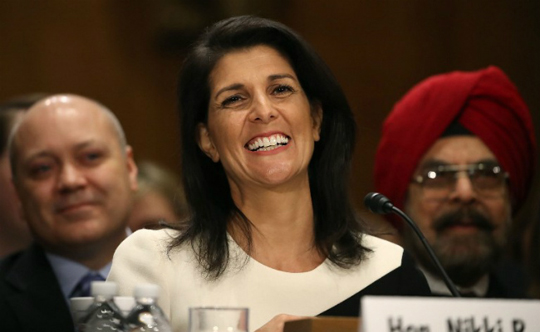
nikkihaley

But not everyone was sold. Senator Chris Coons, D-Del., said Ms Haley didn't convince him that she'll serve effectively. The US ambassador to the international body should be an expert on international affairs, Mr Coons said, "not someone who will be learning on the job."

A Senate vote is expected soon on Mr Trump's choice for secretary of state, former Exxon Mobil CEO Rex Tillerson. The Foreign Relations Committee narrowly approved his nomination Monday, 11-10. No Democrats on the panel voted for Mr Tillerson.

Mr Tillerson's bid got a key boost when Senator Joe Manchin, D-W.Va, announced his support Tuesday. Mr Manchin, who faces re-election in 2018 in a state that backed Mr Trump heavily in the presidential election, said Mr Tillerson's extensive business career "will bring a unique perspective to the State Department."

The vote on Ms Haley capped a day when the GOP-led panels endorsed Mr Trump's choices to lead the Transportation, Housing, and Commerce departments. Yet congressional Republicans criticized Democrats for not moving quickly enough on all of the president's selections.

Senator Dianne Feinstein of California, the top Democrat on the Senate Judiciary Committee, forced a one-week delay - until January 31 - of the committee's vote on Mr Trump's attorney general nominee, Senator Jeff Sessions.

Ms Feinstein said senators "owe it" to the more than 1 million women who marched in Washington and other locations on Saturday to be careful in considering Sessions' nomination and his willingness to protect equal rights. She also said the committee received 188 pages of new material that needs to be reviewed. Committee rules allow any member of the panel to delay a vote.

Deliberations over two of Mr Trump's picks turned testy as both nominees faced questions from Democrats over their personal finances. Rep. Tom Price, R-Ga., the president's choice for health secretary, defended his decision to invest in health care companies as he testified before the Senate Finance Committee.

Panel staffers found Mr Price undervalued around 400,000 shares of stock in Australian drug company Innate Immunotherapeutics that he purchased last August. He reported the shares were valued at $50,000 to $100,000, but those shares were worth up to $250,000. Mr Price blamed a "clerical error" and answered "no" when Sen. Ron Wyden, D-Ore., asked if he'd used poor judgment.

Senator Bernie Sanders, I-Vt., said Mr Trump's nominee for budget director, South Carolina Rep. Mick Mulvaney, should be disqualified because he failed to pay more than $15,000 in payroll taxes for a babysitter more than a decade ago. Mr Mulvaney said he discovered the unpaid taxes while preparing for the nominating process. He has since paid the taxes.

Mr Trump's choice for education secretary, Betsy DeVos, is also being scrutinised by Democrats about her qualifications, political donations and longtime work advocating for charter schools and school choice in her home state of Michigan.

Sen. Gary Peters, D-Mich., delivered a withering critique of DeVos on Tuesday, saying he has no confidence she will fully support traditional public schools and students.

The Senate Commerce Committee approved by voice votes Mr Trump's choices of conservative billionaire investor Wilbur Ross to run the Commerce Department and Elaine Chao to lead the Transportation Department.

Mr Ross has specialized in buying distressed companies that still have a potential for delivering profits. He has known Mr Trump for more than 20 years, was an early supporter of his presidential campaign and served as an economic policy adviser to Mr Trump's team.

Ms Chao, an experienced Washington hand, was labor secretary in President George W Bush's administration and deputy transportation secretary under President George HW Bush. She is also the wife of Senate Majority Leader Mitch McConnell of Kentucky.

Ms Chao is expected to play a major role in Mr Trump's effort to fulfill his campaign promise to generate $1 trillion in infrastructure investment.

Ben Carson, nominated to lead the Department of Housing and Urban Development, won unanimous approval from the Senate Banking, Housing and Urban Affairs Committee. The former Republican presidential candidate and celebrated neurosurgeon would lead a sprawling agency with 8,300 employees and a budget of about $47 billion.

Senator Michael Crapo of Idaho, the committee's Republican chairman, praised Carson and said the department "will benefit from having a secretary with a different perspective and a diverse background." Sen. Sherrod Brown of Ohio, the panel's top Democrat, said he had reservations but welcomed Carson's promises to address lead hazards in public housing.

Comments

Add new comment

  • Coastaldigest.com reserves the right to delete or block any comments.
  • Coastaldigset.com is not responsible for its readers’ comments.
  • Comments that are abusive, incendiary or irrelevant are strictly prohibited.
  • Please use a genuine email ID and provide your name to avoid reject.
News Network
June 9,2020

Washington, Jun 9: When epidemiologists talked about "flattening the curve," they probably didn't mean it this way: the US hit its peak coronavirus caseload in April, but since that time the graph has been on a seemingly unending plateau.

That's unlike several other hard-hit countries which have successfully pushed down their numbers of new cases, including Spain and Italy, which now have bell-shaped curves.

Experts say the prolonged nature of the US epidemic is the result of the cumulative impact of regional outbreaks, as the virus that started out primarily on the coasts and in major cities moves inward.

Layered on top of that are the effects of lifting lockdowns in parts of the country that are experiencing rising cases, as well as a lapse in compliance with social distancing guidelines because of economic hardship, and in some cases a belief that the threat is overstated.

"The US is a large country both in geography and population, and the virus is at very different stages in different parts of the country," Tom Frieden, a former director of the Centers for Disease Control and Prevention told AFP.

The US saw more than 35,000 new cases for several days in April. While that figure has declined, it has still been exceeding 20,000 regularly in recent days.

By contrast, Italy was regularly hitting more than 5,000 cases per day in March but is currently experiencing figures in the low hundreds.

"We did not act quickly and robustly enough to stop the virus spreading initially, and data indicate that it travelled from initial hotspots along major transport routes into other urban and rural areas," added Frieden, now CEO of the non-profit Resolve to Save Lives.

To wit: the East Coast states of New York, New Jersey and Massachusetts accounted for about 50 percent of all cases until about a month or so ago -- but now the geographic footprint of the US epidemic has shifted to the Midwest and southeast, including Florida.

Another key problem, said Jennifer Nuzzo, an epidemiologist at Johns Hopkins, is that the United States is still not doing enough testing, contact tracing and isolation.

After coming late to the testing party -- for reasons ranging from technical issues to regulatory hurdles -- the US has now conducted more COVID-19 tests than any other country.

It even has one of the highest per capita rates per country of 62 per 1,000 people, according to the website ourworldindata.org -- better than Germany (52 per 1,000) and South Korea (20 per 1,000).

But according to Nuzzo, these numbers are misleading, because "the amount of testing that a country should do should be scaled to the size of its epidemic.

"The United States has the largest epidemic in the world so obviously we need to do a lot more testing than any other country."

For Johns Hopkins, the more important metric is the positivity rate -- that is, out of all tests conducted, how many came back positive for COVID-19.

As of June 7, the United States had an average daily positivity rate of 14 percent, well above the World Health Organization guideline of 5 percent over two weeks before social distancing guidelines should be relaxed.

By contrast, Germany, which has tested far fewer people in relation to its population, has a positivity rate of 5 percent.

Even if testing were scaled up, carrying out tests in of itself does very little good without the next steps -- finding out who was exposed and then asking them to isolate.

Here also, too many US states are lagging woefully behind.

Texas, which is experiencing a surge in cases after relaxing its lockdown, is a case in point. The state targeted hiring a modest 4,000 tracers by June, but according to local reports is still more than a thousand shy of even that goal.

Opt-in app based efforts have also been slow to get off the ground.

Then there is the fact that some people are growing tired of lockdowns, while others don't have the economic luxury of being able to stay home for prolonged periods.

The government sent some 160 million Americans a single stimulus check of up to $1,200 back in April but it's not clear whether more will be forthcoming.

Still others, particularly in so-called red states under Republican leadership, have chafed under restrictions and mask-wearing guidelines that they see as an affront to their personal freedom.

"The US is kind of on the extreme of the individual liberty side," Sten Vermund, dean of the Yale School of Public Health, told AFP.

Part of this has to do with mixed messaging from Republican leaders, including President Donald Trump, said Nuzzo.

"We have had at the highest political level an assertion that this is a situation that's been overblown, and that maybe certain protective behaviors are not necessary," she said.

More recently, tens of thousands of people across the country have taken to the streets to protest the killing on an unarmed black man by police, risking coronavirus infection to demonstrate against the public health threat of racialized state violence.

Comments

Add new comment

  • Coastaldigest.com reserves the right to delete or block any comments.
  • Coastaldigset.com is not responsible for its readers’ comments.
  • Comments that are abusive, incendiary or irrelevant are strictly prohibited.
  • Please use a genuine email ID and provide your name to avoid reject.
Agencies
July 3,2020

The dollar's dominance will slowly melt away over the coming year on weakening global demand and a sombre U.S. economic outlook, according to a Reuters poll of currency forecasters whose views depend on there being no second coronavirus shock.

Despite fears a surge in new Covid-19 cases would delay economies reopening and stymie a tentative recovery, world stocks have rallied - with the S&P 500 finishing higher in June, marking its biggest quarterly percentage gain since the height of the technology boom in 1998.

Caught between bets in favour of riskier investments, weak U.S. economic prospects as well as an easing in the thirst for dollars after the Federal Reserve flooded markets with liquidity, the greenback fell nearly 1.0 per cent last month. It was its worst monthly performance since December.

While there was a dire prognosis from the top U.S. medical expert on the coronavirus' spread, the June 25-July 1 poll of over 70 analysts showed weak dollar projections as Fed Chair Jerome Powell on Monday reiterated the economic outlook for the world's largest economy was uncertain.

"The dollar rises in two instances: when you see risk off or when there is a situation where the U.S. is leading the global recovery, and we don't think that's going to be the case anytime soon," said Gavin Friend, senior FX strategist at NAB Group in London.

"The U.S. is playing fast and loose with the virus, and chronologically they're behind the rest of the world."

Currency speculators, who had built up trades against the dollar to the highest in two years during May, increased their out-of-favour dollar bets further last week, the latest positioning data showed.

About 80 per cent of analysts, 53 of 66, said the likely path for the dollar over the next six months was to trade around current levels, alternating between slight gains and losses in a range. That suggests the greenback may be at a crucial crossroad as more currency strategists have turned bearish.

But more than 90 per cent, or 63 of 68, said a second shock from the pandemic would push the dollar higher. Five said it would push the U.S. currency lower.

Much will also depend on debt servicing and repayments by Asian, European and other international borrowers in U.S. dollars.

While an early shortage of dollars in March from the pandemic's first shock pushed the Fed to open currency swap lines with major central banks, international funding strains have eased significantly since. In recent weeks, usage of the facility has reduced dramatically.

That trend is expected to continue over the next six months with major central banks' usage of swap lines to "stay around current levels", according to 32 of 46 analysts. While 13 predicted a sharp drop, only one respondent said use of them would "rise sharply".

The dollar index, which measures the greenback's strength against six other major currencies, has slipped over 5 per cent since touching a more than three-year high in March.

When asked which currencies would perform better against the dollar by end-December, a touch over half of 49 respondents said major developed market ones, with the remaining almost split between commodity-linked and emerging market currencies.

"The dollar is so overvalued, and has been overvalued for a long time, it's time now for it to come back down again, as we head towards the (U.S.) election," added NAB's Friend.

Over the last quarter, the euro has staged a 1.8 per cent comeback after falling by a similar margin during the first three months of the year. For the month of June, the euro was up 1.2 per cent against the dollar.

The single currency was now expected to gain about 2.5 per cent to trade at $1.15 in a year from around $1.12 on Wednesday, slightly stronger than $1.14 predicted last month. While those findings are similar to what analysts have been predicting for nearly two years, there was a clear shift in their outlook for the euro, with the range of forecasts showing higher highs and higher lows from last month.

"In comparison to even a month or two ago, the outlook in Europe has improved significantly," said Lee Hardman, currency strategist at MUFG.

"I think that makes the euro look relatively more attractive and cheap against the likes of the dollar. We're not arguing strongly for the euro to surge higher, we're just saying, after the weakness we have seen in recent years, there is the potential for that weakness to start to reverse."

Comments

Add new comment

  • Coastaldigest.com reserves the right to delete or block any comments.
  • Coastaldigset.com is not responsible for its readers’ comments.
  • Comments that are abusive, incendiary or irrelevant are strictly prohibited.
  • Please use a genuine email ID and provide your name to avoid reject.
News Network
June 1,2020

Washington, Jun 1: Police fired tear gas outside the White House late Sunday as major US cities were put under curfew to suppress rioting as anti-racism protestors again took to the streets to voice fury at police brutality.

With the Trump administration branding instigators of six nights of rioting as domestic terrorists, there were more confrontations between protestors and police and fresh outbreaks of looting.

Violent clashes erupted repeatedly in a small park next to the White House, with authorities using tear gas, pepper spray and flash bang grenades to disperse crowds who lit several large fires and damaged property.

Local US leaders appealed to citizens to give constructive outlet to their rage over the death of an unarmed black man in Minneapolis, while night-time curfews were imposed in cities including Washington, Los Angeles and Houston.

One closely watched protest was outside the state capitol in Minneapolis' twin city of St. Paul, where several thousand people gathered before marching down a highway.

"We have black sons, black brothers, black friends, we don't want them to die. We are tired of this happening, this generation is not having it, we are tired of oppression," said Muna Abdi, a 31-year-old black woman who joined the protest.

"I want to make sure he stays alive," she added in reference to her son, aged three.

Hundreds of police and National Guard troops were deployed ahead of the protest.

At one point, some of the protestors who had reached a bridge were forced to scramble for cover when a truck drove at speed after having apparently breached a barricade.

The driver was later taken to hospital after the protestors hauled him from the vehicle, although there were no immediate reports of other casualties.

There were other large-scale protests in cities including New York and Miami.

Washington's mayor ordered a curfew from 11:00 pm until 6:00 am, as a report in the New York Times said that President Donald Trump had been rushed by Secret Service agents into an underground bunker at the White House on Friday night during an earlier protest.

Stores ransacked

Large-scale violence has rocked many US cities in recent days, and looters ransacked stores in a neighborhood of Philadelphia on Sunday.

In the Los Angeles suburb of Santa Monica, looting was reported at stores in a popular beachside shopping center.

Officials in LA -- a city scarred by the 1992 riots over the police beating of Rodney King, an African-American man -- imposed a curfew from 4:00 pm Sunday until dawn.

"Please, use your discretion and go early, go home, stay home and help us make sure that those who want to change this conversation from being about racial justice to be about burning things and looting things, don't win the day," the city's mayor Eric Garcetti said on CNN.

The shocking videotaped death last Monday of an unarmed black man, George Floyd, at the hands of police in Minneapolis ignited the nationwide wave of outrage over law enforcement's repeated use of lethal force against unarmed African Americans.

Floyd stopped breathing after Minneapolis police officer Derek Chauvin knelt on his neck for nearly nine minutes.

Chauvin has been charged with third-degree murder and is due to make his first appearance in court on Monday. Three other officers with him have been fired but for now face no charges.

Governor Tim Walz has mobilized all of Minnesota's National Guard troops  -- the state guard's biggest mobilization ever -- to help restore order.

Police fired tear gas and stun grenades to clear streets of curfew violators Saturday night in Minneapolis.

Walz extended a curfew for a third night Sunday and praised police and guardsmen for holding down violence. "They did so in a professional manner. They did so without a single loss of life and minimal property damage," he said.

"Congratulations to our National Guard for the great job they did immediately upon arriving in Minneapolis, Minnesota, last night," President Donald Trump tweeted, adding that they "should be used in other States before it is too late!"

The Department of Defense said that around 5,000 National Guard troops had been mobilized in 15 states as well as the capital Washington, with another 2,000 on standby.

The widespread resort to uniformed National Guards units is rare, and it evoked disturbing memories of the rioting in US cities in 1967 and 1968 in a turbulent time of protest over racial and economic disparities.

Trump blamed the extreme left for the violence, saying he planned to designate a group known as Antifa as a terrorist organization.

"The violence instigated and carried out by Antifa and other similar groups in connection with the rioting is domestic terrorism and will be treated accordingly," added Attorney General Bill Barr.

'A nation in pain'

Atlanta Mayor Keisha Lance Bottoms said Trump, who has often urged police to use tough tactics, was not helping matters.

"We are beyond a tipping point in this country, and his rhetoric only enflames that," she said on CBS.

Joe Biden, Trump's likely Democratic opponent in November's presidential election, visited the scene of one anti-racism protest.

"We are a nation in pain right now, but we must not allow this pain to destroy us," Biden tweeted, posting a picture of him speaking with an African-American family at the site where protesters had gathered in Delaware late Saturday.

Floyd's death has triggered protests beyond the United States, with hundreds rallying outside the US embassy in London in solidarity.

"I'm here because I'm tired, I'm fed up with it. When does this stop?" Doreen Pierre told AFP at the protest.

In Germany, England football international Jadon Sancho marked one of his three goals for Borussia Dortmund against Paderborn by lifting his jersey to reveal a T-shirt bearing the words "Justice for George Floyd".

Comments

Add new comment

  • Coastaldigest.com reserves the right to delete or block any comments.
  • Coastaldigset.com is not responsible for its readers’ comments.
  • Comments that are abusive, incendiary or irrelevant are strictly prohibited.
  • Please use a genuine email ID and provide your name to avoid reject.