Valley erupts in protest over deaths in Army firing

November 5, 2014

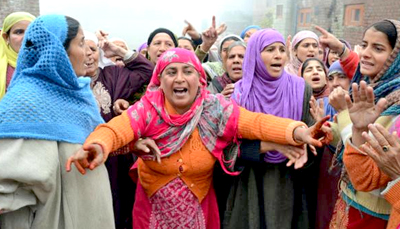
Srinagar, Nov 5: Anger over the killing of two schoolboys in Army firing on Monday evening spilled over to the streets on Tuesday with stone-throwing protesters clashing with the police, forcing the authorities to clamp curfew in several parts of downtown Srinagar.

Valley Army firingIn Nowgam, the home of the slain boys, clashes took place through the day.

Senior district administration officials said curfew was imposed in Khanyar, Nowhatta, Mahraj Gunj, Rainawari, Safakadal and Nowgam and there was palpable tension throughout the city.

The two boys who died were identified as Faisal and Mehrajuddin. Faisal was studying in class VII. He had gone out in his father’s car to buy curtains for the hall where the family was planning a party on Sunday. “Faisal met his neighbourhood friends and all of them decided to go to Chattargam for a while to watch Marsiya (mourning on Muharram). Then the Army killed him,” says Faisal’s cousin, Jan Muzaffar.

According to one of the boys, who escaped unhurt, their car brushed against a tipper truck on their way to Chattargam and were afraid that the driver would catch hold of them and beat them up. “They drove fast fearing the tipper truck driver and missed the Army signal to stop and they [the Army] killed them for it,” says Mohammad Sami, a shopkeeper outside Faisal’s home. “I saw him when he left home and then when they brought his body today, I couldn’t recognise him.” Faisal’s brother, Faizan (9) could not understand why the Army did not shoot at the tyres of the car if they wanted to stop the vehicle. “Why did they shoot at the windows,” he wondered.

Defence Minister Arun Jaitely said a fair inquiry would be held and action taken against those found guilty.

Comments

Add new comment

  • Coastaldigest.com reserves the right to delete or block any comments.
  • Coastaldigset.com is not responsible for its readers’ comments.
  • Comments that are abusive, incendiary or irrelevant are strictly prohibited.
  • Please use a genuine email ID and provide your name to avoid reject.
News Network
July 18,2020

New Delhi, Jul 18: The Covid-19 lockdown-led reduction in air pollution levels across five Indian cities, including Delhi and Mumbai, may have prevented about 630 premature deaths, and saved USD 690 million in health costs in the country, according to a new study.

Scientists, including those from the University of Surrey in the UK, assessed the levels of harmful fine particulate matter (PM2.5) from vehicles and other sources in five Indian cities -- Delhi, Mumbai, Kolkata, Chennai and Hyderabad -- since the beginning of the lockdown period.

The study, published in the journal Sustainable Cities and Society, compared these lockdown PM2.5 figures from 25 March up until 11 May, with those from similar periods of the preceding five years, and found that the measure reduced pollution levels in all these places.

According to the scientists, during this period, the levels of these harmful air pollutants reduced by 10 per cent in Mumbai, and by up to 54 per cent in Delhi.

"The percentage reduction for the other cities ranged from 24 to 32 per cent, which was slightly smaller than the measured values for Delhi and Mumbai," the scientists noted in the study.

"While the reduction in PM2.5 pollution may not be surprising, the size of the reduction should make us all take notice of the impact we have been having on the planet," said Prashant Kumar, a co-author of the study from the University of Surrey.

The scientists said these reductions in PM2.5 were comparable to those reported in other cities across the world, such as in Austria's capital Vienna (60 per cent), and Shanghai (42 per cent) in China.

They also calculated the monetary value of the reduced mortality due to air pollution and found that the lowered levels of PM2.5 may have saved 630 people from premature death, and USD 690 million in health costs in India.

Coronavirus India update: State-wise total number of confirmed cases, deaths on July 17

According to the researchers, the present lockdown situation offers observational opportunities regarding potential control systems and regulations for improved urban air quality.

They said an integrated approach might help in understanding the overall impacts of Covid-19 lockdown-style interventions and support the implementation of relevant policy frameworks.

"This is an opportunity for us all to discuss and debate what the 'new normal' should look like - particularly when it comes to the quality of the air we breathe," Kumar said.

Comments

Add new comment

  • Coastaldigest.com reserves the right to delete or block any comments.
  • Coastaldigset.com is not responsible for its readers’ comments.
  • Comments that are abusive, incendiary or irrelevant are strictly prohibited.
  • Please use a genuine email ID and provide your name to avoid reject.
News Network
August 8,2020

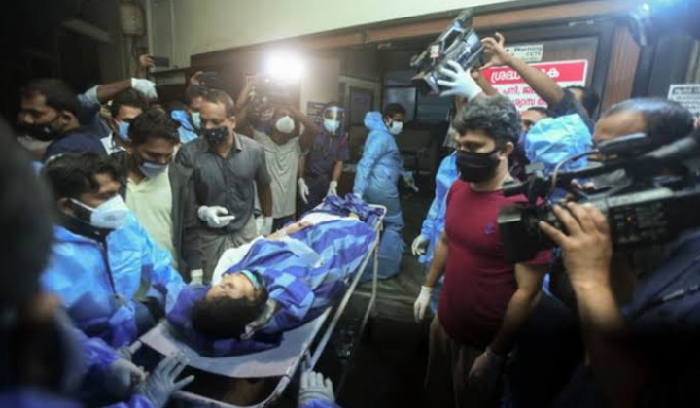
Kozhikode, Aug 8: A family of five, returning to their hometown at Koducalli in Kozhikode from Dubai, were aboard the fateful Air India Express flight that crash-landed at the Kozhikode airport claiming at least 18 lives on Friday.

Saifudheen, 40, is a businessman in Dubai. During the vacation when schools were closed here, his wife Fasalunnisa travelled, along with their children Muhammad Shahil, Fathima Sana and Aysha Shanza, to meet her husband.

On Friday, they were all travelling in the Air India aircraft to Kozhikode.

All five have received injuries and have been admitted to Baby Memorial Hospital Kozhikode except Sana, who is admitted to Al Shifa Hospital at Perinthalmanna in Malappuram.

"Saifudheen is my uncle. He and his family members were returning from Dubai when this unfortunate incident occurred. We were informed about the mishap at 8 pm. Now the family members have been shifted to Baby Memorial Hospital and everyone is fine now," Muhammad Salih, nephew of Saifudheen said.

The death toll in the flight crash landing incident at Kozhikode International Airport in Kerala rose to 18, including two pilots, Civil Aviation Minister Hardeep Singh Puri said on Saturday.

The minister said that he will visit the Kozhikode airport to take stock of the situation.

Two special relief flights have been arranged from Delhi and one from Mumbai for rendering humanitarian assistance to all the passengers and the family members.

Aircraft Accident Investigation Bureau (AAIB), Directorate General of Civil Aviation (DGCA) and Flight Safety Departments have reached to investigate the incident, the Air India Express stated.

Comments

Add new comment

  • Coastaldigest.com reserves the right to delete or block any comments.
  • Coastaldigset.com is not responsible for its readers’ comments.
  • Comments that are abusive, incendiary or irrelevant are strictly prohibited.
  • Please use a genuine email ID and provide your name to avoid reject.
News Network
January 6,2020

Jan 6: India’s Finance Ministry has delivered a challenge to its revenue collectors: meet tax targets despite $20 billion of corporate tax cuts.

Through a video conference on Dec. 16, officials were exhorted to meet the direct tax mop-up target of 13.4 trillion rupees ($187 billion), a government official told reporters. Collection in the eight months to November grew at 5% from a year earlier, against the desired 17%.

The missive shows Prime Minister Narendra Modi’s urgent need to buoy public finances in a slowing economy where April-November tax collections were half the amount budgeted. Authorities withheld some payments to states and have capped ministries’ expenditure as the fiscal deficit ballooned beyond the target.

The government’s efforts to maintain its deficit goal goes against advice from some quarters, including central bank Governor Shaktikanta Das, who urged more spending to spur economic growth.

It’s uncertain though how much room Modi’s administration has to boost expenditure, given that it may already be borrowing as much as 540 billion rupees through state-run companies, a figure that isn’t reflected on the federal balance sheet. Uncertainty about public finances pushed up sovereign yields in November and December, compelling Das to announce unconventional policies to keep costs in check.

“This is not a time to conceal the fiscal deficit by off-budget borrowing or deferring payments,” said Indira Rajaraman, an economist and a former member of the Reserve Bank of India’s board. “If they were to stick to the target, that would be catastrophic because there is so much pump-priming that is needed right now.”

GDP grew 4.5% in the quarter ended September, the slowest pace in more than six years as both consumption and investments cooled in Asia’s third-largest economy. Only government spending supported the expansion, piling pressure on Modi to keep stimulating.

S&P Global Ratings warned in December it may downgrade India’s sovereign ratings if economic growth doesn’t recover. Government support seems to be waning now, with ministries asked to cap spending in the final quarter of the financial year at 25% of the amount budgeted rather than 33% allowed earlier. This new rule will hamstring sectors including agriculture, aviation and coal, where not even half of annual targets have been disbursed.

As the federal government runs short of money, it’s been delaying payouts to state administrations.

Private hospitals have threatened to suspend cash-less services to government employees over non-payment of dues, while a builder informed the stock exchange about delayed rental payments from no less than the tax office itself.

India is considering a litigation-settlement plan that will allow companies to exit lingering tax disputes by paying a portion of the money demanded by the government, the Economic Times newspaper reported Saturday.

The move will help improve the ease of doing business besides unlocking a part of the almost 8 trillion rupees ($111 billion) caught up in these disputes. The step, which is being considered as part of the annual budget, could also bridge India’s fiscal gap.

Finance Minister Nirmala Sitharaman has refused to comment on the deficit goal before the official budget presentation due Feb. 1.

A deviation from target, if any, “will need to be balanced with a credible consolidation plan further-out,” said Radhika Rao, an economist at DBS Group Holdings Ltd. in Singapore.


Comments

Add new comment

  • Coastaldigest.com reserves the right to delete or block any comments.
  • Coastaldigset.com is not responsible for its readers’ comments.
  • Comments that are abusive, incendiary or irrelevant are strictly prohibited.
  • Please use a genuine email ID and provide your name to avoid reject.