



Valley erupts in protest over deaths in Army firing

November 5, 2014

Srinagar, Nov 5: Anger over the killing of two schoolboys in Army firing on Monday evening spilled over to the streets on Tuesday with stone-throwing protesters clashing with the police, forcing the authorities to clamp curfew in several parts of downtown Srinagar.
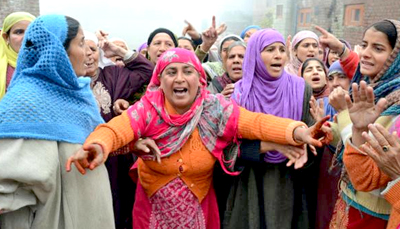
Valley Army firingIn Nowgam, the home of the slain boys, clashes took place through the day.

Senior district administration officials said curfew was imposed in Khanyar, Nowhatta, Mahraj Gunj, Rainawari, Safakadal and Nowgam and there was palpable tension throughout the city.

The two boys who died were identified as Faisal and Mehrajuddin. Faisal was studying in class VII. He had gone out in his father’s car to buy curtains for the hall where the family was planning a party on Sunday. “Faisal met his neighbourhood friends and all of them decided to go to Chattargam for a while to watch Marsiya (mourning on Muharram). Then the Army killed him,” says Faisal’s cousin, Jan Muzaffar.

According to one of the boys, who escaped unhurt, their car brushed against a tipper truck on their way to Chattargam and were afraid that the driver would catch hold of them and beat them up. “They drove fast fearing the tipper truck driver and missed the Army signal to stop and they [the Army] killed them for it,” says Mohammad Sami, a shopkeeper outside Faisal’s home. “I saw him when he left home and then when they brought his body today, I couldn’t recognise him.” Faisal’s brother, Faizan (9) could not understand why the Army did not shoot at the tyres of the car if they wanted to stop the vehicle. “Why did they shoot at the windows,” he wondered.

Defence Minister Arun Jaitely said a fair inquiry would be held and action taken against those found guilty.

Comments

Add new comment

  • Coastaldigest.com reserves the right to delete or block any comments.
  • Coastaldigset.com is not responsible for its readers’ comments.
  • Comments that are abusive, incendiary or irrelevant are strictly prohibited.
  • Please use a genuine email ID and provide your name to avoid reject.
News Network
March 12,2020

Bengaluru, Mar 12: Imarti Devi, who recently resigned as Congress MLA from Madhya Pradesh, on Wednesday said that she was happy with Jyotiraditya Scindia's decision to join the BJP.

Imarti said: "All 22 MLAs are here (in Bengaluru) on their own. We're happy that Scindiaji has taken this decision. I'll always stay with him even if I had to jump in a well."

"When we were in the Congress, Kamal Nathji never heard us," she said.

Another rebel leader and former minister Mahendra Singh Sisodia said: "Betrayal is not done by Jyotiraditya Scindia. Instead, betrayal was done by the Congress and Kamal Nathji."

"Congress betrayed the people of Madhya Pradesh. We are with Jyotiraditya Scindia," he said.

Comments

Add new comment

  • Coastaldigest.com reserves the right to delete or block any comments.
  • Coastaldigset.com is not responsible for its readers’ comments.
  • Comments that are abusive, incendiary or irrelevant are strictly prohibited.
  • Please use a genuine email ID and provide your name to avoid reject.
Agencies
May 21,2020

More than 50 million people in India do not have access to effective handwashing, putting them at a greater risk of acquiring and transmitting the novel coronavirus, according to a study.

Researchers from the Institute for Health Metrics and Evaluation (IHME) at the University of Washington in the US found that without access to soap and clean water, over 2 billion people in low- and middle-income nations -- a quarter of the world's population -- have a greater likelihood of transmitting the coronavirus than those in wealthy countries.

According to the study, published in the journal Environmental Health Perspectives, more than 50 per cent of the people in sub-Saharan Africa and Oceania lacked access to effective handwashing.

"Handwashing is one of the key measures to prevent COVID transmission, yet it is distressing that access is unavailable in many countries that also have limited health care capacity," said Michael Brauer, a professor at IHME.

The study found that in 46 countries, more than half of people lacked access to soap and clean water.

In India, Pakistan, China, Bangladesh, Nigeria, Ethiopia, Democratic Republic of the Congo, and Indonesia, more than 50 million persons in each country were estimated to be without handwashing access, according to the study.

"Temporary fixes, such as hand sanitizer or water trucks, are just that -- temporary fixes," Brauer said.

"But implementing long-term solutions is needed to protect against COVID and the more than 700,000 deaths each year due to poor handwashing access," Brauer said.

He noted that even with 25 per cent of the world's population lacking access to effective handwashing facilities, there have been "substantial improvements in many countries" between 1990 and 2019.

Those countries include Saudi Arabia, Morocco, Nepal, and Tanzania, which have improved their nations' sanitation, the researchers said.

The study does not estimate access to handwashing facilities in non-household settings such as schools, workplaces, health care facilities, and other public locations such as markets.

Earlier this month, the World Health Organization predicted 190,000 people in Africa could die of COVID-19 in the first year of the pandemic, and that upward of 44 million of the continent's 1.3 billion people could be infected with the coronavirus, the researchers said. 

Comments

Add new comment

  • Coastaldigest.com reserves the right to delete or block any comments.
  • Coastaldigset.com is not responsible for its readers’ comments.
  • Comments that are abusive, incendiary or irrelevant are strictly prohibited.
  • Please use a genuine email ID and provide your name to avoid reject.
News Network
March 4,2020

New Delhi, Mar 4: The Supreme Court on Wednesday revoked the ban of cryptocurrency imposed by the Reserve Bank of India (RBI) in 2018.

Pronouncing the verdict, the three-judge bench of the apex court said the ban was 'disproportionate'.

The bench included Justice Rohinton Fali Nariman, Justice S Ravindra Bhat and Justice V Ramasubramanian.

The Internet and Mobile Association of India (IAMAI), whose members include cryptocurrency exchanges, and others had approached the top court objecting to a 2018 RBI circular directing regulated entities to not deal with cryptocurrencies.

Advocate Ashim Sood, appearing for IAMI, submitted that Reserve Bank of India lacked jurisdiction to forbid dealings in cryptocurrencies. The blanket ban was based on an erroneous understanding that it was impossible to regulate cryptocurrencies, Sood submitted.

The petitioners had argued that the RBI's circular taking cryptocurrencies out of the banking channels would deplete the ability of law enforcement agencies to regulate illegal activities in the industry.

IAMAI had claimed the move of RBI had effectively banned legitimate business activity via the virtual currencies (VCs).

The RBI on April 6, 2018, had issued the circular that barred RBI-regulated entities from "providing any service in relation to virtual currencies, including those of transfer or receipt of money in accounts relating to the purchase or sale of virtual currencies".

Comments

Add new comment

  • Coastaldigest.com reserves the right to delete or block any comments.
  • Coastaldigset.com is not responsible for its readers’ comments.
  • Comments that are abusive, incendiary or irrelevant are strictly prohibited.
  • Please use a genuine email ID and provide your name to avoid reject.