



Varanasi fears polarisation as Kejriwal hits campaign trail

April 15, 2014

Varanasi, Apr 15: As political pitch gets stronger in this city of temples and weavers with the arrival of AAP chief Arvind Kejriwal, leaders across party lines are fearing a highly polarised scenario on religious lines ahead of Lok Sabha polls next month.
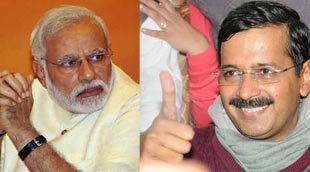
kej_modiWhile senior leaders from BJP dismiss the impact of any anti-Modi polarisation among Muslims, who account for about 18 per cent votes here and close to 30 per cent in urban areas, local leaders from various parties including the saffron party said there was a high probability of Muslim votes being polarised towards the strongest candidate against Gujarat Chief Minister Narendra Modi.
Local leaders from various parties including Congress, SP and BSP, also accused Kejriwal of trying to influence Muslims by projecting himself as the strongest candidate against Modi.

Soon after arriving here this morning, Kejriwal met Benares Shahar-e-Kazi Ghulam Nasir and sought his support. According to AAP leaders here, Nasir told Kejriwal that he would pray for his success.
Kejriwal also met some Balmiki Samaj leaders and visited areas populated by Dalits to seek their support. He is staying at the house of Viplav Mishra, brother of late Veerbhadra Mishra, who was mahant of Sankat Mochan Mandir, a Hanuman temple which is very popular among locals and people visiting Varanasi.
Kejriwal is likely to file his nomination on April 23, before which he may go to Amethi for a couple of days to campaign for party colleague Kumar Vishwas who is fighting against Congress Vice President Rahul Gandhi.
When asked whether BJP was wary of any anti-Modi polarisation among Muslim voters in favour of Kejriwal, party leaders dismissed such claims, saying Modi's win was a foregone conclusion and the fight was only about margins.
BJP's Nalin Kohli, who is camping here for elections, said it was not at all concerned about polarisation and the party was fighting the elections with agenda of 'one India, great India' and the new government would work for solving the problems faced by people of this country.
However, some other local BJP leaders accepted that there were apprehensions about polarisation of votes against Modi, but the quantum would not be enough to defeat the party's prime ministerial candidate and the 'ever-growing' wave in his favour.
On the other hand, Congress candidate Ajay Rai said that it was BJP which was working towards creating a polarisation on the religious lines and the party had done similar things in last Lok Sabha elections.
Rai went on to blame BJP of conspiring to put Muslim strongman leader Mukhtar Ansari in the fray so that minority votes get divided between him and Samajwadi Party. Rai had fought last Lok Sabha elections as a SP candidate, while Ansari was BSP candidate.
Since then, Ansari and his brothers have formed Qaumi Ekta Dal and is currently an MLA, while Rai is a Congress MLA right now. Ansari had earlier said he would fight against Modi, but recently decided against contesting Lok Sabha polls and has said he does not want anti-Modi votes to get divided.
Also in the fray is SP's Kailash Chaurasia, and BSP's Vijay Prakash Jaiswal and both the parties are putting their claims on minority, Dalit and backward votes.
SP's state secretary and UP Janjatiya Lok Kala Sanskriti Sansthan Chairman Manoj Rai Dhoopchandi said that the party would get huge support from minorities, backward and extreme backward caste voters as the state government has worked hard for their development.
"We are asking for votes on the basis of development work done by our government," he said, while accusing Kejriwal and Rai of trying to usurp SP's vote bank of minorities.
He said that the people of Varanasi would not be lured by them as they now that Kejriwal was an outsider and even Rai was wrongly claiming to be a local leader as his MLA constituency was hardly within Varanasi Lok Sabha area.
"Besides, people know that Rai is an ex-BJP leader and he has changed many parties, making him unacceptable among people here," he said.
Some Muslim leaders, on the other hand said, they do not want to be very vocal against Modi and the community is rather focussing on supporting candidates who can fight corruption or those who can work for local issues.
In 2009, there was reportedly huge polarisation against Ansari in Varanasi, and Murli Manohar Joshi could sail through by a small margin. Local leaders say that Joshi could muster enough support at the last moment after some other candidates pledged their support to BJP to defeat Ansari and they fear a similar situation against Modi this time.
Usman Gani, State Incharge of Momin Conference, which had been a major participant in Gandhian Khadi movement, categorically said that Aam Aadmi Party would fulfil the dreams of clean and secular India.
Surprisingly, neither has any major party announced any Muslim candidate so far for Varanasi seat, nor has any strong minority leader announced plans to fight independently.
Gani said he is hopeful that Quami Ekta Dal would also lend its support to Kejriwal as he was the only leader to stand up to the stature of Modi.
Momin Conference in Varanasi has been supporting AAP and it has given its own office to AAP in Sigra locality for election campaign purposes.

Comments

Casie
 - 
Tuesday, 12 Jan 2016

Istniejemy kompania ustawiona w delikatnej spacje od Zaznania tudziez
zagarniamy sie zwykle armatura szamb dietetycznych, lokalne oczyszczalnie przylegle czerpia naturalnie z rozdzielaczy spójniki od ich producentów

Feel free to surf to my web-site ... przydomowa oczyszczalnia scieków: http://fjxlh.com.w010.mydns114.net/comment/html/?4509.html

Add new comment

  • Coastaldigest.com reserves the right to delete or block any comments.
  • Coastaldigset.com is not responsible for its readers’ comments.
  • Comments that are abusive, incendiary or irrelevant are strictly prohibited.
  • Please use a genuine email ID and provide your name to avoid reject.
News Network
March 9,2020

Mumbai, Mar 9: India's Yes Bank will not be merged with State Bank of India, which is set to infuse funds in the beleaguered lender, the newly appointed administrator leading the rescue plan said in a television interview on Monday.

"There is absolutely no question of a merger," Prashant Kumar, the administrator, told the CNBC TV18 channel.

The Reserve Bank of India (RBI) on Thursday took control of Yes Bank, after the lender - which is laden with bad debts - failed to raise the capital it needs to stay above mandated regulatory requirements.

Placing Yes Bank under a 30-day moratorium, the central bank imposed limits on withdrawals to protect depositors and said it would work on a revival plan. The move spooked depositors, who rushed to withdraw funds from the bank.

Kumar, a former finance chief at SBI, assured depositors their money was safe and that the moratorium on Yes Bank might be lifted much before the deadline on April 3 and normal banking operations might resume as early as Friday.

He also mentioned that the withdrawal limit of Yes Bank may be removed by March 15, 2020.

SBI Chairman Rajnish Kumar said on Saturday the state-run bank would need to invest up to 24.5 billion rupees ($331 million) to buy a 49% stake in Yes Bank as part of the initial phase of the rescue deal, adding that the survival of troubled lender was a "must".

Comments

Add new comment

  • Coastaldigest.com reserves the right to delete or block any comments.
  • Coastaldigset.com is not responsible for its readers’ comments.
  • Comments that are abusive, incendiary or irrelevant are strictly prohibited.
  • Please use a genuine email ID and provide your name to avoid reject.
News Network
February 2,2020

Feb 2: Prime Minister Narendra Modi’s second budget in seven months disappointed investors who were hoping for big-bang stimulus to revive growth in Asia’s third-largest economy.

The fiscal plan -- delivered by Finance Minister Nirmala Sitharaman on Saturday -- proposed tax cuts for individuals and wider deficit targets but failed to provide specific steps to fix a struggling financial sector, improve infrastructure and create jobs. Stocks slumped as a proposal to scrap the dividend distribution tax for companies failed to impress investors.

"Far from being a game changer, the budget provides little in terms of short-term growth stimulus,” said Priyanka Kishore, head of India and South East Asia economics at Oxford Economics Ltd. in Singapore. “While income tax cuts will provide some relief on the consumption front, the multiplier effect is low and the overall stance of the budget is not expansionary."

India has gone from being the world’s fastest-growing major economy three years ago, expanding at 8%, to posting its weakest performance in more than a decade this fiscal year, estimated at 5%.

While the government has taken a number of steps in recent months to spur growth, they’ve fallen short of spurring demand in the consumption-driven economy. Saturday’s budget just added to the glum sentiment.

Okay Budget

“It’s an okay budget but not firing on all cylinders that the market was hoping for,” said Andrew Holland, chief executive officer at Avendus Capital Alternate Strategies in Mumbai.

The government had limited scope for a large stimulus given a huge shortfall in revenues in the current year. The slippage induced Sitharaman to invoke a never-used provision in fiscal laws, allowing the government to exceed the budget gap by 0.5 percentage points. The result: the deficit for the year ending March was widened to 3.8% of gross domestic product from a planned 3.3%.

On Friday, India’s chief economic adviser Krishnamurthy Subramanian said reviving economic growth was an “urgent priority” and deficit goals could be relaxed to achieve that. The adviser’s Economic Survey estimated growth will rebound to 6%-6.5% in the year starting April.

The fiscal gap will narrow to 3.5% next year, as the government budgeted for gross market borrowing to rise marginally to 7.8 trillion rupees from 7.1 trillion rupees in the current year. A plan to earn 2.1 trillion rupees by selling state-owned assets in the year starting April will also help plug the deficit.

Total spending in the coming fiscal year will increase to 30.4 trillion rupees, representing a 13% increase from the current year’s budget, according to latest data.

Key highlights from the budget:

* Tax on annual income up to 1.25 million rupees pared, with riders

* Dividend distribution tax to be levied on investors, instead of companies

* Farm sector budget raised 28%, transport infrastructure gets 7% more

* Spending on education raised 5%

* Fertilizer subsidy cut 10%

Analysts said the muted spending plan to keep the deficit in check will lead to more downside risks to growth in the coming months.

“It is very doubtful that the increase in expenditure will push demand much,” Chakravarthy Rangarajan, former governor at the Reserve Bank of India told BloombergQuint, adding that achieving next year’s budget deficit goal of 3.5% of GDP was doubtful.

With the government sticking to a conservative fiscal path, the focus will now turn to central bank, which is set to review monetary policy on Feb. 6. Given inflation has surged to a five-year high of 7.35%, the RBI is unlikely to lower interest rates.

What Bloomberg’s Economists Say:

The burden of recovery now falls solely on the Reserve Bank of India. With inflation breaching RBI’s target at present, any rate cuts by the central bank are likely to be delayed and contingent upon inflation falling below the upper end of its 2%-6% target range.

-- Abhishek Gupta, India economist

Governor Shaktikanta Das may instead focus on unconventional policy tools such as the Federal Reserve-style Operation Twist -- buying long-end debt while selling short-tenor bonds -- to keep borrowing costs down.

Comments

Add new comment

  • Coastaldigest.com reserves the right to delete or block any comments.
  • Coastaldigset.com is not responsible for its readers’ comments.
  • Comments that are abusive, incendiary or irrelevant are strictly prohibited.
  • Please use a genuine email ID and provide your name to avoid reject.
Agencies
June 29,2020

New Delhi, Jun 29: Fuel prices rose on Monday again after a days pause with oil marketing companies increasing the pump price of petrol by 5 paisa and diesel by 13 paisa per litre in Delhi.

In the national capital, petrol price on Monday stood at Rs 80.43 per litre while that of diesel at Rs 80.53 a litre.

With this increase, fuel prices have moved up on 22 of the last 23 days (with no rise on Sunday). Petrol prices, however, were unchanged for an additional day in between after the daily revision based on dynamic pricing was reinstated by OMCs.

Since the daily price revision resumed on June 7, petrol price has increased Rs 9.17 and diesel rose by Rs 11.14 in the national capital. In the other cities the magnitude of increase was similar.

During the past 23 days, the quantum of price hike gradually declined from around 60 paise raise for a few days, immediately post the resumption of daily price revision, to less than 20 paise during the past few days and now even less than 10 paisa per litre.

In a historic development, the price of diesel surged above that of petrol in the national capital during this period. It continues to remain higher even though on Saturday the quantum of petrol price hike was higher than that of diesel.

Officials in oil marketing companies said that it is hard to predict which of the two fuels will be priced higher in the Capital as the gap between the two is almost negligible. But petrol prices have shown more volatility in international markets that may take it ahead once again in coming days.

Apart from Delhi, the retail prices of petrol and diesel have followed the traditional path in other metros with petrol being priced at a premium of between Rs 5 and 8 per litre. The difference between the auto fuel prices in Delhi and other metros is because of the taxation structure.

While both petrol and diesel are at similar levels of taxes (state and centre) in Delhi, it is higher for petrol in many other Indian cities.

Globally diesel is priced a tad higher than petrol. In India too, the base price of diesel is slightly higher than petrol but taxation at central and state levels changed the complexion of retail prices.

If the price of petroleum products and crude hold their positions in global markets, then petrol and diesel prices rise may stop for a longer period and we may even see marginal fall in prices.

Fuel prices have been increasing since June 7 when oil companies began the daily price revision mechanism after a hiatus of 82 days during the lockdown.

Comments

Add new comment

  • Coastaldigest.com reserves the right to delete or block any comments.
  • Coastaldigset.com is not responsible for its readers’ comments.
  • Comments that are abusive, incendiary or irrelevant are strictly prohibited.
  • Please use a genuine email ID and provide your name to avoid reject.