



Varanasi fears polarisation as Kejriwal hits campaign trail

April 15, 2014

Varanasi, Apr 15: As political pitch gets stronger in this city of temples and weavers with the arrival of AAP chief Arvind Kejriwal, leaders across party lines are fearing a highly polarised scenario on religious lines ahead of Lok Sabha polls next month.
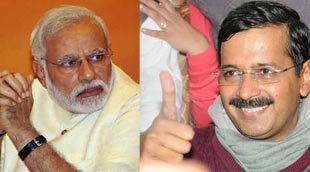
kej_modiWhile senior leaders from BJP dismiss the impact of any anti-Modi polarisation among Muslims, who account for about 18 per cent votes here and close to 30 per cent in urban areas, local leaders from various parties including the saffron party said there was a high probability of Muslim votes being polarised towards the strongest candidate against Gujarat Chief Minister Narendra Modi.
Local leaders from various parties including Congress, SP and BSP, also accused Kejriwal of trying to influence Muslims by projecting himself as the strongest candidate against Modi.

Soon after arriving here this morning, Kejriwal met Benares Shahar-e-Kazi Ghulam Nasir and sought his support. According to AAP leaders here, Nasir told Kejriwal that he would pray for his success.
Kejriwal also met some Balmiki Samaj leaders and visited areas populated by Dalits to seek their support. He is staying at the house of Viplav Mishra, brother of late Veerbhadra Mishra, who was mahant of Sankat Mochan Mandir, a Hanuman temple which is very popular among locals and people visiting Varanasi.
Kejriwal is likely to file his nomination on April 23, before which he may go to Amethi for a couple of days to campaign for party colleague Kumar Vishwas who is fighting against Congress Vice President Rahul Gandhi.
When asked whether BJP was wary of any anti-Modi polarisation among Muslim voters in favour of Kejriwal, party leaders dismissed such claims, saying Modi's win was a foregone conclusion and the fight was only about margins.
BJP's Nalin Kohli, who is camping here for elections, said it was not at all concerned about polarisation and the party was fighting the elections with agenda of 'one India, great India' and the new government would work for solving the problems faced by people of this country.
However, some other local BJP leaders accepted that there were apprehensions about polarisation of votes against Modi, but the quantum would not be enough to defeat the party's prime ministerial candidate and the 'ever-growing' wave in his favour.
On the other hand, Congress candidate Ajay Rai said that it was BJP which was working towards creating a polarisation on the religious lines and the party had done similar things in last Lok Sabha elections.
Rai went on to blame BJP of conspiring to put Muslim strongman leader Mukhtar Ansari in the fray so that minority votes get divided between him and Samajwadi Party. Rai had fought last Lok Sabha elections as a SP candidate, while Ansari was BSP candidate.
Since then, Ansari and his brothers have formed Qaumi Ekta Dal and is currently an MLA, while Rai is a Congress MLA right now. Ansari had earlier said he would fight against Modi, but recently decided against contesting Lok Sabha polls and has said he does not want anti-Modi votes to get divided.
Also in the fray is SP's Kailash Chaurasia, and BSP's Vijay Prakash Jaiswal and both the parties are putting their claims on minority, Dalit and backward votes.
SP's state secretary and UP Janjatiya Lok Kala Sanskriti Sansthan Chairman Manoj Rai Dhoopchandi said that the party would get huge support from minorities, backward and extreme backward caste voters as the state government has worked hard for their development.
"We are asking for votes on the basis of development work done by our government," he said, while accusing Kejriwal and Rai of trying to usurp SP's vote bank of minorities.
He said that the people of Varanasi would not be lured by them as they now that Kejriwal was an outsider and even Rai was wrongly claiming to be a local leader as his MLA constituency was hardly within Varanasi Lok Sabha area.
"Besides, people know that Rai is an ex-BJP leader and he has changed many parties, making him unacceptable among people here," he said.
Some Muslim leaders, on the other hand said, they do not want to be very vocal against Modi and the community is rather focussing on supporting candidates who can fight corruption or those who can work for local issues.
In 2009, there was reportedly huge polarisation against Ansari in Varanasi, and Murli Manohar Joshi could sail through by a small margin. Local leaders say that Joshi could muster enough support at the last moment after some other candidates pledged their support to BJP to defeat Ansari and they fear a similar situation against Modi this time.
Usman Gani, State Incharge of Momin Conference, which had been a major participant in Gandhian Khadi movement, categorically said that Aam Aadmi Party would fulfil the dreams of clean and secular India.
Surprisingly, neither has any major party announced any Muslim candidate so far for Varanasi seat, nor has any strong minority leader announced plans to fight independently.
Gani said he is hopeful that Quami Ekta Dal would also lend its support to Kejriwal as he was the only leader to stand up to the stature of Modi.
Momin Conference in Varanasi has been supporting AAP and it has given its own office to AAP in Sigra locality for election campaign purposes.

Comments

Casie
 - 
Tuesday, 12 Jan 2016

Istniejemy kompania ustawiona w delikatnej spacje od Zaznania tudziez
zagarniamy sie zwykle armatura szamb dietetycznych, lokalne oczyszczalnie przylegle czerpia naturalnie z rozdzielaczy spójniki od ich producentów

Feel free to surf to my web-site ... przydomowa oczyszczalnia scieków: http://fjxlh.com.w010.mydns114.net/comment/html/?4509.html

Add new comment

  • Coastaldigest.com reserves the right to delete or block any comments.
  • Coastaldigset.com is not responsible for its readers’ comments.
  • Comments that are abusive, incendiary or irrelevant are strictly prohibited.
  • Please use a genuine email ID and provide your name to avoid reject.
Agencies
May 30,2020

New Delhi, May 30: The COVID-19 pandemic has left the Indian private healthcare sector in acute financial distress, a new survey said on Friday adding that the healthcare facilities in the country have witnessed at least 80 per cent fall in average revenue.

Post the lockdown from March 24, Indian hospitals have seen a large impact, especially among small and medium-sized hospitals, which are now facing existential challenges.

The survey by healthcare industry body NATHEALTH was conducted in 251 healthcare facilities across nine states and 69 cities to assess the impact of COVID-19 on the domestic healthcare industry.

The findings showed that 90 per cent of the surveyed healthcare facilities are facing financial challenges with 21 per cent facilities facing an existential threat.

"There is a need for a stimulus package to revive the Indian healthcare industry which will be crucial to provide much-needed relief to the healthcare sector which is the frontline defence in this fight against COVID-19," said Dr Sudarshan Ballal, President NATHEALTH.

According to the survey, hospitals in tier 1 and tier 2 cities are experiencing a 78 per cent reduction in OPD footfalls, and a drop of 79 per cent in in-patient admissions.

The study found that 90 per cent of organisations require some form of financial assistance.

The findings indicated that even after the lockdown lift, the situation will remain difficult for the hospitals and nursing homes as patients will hesitate from visiting hospitals.

Comments

Add new comment

  • Coastaldigest.com reserves the right to delete or block any comments.
  • Coastaldigset.com is not responsible for its readers’ comments.
  • Comments that are abusive, incendiary or irrelevant are strictly prohibited.
  • Please use a genuine email ID and provide your name to avoid reject.
Agencies
July 6,2020

New Delhi, Jul 6: The Indian Academy of Sciences, a Bengaluru-based body of scientists, has said the Indian Council for Medical Research's (ICMR) target to launch a coronavirus vaccine by August 15 is "unfeasible" and "unrealistic".

The IASc said while there is an unquestioned urgent need, vaccine development for use in humans requires scientifically executed clinical trials in a phased manner.

While administrative approvals can be expedited, the "scientific processes of experimentation and data collection have a natural time span that cannot be hastened without compromising standards of scientific rigour", the IASc said in a statement.

In its statement, the IASc referred to the ICMR's letter which states that "it is envisaged to launch the vaccine for public health use latest by 15th August 2020 after completion of all clinical trials".

The ICMR and Bharat Biotech India Limited, a private pharmaceutical company, are jointly developing the vaccine against the novel coronavirus -- SARS-CoV-2.

The IASc welcomes the exciting development of a candidate vaccine and wishes that the vaccine is quickly made available for public use, the statement said.

"However, as a body of scientists including many who are engaged in vaccine development IASc strongly believes that the announced timeline is unfeasible. This timeline has raised unrealistic hope and expectations in the minds of our citizens," it said.

Aiming to launch an indigenous COVID-19 vaccine by August 15, the ICMR had written to select medical institutions and hospitals to fast-track clinical trial approvals for the vaccine candidate, COVAXIN.

Experts have also cautioned against rushing the process for developing a COVID-19 vaccine and stressed that it is not in accordance with the globally accepted norms to fast-track vaccine development for diseases of pandemic potential.

The IASc said trials for a vaccine involve evaluation of safety (Phase 1 trial), efficacy and side effects at different dose levels (Phase 2 trial), and confirmation of safety and efficacy in thousands of healthy people (Phase 3 trial) before its release for public use.

Clinical trials for a candidate vaccine require participation of healthy human volunteers. Therefore, many ethical and regulatory approvals need to be obtained prior to the initiation of the trials, it added.

The IASc said the immune responses usually take several weeks to develop and relevant data should not be collected earlier.

"Moreover, data collected in one phase must be adequately analysed before the next phase can be initiated. If the data of any phase are unacceptable then the clinical trial is required to be immediately aborted," it said.

For example, if the data collected from Phase 1 of the clinical trial show that the vaccine is not adequately safe, then Phase 2 cannot be initiated and the candidate vaccine must be discarded.

For these reasons, the Indian Academy of Sciences believes that the announced timeline is "unreasonable and without precedent", the statement said.

"The Academy strongly believes that any hasty solution that may compromise rigorous scientific processes and standards will likely have long-term adverse impacts of unforeseen magnitude on citizens of India," it said.

Comments

Add new comment

  • Coastaldigest.com reserves the right to delete or block any comments.
  • Coastaldigset.com is not responsible for its readers’ comments.
  • Comments that are abusive, incendiary or irrelevant are strictly prohibited.
  • Please use a genuine email ID and provide your name to avoid reject.
Agencies
January 20,2020

New Delhi, Jan 20: The BJP has got a brand new President in the form of JP Nadda. At around 2.30 pm, the announcement was made, bringing an end to the Amit Shah era in BJP. The party's Working President Jagat Prakash Nadda won unopposed, sparking celebrations outside the BJP headquarters here on Monday. 

Amit Shah himself was among the people who proposed Nadda's name along with Nitin Gadkari and Rajnath Singh. Soon after his annointment, BJP election returning officer Radha Mohan Singh told the media, "I announce JP Nadda as the new BJP President." Shah was also seen hugging Nadda.

The nomination process for the post of the BJP President began at 10 am and went on till 12.30 pm. For the next hour, the filed nomination paper, which was just one, was examined. Party members waitied till 2.30 pm for the candidate to withdraw if he wished to. It was after this that Nadda was declared as the man who would step into the shoes of Amit Shah.

Many in the BJP believe that although Nadda is the BJP chief now, Shah would still make all macro-level decisions like pre poll alliances or top organisational appointments. Nadda would be in charge of monitoring the day-to-day needs of the organisation. BJP sources say that Amit Shah himself wanted an arrangement like this one and personally wanted Nadda to take over. as he helped Shah formulate legislations like Triple Talaq and Citizenship Amendment Act.

The party constitution mandates completion of election of at least 50 per cent of state Presidents for the election of national President to happen. In the last few days, the BJP has completed the election of a slew of state Presidents like in West Bengal, Nagaland among others.

The process of election of the national BJP President is quite elaborate and has been described in detail in the party constitution, which says that the national president shall be elected by an electoral college, comprising members of the national council and the state councils.

"Any 20 members of the electoral college of a state can jointly propose the name of a person, who has been an active member for four terms and has 15 years of membership, for the post of national president. Such joint proposal should come from not less than five states where elections have been completed for the national council. The consent of the candidate is necessary," it says.

Who is JP Nadda?

Jagat Prakash Nadda, 59, who has his roots in the Rashtriya Swayamsevak Sangh (RSS) and its affiliates, was appointed the Bharatiya Janata Party (BJP) national President on Monday, replacing his 'mentor' and Union Home Minister Amit Shah.

Former environment, health and law minister from Himachal Pradesh, which has just four of the Lok Sabha's 543 seats, Nadda has tried to carve out his own space in national politics with his low profile and astute organisational skills, believe his party leaders.

He rose through the ranks from the Akhil Bharatiya Vidyarthi Parishad (ABVP), the student wing of the RSS, from where he has managed to build inroads from university to the state politics.

Nadda has been active on the national political scene since 2010 when he was picked by then BJP chief Nitin Gadkari to join his new team. He was made the party's national general secretary.

Born on December 2, 1960, Nadda did his graduation from Patna and holds a post-graduate degree in political science and Bachelor of Legislative Law (LL.B) from Himachal Pradesh University in Shimla.

Starting his political career as a student leader of the ABVP in 1978, Nadda had also worked both with Gadkari and Shah even in the party's youth wing -- the Bharatiya Yuva Morcha -- from 1991 to 1994.

His wife Mallika Nadda, who teaches history at the Himachal Pradesh University and is currently posted in university's campus in Delhi, was an ABVP activist too, and its national general secretary from 1988 to 1999.

In the previous BJP government (2007-12) in the state, Nadda was forced to resign as Forest Minister in 2010 owing to differences between him and then chief minister Prem Kumar Dhumal.

He was elected to the Rajya Sabha in 2012.

Nadda won his first Assembly election from Bilaspur (Sadar) in Himachal in 1993. In 1998, he again won from that seat and became the state Health Minister.

He lost the Assembly elections in 2003, but again won in 2007 and was appointed the Forest Minister in the Himachal Pradesh.

Nadda, as a forest minister, was the brain behind opening forest police stations to check forest crimes, launching community-driven plantation, setting up forest ponds and the massive plantation of deodars to boost the depleting green cover of the 'Queen of Hills', as Shimla was fondly called by the British.

A close confidant of Prime Minister Narendra Modi, Nadda was among those who were mentioned as likely aspirants to the BJP top post after Rajnath Singh was inducted into the Central government as the Home Minister in 2014.

Later, Nadda was inducted into the union cabinet in its first expansion in 2014 as the Health Minister.

Hailing Nadda's appointment, Chief Minister Jai Ram Thakur told IANS it is a proud moment that a leader belonging to a small state in the national politics is today the leader of the country's biggest national party.

His father N.L. Nadda, who was a Vice-Chancellor of the Ranchi University, resides in Bilaspur town.

Comments

Add new comment

  • Coastaldigest.com reserves the right to delete or block any comments.
  • Coastaldigset.com is not responsible for its readers’ comments.
  • Comments that are abusive, incendiary or irrelevant are strictly prohibited.
  • Please use a genuine email ID and provide your name to avoid reject.