



Varanasi fears polarisation as Kejriwal hits campaign trail

April 15, 2014

Varanasi, Apr 15: As political pitch gets stronger in this city of temples and weavers with the arrival of AAP chief Arvind Kejriwal, leaders across party lines are fearing a highly polarised scenario on religious lines ahead of Lok Sabha polls next month.
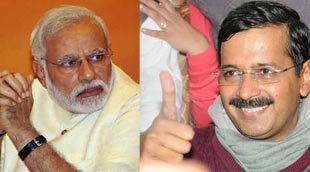
kej_modiWhile senior leaders from BJP dismiss the impact of any anti-Modi polarisation among Muslims, who account for about 18 per cent votes here and close to 30 per cent in urban areas, local leaders from various parties including the saffron party said there was a high probability of Muslim votes being polarised towards the strongest candidate against Gujarat Chief Minister Narendra Modi.
Local leaders from various parties including Congress, SP and BSP, also accused Kejriwal of trying to influence Muslims by projecting himself as the strongest candidate against Modi.

Soon after arriving here this morning, Kejriwal met Benares Shahar-e-Kazi Ghulam Nasir and sought his support. According to AAP leaders here, Nasir told Kejriwal that he would pray for his success.
Kejriwal also met some Balmiki Samaj leaders and visited areas populated by Dalits to seek their support. He is staying at the house of Viplav Mishra, brother of late Veerbhadra Mishra, who was mahant of Sankat Mochan Mandir, a Hanuman temple which is very popular among locals and people visiting Varanasi.
Kejriwal is likely to file his nomination on April 23, before which he may go to Amethi for a couple of days to campaign for party colleague Kumar Vishwas who is fighting against Congress Vice President Rahul Gandhi.
When asked whether BJP was wary of any anti-Modi polarisation among Muslim voters in favour of Kejriwal, party leaders dismissed such claims, saying Modi's win was a foregone conclusion and the fight was only about margins.
BJP's Nalin Kohli, who is camping here for elections, said it was not at all concerned about polarisation and the party was fighting the elections with agenda of 'one India, great India' and the new government would work for solving the problems faced by people of this country.
However, some other local BJP leaders accepted that there were apprehensions about polarisation of votes against Modi, but the quantum would not be enough to defeat the party's prime ministerial candidate and the 'ever-growing' wave in his favour.
On the other hand, Congress candidate Ajay Rai said that it was BJP which was working towards creating a polarisation on the religious lines and the party had done similar things in last Lok Sabha elections.
Rai went on to blame BJP of conspiring to put Muslim strongman leader Mukhtar Ansari in the fray so that minority votes get divided between him and Samajwadi Party. Rai had fought last Lok Sabha elections as a SP candidate, while Ansari was BSP candidate.
Since then, Ansari and his brothers have formed Qaumi Ekta Dal and is currently an MLA, while Rai is a Congress MLA right now. Ansari had earlier said he would fight against Modi, but recently decided against contesting Lok Sabha polls and has said he does not want anti-Modi votes to get divided.
Also in the fray is SP's Kailash Chaurasia, and BSP's Vijay Prakash Jaiswal and both the parties are putting their claims on minority, Dalit and backward votes.
SP's state secretary and UP Janjatiya Lok Kala Sanskriti Sansthan Chairman Manoj Rai Dhoopchandi said that the party would get huge support from minorities, backward and extreme backward caste voters as the state government has worked hard for their development.
"We are asking for votes on the basis of development work done by our government," he said, while accusing Kejriwal and Rai of trying to usurp SP's vote bank of minorities.
He said that the people of Varanasi would not be lured by them as they now that Kejriwal was an outsider and even Rai was wrongly claiming to be a local leader as his MLA constituency was hardly within Varanasi Lok Sabha area.
"Besides, people know that Rai is an ex-BJP leader and he has changed many parties, making him unacceptable among people here," he said.
Some Muslim leaders, on the other hand said, they do not want to be very vocal against Modi and the community is rather focussing on supporting candidates who can fight corruption or those who can work for local issues.
In 2009, there was reportedly huge polarisation against Ansari in Varanasi, and Murli Manohar Joshi could sail through by a small margin. Local leaders say that Joshi could muster enough support at the last moment after some other candidates pledged their support to BJP to defeat Ansari and they fear a similar situation against Modi this time.
Usman Gani, State Incharge of Momin Conference, which had been a major participant in Gandhian Khadi movement, categorically said that Aam Aadmi Party would fulfil the dreams of clean and secular India.
Surprisingly, neither has any major party announced any Muslim candidate so far for Varanasi seat, nor has any strong minority leader announced plans to fight independently.
Gani said he is hopeful that Quami Ekta Dal would also lend its support to Kejriwal as he was the only leader to stand up to the stature of Modi.
Momin Conference in Varanasi has been supporting AAP and it has given its own office to AAP in Sigra locality for election campaign purposes.

Comments

Casie
 - 
Tuesday, 12 Jan 2016

Istniejemy kompania ustawiona w delikatnej spacje od Zaznania tudziez
zagarniamy sie zwykle armatura szamb dietetycznych, lokalne oczyszczalnie przylegle czerpia naturalnie z rozdzielaczy spójniki od ich producentów

Feel free to surf to my web-site ... przydomowa oczyszczalnia scieków: http://fjxlh.com.w010.mydns114.net/comment/html/?4509.html

Add new comment

  • Coastaldigest.com reserves the right to delete or block any comments.
  • Coastaldigset.com is not responsible for its readers’ comments.
  • Comments that are abusive, incendiary or irrelevant are strictly prohibited.
  • Please use a genuine email ID and provide your name to avoid reject.
News Network
March 27,2020

New Delhi, Mar 27: The death toll due to COVID-19 rose to 17 in the country on Friday and the number of coronavirus cases climbed to 724, according to the Health Ministry. In its updated figures at 9.15 am, the ministry stated that four deaths were reported from Maharashtra while Gujarat had registered three deaths.

Karnataka has reported two deaths so far, while Madhya Pradesh, Tamil Nadu, Bihar, Punjab, Delhi, West Bengal, Jammu and Kashmir and Himachal Pradesh have reported one death each.

According to the data, the number of active COVID-19 cases in the country stood at 640, while 66 people were either cured or discharged and one had migrated. The total number of 724 cases included 47 foreign nationals, the ministry said.

Comments

Add new comment

  • Coastaldigest.com reserves the right to delete or block any comments.
  • Coastaldigset.com is not responsible for its readers’ comments.
  • Comments that are abusive, incendiary or irrelevant are strictly prohibited.
  • Please use a genuine email ID and provide your name to avoid reject.
Agencies
June 25,2020

New Delhi, Jun 25: The Supreme Court on Thursday asked the Centre and the CBSE to issue fresh notification in connection with Class 12 exams, clarifying the option between internal assessment and exams later.

The observation from the top court after it was informed that the CBSE has decided to cancel the remaining board exams for Class 10 and Class 12.

A bench comprising Justices AM Khanwilkar, Dinesh Maheshwari and Sanjiv Khanna asked the Centre to clarify the issue of taking the option between internal assessment and exams later.

"Clarify the date of results," said the bench, noting that the CBSE will have to submit a fresh draft notification cancelling class 12 Board exams and affidavit on Friday morning, before the top court continues to hear the matter again at 10.30 a.m.

The apex court also sought clarity on the beginning of the new academic year.

It told Solicitor General Tushar Mehta, representing the Centre, that the CBSE is willing to conduct exams when the situation is conducive, but this may vary from state to state. "Will the decision be taken by a central authority or will the state government take the decision? How are you going to deal with that situation?"

Mehta replied that the decision must be taken according to the situation. To this, the bench said should not the solution be pan-India?

"You have not said when you will decide on this issue, and when you will take stock of these things. Some time frame will have to be given," noted the bench.

Continuing its queries, the bench said: "What about state regional board exams... the CBSE does not hold all the exams. The state Board is also there."

Mehta replied that the instructions from the controller of examinations are that exams are controlled centrally. "State boards assist the CBSE," he replied.

The bench observed that the government should modify the draft notification and include the state board issue. "Clear the stand that decision will be taken at the central level and not at the state level... other courses will have to be delayed till CBSE exam results come out," it said.

Mehta replied the assessment results will be published now, and if a student wants to opt to give the exam, then that will be conducted later. The top court asked Mehta to bring this on record and redraft the notification.

Comments

Add new comment

  • Coastaldigest.com reserves the right to delete or block any comments.
  • Coastaldigset.com is not responsible for its readers’ comments.
  • Comments that are abusive, incendiary or irrelevant are strictly prohibited.
  • Please use a genuine email ID and provide your name to avoid reject.
Agencies
May 23,2020

New Delhi, May 23: The nationwide lockdown will no longer help India in its fight against COVID-19, and in its place community-driven containment, isolation and quarantine strategies have to be brought into play, leading virologist Shahid Jameel said.

The recipient of Shanti Swarup Bhatnagar Prize for Science and Technology also stressed that testing should be carried out vigorously to identify coronavirus hotspots and isolate those areas.

"Our current testing rate at 1,744 tests per million population is one of the lowest in the world. We should deploy both antibody tests and confirmatory PCR tests. This will tell us about pockets of ongoing infection and past (recovered) infection. This will provide data to open up gradually and let economic activity resume," Jameel told PTI in an interview.

He stressed that testing has to be dynamic to continuously monitor red, orange and green zones and change these based on that data.

About community transmission of COVID-19 in India, Jameel said the country reached that stage long ago.

"We reached community transmission a long time ago. It's just that the health authorities are not admitting it. Even ICMR's own study of SARI (severe acute respiratory illness) showed that about 40 per cent of those who tested positive for SARS-CoV-2 did not have any history of overseas travel or contact to a known case. If this is not community transmission, then what is?" he posed.

Lockdown bought India time in its fight against coronavirus, but continuing it is unlikely to yield any further dividend, Jameel said.

"Instead, community-driven local lockdowns, isolations and quarantines have to come into play. Building trust is most important so that people follow rules. A public health problem cannot be dealt with as a law-and-order problem."

The nationwide lockdown, initially imposed from March 25 to April 14, has been extended thrice and will continue at least till May 31. The virus has claimed 3,720 lives and infected over 1.25 lakh people in the country so far.

Jameel has expertise in the fields of molecular biology, infectious diseases, and biotechnology. He is the CEO of Wellcome Trust/Department of Biotechnology's India Alliance and is best known for extensive research in Hepatitis E virus and HIV.

He said COVID-19 will eventually be controlled through herd immunity, which is acquired in two ways – when a sufficient fraction of the population gets infected and recovers, and with vaccination.

"It is estimated that for SARS-CoV-2 at least 60 per cent of the population would have to be infected and recovered, or vaccinated. This will happen over the course of the next few years," Jameel said.

Herd immunity is reached when the majority of a population becomes immune to an infectious disease, either because they have become infected and recovered, or through vaccination. When that happens, the disease is less likely to spread to people who aren't immune, because there just aren't enough infectious carriers.

"India has 1.38 billion people, a population density of about 400/sq km and a healthcare system ranked at 143 in the world. If we allow 60 per cent people to get infected quickly in the hopes of herd immunity, that would mean 830 million infections," Jameel said.

"If 15 per cent need hospitalization that means about 125 million isolation beds (we have 0.3 million). If five per cent need oxygen and ventilatory support, this amounts to about 42 million oxygen support and ICU beds; we have 0.1 million oxygen support beds and 34,000 ICU beds. This would overwhelm the healthcare system causing mayhem," he said.

Jameel said if the population level mortality is 0.5 per cent that would mean 40 lakh deaths. "Are we prepared to pay this price for herd immunity in the short term? Clearly not," he said.

He said it is unlikely that a vaccine would be available by the end of the year.

"Even then, we don't know yet how long it would give protection – weeks, months, one year, a few years? I don't think we will return to pre-coronavirus days for at least the next 3-5 years. This is also a chance to evaluate if we want to return to those unsustainable, environment-damaging ways. COVID-19 is a timely warning to reform our way of living," he said.

Jameel said it is hard to predict but plausible that COVID-19 would return in second or third wave.

"Later waves come when we don't understand the disease and become lax. A comparison to Spanish Flu is not entirely valid because in 1918 no one knew what caused it. No one had seen a virus till the mid-1930s as the electron microscope needed to view those was invented in 1931," he said.

"Today we know a lot more about the pathogen, its genetic makeup, how it transmits and how to prevent it. We need to be sensible and follow expert advice," he said.

If there is any scientific evidence linking deforestation, rapid urbanisation, climate change with pandemics like COVID-19, he said zoonotic viruses -- those that jump from animals to humans -- happen so when wild animal–human contacts increase.

"Deforestation destroys animal habitats bringing them closer to humans. When you cut forests, bats come to roost on trees closer to human habitations. Their viruses in secretions/stool get transmitted to domestic animals and on to humans. This happened clearly with Nipah virus outbreak in Malaysia in 1997-98 from fruit bats to pigs to humans," he said.

"COVID-19 possibly arose in wet animal markets due to dietary habits that bring all kinds of live and dead wild animals in close contact with humans," Jameel added.

Comments

Add new comment

  • Coastaldigest.com reserves the right to delete or block any comments.
  • Coastaldigset.com is not responsible for its readers’ comments.
  • Comments that are abusive, incendiary or irrelevant are strictly prohibited.
  • Please use a genuine email ID and provide your name to avoid reject.