



Varanasi fears polarisation as Kejriwal hits campaign trail

April 15, 2014

Varanasi, Apr 15: As political pitch gets stronger in this city of temples and weavers with the arrival of AAP chief Arvind Kejriwal, leaders across party lines are fearing a highly polarised scenario on religious lines ahead of Lok Sabha polls next month.
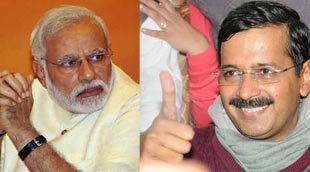
kej_modiWhile senior leaders from BJP dismiss the impact of any anti-Modi polarisation among Muslims, who account for about 18 per cent votes here and close to 30 per cent in urban areas, local leaders from various parties including the saffron party said there was a high probability of Muslim votes being polarised towards the strongest candidate against Gujarat Chief Minister Narendra Modi.
Local leaders from various parties including Congress, SP and BSP, also accused Kejriwal of trying to influence Muslims by projecting himself as the strongest candidate against Modi.

Soon after arriving here this morning, Kejriwal met Benares Shahar-e-Kazi Ghulam Nasir and sought his support. According to AAP leaders here, Nasir told Kejriwal that he would pray for his success.
Kejriwal also met some Balmiki Samaj leaders and visited areas populated by Dalits to seek their support. He is staying at the house of Viplav Mishra, brother of late Veerbhadra Mishra, who was mahant of Sankat Mochan Mandir, a Hanuman temple which is very popular among locals and people visiting Varanasi.
Kejriwal is likely to file his nomination on April 23, before which he may go to Amethi for a couple of days to campaign for party colleague Kumar Vishwas who is fighting against Congress Vice President Rahul Gandhi.
When asked whether BJP was wary of any anti-Modi polarisation among Muslim voters in favour of Kejriwal, party leaders dismissed such claims, saying Modi's win was a foregone conclusion and the fight was only about margins.
BJP's Nalin Kohli, who is camping here for elections, said it was not at all concerned about polarisation and the party was fighting the elections with agenda of 'one India, great India' and the new government would work for solving the problems faced by people of this country.
However, some other local BJP leaders accepted that there were apprehensions about polarisation of votes against Modi, but the quantum would not be enough to defeat the party's prime ministerial candidate and the 'ever-growing' wave in his favour.
On the other hand, Congress candidate Ajay Rai said that it was BJP which was working towards creating a polarisation on the religious lines and the party had done similar things in last Lok Sabha elections.
Rai went on to blame BJP of conspiring to put Muslim strongman leader Mukhtar Ansari in the fray so that minority votes get divided between him and Samajwadi Party. Rai had fought last Lok Sabha elections as a SP candidate, while Ansari was BSP candidate.
Since then, Ansari and his brothers have formed Qaumi Ekta Dal and is currently an MLA, while Rai is a Congress MLA right now. Ansari had earlier said he would fight against Modi, but recently decided against contesting Lok Sabha polls and has said he does not want anti-Modi votes to get divided.
Also in the fray is SP's Kailash Chaurasia, and BSP's Vijay Prakash Jaiswal and both the parties are putting their claims on minority, Dalit and backward votes.
SP's state secretary and UP Janjatiya Lok Kala Sanskriti Sansthan Chairman Manoj Rai Dhoopchandi said that the party would get huge support from minorities, backward and extreme backward caste voters as the state government has worked hard for their development.
"We are asking for votes on the basis of development work done by our government," he said, while accusing Kejriwal and Rai of trying to usurp SP's vote bank of minorities.
He said that the people of Varanasi would not be lured by them as they now that Kejriwal was an outsider and even Rai was wrongly claiming to be a local leader as his MLA constituency was hardly within Varanasi Lok Sabha area.
"Besides, people know that Rai is an ex-BJP leader and he has changed many parties, making him unacceptable among people here," he said.
Some Muslim leaders, on the other hand said, they do not want to be very vocal against Modi and the community is rather focussing on supporting candidates who can fight corruption or those who can work for local issues.
In 2009, there was reportedly huge polarisation against Ansari in Varanasi, and Murli Manohar Joshi could sail through by a small margin. Local leaders say that Joshi could muster enough support at the last moment after some other candidates pledged their support to BJP to defeat Ansari and they fear a similar situation against Modi this time.
Usman Gani, State Incharge of Momin Conference, which had been a major participant in Gandhian Khadi movement, categorically said that Aam Aadmi Party would fulfil the dreams of clean and secular India.
Surprisingly, neither has any major party announced any Muslim candidate so far for Varanasi seat, nor has any strong minority leader announced plans to fight independently.
Gani said he is hopeful that Quami Ekta Dal would also lend its support to Kejriwal as he was the only leader to stand up to the stature of Modi.
Momin Conference in Varanasi has been supporting AAP and it has given its own office to AAP in Sigra locality for election campaign purposes.

Comments

Casie
 - 
Tuesday, 12 Jan 2016

Istniejemy kompania ustawiona w delikatnej spacje od Zaznania tudziez
zagarniamy sie zwykle armatura szamb dietetycznych, lokalne oczyszczalnie przylegle czerpia naturalnie z rozdzielaczy spójniki od ich producentów

Feel free to surf to my web-site ... przydomowa oczyszczalnia scieków: http://fjxlh.com.w010.mydns114.net/comment/html/?4509.html

Add new comment

  • Coastaldigest.com reserves the right to delete or block any comments.
  • Coastaldigset.com is not responsible for its readers’ comments.
  • Comments that are abusive, incendiary or irrelevant are strictly prohibited.
  • Please use a genuine email ID and provide your name to avoid reject.
Agencies
April 14,2020

New Delhi, Apr 14: Prime Minister Narendra Modi has announced the extension of a nationwide lockdown till May 3 to contain the spread of Covid-19 as the number of novel coronavirus cases surged past 10,000-mark on Tuesday. Hinting at partial relief, however, the Prime Minister said there could be some relaxations after April 20 in places where there is no hotspot.

Lockdown 2.0 will come into force from April 14 till May 3, PM Modi said in a televised address to the nation on Tuesday. The 19-day extension of the lockdown till May 3 is an attempt to contain the spread of novel coronavirus which has affected over 10,000 people in India. 

Even before #COVID19 cases touched 100, India made it compulsory for foreign returnees to remain in 14 days isolation. We imposed 21-day lockdown when we had 550 cases: PM Narendra Modi https://t.co/qi8MgG8qPQ

— ANI (@ANI) April 14, 2020
PM Modi said the Centre will closely monitor hotspots in states across India and added that those areas where there are no hotspots will get partial relief. “Till April 20, all districts, localities, states will be closely monitored, as to how strictly they are implementing norms. States where hotspots are contained could be allowed to resume some important activities, but with certain conditions,” the PM said.

The Prime Minister, in his address to India on Tuesday, began by lauding the efforts of Indians in the fight against novel coronavirus. “Covid-19 is spreading fast but India’s fight against coronavirus is going strong. It is because of your efforts that we are able to put up a fight,” the PM said as he thanked people for their co-operation.

PM Modi said, “People have gone through hardships to save India. I know how many difficulties you faced. I respectfully bow to the people of India for their sacrifice.”

The national lockdown first came into force from March 25 when the PM took an unprecedented measure in the fight against Covid-19. The lockdown was scheduled to end today.

STATES PUSHED FOR LOCKDOWN 2.0

The decision to extend the lockdown followed after a broad consensus emerged that the national lockdown should be extended by at least two weeks following a meeting between PM Modi and state chief ministers on Saturday.

It was reportedly after this meet with the Prime Minister that it was decided that the nationwide lockdown will be extended to tackle the spread of Coivid-19. The extension request from states came despite concerns that the shutdown will put millions out of work.

PM has taken correct decision to extend lockdown. Today, India’s position is better than many developed countries because we started lockdown early. If it is stopped now, all gains would be lost. To consolidate, it is imp to extend it

— Arvind Kejriwal (@ArvindKejriwal) April 11, 2020
"If it is stopped now, all gains would be lost. To consolidate, it is imp (important) to extend it," Arvind Kejriwal had written on Twitter after the meeting while he added that PM Modi had "taken (a) correct decision to extend (the) lockdown”.

Several states had, however, pushed for resumption of some economic activities like in the farming sector in areas where no cases of the novel coronavirus have been reported.

ALL THAT HAS HAPPENED TILL NOW

Prime Minister Narendra Modi first addressed an anxious nation on March 19 as the coronavirus pandemic emerged as a serious concern for the country. In his televised address, the PM asked the people to observe ‘Janata Curfew’ for March 22.
The Prime Minister urged Indians to remain indoors as much as possible as he suggested ways to battle the coronavirus pandemic.

On March 24, the Prime Minister came back and announced a 21-day lockdown across the country. In his second address, PM Modi said the step was taken as it was the only way to break the chain of infection. The lockdown was to be in effect till April 14.

PM Modi later asked citizens to make noise at 5 pm to show their appreciation for medics, nurses and sanitation workers. This call was well received as Indians came out to clap, clang metal vessels and ring bells to cheer workers battling the spread of the coronavirus.

Ten days into the lockdown, the Prime Minister addressed the nation again and asked people to light candles, lamps and hold mobile phone torches for nine minutes from 9 pm on April 5 to demonstrate a collective will to fight coronavirus.

As of Tuesday morning, the death toll due to coronavirus has climbed to 339 with over 50 deaths within 24 hours. The number of cases in the country, meanwhile, had crossed the 10,000-mark, according to the Union Health Ministry. Over a thousand have been cured and discharged.

Comments

Add new comment

  • Coastaldigest.com reserves the right to delete or block any comments.
  • Coastaldigset.com is not responsible for its readers’ comments.
  • Comments that are abusive, incendiary or irrelevant are strictly prohibited.
  • Please use a genuine email ID and provide your name to avoid reject.
Agencies
May 21,2020

More than 50 million people in India do not have access to effective handwashing, putting them at a greater risk of acquiring and transmitting the novel coronavirus, according to a study.

Researchers from the Institute for Health Metrics and Evaluation (IHME) at the University of Washington in the US found that without access to soap and clean water, over 2 billion people in low- and middle-income nations -- a quarter of the world's population -- have a greater likelihood of transmitting the coronavirus than those in wealthy countries.

According to the study, published in the journal Environmental Health Perspectives, more than 50 per cent of the people in sub-Saharan Africa and Oceania lacked access to effective handwashing.

"Handwashing is one of the key measures to prevent COVID transmission, yet it is distressing that access is unavailable in many countries that also have limited health care capacity," said Michael Brauer, a professor at IHME.

The study found that in 46 countries, more than half of people lacked access to soap and clean water.

In India, Pakistan, China, Bangladesh, Nigeria, Ethiopia, Democratic Republic of the Congo, and Indonesia, more than 50 million persons in each country were estimated to be without handwashing access, according to the study.

"Temporary fixes, such as hand sanitizer or water trucks, are just that -- temporary fixes," Brauer said.

"But implementing long-term solutions is needed to protect against COVID and the more than 700,000 deaths each year due to poor handwashing access," Brauer said.

He noted that even with 25 per cent of the world's population lacking access to effective handwashing facilities, there have been "substantial improvements in many countries" between 1990 and 2019.

Those countries include Saudi Arabia, Morocco, Nepal, and Tanzania, which have improved their nations' sanitation, the researchers said.

The study does not estimate access to handwashing facilities in non-household settings such as schools, workplaces, health care facilities, and other public locations such as markets.

Earlier this month, the World Health Organization predicted 190,000 people in Africa could die of COVID-19 in the first year of the pandemic, and that upward of 44 million of the continent's 1.3 billion people could be infected with the coronavirus, the researchers said. 

Comments

Add new comment

  • Coastaldigest.com reserves the right to delete or block any comments.
  • Coastaldigset.com is not responsible for its readers’ comments.
  • Comments that are abusive, incendiary or irrelevant are strictly prohibited.
  • Please use a genuine email ID and provide your name to avoid reject.
News Network
July 1,2020

Jul 1: Gold prices in India hit an all-time high on Wednesday, tracking a global rally, as surging coronavirus cases in many countries raised the metal's safe-haven appeal.

Local gold futures hit an all-time high of Rs 48,871 ($646.66) per 10 grams in early trade, taking their gains to 25% in 2020 so far. The contract had gained nearly 25% in 2019.

However, this dampened the retail demand for gold in India, the world's second-largest consumer of the precious metal.

"Retail demand is negligible. Buyers are postponing purchases anticipating a correction in prices," said a Mumbai-based bank dealer with a bullion importing bank.

In thin trade, dealers were offering a discount of up to $22 an ounce over official domestic prices on Wednesday afternoon, up from the last week's $18. The domestic price includes a 12.5% import tax and 3% sales tax.

The country's gold imports in May plunged 99% from a year earlier as international air travel was banned and jewellery shops were closed amid a nationwide lockdown to curb the spread of coronavirus.

In overseas market, spot gold firmed near an eight-year peak on Wednesday, as a spike in coronavirus cases in the United and States and many other countries has cast a shadow on hopes for a quicker global economic recovery, driving inflows into safe-haven assets.

According to a latest Reuters tally, the coronavirus has infected more than 10.48 million people worldwide so far.

Comments

Add new comment

  • Coastaldigest.com reserves the right to delete or block any comments.
  • Coastaldigset.com is not responsible for its readers’ comments.
  • Comments that are abusive, incendiary or irrelevant are strictly prohibited.
  • Please use a genuine email ID and provide your name to avoid reject.