


Varanasi fears polarisation as Kejriwal hits campaign trail

April 15, 2014

Varanasi, Apr 15: As political pitch gets stronger in this city of temples and weavers with the arrival of AAP chief Arvind Kejriwal, leaders across party lines are fearing a highly polarised scenario on religious lines ahead of Lok Sabha polls next month.
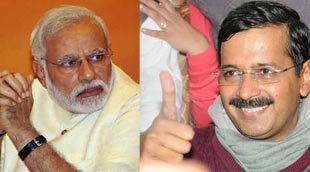
kej_modiWhile senior leaders from BJP dismiss the impact of any anti-Modi polarisation among Muslims, who account for about 18 per cent votes here and close to 30 per cent in urban areas, local leaders from various parties including the saffron party said there was a high probability of Muslim votes being polarised towards the strongest candidate against Gujarat Chief Minister Narendra Modi.
Local leaders from various parties including Congress, SP and BSP, also accused Kejriwal of trying to influence Muslims by projecting himself as the strongest candidate against Modi.

Soon after arriving here this morning, Kejriwal met Benares Shahar-e-Kazi Ghulam Nasir and sought his support. According to AAP leaders here, Nasir told Kejriwal that he would pray for his success.
Kejriwal also met some Balmiki Samaj leaders and visited areas populated by Dalits to seek their support. He is staying at the house of Viplav Mishra, brother of late Veerbhadra Mishra, who was mahant of Sankat Mochan Mandir, a Hanuman temple which is very popular among locals and people visiting Varanasi.
Kejriwal is likely to file his nomination on April 23, before which he may go to Amethi for a couple of days to campaign for party colleague Kumar Vishwas who is fighting against Congress Vice President Rahul Gandhi.
When asked whether BJP was wary of any anti-Modi polarisation among Muslim voters in favour of Kejriwal, party leaders dismissed such claims, saying Modi's win was a foregone conclusion and the fight was only about margins.
BJP's Nalin Kohli, who is camping here for elections, said it was not at all concerned about polarisation and the party was fighting the elections with agenda of 'one India, great India' and the new government would work for solving the problems faced by people of this country.
However, some other local BJP leaders accepted that there were apprehensions about polarisation of votes against Modi, but the quantum would not be enough to defeat the party's prime ministerial candidate and the 'ever-growing' wave in his favour.
On the other hand, Congress candidate Ajay Rai said that it was BJP which was working towards creating a polarisation on the religious lines and the party had done similar things in last Lok Sabha elections.
Rai went on to blame BJP of conspiring to put Muslim strongman leader Mukhtar Ansari in the fray so that minority votes get divided between him and Samajwadi Party. Rai had fought last Lok Sabha elections as a SP candidate, while Ansari was BSP candidate.
Since then, Ansari and his brothers have formed Qaumi Ekta Dal and is currently an MLA, while Rai is a Congress MLA right now. Ansari had earlier said he would fight against Modi, but recently decided against contesting Lok Sabha polls and has said he does not want anti-Modi votes to get divided.
Also in the fray is SP's Kailash Chaurasia, and BSP's Vijay Prakash Jaiswal and both the parties are putting their claims on minority, Dalit and backward votes.
SP's state secretary and UP Janjatiya Lok Kala Sanskriti Sansthan Chairman Manoj Rai Dhoopchandi said that the party would get huge support from minorities, backward and extreme backward caste voters as the state government has worked hard for their development.
"We are asking for votes on the basis of development work done by our government," he said, while accusing Kejriwal and Rai of trying to usurp SP's vote bank of minorities.
He said that the people of Varanasi would not be lured by them as they now that Kejriwal was an outsider and even Rai was wrongly claiming to be a local leader as his MLA constituency was hardly within Varanasi Lok Sabha area.
"Besides, people know that Rai is an ex-BJP leader and he has changed many parties, making him unacceptable among people here," he said.
Some Muslim leaders, on the other hand said, they do not want to be very vocal against Modi and the community is rather focussing on supporting candidates who can fight corruption or those who can work for local issues.
In 2009, there was reportedly huge polarisation against Ansari in Varanasi, and Murli Manohar Joshi could sail through by a small margin. Local leaders say that Joshi could muster enough support at the last moment after some other candidates pledged their support to BJP to defeat Ansari and they fear a similar situation against Modi this time.
Usman Gani, State Incharge of Momin Conference, which had been a major participant in Gandhian Khadi movement, categorically said that Aam Aadmi Party would fulfil the dreams of clean and secular India.
Surprisingly, neither has any major party announced any Muslim candidate so far for Varanasi seat, nor has any strong minority leader announced plans to fight independently.
Gani said he is hopeful that Quami Ekta Dal would also lend its support to Kejriwal as he was the only leader to stand up to the stature of Modi.
Momin Conference in Varanasi has been supporting AAP and it has given its own office to AAP in Sigra locality for election campaign purposes.

Comments

Casie
 - 
Tuesday, 12 Jan 2016

Istniejemy kompania ustawiona w delikatnej spacje od Zaznania tudziez
zagarniamy sie zwykle armatura szamb dietetycznych, lokalne oczyszczalnie przylegle czerpia naturalnie z rozdzielaczy spójniki od ich producentów

Feel free to surf to my web-site ... przydomowa oczyszczalnia scieków: http://fjxlh.com.w010.mydns114.net/comment/html/?4509.html

Add new comment

  • Coastaldigest.com reserves the right to delete or block any comments.
  • Coastaldigset.com is not responsible for its readers’ comments.
  • Comments that are abusive, incendiary or irrelevant are strictly prohibited.
  • Please use a genuine email ID and provide your name to avoid reject.
News Network
May 10,2020

Kochi, May 10: A total of 698 people who were evacuated from Maldives on INS Jalashwa, arrived here on Sunday around 9.30am (India time), said the Cochin Port officials. This operation is part of Indian Navy's 'Operation Samudra Setu'.

Another 121 from Lakshadweep also arrived at Mattanchery, near here. on MV Arabian Sea - a passenger/cargo ship sailing under the Indian Flag.

Samudrika Cruise Terminal has been opened up for handling the expatriates and Port has taken up necessary refurbishments consistent with the medical protocols.

The Cochin Port Trust officials said the first group of 698 persons evacuated from Maldives comprises 595 males and 103 females. Of this, 14 are children below 10 years and 19 pregnant women.

Among the 698 passengers, 440 are from Kerala, 156 from Tamil Nadu and the rest are from various states in the country.

Ernakulam district collector S. Suhas said all those from Tamil Nadu will be sent to their state in the bus.

The ship is berthed at BTP Jetty and the disembarkation procedures are being carried out at Samudrika Cruise Terminal. It will take around three hours for all the passengers to be cleared.

According to the protocols, all the Keralaites will be sent for 14 days institutional quarantine at their respective home districts.

Those who are having exemption from institutional quarantine have to be at home isolation.

Among the 121 who arrived on MV Arabian Sea from Lakshadweep include students and those Keralaites who work in the island.

The protocol for these 121 passengers is that since they have been checked there, all these people can go to their homes and be in isolation for 14 days.

The general guideline is if any one shows any symptoms of Covid-19, all such people will be directly sent to Covid hospitals, here.

The distance between Male and Kochi is 493 nautical miles and it began its voyage to Kochi on Friday evening.

INS Jalashwa is an Indian naval ship attached to the Eastern Naval Command. It was acquired from the United States and was commissioned in 2007.

INS Jalashwa has the capacity to accommodate 1000 troops, and comes equipped with extensive medical facilities, including four operation theatres, and a 12-bed ward facility.

Comments

Add new comment

  • Coastaldigest.com reserves the right to delete or block any comments.
  • Coastaldigset.com is not responsible for its readers’ comments.
  • Comments that are abusive, incendiary or irrelevant are strictly prohibited.
  • Please use a genuine email ID and provide your name to avoid reject.
News Network
June 18,2020

New Delhi, Jun 18: The border clash between Indian and Chinese soldiers in Ladakh broke the brittle quiet – and also the sense of security for anxious Chinese nationals in India who fear a backlash with anti-Chinese sentiment spiralling in the country.

With the high altitude violent face-off in eastern Ladakh’s Galwan Valley spurring hashtags such as “Boycott China” and “Teach Lesson to China” and leading to street protests, the undercurrents of tension were evident.

Wary of being identified, some said they had been reassured by their friends but were still apprehensive for themselves and their families.

"They (Chinese families) don''t want to speak to the media. They are not going out and are worried about their security and well being. Their families are also worried back home," Mohammed Saqib, secretary general of the India China Economic & Cultural Council, told PTI.

He added that his Chinese friends in India been calling him since they heard news about Monday night’s clashes in which 20 Indian soldiers were killed -- the worst military confrontation in five decades -- and expressed concern over growing anti-China sentiments.

A Chinese national from Beijing working in Gurgaon for a Chinese mobile firm initially refused to talk, saying he did not want to speak to the media and later shared his thoughts only on condition of anonymity.

"There is talk of border standoff and tensions, but we know Indians are very warm people and that is why I have told my family that all is fine here and they should not worry," he said.

Another Chinese national working in Gurgaon said he and his family are feeling the stress amid the spiralling conflict between India and China, but many friends have been reassuring him.

"They (Chinese in India) are under a lot of stress naturally. Such a conflict puts a lot of stress as they could bear the brunt and the same applies to Indians in China," B R Deepak, professor at the Centre for Chinese and South East Asian Studies of the Jawaharlal Nehru University said.

He said it was unfortunate that the border standoff derailed the commemorative programmes aimed at strengthening ties at a time the two countries were gearing to celebrate 70 years of establishment of diplomatic ties.

Experts also feel the border clash is likely to have a significant negative impact on the economic and people to people ties.

There are scores of Chinese in India working in various Chinese firms and also those who are studying in universities like JNU.

About 3,000 Chinese people, doing business or studying in big cities in India, were stranded in India at the start of the COVID-19 crisis, and about half of them returned to China before the lockdown began on March 25.

The Chinese Embassy in New Delhi announced on May 25 that they will arrange for flights to take back students, tourists and businesspersons to five Chinese cities, including Shanghai and Guangzhou.

"It will impact the psychology of the Chinese here. There are 2,000 Chinese firms in various sectors in India which are going to be impacted," Deepak said.

Future investments from the Chinese side could also be impacted, he said.

Moreover, as far as people-to-people contacts are concerned, the number of Chinese students choosing India as a preferred destination is likely to go down, Deepak said.

Alka Acharya, another China expert, said there are two kinds of impacts of such an incident -- short term and medium term.

Usually after the initial nationalistic reaction in the short term things tend to normalise in the medium term, but with such a border clash happening for the first time in decades clearly the resonance would be much more in both India and China, said Acharya, professor at the Centre for East Asian Studies, School of International Studies, in JNU.

“Due to the impact of the COVID-19 crisis on the economy, whether India can take a hardline in terms of economics towards China, is a tricky question,” she said.

In the immediate context, there may be a dip in economic ties with calls for boycott of Chinese goods and services, Acharya said.

The manner in which this crisis is resolved will affect how ties will be affected in the medium term, she said.

The headlines have added to the anxiety.

A group of ex-armymen gathered near the Chinese embassy to protest the killing of 20 Indian Army personnel in Ladakh’s Galwan Valley. And another group of around 10 protesters belonging to the Swadeshi Jagaran Manch protested near the Teen Murti roundabout in Central Delhi.

The anti-China sentiment prevalent among the common public is also finding a reflection in government policy with sources saying the Department of Telecom (DoT) is set to ask state-owned Bharat Sanchar Nigam Ltd (BSNL) not to use Chinese telecom gear in its 4G upgradation.

Trade bodies like CAIT are also calling for a boycott of Chinese products.

And Chinese handset maker Oppo cancelled the livestream launch of its flagship 5G smartphone in the country amid protests.

Monday night’s clashes between the Chinese and Indian troops in Galwan Valley significantly escalated the already volatile border standoff between the two countries.

The casualties on the Chinese side are not yet known. However, government sources, citing an American intelligence report, claimed the total number of soldiers killed and seriously wounded could be 35.

Comments

Add new comment

  • Coastaldigest.com reserves the right to delete or block any comments.
  • Coastaldigset.com is not responsible for its readers’ comments.
  • Comments that are abusive, incendiary or irrelevant are strictly prohibited.
  • Please use a genuine email ID and provide your name to avoid reject.
Agencies
May 21,2020

More than 50 million people in India do not have access to effective handwashing, putting them at a greater risk of acquiring and transmitting the novel coronavirus, according to a study.

Researchers from the Institute for Health Metrics and Evaluation (IHME) at the University of Washington in the US found that without access to soap and clean water, over 2 billion people in low- and middle-income nations -- a quarter of the world's population -- have a greater likelihood of transmitting the coronavirus than those in wealthy countries.

According to the study, published in the journal Environmental Health Perspectives, more than 50 per cent of the people in sub-Saharan Africa and Oceania lacked access to effective handwashing.

"Handwashing is one of the key measures to prevent COVID transmission, yet it is distressing that access is unavailable in many countries that also have limited health care capacity," said Michael Brauer, a professor at IHME.

The study found that in 46 countries, more than half of people lacked access to soap and clean water.

In India, Pakistan, China, Bangladesh, Nigeria, Ethiopia, Democratic Republic of the Congo, and Indonesia, more than 50 million persons in each country were estimated to be without handwashing access, according to the study.

"Temporary fixes, such as hand sanitizer or water trucks, are just that -- temporary fixes," Brauer said.

"But implementing long-term solutions is needed to protect against COVID and the more than 700,000 deaths each year due to poor handwashing access," Brauer said.

He noted that even with 25 per cent of the world's population lacking access to effective handwashing facilities, there have been "substantial improvements in many countries" between 1990 and 2019.

Those countries include Saudi Arabia, Morocco, Nepal, and Tanzania, which have improved their nations' sanitation, the researchers said.

The study does not estimate access to handwashing facilities in non-household settings such as schools, workplaces, health care facilities, and other public locations such as markets.

Earlier this month, the World Health Organization predicted 190,000 people in Africa could die of COVID-19 in the first year of the pandemic, and that upward of 44 million of the continent's 1.3 billion people could be infected with the coronavirus, the researchers said. 

Comments

Add new comment

  • Coastaldigest.com reserves the right to delete or block any comments.
  • Coastaldigset.com is not responsible for its readers’ comments.
  • Comments that are abusive, incendiary or irrelevant are strictly prohibited.
  • Please use a genuine email ID and provide your name to avoid reject.