



Veto will not preclude us from acting: US on China's stand on Masood Azhar

April 4, 2017

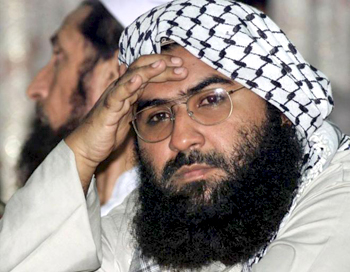
United Nations, Apr 4: The US said today that countries using veto to scuttle sanctioning of terrorists will not "preclude" it from taking actions, amid continued Chinese opposition to efforts to get Pakistan-based JeM chief Masood Azhar banned by the UN.
Masood 2"The administration very much is looking at all of these avenues and some of the things we have talked about is sanctions and who is on the list and how we have managed that," US' envoy to the UN Nikki Haley told reporters here.

"And that is part of what we are going to try and find our place with is that we do want to make sure that we are calling out those that we need to call out," she said.

Haley made the remarks while addressing a press conference after assuming role of President of the Security Council for the month of April.

She was asked about efforts to get terrorists, particularly those in the South Asian region, sanctioned under UNSC's sanctions list and how another permanent member scuttles these efforts by using its veto power, a veiled reference to China blocking moves to ban Jaish-e-Mohammed chief Azhar.

"Are we going to have people that veto certain issues? Yes. But that doesn't preclude the US from acting and it certainly does not preclude us from trying to see if we can change that as well," Haley said.

"Our goal is to get more done together than we do separately. If we cannot get it done separately then we just move in another direction to still get the same things done," she said.

The US wants to make sure that it is leading towards a "result" and "not sitting back" and allowing things to happen.

"I think you are obviously seeing a very aggressive administration because we feel like in order to lead we need to act and in order to act we need to make sure we have those conversations with the National Security Council and we are having those conversations with the National Security Council," she said.

Haley noted that a lot has happened in the last two months of her assuming the UN ambassador's role under the Trump administration and a lot will continue to happen "but it is all about how we can make sure we are moving the ball".

Haley also brought up her Indian heritage when she asked about her qualities of being able to speak freely and openly and whether she was offered the role of Secretary of State by Donald Trump.

"Every position that I have ever had, people have assumed that I'm looking towards something bigger when in reality I'm the daughter of Indian parents who said to me 'whatever you do be great at it and make sure people remember you for it'. That is all I am trying to do," Haley said.

"That is all I have ever known how to be is to try and just do my job to the best of my ability and if that comes out blunt and if that comes out strong -- I'm one of two brothers and a sister -- my parents raised us all to be strong," she said.

Comments

Add new comment

  • Coastaldigest.com reserves the right to delete or block any comments.
  • Coastaldigset.com is not responsible for its readers’ comments.
  • Comments that are abusive, incendiary or irrelevant are strictly prohibited.
  • Please use a genuine email ID and provide your name to avoid reject.
News Network
June 5,2020

Karachi, Jun 5: Pakistan's coronavirus cases rose to 89,249 on Friday after a record 4,896 new infections were detected in the country, while the death toll due to COVID-19 has reached 1,838, according to the health ministry.

The Ministry of National Health Service said that 68 patients died in the last 24 hours, taking the death toll to 1,838, whereas another 31,198 people have recovered.

It was the third consecutive day when a record number of cases were reported in Pakistan after the Eid holidays and easing of lockdown restrictions at the end of May.

Sindh province reported 33,536 infections, Punjab 33,144, Khyber-Pakhtunkhwa 11,890, Balochistan 5,582, Islamabad 3,946, Gilgit-Baltistan 852 and Pakistan-occupied Kashmir 299.

The authorities have conducted 638,323 tests, including a record 22,812 tests in the last 24 hours, the ministry said.

Despite the spike in number of COVID-19 cases, both houses of parliament are scheduled to meet separately on Friday. The Senate session started this morning while the National Assembly will be held in the afternoon, Radio Pakistan reported.

Chairman Senate Sadiq Sanjrani and Speaker National Assembly Asad Qaiser at a meeting at the parliament house in Islamabad reviewed arrangements made for the two sessions.

Fumigation was also carried out in the parliament house for the safety of the lawmakers and staff.

Earlier, the Opposition rejected the idea of virtual meetings and insisted that the sessions be held in person, noting that it was an important session of parliament because the budget is expected to be presented in the National Assembly in the next week.

The novel coronavirus which first originated from China's Wuhan city in December last year has claimed 391,249 lives and has infected over 6 million people globally, according to Johns Hopkins University data.

Comments

Add new comment

  • Coastaldigest.com reserves the right to delete or block any comments.
  • Coastaldigset.com is not responsible for its readers’ comments.
  • Comments that are abusive, incendiary or irrelevant are strictly prohibited.
  • Please use a genuine email ID and provide your name to avoid reject.
News Network
May 7,2020

United Nations, May 7: An average of 80,000 COVID-19 cases were reported each day in April to the World Health Organization, the top UN health agency has said, noting that South Asian nations like India and Bangladesh are seeing a spike in the infections while the numbers are declining in regions such as Western Europe.

WHO Director-General Tedros Adhanom Ghebreyesus said on Wednesday that countries must also be able to manage any risk of the disease being imported into their territories, and communities should be fully educated to adjust to what will be a "new norm".

He said as the countries press forward in the common fight against COVID-19, they should also lay the groundwork for resilient health systems globally.

"More than 3.5 million cases of COVID-19 and almost 250,000 deaths have now been reported to the WHO. Since the beginning of April, an average of around 80,000 new cases have been reported to the WHO every day," Ghebreyesus said in Geneva yesterday.

Asserting that the virus cases were not just numbers, he said: "every single case is a mother, a father, a son, a daughter, a brother, sister or friend".

He said while the numbers are declining in Western Europe, more cases are being reported every day from Eastern Europe, Africa, South-East Asia, the Eastern Mediterranean and the Americas. Even within regions and within countries, there are divergent trends, the agency added.

While some countries are reporting an increase in COVID-19 cases over time, many have seen caseloads rise because they have ramped up testing, the WHO official said.

"We've also seen in Europe and Western Europe a fundamental decrease in the number of cases, but we have seen an associated increase in the number of cases reported in places like the Russian Federation. Southeast, the Western Pacific areas are relatively on the downward trend like Korea and others, but then we do see in South Asia, in places like Bangladesh, in India, some trends towards increase.

"So it's very difficult to say that any particular region is improving or (not improving). There are individual countries within each region that are having difficulties getting on top of this disease and I am particularly concerned about those countries that have (an) ongoing humanitarian crisis," WHO's Executive Director Michael Ryan said.

The death toll due to COVID-19 in India rose to 1,783 while the number of cases climbed to 52,952 on Thursday, registering an increase of 89 deaths and 3,561 cases in the last 24 hours, the Union Health Ministry said.

The number of active COVID-19 cases stood at 35,902 while 15,266 people have recovered, it said.

Noting that while seeing an increase in the number of cases is not good in terms of transmission, WHO's Emerging Diseases and Zoonoses Unit head Maria Van Kerkhove said: "but I don't want to equate that with something (being) wrong".

"I want to equate that with countries are working very hard to increase their ability to find the virus, to find people with the virus, to have testing in place to identify who has COVID-19, and putting into place what they need to do to care for those patients," Kerkhove said.

With more countries considering easing restrictions implemented to curb the spread of the coronavirus, the WHO has again reminded the authorities of the need to maintain vigilance.

"The risk of returning to lockdown remains very real if countries do not manage the transition extremely carefully, and in a phased approach," Ghebreyesus said.

He urged countries to consider the UN agency's six criteria for lifting stay-at-home measures.

That advice includes ensuring surveillance is strong, cases are declining and transmission is controlled. Health systems also must be able to detect, isolate, test and treat cases, and to trace all contacts.

Additionally, the risk of outbreak in settings such as health facilities and nursing homes needs to be minimised, while schools, workplaces and other public locations should have preventive measures in place.

"The COVID-19 pandemic will eventually recede, but there can be no going back to business as usual. We cannot continue to rush to fund panic but let preparedness go by the wayside," he said.

He said the crisis has highlighted the importance of strong national health systems as the foundation of global health security: not only against pandemics but also against the multitude of health threats that people across the world face every day.

"If we learn anything from COVID-19, it must be that investing in health now will save lives later," Ghebreyesus said.

While the world currently spends around USD 7.5 trillion on health annually, the WHO believes the best investments are in promoting health and preventing disease.

"Prevention is not only better than cure, it's cheaper, and the smartest thing to do," he said.

The deadly coronavirus, which originated from the Chinese city of Wuhan in December last year, has infected over 3.7 million people and killed 263,831 people globally, according to a tally by Johns Hopkins University.

Comments

Add new comment

  • Coastaldigest.com reserves the right to delete or block any comments.
  • Coastaldigset.com is not responsible for its readers’ comments.
  • Comments that are abusive, incendiary or irrelevant are strictly prohibited.
  • Please use a genuine email ID and provide your name to avoid reject.
News Network
March 21,2020

Beijing, Mar 21: China reported no domestically transmitted coronavirus cases for the third consecutive day even as seven more fatalities have been confirmed, taking the death toll in the country to 3255.

No new domestically transmitted cases of COVID-19 were reported on the Chinese mainland for the third day in a row on Friday, China's National Health Commission (NHC) said on Saturday.

The overall confirmed cases on the mainland had reached 81,008 by the end of Friday, which included 3,255 who died, 6,013 patients still undergoing treatment, 71,740 patients who had been discharged after recovery, the NHC said.

The NHC said 41 new confirmed COVID-19 cases were reported on the Chinese mainland on Friday from the people arriving from abroad, taking the total number of imported cases to 269.

Comments

Add new comment

  • Coastaldigest.com reserves the right to delete or block any comments.
  • Coastaldigset.com is not responsible for its readers’ comments.
  • Comments that are abusive, incendiary or irrelevant are strictly prohibited.
  • Please use a genuine email ID and provide your name to avoid reject.