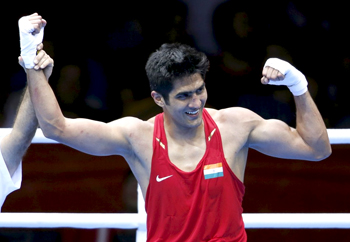
Vijender Singh set to face Sonny Whiting in professional debut

October 10, 2015

Manchester, Oct 10: Indian boxer Vijender Singh is all set to face Sonny Whiting in his professional debut at Manchester Arena, UK on Saturday.

VijenderVijender, who has been training hard under Lee Beard from more than last one month, is confident of a winning start in the four round bout.

Reflecting his views on his upcoming bout, Vijender said, "I am totally focused and waiting for the moment to enter the ring. The strategy would be to enter the ring, hit hard and come out as a winner. I have done a lot for my country in amateur boxing and now I want to do achieve something in the professional circuit which will be going to open new hopes for young Indian boxers in the pro boxing. It's just a countdown of few hours now. All the hard training is done and everything will be put into practice in the ring against Whiting. Now it is focussing the last few hours into the mental preparation and getting my mind set on defeating Whiting."

The 2008 Olympic bronze medallist added, "I have heard lots of comments about my opponent Sonny Whiting but will definitely give him reply through my punches. It's time to implement new techniques and hardwork I have done in the past one month here in Manchester" said Vijender.

Meanwhile, Whiting is eagerly waiting to take on the 29-year-old Indian pugilist.

"I don't care if Vijender is a superstar or a regular boxer, the result will be the same, I am going to smash him up," he said.

Comments

Add new comment

  • Coastaldigest.com reserves the right to delete or block any comments.
  • Coastaldigset.com is not responsible for its readers’ comments.
  • Comments that are abusive, incendiary or irrelevant are strictly prohibited.
  • Please use a genuine email ID and provide your name to avoid reject.
Agencies
January 9,2020

Jeddah, Jan 9: Barcelona coach Ernesto Valverde criticised the new Supercopa format and said that "football has become a business and as a business it looks for income".

"The bottom line is football has become a business and as a business it looks for income. That's the reason we are all here," Goal.com quoted Valverde as saying ahead of Barca's semi-final against Atletico.

"It's a completely different format to what we're used to. It was always the first title and the opener of the season and to me, that seemed fine," he added.

The Supercopa was traditionally a two-legged affair played between the winners of La Liga and the Copa del Rey at the beginning of the season, but following last term's one-off meeting between Barca and Sevilla in Tangier, Morocco, the Royal Spanish Football Federation (RFEF) went ahead with a full revamp.

Instead of just two teams being involved, the Supercopa has been expanded to also include the runners-up from La Liga and the Copa - meaning Barca and Valencia are joined by Real Madrid and Atletico Madrid. It is also set to be hosted in Saudi Arabia for the next three editions.

"It's been changed and let's see, it will be judged once it has happened. It's interesting, with four good teams, but from a sporting point of view, I'm not sure," Valverde said.

"We must bear in mind that the football we are involved in is an industry, sources of income are sought and in the same way that there are special connotations in this country, there are also in Morocco, where we played last year," he added.

Barcelona will face Atletico Madrid in the semifinal of the Supercopa at King Abdullah Sports City Stadium in Jeddah on January 10.

Comments

Add new comment

  • Coastaldigest.com reserves the right to delete or block any comments.
  • Coastaldigset.com is not responsible for its readers’ comments.
  • Comments that are abusive, incendiary or irrelevant are strictly prohibited.
  • Please use a genuine email ID and provide your name to avoid reject.
News Network
March 5,2020

Mar 5: India reached a maiden women's Twenty20 World Cup final Thursday after their last four clash against England was washed out, sparking calls for the International Cricket Council to include reserve days in future events.

Harmanpreet Kaur's unbeaten side were due to face the 2009 champions at the Sydney Cricket Ground, but the rain began pouring early in the day with barely any let-up.

With a minimum 10 overs per side needed for a result and no break in the weather, the umpires called it off without a ball being bowled.

Normally, five overs per side are needed to constitute a Twenty20 match, but the rules are different for ICC tournaments.

Four-time champions Australia are scheduled to take on South Africa later in the second semi-final, with that match also under threat.

With no reserve day, the highest-ranked teams from the two groups move into the final if play is not possible

That would pit India against South Africa at the Melbourne Cricket Ground on Sunday, where organisers are hoping to attract 90,000 plus fans, denying Australia a chance to defend their crown.

A reserve day is allowed for the final and the lack of one for the semis has been criticised by some players, with England captain Heather Knight among those calling for change.

"If both semi-finals are lost it would be a sad time for the tournament," she told reporters ahead of the match. "It's obviously going to be a shame if it does happen and I'm sure there will be a lot of pressure on the ICC to change that."

Cricket Australia chief Kevin Roberts said he sought clarification from the ICC about adding a reserve day with the Sydney weather looking ominous, but the request was denied.

"We've asked the question and it's not part of the playing conditions and we respect that," he told Melbourne's SEN radio.

"It gives you cause to reflect and think about how you might improve things in the future, but going into a tournament with a given set of playing conditions and rules, I don't think it's time to tinker with the rules."

It is not the way India would have wanted to make the final, but they are deserving of being there having gone through the group phase as the only unbeaten team.

After opening their campaign by upsetting Australia, they beat Bangladesh, New Zealand and then Sri Lanka.

While the entire team played well, teenage batting prodigy Shafali Verma excelled, which saw her elevated to the top of the ICC T20 batting rankings this week aged just 16.

She is only the second Indian after Mithali Raj to reach number one, pushing New Zealand veteran Suzie Bates down to second.

Ranked four in the world, India had made three semi-finals before this year and lost every time, including against England at the last World Cup.

Comments

Add new comment

  • Coastaldigest.com reserves the right to delete or block any comments.
  • Coastaldigset.com is not responsible for its readers’ comments.
  • Comments that are abusive, incendiary or irrelevant are strictly prohibited.
  • Please use a genuine email ID and provide your name to avoid reject.
Agencies
April 2,2020

Lausanne, Apr 2: The postponement of the Tokyo Olympics and the shutdown of the sporting calendar because of the coronavirus pandemic are going to hit international sports federations hard financially.

Many sports that are part of the Games depend heavily on the payouts every four years from the International Olympic Committee (IOC).

"The situation is tense and very gloomy. An assessment will be made, but clearly some posts are under threat," said an official of a major international federation.

The 28 international federations (IF) of the sports that were due to be present at the Tokyo Olympics, would have received substantial sums from the IOC.

However, the postponement of the Games until 2021 could lead to a freeze of their payment.

"We have a lot of IF with substantial reserves, but others work on a different business model, they have income from major events which are suspended, which can be a problem for the cashflow if they don't have enough reserves," said Andrew Ryan, director general of the Association of International Olympic Summer Sports Federations (ASOIF), which is responsible for distributing this money.

The five additions to the Tokyo Games programme - karate, surfing, skateboarding, climbing and baseball/softball - are not eligible.

The Olympic payout totalled 520 million after the Rio Games, four years ago.

"The Olympic money could be less than for Rio 2016," Ryan warned before adding: "My advice is to budget the same as in Rio".

The federations receive money on a sliding scale determined by their audience and size.

The three largest (athletics, swimming and gymnastics) can expect approximately 40 million.

For the second tier, made up of cycling, basketball, volleyball, football and tennis, the sum is 25 million.

For group three, which contains eight sports, including boxing, rowing, judo and table tennis, it is 17 million.

The nine sports in the next level (including sailing, canoing and fencing) receive 12 million.

For the three in the last category (rugby, golf, modern pentathlon) the payout is 7 million.

For the largest associations, such as football's FIFA which has a 1.5 billion nest egg, or basketball body FIBA which has CHF 44.4 million (42 million euros) in reserves, IOC aid represents a small proportion of their income.

For others, it is vital.

"Some IF probably don't have the cashflow to survive one year," said Ryan.

For most federations, the postponement of the Olympic Games has a domino effect, forcing them to reschedule their own money-earning competitions.

"The revenues from these events will eventually come in," said Ryan. "But this impacts the cashflow." World Athletics has already postponed the 2021 World Championships in Eugene, Oregon to 2022.

The International Swimming Federation (FINA) will have to do the same for its World Championships scheduled for next summer in Fukuoka, Japan, when they would probably clash with the Tokyo Games.

"One edition of the World Championships means for us 10 million in revenues," said one sports federation official, speaking on condition of anonymity.

"If this income is postponed, totally or partially, for a year, we will face major problems, especially if the IOC money, originally expected in September, is not paid out."

The Singapore-based International Table Tennis Federation has already taken steps, with "the Executive Committee agreeing to reduce their expenses and senior staff offering to take a salary reduction," said marketing director Matt Pound, but, he added,"further cuts will take place if needed."

- 'Significant loss of revenue' -

The ITTF has suspended all its competitions until June and that is costly.

Kim Andersen, the Danish president of London-based World Sailing, said commercial revenues are not immune.

"The IOC will eventually pay out its aid, but what weighs most heavily is the uncertainty about whether our competitions will be held and whether our sponsors will be maintained," he said.

The IOC is not prepared to go into details of what it plans.

"It is not possible at this stage to assess the overall impact" of the postponement of the Tokyo Olympics, an official told AFP.

"It depends on a number of variables that are currently being studied." According to an official of one federation: "the IOC will discuss on a case-by-case basis, sport by sport".

Another option is for the federations to ask for a share of the public aid set up to deal with the coronavirus crisis, in Switzerland, where 22 ASOIF members are based and also in the United Kingdom, home of World Sailing.

"Can sports federations benefit from federal aid? The answer is yes, in principle," Philippe Leuba, State Councillor of the canton of Vaud, in charge of the economy and sport, told.


Comments

Add new comment

  • Coastaldigest.com reserves the right to delete or block any comments.
  • Coastaldigset.com is not responsible for its readers’ comments.
  • Comments that are abusive, incendiary or irrelevant are strictly prohibited.
  • Please use a genuine email ID and provide your name to avoid reject.