



Virgin Galactic spaceship test flight ends in fatal crash, one pilot killed

November 1, 2014

Mojave/California, Nov 1: A suborbital passenger spaceship being developed by Richard Branson's Virgin Galactic company crashed during a test flight on Friday near the Mojave Air and Space Port in California, killing one pilot and seriously injuring the other, officials said.
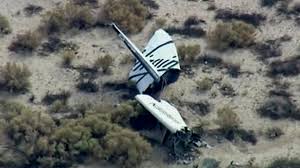
Virgin GalacticThe crash of the vehicle, undergoing its first powered test flight since January over the Mojave Desert, 95 miles (150km) north of Los Angeles, came days after another private space company, Orbital Sciences Corp, lost a rocket in an explosion moments after liftoff in Virginia.

The back-to-back accidents dealt a considerable blow to the fledgling commercial space launch industry, which has been taking on more work traditionally done by the US government while expanding for-profit space markets, including tourism.

Television footage of the Virgin Galactic crash site showed wreckage of the spacecraft lying in two large pieces on the ground, and the company said the spacecraft was destroyed. Kern County Sheriff Donny Youngblood said a debris field was spread over more than a mile.

One spaceship pilot was killed in the crash and his body was found in the wreckage, while the second pilot, who ejected and parachuted to the ground, survived with serious injuries, Kern County Sheriff Donny Youngblood said. The survivor was found more than a mile from the main wreckage site, he said.

Both crew members were test pilots for Scaled Composites, the Northrop Gruman Corp subsidiary that designed and built the spacecraft for Virgin and lost three other employees in a July 2007 ground test accident during development of the ship's propulsion system.

Friday's crash occurred shortly after the craft, dubbed SpaceShipTwo, separated from the jet airplane that carried it aloft for its high-altitude launch, according to the Federal Aviation Administration.

Scaled Composites President Kevin Mickey told a news conference the ill-fated flight was the first using a new rocket fuel formula the company switched to in May. He said that formula "had been proven and tested on the ground" before Friday's test launch.

Stuart Witt, chief executive of the space port, said officials were not ready to "speculate on the cause" of the crash.

The National Transportation Safety Board said it was sending one of its "go-teams" to investigate the accident.

Branson said via Twitter that he was on his way to Mojave following the crash. "Thoughts with all @virgingalactic & Scaled," he tweeted.

George Whitesides, chief executive of Virgin Galactic, said he expected Branson to arrive by Saturday morning.

"Space is hard, and today was a tough day. We are going to be supporting the investigation as we figure out what happened today, and we're going to get through it," he told a news conference at the space port.

He added: "We believe we owe it to the folks who were flying these vehicles as well as the folks who have been working so hard on them, to understand this and to move forward, which is what we'll do."

Paying customers must wait

More than 800 people have paid or put down deposits to eventually fly aboard the spaceship, which is hauled to an altitude of about 45,000 feet (13.7kms) and released by Virgin's White Knight Two carrier jet airplane. According to plans, the spaceship then fires its rocket motor to catapult it to about 62 miles (100km) above Earth, giving passengers a view of the planet set against the blackness of space and a few minutes of weightlessness.

The vehicle is based on a prototype, SpaceShipOne, which 10 years ago won the $10 million Ansari X Prize for becoming the first privately developed manned spacecraft to fly in space.

"During the test, the vehicle suffered a serious anomaly resulting in the loss of SpaceShipTwo," Virgin said in a statement just after the crash, adding: "We will work closely with relevant authorities to determine the cause of this accident and provide updates ASAP."

Witt said the first sign of a malfunction came 90 seconds to two minutes after the carrier jet released the spacecraft, which occurred at 10:10am local time.

"There's usually a certain cadence, and you see things occurring, and the thing makes a contrail and the like. Because of the very light cirrus clouds, I was eyes on, but I didn't see any anomaly. In fact it was when I wasn't hearing anything that I became concerned. And I looked over at my colleague, and then there was a radio call, something about a chute."

The crash was the second accident this week involving a commercial US space company. On Tuesday, an Antares rocket built and launched by Orbital Sciences exploded 15 seconds after liftoff from Wallops Island, Virginia, destroying a cargo ship bound for the International Space Station.

Friday's crash marked a major setback for Virgin Galactic, a US offshoot of billionaire Branson's London-based Virgin Group. The company was aiming to make the world's first commercial suborbital space flights with SpaceShipTwo, a six-passenger, two-pilot spacecraft.

The launch was to have been the first in a series of test flights leading up to Virgin Galactic's maiden flight beyond Earth's atmosphere.

Virgin ultimately was planning to add four more suborbital spacecraft to its fleet, along with a second White Knight carrier jet. Plans call for the fleet to fly out of a new commercial space port in Las Cruces, New Mexico, once the company completes all test flights and is certified for passenger service to begin.

Virgin Galactic's Whitesides told a Toronto space conference earlier this month that a second spacecraft was already under construction and about 60 percent complete.

Other companies developing passenger suborbital spacecraft include privately owned XCOR Aerospace, which is building a two-person space plane called Lynx, and Blue Origin, a startup space company owned by Amazon.com Inc founder Jeff Bezos.

Virgin Galactic also plans to use its White Knight Two carrier jets to launch small satellites and payloads into orbit.

Comments

Add new comment

  • Coastaldigest.com reserves the right to delete or block any comments.
  • Coastaldigset.com is not responsible for its readers’ comments.
  • Comments that are abusive, incendiary or irrelevant are strictly prohibited.
  • Please use a genuine email ID and provide your name to avoid reject.
News Network
January 6,2020

Sydney, Jan 6: Reserve troops fanned out across fire-ravaged regions in three Australian states on Monday after a horror weekend, as the government pledged $1.4 billion over two years to help recover from the devastating months-long crisis.

Catastrophic bushfires have turned swathes of land into smouldering, blackened hellscapes and destroyed an area about the size of the island of Ireland, according to official figures, with authorities warning the disaster still has weeks or months to run.

Prime Minister Scott Morrison, whose government has been criticised for its slow response to the emergency, pledged Australian $2 billion ($1.4 billion) of taxpayer money for a national recovery fund.

"It's a long road ahead and we will be with these communities every step of the way as they rebuild," Morrison said.

Firefighters joined by fresh teams from the US and Canada were taking advantage of rainy and cooler conditions to tackle out-of-control blazes ahead of rising temperatures forecast later this week.

In the biggest-ever call up of reserves, military teams were deployed across eastern Australia to help emergency services assess the damage, restore power and deliver supplies of food, water and fuel to cut-off communities.

For the first time in Australian history the government also deployed its medical assistance team, normally sent to other nations to lend support in the aftermath of their disasters to help evacuees.

"There is no room for complacency, especially as we have over 130 fires burning across (New South Wales) state still," Premier of New South Wales state Gladys Berejiklian said on Monday.

New normal

Almost five million hectares (50,000 square kilometres) have been razed across New South Wales and more than 1.2 million hectares in Victoria since late September, officials said.

That took the total amount of land burnt close to eight million hectares, around the size of the island of Ireland or South Carolina.

Twenty-four people have lost their lives so far, with over 1,800 homes damaged.

Two people are missing in New South Wales, the nation's most populous state.

In Victoria, Premier Daniel Andrews established a bushfire recovery agency to help devastated towns. It will be a permanent body, he said, as intense fires will become commonplace.

"We should just be honest about the fact that we're going to see more and more fires, more and more damage as each fire season comes... this is the new normal," Andrews told reporters.

The chair of the newly established Victoria state's bushfire appeal fund, Pat McNamara, added that this year's summer bushfire season was a "creeping disaster".

"We're still not even into what we would regard as the peak of the fire season," McNamara told national broadcaster ABC.

In the usually picturesque southeastern town of Eden, Holly Spence said she spent more than 12 hours defending her family's farm on Saturday, less than a week after saving it on New Year's Eve.

"We don't want to go through this for a third time," the 28-year-old told AFP.

Fiona Kennelly, 50, who evacuated with 24 members of her extended family to a motel outside Eden, said she was relieved the easing conditions allowed them to get some respite from the crisis.

"It's good to see daylight at the right time again," she told AFP, adding that the skies had been turning pitch-black in the afternoons.

Public anger

The impact of the bushfires has spread beyond affected communities, with heavy smoke engulfing the country's second-largest city Melbourne and the national capital Canberra.

Some government departments were shut in Canberra as the city's air quality was once-again ranked the world's poorest, according to independent online air-quality index monitor Air Visual.

The disaster has sparked growing public anger with Morrison. Rallies are planned on Friday to call on his government to step up efforts to tackle climate change, which experts say have helped fuel the fires.

In Los Angeles, Hollywood superstar Russell Crowe said he was back home fighting the fires and that the disaster was "climate change-based".

"We need to act on science, move our global workforce to renewable energy and respect our planet for the unique and amazing place it is. That way, we all have a future," he said in a message read out by Jennifer Aniston.

Australian actress Cate Blanchett praised the volunteer firefighters battling the blazes, adding: "When one country faces a climate disaster, we all face a climate disaster. We're in it together."

Comments

Add new comment

  • Coastaldigest.com reserves the right to delete or block any comments.
  • Coastaldigset.com is not responsible for its readers’ comments.
  • Comments that are abusive, incendiary or irrelevant are strictly prohibited.
  • Please use a genuine email ID and provide your name to avoid reject.
Agencies
March 1,2020

Washington, Mar 1: The US Federal Communications Commission (FCC) has proposed a fine of over $200 million for all major US mobile carriers for selling the location data of customers to some agencies.

The Federal Communications Commission today proposed fines against the nation's four largest wireless carriers for apparently selling access to their customers' location information without taking reasonable measures to protect against unauthorised access to that information. As a result, T-Mobile faces a proposed fine of more than $91 million, AT&T faces a proposed fine of more than $57 million, Verizon faces a proposed fine of more than $48 million, and Sprint faces a proposed fine of more than $12 million, the FCC said in a statement on Friday.

The Enforcement Bureau of FCC opened this investigation after reports surfaced that a Missouri Sheriff, Cory Hutcheson, used a "location-finding service" operated by Securus, a provider of communications services to correctional facilities, to access the location information of the wireless carriers' customers without their consent between 2014 and 2017.

"American consumers take their wireless phones with them wherever they go. And information about a wireless customer's location is highly personal and sensitive. The FCC has long had clear rules on the books requiring all phone companies to protect their customers' personal information. And since 2007, these companies have been on notice that they must take reasonable precautions to safeguard this data and that the FCC will take strong enforcement action if they don't. Today, we do just that," said FCC Chairman Ajit Pai.

"This FCC will not tolerate phone companies putting Americans' privacy at risk."

The FCC also admonished these carriers for apparently disclosing their customers' location information, without their authorisation, to a third party

The four major US carriers mentioned sold access to their customers' location information to "aggregators," who then resold access to such information to third-party location-based service providers (like Securus).

Although their exact practices varied, each carrier relied heavily on contract-based assurances that the location-based services providers (acting on the carriers' behalf) would obtain consent from the wireless carrier's customer before accessing that customer's location information.

Comments

Add new comment

  • Coastaldigest.com reserves the right to delete or block any comments.
  • Coastaldigset.com is not responsible for its readers’ comments.
  • Comments that are abusive, incendiary or irrelevant are strictly prohibited.
  • Please use a genuine email ID and provide your name to avoid reject.
News Network
April 28,2020

Washington, Apr 28: After nearly three weeks in an intensive care unit in Los Angeles, doctors treating 41-year-old Broadway actor Nick Cordero for COVID-19 were forced to amputate his right leg.

The flow of blood had been impeded by a blood clot: yet another dangerous complication of the disease that has been bubbling up in frontline reports from China, Europe and the United States.

To be sure, so-called "thrombotic events" occur for a variety of reasons among intensive care patients, but the rates among COVID-19 patients are far higher than would be otherwise expected.

"I have had 40-year-olds in my ICU who have clots in their fingers that look like they'll lose the finger, but there's no other reason to lose the finger than the virus," Shari Brosnahan, a critical care doctor at NYU Langone said.

One of these patients is suffering from a lack of blood flow to both feet and both hands, and she predicts an amputation may be necessary, or the blood vessels may get so damaged that an extremity could drop off by itself.

Blood clots aren't just dangerous for our limbs, but can make their way to the lungs, heart or brain, where they may cause lethal pulmonary embolisms, heart attacks, and strokes.

A recent paper from the Netherlands in the journal Thrombosis Research found that 31 percent of 184 patients suffered thrombotic complications, a figure that the researchers called "remarkably high" -- even if extreme consequences like amputation are rare.

Behnood Bikdeli, a doctor at New York-Presbyterian Hospital, assembled an international consortium of experts to study the issue. Their findings were published in the Journal of The American College of Cardiology.

The experts found the risks were so great that COVID-19 patients "may need to receive blood thinners, preventively, prophylactically," even before imaging tests are ordered, said Bikdeli.

What exactly is causing it? The reasons aren't fully understood, but he offered several possible explanations.

People with severe forms of COVID-19 often have underlying medical conditions like heart or lung disease -- which are themselves linked to higher rates of clotting.

Next, being in intensive care makes a person likelier to develop a clot because they are staying still for so long. That's why for example people are encouraged to stretch and move around on long haul flights.

It's also now clear the COVID-19 illness is associated with an abnormal immune reaction called "cytokine storm" -- and some research has indicated this too is linked to higher rates of clotting.

There could also be something about the virus itself that is causing coagulation, which has some precedent in other viral illnesses.

A paper in the journal The Lancet last week showed that the virus can infect the inner cell layer of organs and of blood vessels, called the endothelium. This, in theory, could interfere with the clotting process.

According to Brosnahan, while thinners like Heparin are effective in some patients, they don't work for all patients because the clots are at times too small.

"There are too many microclots," she said. "We're not sure exactly where they are."

Autopsies have in fact shown some people's lungs filled with hundreds of microclots.

The arrival of a new mystery however helps solve a slightly older one.

Cecilia Mirant-Borde, an intensive care doctor at a military veterans hospital in Manhattan, told AFP that lungs filled with microclots helped explain why ventilators work poorly for patients with low blood oxygen.

Earlier in the pandemic doctors were treating these patients according to protocols developed for acute respiratory distress syndrome, sometimes known as "wet lung."

But in some cases, "it's not because the lungs are occupied with water" -- rather, it's that the microclotting is blocking circulation and blood is leaving the lungs with less oxygen than it should.

It has just been a little under five months since the virus emerged in Wuhan, China, and researchers are learning more about its impact every day.

"While we react surprised, we shouldn't be as surprised as we were. Viruses tend to do weird things," said Brosnahan.

While the dizzying array of complications may seem daunting, "it's possible there'll be one or a couple of unifying mechanisms that describe how this damage happens," she said.

"It's possible it's all the same thing, and that there'll be the same solution."

Comments

Add new comment

  • Coastaldigest.com reserves the right to delete or block any comments.
  • Coastaldigset.com is not responsible for its readers’ comments.
  • Comments that are abusive, incendiary or irrelevant are strictly prohibited.
  • Please use a genuine email ID and provide your name to avoid reject.