


Want to free Internet? Do philanthropy: Mittal to Zuckerberg

March 9, 2015

Barcelona, Mar 9: Taking on social networking giant Facebook's ambitious 'free internet' plans, telecom major Bharti Airtel chief Sunil Mittal has said the companies should do 'philanthropy' if they stop charging for mobile internet.
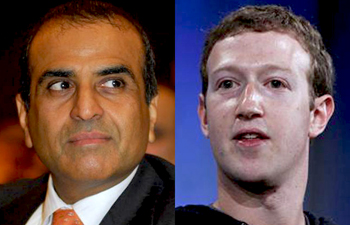
Mittal ZuckerbergFacebook has launched an 'internet.org' initiative under which users can access internet free of charge for select websites if they come through a partner telecom operator.

Incidentally, Airtel Africa is one such partner for Facebook, while rival Reliance Communications has partnered Facebook in India for this initiative, which is based on assumption that bringing more people to the internet fold by offering them free service initially is good for the industry.

Mittal, who met Facebook founder and CEO Mark Zuckerberg here at the Mobile World Congress, said that the social networking major is right in its thinking that such a would expand the market, but telecom operators also need to get their revenues and charge for the services.

"I told him (Zuckerberg) that you are right that this (internet.org) expands the market. At the end, you must understand that we (telecom operators) need to charge you for something. SMSes have gone more or less, voice is going down and they (Facebook) recognise that," Mittal said in a media interaction here.

"If you are going to make the data free, then let's do completely philanthropic projects. Government must make spectrum free, there should be free network, but it is not happening," the billionaire industrialist said, while adding that telecom companies were as such not making large money.

The comments, incidentally, come at a time when a high-pitched auction is underway in India for spectrum and committed bids worth about Rs 86,000 crore have come in within first four days of bidding -- crossing the minimum targetted amount of Rs 82,000 crore. The auction will resume tomorrow, as more unsold spectrum is left and there are expectations that the overall auction may cross Rs one lakh crore.

Telecom companies say they invest billions of dollars in spectrum, network and other operations, but they argue that internet-based entities offering pseudo-telecom services are piggy-backing on the mobile operators' networks without bearing much investments on their own.

At the same event here, UK-based telecom giant Vodafone's global CEO Vittorio Colao reportedly said about Facebook's free-of-cost internet plan that "it is almost like Zuckerberg does philanthropy, but with my money."

Mittal cautioned that investments in mobile networks by industry will go down as Internet-based messaging and calling services are 'cannibalising' revenues of telecom firms.

"He (Zuckerberg) is saying that make Internet.org lite version of Facebook free of data charge, so that people will upgrade. People will come to internet for the first time. The point is that it is self-serving for them," Mittal said.

Telecom operators have been facing pressure on their financials from the emergence of a number of Over-The-Top (OTT) firms like Facebook (through its WhatsApp messaging service), Skype and Viber, which on their part claim to be helping telecom operators grow business.

"We (telecom operators, social media and over-the-top players) are good for each other but they, regulators and politicians must understand that networks' investment must be on reasonable terms. Gone are the days when telecom companies were making large amounts of money," Mittal said.

"OTT players must understand pains of the mobile industry. Sometimes we are seeing as gatekeeper, bad guys. The fact of matter is spectrum - there is cost, network there is cost and tariff has gone up by only 3 paise in last three years," he added.

In December, Airtel had announced separate charges for Internet based calling services but withdrew it after an outcry on social media.

"The rate that we announced was exactly the same rate as a voice call. If you do one minute VoIP (internet based calls) in kilobyte terms it would be exactly the same as voice call. It was exactly the same as one minute call," Mittal said.

Comments

Add new comment

  • Coastaldigest.com reserves the right to delete or block any comments.
  • Coastaldigset.com is not responsible for its readers’ comments.
  • Comments that are abusive, incendiary or irrelevant are strictly prohibited.
  • Please use a genuine email ID and provide your name to avoid reject.
Agencies
July 15,2020

Washington, Jul 15: The Trump administration has agreed to rescind its July 6 rule, which temporarily barred international students from staying in the United States unless they attend at least one in-person course, a federal district court judge said on Tuesday.

The U-turn by the Trump administration comes following a nationwide outrage against its July 6 order and a series of lawsuits filed by a large number of educational institutions, led by the prestigious Harvard University and Massachusetts Institute of Technology (MIT), seeking a permanent injunctive relief to bar the Department of Homeland Security (DHS) and the US Immigration and Customs Enforcement (ICE) from enforcing the federal guidelines barring international students attending colleges and universities offering only online courses from staying in the country.

As many as 17 US states and the District of Columbia, along with top American IT companies such as Google, Facebook and Microsoft, joined MIT and Harvard in the US District Court in Massachusetts against the DHS and the ICE in seeking an injunction to stop the entire rule from going into effect.

"I have been informed by the parties that they have come to a resolution. They will return to the status quo," Judge Allison Burroughs, the federal district judge in Boston, said in a surprise statement at the top of the hearing on the lawsuit.

The announcement comes as a big relief to international students, including those from India. In the 2018-2019 academic year, there were over 10 lakh international students in the US. According to a recent report of the Student and Exchange Visitor Program (SEVP), 1,94,556 Indian students were enrolled in various academic institutions in the US in January.

Judge Burroughs said the policy would apply nationwide.

"Both the policy directive and the frequently asked questions would not be enforced anyplace," she said, referring to the agreement between the US government and MIT and Harvard.

Congressman Brad Scneider said this is a great win for international students, colleges and common sense.

"The Administration needs to give us a plan to tackle our public health crisis - it can't be recklessly creating rules one day and rescinding them the next," he said in a tweet.

Last week, more than 136 Congressmen and 30 senators wrote to the Trump administration to rescind its order on international students.

"This is a major victory for the students, organisers and institutions of higher education in the #MA7 and all across the country that stood up and fought back against this racist and xenophobic rule," said Congresswoman Ayanna Pressley.

"Taking online classes shouldn't force international students out of our country," Congressman Mikie Sherrill said in a tweet.

In its July 6 notice, the ICE had said all student visa holders, whose university curricula were only offered online, "must depart the country or take other measures, such as transferring to a school with in-person instruction to remain in lawful status".

"If not, they may face immigration consequences, including but not limited to the initiation of removal proceedings," it had said.

In their lawsuit, the 17 states and the District of Columbia said for many international students, remote learning in the countries and communities they come from would impede their studies or be simply impossible.

The lawsuit alleged that the new rule imposes a significant economic harm by precluding thousands of international students from coming to and residing in the US and finding employment in fields such as science, technology, biotechnology, healthcare, business and finance, and education, and contributing to the overall economy.

In a separate filing, companies like Google, Facebook and Microsoft, along with the US Chamber of Commerce and other IT advocacy groups, asserted that the July 6 ICE directive will disrupt their recruiting plans, making it impossible to bring on board international students that businesses, including the amici, had planned to hire, and disturb the recruiting process on which the firms have relied on to identify and train their future employees.

The July 6 directive will make it impossible for a large number of international students to participate in the CPT and OPT programmes. The US will "nonsensically be sending...these graduates away to work for our global competitors and compete against us...instead of capitalising on the investment in their education here in the US", they said.

Comments

Add new comment

  • Coastaldigest.com reserves the right to delete or block any comments.
  • Coastaldigset.com is not responsible for its readers’ comments.
  • Comments that are abusive, incendiary or irrelevant are strictly prohibited.
  • Please use a genuine email ID and provide your name to avoid reject.
News Network
April 24,2020

Washington, Apr 24: The number of coronavirus cases in the US has surpassed 850,000, Johns Hopkins University Coronavirus Resource Center data revealed on Thursday (local time).
The country now has registered 8,56,209 cases overall, according to the data, including 47,272 deaths.

The US currently leads the world in the number of reported COVID-19 deaths and confirmed cases.

There are more than 2.6 million COVID-19 cases around the world and more than 1,85,000 deaths, according to the data.

Comments

Add new comment

  • Coastaldigest.com reserves the right to delete or block any comments.
  • Coastaldigset.com is not responsible for its readers’ comments.
  • Comments that are abusive, incendiary or irrelevant are strictly prohibited.
  • Please use a genuine email ID and provide your name to avoid reject.
News Network
May 14,2020

May 14: The UN’s children agency has warned that an additional 6,000 children could die daily from preventable causes over the next six months as the COVID-19 pandemic weakens the health systems and disrupts routine services, the first time that the number of children dying before their fifth birthday could increase worldwide in decades.

As the coronavirus outbreak enters its fifth month, the UN Children’s Fund (UNICEF) requested USD 1.6 billion to support its humanitarian response for children impacted by the pandemic.

The health crisis is “quickly becoming a child rights crisis. And without urgent action, a further 6,000 under-fives could die each day,” it said.

With a dramatic increase in the costs of supplies, shipment and care, the agency appeal is up from a USD 651.6 million request made in late March – reflecting the devastating socioeconomic consequences of the disease and families’ rising needs.

"Schools are closed, parents are out of work and families are under strain," UNICEF Executive Director Henrietta Fore said on Tuesday.

 “As we reimagine what a post-COVID world would look like, these funds will help us respond to the crisis, recover from its aftermath, and protect children from its knock-on effects.”

The estimate of the 6,000 additional deaths from preventable causes over the next six months is based on an analysis by researchers from the Johns Hopkins Bloomberg School of Public Health, published on Wednesday in the Lancet Global Health Journal.

UNICEF said it was based on the worst of three scenarios analysing 118 low and middle-income countries, estimating that an additional 1.2 million deaths could occur in just the next six months, due to reductions in routine health coverage, and an increase in so-called child wasting.

Around 56,700 more maternal deaths could also occur in just six months, in addition to the 144,000 likely deaths across the same group of countries. The worst case scenario, of children dying before their fifth birthdays, would represent an increase "for the first time in decades,” Fore said.

"We must not let mothers and children become collateral damage in the fight against the virus. And we must not let decades of progress on reducing preventable child and maternal deaths, be lost,” she said.

Access to essential services, like routine immunisation, has already been compromised for hundreds of millions of children and threatens a significant increase in child mortality.

According to a UNICEF analysis, some 77 per cent of children under the age of 18 worldwide are living in one of 132 countries with COVID-19 movement restrictions.

The UN agency also spotlighted that the mental health and psychosocial impact of restricted movement, school closures and subsequent isolation are likely to intensify already high levels of stress, especially for vulnerable youth.

At the same time, they maintained that children living under restricted movement and socio-economic decline are in greater jeopardy of violence and neglect. Girls and women are at increased risk of sexual and gender-based violence.

The UNICEF pointed out that in many cases, refugee, migrant and internally displaced children are experiencing reduced access to protection and services while being increasingly exposed to xenophobia and discrimination.

“We have seen what the pandemic is doing to countries with developed health systems and we are concerned about what it would do to countries with weaker systems and fewer available resources,” Fore said.

In countries suffering from humanitarian crises, UNICEF is working to prevent transmission and mitigate the collateral impacts on children, women and vulnerable populations – with a special focus on access to health, nutrition, water and sanitation, education and protection.

To date, the UN agency said it has received USD 215 million to support its pandemic response, and additional funding will help build upon already-achieved results.

Within its response, UNICEF has reached more than 1.67 billion people with COVID-19 prevention messaging around hand washing and cough and sneeze hygiene; over 12 million with critical water, sanitation and hygiene supplies; and nearly 80 million children with distance or home-based learning.

The UN agency has also shipped to 52 countries, more than 6.6 million gloves, 1.3 million surgical masks, 428,000 N95 respirators and 34,500 COVID-19 diagnostic tests, among other items.

Comments

Add new comment

  • Coastaldigest.com reserves the right to delete or block any comments.
  • Coastaldigset.com is not responsible for its readers’ comments.
  • Comments that are abusive, incendiary or irrelevant are strictly prohibited.
  • Please use a genuine email ID and provide your name to avoid reject.