


Want to free Internet? Do philanthropy: Mittal to Zuckerberg

March 9, 2015

Barcelona, Mar 9: Taking on social networking giant Facebook's ambitious 'free internet' plans, telecom major Bharti Airtel chief Sunil Mittal has said the companies should do 'philanthropy' if they stop charging for mobile internet.
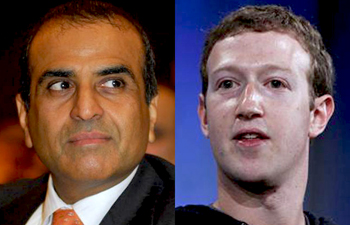
Mittal ZuckerbergFacebook has launched an 'internet.org' initiative under which users can access internet free of charge for select websites if they come through a partner telecom operator.

Incidentally, Airtel Africa is one such partner for Facebook, while rival Reliance Communications has partnered Facebook in India for this initiative, which is based on assumption that bringing more people to the internet fold by offering them free service initially is good for the industry.

Mittal, who met Facebook founder and CEO Mark Zuckerberg here at the Mobile World Congress, said that the social networking major is right in its thinking that such a would expand the market, but telecom operators also need to get their revenues and charge for the services.

"I told him (Zuckerberg) that you are right that this (internet.org) expands the market. At the end, you must understand that we (telecom operators) need to charge you for something. SMSes have gone more or less, voice is going down and they (Facebook) recognise that," Mittal said in a media interaction here.

"If you are going to make the data free, then let's do completely philanthropic projects. Government must make spectrum free, there should be free network, but it is not happening," the billionaire industrialist said, while adding that telecom companies were as such not making large money.

The comments, incidentally, come at a time when a high-pitched auction is underway in India for spectrum and committed bids worth about Rs 86,000 crore have come in within first four days of bidding -- crossing the minimum targetted amount of Rs 82,000 crore. The auction will resume tomorrow, as more unsold spectrum is left and there are expectations that the overall auction may cross Rs one lakh crore.

Telecom companies say they invest billions of dollars in spectrum, network and other operations, but they argue that internet-based entities offering pseudo-telecom services are piggy-backing on the mobile operators' networks without bearing much investments on their own.

At the same event here, UK-based telecom giant Vodafone's global CEO Vittorio Colao reportedly said about Facebook's free-of-cost internet plan that "it is almost like Zuckerberg does philanthropy, but with my money."

Mittal cautioned that investments in mobile networks by industry will go down as Internet-based messaging and calling services are 'cannibalising' revenues of telecom firms.

"He (Zuckerberg) is saying that make Internet.org lite version of Facebook free of data charge, so that people will upgrade. People will come to internet for the first time. The point is that it is self-serving for them," Mittal said.

Telecom operators have been facing pressure on their financials from the emergence of a number of Over-The-Top (OTT) firms like Facebook (through its WhatsApp messaging service), Skype and Viber, which on their part claim to be helping telecom operators grow business.

"We (telecom operators, social media and over-the-top players) are good for each other but they, regulators and politicians must understand that networks' investment must be on reasonable terms. Gone are the days when telecom companies were making large amounts of money," Mittal said.

"OTT players must understand pains of the mobile industry. Sometimes we are seeing as gatekeeper, bad guys. The fact of matter is spectrum - there is cost, network there is cost and tariff has gone up by only 3 paise in last three years," he added.

In December, Airtel had announced separate charges for Internet based calling services but withdrew it after an outcry on social media.

"The rate that we announced was exactly the same rate as a voice call. If you do one minute VoIP (internet based calls) in kilobyte terms it would be exactly the same as voice call. It was exactly the same as one minute call," Mittal said.

Comments

Add new comment

  • Coastaldigest.com reserves the right to delete or block any comments.
  • Coastaldigset.com is not responsible for its readers’ comments.
  • Comments that are abusive, incendiary or irrelevant are strictly prohibited.
  • Please use a genuine email ID and provide your name to avoid reject.
News Network
April 29,2020

Apr 29: US President Donald Trump doubled down on China for failing to tame the coronavirus at its very origin, saying it has led to 184 countries "going through hell", as several American lawmakers demanded steps to reduce dependence on Beijing for manufacturing and minerals.

Trump has been publicly blaming China for the global spread of the "invisible enemy" and launched an investigation against it. He has also indicated that the US may be looking at "a lot more money" in damages from China than the USD 140 billion being sought by Germany from Beijing for the pandemic.

Leaders of the US, the UK and Germany believe that the deaths and the destruction of the global economy could have been avoided, had China shared the information about the virus in its early phases.

"It's in 184 countries, as you hear me say often. It's hard to believe. It's inconceivable," Trump told reporters at White House Tuesday. "It should have been stopped at the source, which was China. It should have been stopped very much at the source, but it wasn't. And now we have 184 countries going through hell.”

The virus, which originated in China's Wuhan city in mid-November, has killed more than two lakh people and infected over three million globally. The largest number of them are in the US: nearly 59,000 deaths and over one million infections.

The massive outbreak in the US has put Trump under increasing pressure from American lawmakers to decrease US dependence on Beijing and they have also sought compensation from China.

Senator Ted Cruz and his colleagues have urged Defence Secretary Mark Esper and Interior Secretary David Bernhardt to support the development of a fully domestic supply chain of rare earths and other minerals that are critical for manufacturing defence technologies and supporting national security.

“It is clear that our dependence on China for vital rare earths threatens our US manufacturing and defence-industrial base. As the October 2018 Defence Industrial Base Report states: ‘China represents a significant and growing risk to the supply of materials deemed strategic and critical to US national security.' [...] Ensuring a US supply of domestically sourced rare earths will reduce our vulnerability to supply disruptions that poses a grave risk to our military readiness," the Senators wrote.

The US is 100 percent import-dependent for rare earths as well as 13 other metals and minerals on the US Government Critical Minerals List and more than 75 percent import reliant for an additional 10 minerals.

Congressman Brian Mast on Tuesday introduced a legislation to hold China accountable for its "coronavirus deception". The resolution would empower the US to withhold payments on debts owed to China equal to the costs incurred by the US in response to COVID-19.

“China's total lack of transparency and mishandling of the coronavirus outbreak has cost tens of thousands of lives, millions of jobs and left untold economic destruction. Congress must hold China accountable for their cover-up and force them to pay back the taxpayer dollars that have been spent as a result,” Mast said.

Cruz, member of the Senate Foreign Relations Committee, announced his intention to introduce a legislation to cut off Hollywood studios from assistance they receive from the Department of Defence if those studios censor their films for screening in China.

This legislation is part of Sen. Cruz's comprehensive push to combat China's growing influence over what Americans see and hear, which includes legislation targeting information warfare from the Chinese Communist Party across higher education, sports, films, radio broadcasts, and more.

Indian-American Congressman Ami Bera and Congressman Ted S. Yoho, both members of the House Foreign Affairs Committee, will lead a bipartisan virtual Special Order to highlight the importance of US global leadership during the COVID-19 pandemic.

“If we abdicate our place as a leader in global health, there is another country eager to take the reins. China has not been subtle in asserting itself on global health issues, and often not for the benefit of other nations. China's recent coronavirus debacle should be evidence enough that their communist regime cannot be trusted to lead with accountability, transparency, or pragmatism, traits that are essential when fighting widespread disease,” Yoho said.

“As for how China would fare as a global health leader, look no further than the disastrous initial response by the WHO to coronavirus, one that was clearly influenced by Beijing. Information was slow-walked, warnings from nations like Taiwan were ignored at crucial turning points, and cooperation with outside health experts was spurned until it was too late. And it has resulted in the largest public health disaster the world has seen in over a century,” he said.

In an interview to Fox News, Senator Marco Rubio alleged that if China had acted when those warnings were being made, instead of silencing the people that were talking about it, they could have limited the spread.

“So there was no doubt that that was a deliberate decision made on their part. The one way to hold them accountable is to do what we should be doing anyway. That is moving the means of production to become less and less dependent upon them. What you're going to see after this pandemic is that more and more countries are going to prioritize their healthcare manufacturing capabilities and other industries,” he said.

Comments

Add new comment

  • Coastaldigest.com reserves the right to delete or block any comments.
  • Coastaldigset.com is not responsible for its readers’ comments.
  • Comments that are abusive, incendiary or irrelevant are strictly prohibited.
  • Please use a genuine email ID and provide your name to avoid reject.
Agencies
February 4,2020

As the deadly coronavirus has spread worldwide, it has carried with it xenophobia -- and Asian communities around the world are finding themselves subject to suspicion and fear.

When a patient on Australia's Gold Coast refused to shake the hand of her surgeon Rhea Liang, citing the virus that has killed hundreds, the medic's first response was shock.

But after tweeting about the incident and receiving a flood of responses, the respected doctor learned her experience was all too common.

There has been a spike in reports of anti-Chinese rhetoric directed at people of Asian origin, regardless of whether they have ever visited the centre of the epidemic or been in contact with the virus.

Chinese tourists have reportedly been spat at in the Italian city of Venice, a family in Turin was accused of carrying the disease, and mothers in Milan have used social media to call for children to be kept away from Chinese classmates.

In Canada, a white man was filmed telling a Chinese-Canadian woman "you dropped your coronavirus" in the parking lot of a local mall.

In Malaysia, a petition to "bar Chinese people from entering our beloved country" received almost 500,000 signatures in one week.

The incidents are part of what the Australasian College for Emergency Medicine has described as "misinformation" which it says is fuelling "racial profiling" where "deeply distressing assumptions are being made about 'Chinese' or 'Asian-looking' people." Disease has long been accompanied by suspicions of foreigners -- from Irish immigrants being targeted in the Typhoid Mary panic of 1900s America to Nepali peacekeepers being accused of bringing cholera to earthquake-struck Haiti in the last decade.

"It's a common phenomenon," said Rob Grenfell, director of health and biosecurity for Australia's science and research agency CSIRO.

"With outbreaks and epidemics along human history, we've always tried to vilify certain subsets of the population," he said, comparing the behaviour to 1300s plague-ridden medieval Europe, where foreigners and religious groups were often blamed.

"Sure it emerged in China," he said of the coronavirus, "but that's no reason to actually vilify Chinese people." In a commentary for the British Medical Journal, doctor Abraar Karan warned this behaviour could discourage people with symptoms from coming forward.

Claire Hooker, a health lecturer at the University of Sydney, said the responses from governments may have compounded prejudice.

The World Health Organisation has warned against "measures that unnecessarily interfere with international travel and trade", but this has not stopped scores of countries from introducing travel bans.

The tiny Pacific nation of Micronesia has banned its citizens from visiting mainland China altogether.

"Travel bans respond largely to people's fears," said Hooker, and while sometimes warranted, they often "have the effect of cementing an association between Chinese people and scary viruses".

Abbey Shi, a Shanghai-born student in Sydney, said the attitude shown by some of her peers has "become almost an attack on students who are Chinese".

While Australia's conservative government has banished its citizens returning from Wuhan -- the central Chinese city at the epicentre of the virus -- to a remote island for quarantine, thousands of students still stuck in China risk their studies being torpedoed.

"Right now it looks like they have to miss the semester's start and potentially the whole year, because of the way the courses are set up," Shi said.

According to Hooker, studies in Toronto on the impact of Severe Acute Respiratory Syndrome, or SARS -- another global coronavirus outbreak in 2002 -- showed the impact of xenophobic sentiment often lasted much longer than the public health scare.

"While there may be a cessation of direct forms of racism as news about the disease dies down, it takes quite a bit of time for economic recovery and people continue to feel unsafe," she said.

People may not rush back to Chinese businesses or restaurants, and may even heed some of the more outlandish viral social media disinformation -- such as one popular post imploring people to avoid eating noodles for their own safety.

"In one sense you might think the effects lasted from the last coronavirus to this one because the representation as China being a place where diseases come from has been persistent," Hooker said.

Comments

Add new comment

  • Coastaldigest.com reserves the right to delete or block any comments.
  • Coastaldigset.com is not responsible for its readers’ comments.
  • Comments that are abusive, incendiary or irrelevant are strictly prohibited.
  • Please use a genuine email ID and provide your name to avoid reject.
Agencies
April 20,2020

Hong Kong, Apr 20: Oil prices collapsed to more than two-decade lows Monday as traders grow concerned that storage facilities are reaching their limits, while equities were mixed, with some support coming from signs that the coronavirus may have peaked in Europe and the United States.

US crude benchmark West Texas Intermediate briefly plunged almost 20 percent to below 15 -- its lowest since 1999 -- as stockpiles continue to build owing to a crash in demand caused by the COVID-19 pandemic.

Analysts said this month's agreement between top producers to slash output by 10 million barrels a day was having little impact on the oil crisis because of lockdowns and travel restrictions that are keeping billions of people at home.

WTI was hit particularly hard as its main US storage facilities in Cushing, Oklahoma, were filling up.

ANZ said "crude oil prices remained under pressure, as projections of weaker demand weigh on sentiment".

"Despite the OPEC+ alliance agreeing to an unprecedented cut in output, the physical market is awash with oil," it said, referring to the Organization of the Petroleum Exporting Countries and non-OPEC partners.

And AxiCorp's Stephen Innes added: "It's a dump at all cost as no one... wants delivery of oil, with Cushing storage facilities filling by the minute.

"It hasn't taken long for the market to recognise that the OPEC+ deal will not, in its present form, be enough to balance oil markets." Stock traders were in slightly more buoyant mood as governments start to consider how and when to ease lockdowns that have crippled the global economy.

Italy, Spain, France and Britain reported drops in daily death tolls and slowing infection rates.

"We are scoring points against the epidemic," said Prime Minister Edouard Philippe, while insisting "we are not out of the health crisis yet".

Meanwhile, in the US, Andrew Cuomo, governor of badly hit New York state, said the disease was "on the descent", though he cautioned it was "no time to get cocky".

Mounting evidence suggests that the lockdowns and social distancing are slowing the spread of the virus.

That has intensified planning in many countries to begin loosening curbs on movement and easing the crushing pressure on national economies.

Adding to the sense of hope was a report indicating promising research on a drug to treat coronavirus.

Hong Kong, Shanghai and Seoul were each up 0.1 percent, while Wellington added 0.4 percent.

However, Tokyo went into the break 0.9 percent lower, while Sydney and Manila dropped one percent apiece. There were also losses in Taipei, Singapore and Jakarta.

"The longer investors have to contemplate future economic issues while they wait for more countries to be on the downward slope of the pandemic curve, the more scope there is of risk assets pricing in a difficult future," Chris Iggo, of AXA Investment Managers UK, said.

Investors are keeping an eye on Washington, where Congress and the White House are working towards a 450 billion economic relief plan for small business to add to the trillions already pledged to support the economy.

Big-name companies including IBM, Netflix and Coca-Cola are due to deliver their earnings reports.

Comments

Add new comment

  • Coastaldigest.com reserves the right to delete or block any comments.
  • Coastaldigset.com is not responsible for its readers’ comments.
  • Comments that are abusive, incendiary or irrelevant are strictly prohibited.
  • Please use a genuine email ID and provide your name to avoid reject.