


Want to free Internet? Do philanthropy: Mittal to Zuckerberg

March 9, 2015

Barcelona, Mar 9: Taking on social networking giant Facebook's ambitious 'free internet' plans, telecom major Bharti Airtel chief Sunil Mittal has said the companies should do 'philanthropy' if they stop charging for mobile internet.
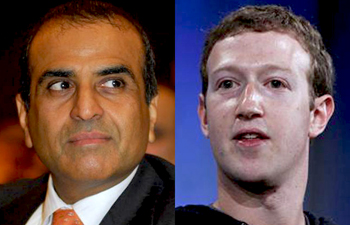
Mittal ZuckerbergFacebook has launched an 'internet.org' initiative under which users can access internet free of charge for select websites if they come through a partner telecom operator.

Incidentally, Airtel Africa is one such partner for Facebook, while rival Reliance Communications has partnered Facebook in India for this initiative, which is based on assumption that bringing more people to the internet fold by offering them free service initially is good for the industry.

Mittal, who met Facebook founder and CEO Mark Zuckerberg here at the Mobile World Congress, said that the social networking major is right in its thinking that such a would expand the market, but telecom operators also need to get their revenues and charge for the services.

"I told him (Zuckerberg) that you are right that this (internet.org) expands the market. At the end, you must understand that we (telecom operators) need to charge you for something. SMSes have gone more or less, voice is going down and they (Facebook) recognise that," Mittal said in a media interaction here.

"If you are going to make the data free, then let's do completely philanthropic projects. Government must make spectrum free, there should be free network, but it is not happening," the billionaire industrialist said, while adding that telecom companies were as such not making large money.

The comments, incidentally, come at a time when a high-pitched auction is underway in India for spectrum and committed bids worth about Rs 86,000 crore have come in within first four days of bidding -- crossing the minimum targetted amount of Rs 82,000 crore. The auction will resume tomorrow, as more unsold spectrum is left and there are expectations that the overall auction may cross Rs one lakh crore.

Telecom companies say they invest billions of dollars in spectrum, network and other operations, but they argue that internet-based entities offering pseudo-telecom services are piggy-backing on the mobile operators' networks without bearing much investments on their own.

At the same event here, UK-based telecom giant Vodafone's global CEO Vittorio Colao reportedly said about Facebook's free-of-cost internet plan that "it is almost like Zuckerberg does philanthropy, but with my money."

Mittal cautioned that investments in mobile networks by industry will go down as Internet-based messaging and calling services are 'cannibalising' revenues of telecom firms.

"He (Zuckerberg) is saying that make Internet.org lite version of Facebook free of data charge, so that people will upgrade. People will come to internet for the first time. The point is that it is self-serving for them," Mittal said.

Telecom operators have been facing pressure on their financials from the emergence of a number of Over-The-Top (OTT) firms like Facebook (through its WhatsApp messaging service), Skype and Viber, which on their part claim to be helping telecom operators grow business.

"We (telecom operators, social media and over-the-top players) are good for each other but they, regulators and politicians must understand that networks' investment must be on reasonable terms. Gone are the days when telecom companies were making large amounts of money," Mittal said.

"OTT players must understand pains of the mobile industry. Sometimes we are seeing as gatekeeper, bad guys. The fact of matter is spectrum - there is cost, network there is cost and tariff has gone up by only 3 paise in last three years," he added.

In December, Airtel had announced separate charges for Internet based calling services but withdrew it after an outcry on social media.

"The rate that we announced was exactly the same rate as a voice call. If you do one minute VoIP (internet based calls) in kilobyte terms it would be exactly the same as voice call. It was exactly the same as one minute call," Mittal said.

Comments

Add new comment

  • Coastaldigest.com reserves the right to delete or block any comments.
  • Coastaldigset.com is not responsible for its readers’ comments.
  • Comments that are abusive, incendiary or irrelevant are strictly prohibited.
  • Please use a genuine email ID and provide your name to avoid reject.
Agencies
June 16,2020

India continues to remain ranked 43rd on an annual World Competitiveness Index compiled by Institute for Management Development (IMD) with some traditional weaknesses like poor infrastructure and insufficient education investment keeping its ranking low, the international business school said on Tuesday.

Singapore has retained its top position on the 63-nation list.

Denmark has moved up to the second position (from 8th last year), Switzerland has gained one place to rank 3rd, the Netherlands has retained its 4th place and Hong Kong has slipped to the fifth place (from 2nd in 2019).

The US has moved down to 10th place (from 3rd last year), while China has also slipped from 14th to 20th place. Among the BRICS nations, India is ranked second after China, followed by Russia (50th), Brazil (56th) and South Africa (59th).

India was ranked 41st on the IMD World Competitiveness Ranking, being produced by the business school based in Switzerland and Singapore every year since 1989, but had slipped to 45th in 2017 before improving to 44th in 2018 and then to 43rd in 2019.

While its overall position has remained unchanged in the 2020 list, it has recorded improvements in areas like long-term employment growth, current account balance, high-tech exports, foreign currency reserves, public expenditure on education, political stability and overall productivity, the IMD said.

However, it has moved down in areas like exchange rate stability, real GDP growth, competition legislation and taxes.

Arturo Bris, Head of Competitiveness Center at IMD Business School, said India continues to struggle on the list and the recent country rating downgrade by Moody’s reflects the uncertainties regarding the economy’s future.

"In our ranking this year, we again emphasize the traditional weaknesses of India -- poor infrastructure, an important deficit in education investment, and a health system that does not reach everybody. For India to follow the path of China, it must stress its intangible infrastructure," Bris said.

"In a less global world, with China, USA, and Europe looking inwards, currencies like the rupee (and the Brazilian real for instance) are going to suffer and display high volatilities.

"Moody’s has threatened the country with a downgrade to junk and that would put India in a terrible position to attract foreign capital. So the urgency for the government should be to fix the short-term problems—and this requires to improve the credibility of the government itself," Bris added.

With the exception of Singapore, the Philippines, Taiwan and the Korean Republic, most Asian economies dropped in rankings this year, the IMD said.

The reason for the Asian economies’ less stellar performance as a region, this year is partly the result of the trade frictions between China and the US, particularly because these economies are highly dependent on trade with China.

About Singapore, which moved to the top rank last year, the IMD said its position is largely driven by the relative ease of setting up business, availability of skilled labour and its cutting-edge technological infrastructure.

The IMD said the impact of COVID-19 on the competitiveness ranking has partially been captured by executives’ opinions about the effectiveness of the different health systems.

In the ASEAN countries included in the survey, only Singapore and Thailand have a positive performance in the effectiveness of the health infrastructure.

Comments

Add new comment

  • Coastaldigest.com reserves the right to delete or block any comments.
  • Coastaldigset.com is not responsible for its readers’ comments.
  • Comments that are abusive, incendiary or irrelevant are strictly prohibited.
  • Please use a genuine email ID and provide your name to avoid reject.
News Network
June 20,2020

Sao Paulo, June 20: Brazil’s government confirmed on Friday that the country has risen above 1 million confirmed coronavirus cases, second only to the United States.

The country’s health ministry said that the total now stood at 10,32,913, up more than 50,000 from Thursday. The ministry said the sharp increase was due to corrections of previous days’ underreported numbers.

Brazilian President Jair Bolsonaro still downplays the risks of the virus after nearly 50,000 deaths from COVID-19 in three months, saying the impact of social isolation measures on the economy could be worse than the disease itself.

Specialists believe the actual number of cases in Brazil could be up to seven times higher than the official statistic. Johns Hopkins University says Brazil is performing an average of 14 tests per 1,00,000 people each day, and health experts say that number is up to 20 times less than needed to track the virus.

Official data show a downward trend of the virus in Brazil’s north, including the hard-hit region of the Amazon, a plateau in cases and deaths in the countries’ biggest cities near the Atlantic coast, but a rising curve in the south.

In the Brazilian countryside, which is much less prepared to handle a crisis, the pandemic is clearly growing. Many smaller cities have weaker health care systems and basic sanitation that’s insufficient to prevent contagion.

“There is a lot of regional inequality in our public health system and a shortage of professionals in the interior,” said Miguel Lago, executive director of Brazil’s Institute for Health Policy Studies, which advises public health officials.

That creates many health care deserts, with people going long distances to get attention. When they leave the hospital, the virus can go with them.

The cattle-producing state of Mato Grosso was barely touched by the virus when it hit the nation’s biggest cities in March. Sitting far from the coast, between the Bolivian border and Brazil’s capital of Brasilia, its 33 lakh residents led a mostly normal life until May. But now its people live under lockdown and meat producers have dozens of infected workers.

In Tangará da Serra, a city of 1,03,000 people in Mato Grosso, the mayor decided Friday to forbid the sale of alcoholic drinks for two weeks as an incentive for people to stay home.

Fᢩo Junqueira said the measure was needed after a spike in COVID-19 cases that filled 80% of the city’s 54 intensive care beds. The city has had nearly 300 cases of the disease, plus three fatalities.

In Rondonópolis, only 300 miles away from Tangará da Serra and home to a thriving economy, health authorities closed the local meatpacking industry after 92 cases were confirmed there. The city of 1,44,000 inhabitants counted 21 deaths from the virus and more than 600 cases. The mayor has also decided to limit sales of alcoholic beverages.

Even regions once considered examples of successful efforts against the virus are now struggling.

Porto Alegre, home to about 14 lakh people, had success in slowing the virus’ spread over the last three months. But now its mayor is considering increasing social isolation measures after ICU occupancy in the city jumped to 80% this month.

We were already making projections for schools to come back, Mayor Nelson Marchezan Jr. told The Associated Press. Now the trend is to impose more restrictions. Outside Sao Paulo city, five regions of the state’s countryside will have to close shops starting Monday due to a rise in coronavirus cases. Governor João Doria announced the decision Friday.

Dr. Mike Ryan, the World Health Organization’s executive director, said at a news conference that Brazil needs to increase its efforts to stop the spread of infections.

“The epidemic is still quite severe in Brazil. I believe health workers are working extremely hard and under pressure to be able to deal with the number of cases that they see on a daily basis,” Dr. Ryan said.

“Certainly the rise is not as exponential as it was previously, so there are some signs that the situation is stabilising. But we’ve seen this before in other epidemics in other countries.”

Margareth Dalcolmo, a clinical researcher and professor of respiratory medicine at the state-funded Oswaldo Cruz Foundation in Rio de Janeiro, believes the reopening in major cities and the virus traveling by road into Brazil’s heartland will keep the pressure on the country’s health system.

“The risk in the interior now is very big,” she said. “Our health system just can’t solve the most serious cases of COVID in many places of the countryside.”

Comments

Add new comment

  • Coastaldigest.com reserves the right to delete or block any comments.
  • Coastaldigset.com is not responsible for its readers’ comments.
  • Comments that are abusive, incendiary or irrelevant are strictly prohibited.
  • Please use a genuine email ID and provide your name to avoid reject.
Agencies
May 28,2020

Washington, May 28: US President Donald Trump has warned social media giants that his government could "strongly regulate" or "close them down" after Twitter fact-checked one of his tweets for the first time.

"Republicans feel that Social Media Platforms totally silence conservatives voices," Xinhua news agency reported citing Trump as saying in a tweet to his 80 million followers on Wednesday.

"We will strongly regulate, or close them down, before we can ever allow this to happen."

Later in the day, he said that Twitter "has now shown everything we have been saying about them... is correct" and vowed "big action to follow".

The President's remarks came after Twitter slapped a warning label on one of his tweets on Tuesday, cautioning readers "Trump makes unsubstantiated claim that mail-in ballots will lead to voter fraud".

It was in response to Trump's tweet, without providing evidence, said: "There is NO WAY (ZERO!) that Mail-In Ballots will be anything less than substantially fraudulent."

Also Read: Obama was ‘grossly incompetent president’, says Donald Trump
It is unclear what regulatory steps the president could take without new laws passed by Congress, the BBC reported.

The White House is yet to offer further details.

Earlier, Trump has accused Twitter of interfering in this year's US presidential election scheduled for November, saying the company was "completely stifling free speech, and I, as president, will not allow it to happen".

With more than 52,000 tweets currently to his name, Trump is a prolific tweeter and relies on the platform to disseminate his views to millions of people.

He has used Twitter to launch attacks on opponents, with targets ranging from North Korean leader Kim Jong-un to his political rivals in the US.

In 2017 he used anti-Muslim tweets aimed at London Mayor Sadiq Khan to serve a domestic political purpose of warning about immigration.

Comments

Add new comment

  • Coastaldigest.com reserves the right to delete or block any comments.
  • Coastaldigset.com is not responsible for its readers’ comments.
  • Comments that are abusive, incendiary or irrelevant are strictly prohibited.
  • Please use a genuine email ID and provide your name to avoid reject.