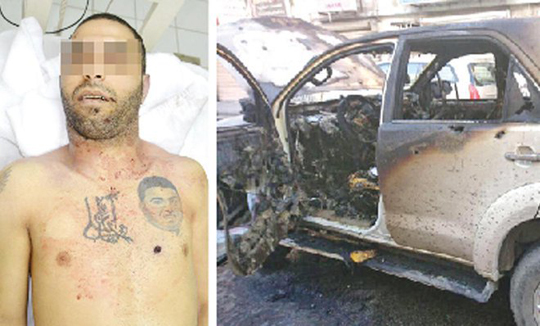
Wanted terrorist gunned down in Saudi Arabia

March 11, 2017

Jeddah, Mar 11: Security authorities in the Eastern Province killed wanted terrorist Mustafa Al-Madad in an exchange of fire in Al-Shawkia neighborhood in Qatif.

terrorist

Al-Madad was involved in terror activities against citizens and security men, as well as against public and private property.

Asked to surrender, he began firing at security men. One security man suffered minor injuries and is receiving treatment. The police were searching a neighborhood where he was hiding, the Saudi Press Agency (SPA) reported.

Maj. Gen. Mansour Al-Turki, Interior Ministry spokesman, said authorities are pursuing all wanted criminals involved in this case, and are calling on them once again to surrender.

Anyone with information about them should contact 990. Substantial information will be compensated as per previously announced rewards, he said.

The Kingdom has been targeted by terror strikes several times in the past.

On Jan. 7, two terrorists were killed after a shootout with security forces in a district north of the capital Riyadh.

Acting on a tip-off that the wanted terrorists were present at a villa in Al-Yasmeen district, security forces cordoned off the area and asked the extremists to surrender.

The militants, who were armed with Kalashnikov rifles, fired randomly at the police and tried to escape in a security patrol car. A police officer, coming from behind the patrol cars, shot them dead.

On July 4, 2016 a suicide bombing in Madinah resulted in the deaths of four security men.

On the same day, a suicide bomber carried out an attack near a US diplomatic building in Jeddah, which injured two security officers.

Comments

Add new comment

  • Coastaldigest.com reserves the right to delete or block any comments.
  • Coastaldigset.com is not responsible for its readers’ comments.
  • Comments that are abusive, incendiary or irrelevant are strictly prohibited.
  • Please use a genuine email ID and provide your name to avoid reject.
coastaldigest.com news network
August 3,2020

Sharjah, Aug 3: A 24-year-old Indian engineer has fallen to death from the sixth floor of a residential building on Eid al-Adha in the UAE's Sharjah, a media report said on Monday. 

The electrical engineer, identified with his single name Sumesh, hailed from the south Indian state of Kerala.

He lived in a building in Al Dhaid in Sharjah, from where he fell to death on Friday, the report said, adding that he was apparently talking over the phone and threw it down minutes before the incident.

Sumesh, who came to the UAE a year ago, worked as a designer in Sharjah's Muwaileh area. His roommates said that he had some "personal issues" that had been "bothering him for some time", according to the report.

"It was Eid al-Adha and our cook had made biryani for us. We were all cracking jokes and having a good time. In fact, even Cuckoo (Sumesh) was also laughing with us. He seemed happy. Nobody had anticipated this. I did sense a few times that something was troubling him and I even asked him about it, but he brushed it off," the report quoted his roommate Dileep Kumar as saying.

Shans KF, another roommate, said Sumesh was to travel to India for his annual leave but could not because of the COVID-19 pandemic.

The police have launched an investigation and moved the body to the forensic lab for an autopsy.

Comments

Add new comment

  • Coastaldigest.com reserves the right to delete or block any comments.
  • Coastaldigset.com is not responsible for its readers’ comments.
  • Comments that are abusive, incendiary or irrelevant are strictly prohibited.
  • Please use a genuine email ID and provide your name to avoid reject.
News Network
March 11,2020

Riyadh, Mar 11: Energy titan Saudi Aramco said Tuesday it will boost crude oil supplies to 12.3 million barrels per day in April, flooding markets as it escalates a price war with Russia.

Riyadh had already slashed its price for April delivery after Russia refused its proposal that producer alliance OPEC+ orchestrate a co-ordinated cut of 1.5 million barrels per day.

The production cut had been mooted to shore up global oil prices, which have gone into meltdown as the deadly new coronavirus casts a pall over the world economy, but now price cuts and rising output indicate an unravelling of OPEC+ co-operation.

"Saudi Aramco announces that it will provide its customers with 12.3 million barrels per day of crude oil in April," the company said in a statement to the Saudi stock exchange.

Saudi Arabia, the world's biggest crude exporter has been pumping some 9.8 million bpd so its announcement on Tuesday means it will be adding at least 2.5 million bpd from April.

"The Company has agreed with its customers to provide them with such volumes starting 1 April 2020. The Company expects that this will have a positive, long-term financial effect," the statement said.

Saudi Arabia says it has an output capacity of 12 million bpd but it is not known for how long it can sustain such levels.

The kingdom also has millions of barrels of crude stored in strategic reserves to be used when needed and is expected to use it to provide the extra supply to the global market.

"Production above 12 million bpd shows the Saudis have something to prove," director of Britain-based RS Energy Bill Farren-Price said.

"This is a grab for market share. The taps are open and the prices have been cut sharply," Farren-Price told AFP.

In a quick response, Russian Energy Minister Alexander Novak said Moscow could boost production in the short term "by 200,00-300,000 bpd, with a potential of 500,000 bpd in the near future".

But he stressed that Moscow was in favour of extending a December agreement that had seen OPEC and Russia agree to cut production by 500,000 barrels per day in 2020, lowering output from October 2018 levels by 1.7 million barrels per day.

The events of recent days have signalled a disintegration of collaboration between OPEC and Russia.

Russia is a non-OPEC member and the world's second-biggest oil producer, but Moscow and other non-members have in recent years co-operated with the oil cartel in an arrangement known as OPEC+.

The Saudi price cuts over the weekend, which were the first salvo in the price war, sent oil prices crashing -- registering the single biggest one-day loss in three decades on Monday.

Saudi Arabia draws around 70 per cent of its revenues from oil, and the revenues are key to ambitious reform programmes launched by Crown Prince Mohammed bin Salman.

Comments

Add new comment

  • Coastaldigest.com reserves the right to delete or block any comments.
  • Coastaldigset.com is not responsible for its readers’ comments.
  • Comments that are abusive, incendiary or irrelevant are strictly prohibited.
  • Please use a genuine email ID and provide your name to avoid reject.
News Network
July 1,2020

Riyadh, Jul 1: Saudis braced Wednesday for a tripling in value added tax, another unpopular austerity measure after the twin shocks of coronavirus and an oil price slump triggered the kingdom's worst economic decline in decades.

Retailers in the country reported a sharp uptick in sales this week of everything from gold and electronics to cars and building materials, as shoppers sought to stock up before VAT is raised to 15 percent.

The hike could stir public resentment as it weighs on household incomes, pushing up inflation and depressing consumer spending as the kingdom emerges from a three-month coronavirus lockdown.

"Cuts, cuts, cuts everywhere," a Saudi teacher in Riyadh told AFP, bemoaning vanishing subsidies as salaries remain stagnant.

"Air conditioner, television, electronic items," he said, rattling off a list of items he bought last week ahead of the VAT hike.

"I can't afford these things from Wednesday."

With its vast oil wealth funding the Arab world's biggest economy, the kingdom had for decades been able to fund massive spending with no taxes at all.

It only introduced VAT in 2018, as part of a push to reduce its dependence on crude revenues.

Then, seeking to shore up state finances battered by sliding oil prices and the coronavirus crisis, it announced in May that it would triple VAT and halt a cost-of-living monthly allowance to citizens.

The austerity push underscores how Saudi Arabia's once-lavish spending is becoming a thing of the past, with the erosion of the welfare system leaving a mostly young population to cope with reduced incomes and a lifestyle downgrade.

That could pile strain on a decades-old social contract whereby citizens were given generous subsidies and handouts in exchange for loyalty to the absolute monarchy.

The rising cost of living may prompt many to ask why state funds are being lavished on multi-billion-dollar projects and overseas assets, including the proposed purchase of English football club Newcastle United.

Shopping malls in the kingdom have drawn large crowds in recent days as retailers offered "pre-VAT sales" and discounts before the hike kicks in.

A gold shop in Riyadh told AFP it saw a 70 percent jump in sales in recent weeks, while a car dealership saw them tick up by 15 percent.

Once the new rate is in place, businesses are predicting depressed sales of everything from cars to cosmetics and home appliances.

Capital Economics forecast inflation will jump up to six percent year-on-year in July, from 1.1 percent in May, as a result.

"The government ended the country's lockdown (in June) and there are signs that economic activity has started to recover," Capital Economics said in a report.

"Nonetheless, we expect the recovery to be slow-going as fiscal austerity measures bite."

The kingdom also risks losing its edge against other Gulf states, including its principal ally the United Arab Emirates, which introduced VAT at the same time but has so far refrained from raising it beyond five percent.

"Saudi Arabia is taking massive risks with contractionary fiscal policies," said Tarek Fadlallah, chief executive officer of the Middle East unit of Nomura Asset Management.

But the kingdom has few choices as oil revenue declines.

Its finances have taken another blow as authorities massively scaled back this year's hajj pilgrimage, from 2.5 million pilgrims last year to around a thousand already inside the country, and suspended the lesser umrah because of coronavirus.

Together the rites rake in some $12 billion annually.

The International Monetary Fund warned the kingdom's GDP will shrink by 6.8 percent this year -- its worst performance since the 1980s oil glut.

The austerity drive would boost state coffers by 100 billion riyals ($26.6 billion), according to state media.

But the measures are unlikely to plug the kingdom's huge budget deficit.

The Saudi Jadwa Investment group forecasts the shortfall will rise to a record $112 billion this year.


Comments

Add new comment

  • Coastaldigest.com reserves the right to delete or block any comments.
  • Coastaldigset.com is not responsible for its readers’ comments.
  • Comments that are abusive, incendiary or irrelevant are strictly prohibited.
  • Please use a genuine email ID and provide your name to avoid reject.