


We came to US to become Americans not Indian-Americans: Jindal

January 16, 2015

Washington, Jan 16: Asserting that he didn't believe in hyphenated identities, Louisiana Governor Bobby Jindal has said that his parents came to the US from India four decades ago to become Americans and not Indian-Americans.bobby jindal
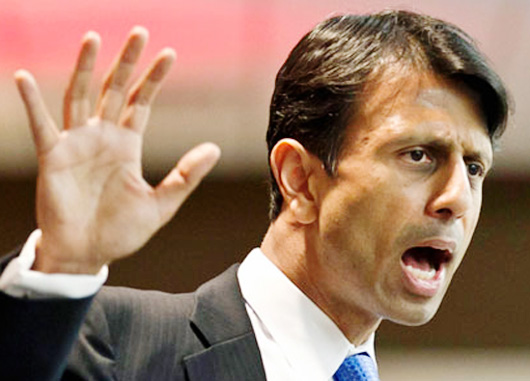
He invoked his ethnic heritage to make a call for immigrant assimilation in the multi-cultural American society and said people who talked about skin pigmentation were the "most dim-witted lot" around.

"My parents came in search of the American Dream, and they caught it. To them, America was not so much a place, it was an idea. My dad and mom told my brother and me that we came to America to be Americans. Not Indian-Americans, simply Americans," Jindal said in a prepared remarks that he is scheduled to deliver next week.

Jindal, the first Indian-American Governor of any American state, is scheduled to address the Henry Jackson Society on Monday in London.

Releasing the prepared remarks of Jindal's speech, his office said the Louisiana Governor will call for immigrant assimilation to strengthen countries and protect freedom.

"If we wanted to be Indians, we would have stayed in India. It's not that they are embarrassed to be from India, they love India. But they came to America because they were looking for greater opportunity and freedom," Jindal said, explaining the reason why he does not like to be called or described as an Indian-American.

"I do not believe in hyphenated Americans. This view gets me into some trouble with the media back home. They like to refer to Indian-Americans, Irish-Americans, African-Americans, Italian-Americans, Mexican-Americans, and all the rest. To be clear – I am not suggesting for one second that people should be shy or embarrassed about their ethnic heritage," he said.

"I am explicitly saying that it is completely reasonable for nations to discriminate between allowing people into their country who want to embrace their culture, or allowing people into their country who want to destroy their culture, or establish a separate culture within," he said.

"It is completely reasonable and even necessary for a sovereign nation to discriminate between people who want to join them and people who want to divide them. And immigration policy should have nothing at all to do with the colour of anyone's skin. I find people who care about skin pigmentation to be the most dim-witted lot around. I want nothing to do with that," he said.

Jindal said his objective in this speech is to speak clearly about what he believes to be America's proper role in international affairs; to speak bluntly about the nature of the threats being faced and the recent tragic events in France; and to suggest what he think is the way forward.

"The first step for America, and for any nation that wants to protect its own freedom and encourage it everywhere is to have a strong economy. When the United States became a major economic power at the end of the 19th century, it had the means to become a major military power and to become a leader in the free world," Jindal said.

The Governor said the first tenet of American foreign policy must always be freedom, and the relentless pursuit of freedom for our people, and for all people, regardless of race, creed, religion, ethnicity, or any other artificial divisions, which humans use to divide one from another.

"America must always be a beacon of freedom throughout the world. I'm not naive enough to suggest that the entire world will ever be free, but I'm also completely opposed to ever giving up on the notion that all people everywhere in the world deserve and desire to be free," he said.

"The next principle is of course security. America must and will pay any price to defend itself and to defend its allies. No two countries are the same, but those countries that value freedom and democracy and civility and decency must band together, and must defend each other," he said.

"Those countries that desire security and harbour no ill- will toward their neighbours must stick together in an increasingly dangerous world. The third principle that is crucial is truth. We must speak the truth, to each other, and to our own countrymen," he said.

"When a country or a movement is behaving badly on the international stage, we must not pretend otherwise. You cannot remedy a problem if you will not name it and define it. One of the most prominent examples in our day is ISIS and all forms of radical Islam. These people have no legitimate claim, they have no justification for their cowardly, barbaric, and inhuman behaviour, and we must not pretend otherwise," Jindal said.

Comments

Add new comment

  • Coastaldigest.com reserves the right to delete or block any comments.
  • Coastaldigset.com is not responsible for its readers’ comments.
  • Comments that are abusive, incendiary or irrelevant are strictly prohibited.
  • Please use a genuine email ID and provide your name to avoid reject.
News Network
June 15,2020

Stockholm, Jun 15: Nuclear powers continue to modernise their arsenals, researchers said Monday, warning that tensions were rising and the outlook for arms control was "bleak".

"The loss of key channels of communication between Russia and the USA... could potentially lead to a new nuclear arms race," said Shannon Kile, director of the nuclear arms control programme at the Stockholm International Peace Research Institute (SIPRI) and co-author of the report.

Russia and the US account for more than 90 percent of the world's nuclear weapons.

Kile was referring to the future of the New START treaty between the US and Russia, which is set to expire in February 2021.

It is the final nuclear deal still in force between the two superpowers, aimed at maintaining their nuclear arsenals below Cold War levels.

"Discussions to extend New START or to negotiate a new treaty made no progress in 2019," the SIPRI researchers noted.

At the same time, nuclear powers continue to modernise their weapons while China and India are increasing the size of their arsenals.

"China is in the middle of a significant modernisation of its nuclear arsenal. It is developing a so-called nuclear triad for the first time, made up of new land- and sea-based missiles and nuclear-capable aircraft," SIPRI said.

The country has repeatedly rejected Washington's insistence that it join any future nuclear arms reduction talks.

The number of nuclear warheads declined in the past year.

At the start of 2020, the United States, Russia, Britain, China, India, Pakistan, Israel and North Korea together had 13,400 nuclear arms, according to SIPRI's estimates, 465 fewer than at the start of 2019.

The decline was attributed mainly to the United States and Russia.

While the future of the New START treaty remains uncertain, Washington and Moscow have continued to respect their obligations under the accord.

"In 2019, the forces of both countries remained below the limits specified by the treaty," the report said. But both nations "have extensive and expensive programmes underway to replace and modernise their nuclear warheads, missile and aircraft delivery systems, and nuclear weapon production facilities," it added.

"Both countries have also given new or expanded roles to nuclear weapons in their military plans and doctrines, which marks a significant reversal of the post-Cold War trend towards the gradual marginalisation of nuclear weapons."

The Treaty on the Non-Proliferation of Nuclear Weapons (NPT), a cornerstone of the global nuclear non-proliferation regime, celebrates its 50th anniversary this year.

The number of nuclear arms worldwide has declined since hitting a peak of almost 70,000 in the mid-1980s.

The five original nuclear powers -- Washington, Beijing, Moscow, Paris and London -- in March reiterated their commitment to the treaty.

Comments

Add new comment

  • Coastaldigest.com reserves the right to delete or block any comments.
  • Coastaldigset.com is not responsible for its readers’ comments.
  • Comments that are abusive, incendiary or irrelevant are strictly prohibited.
  • Please use a genuine email ID and provide your name to avoid reject.
News Network
May 25,2020

Beijing, May 25: China has reported 51 new coronavirus cases including 40 asymptomatic infections, majority of them in the contagion's first epicentre Wuhan, where over six million tests have been conducted in the last 10 days, health officials said on Monday.

The country's National Health Commission (NHC) said that 11 new imported cases were reported on Sunday.

While no new domestically-transmitted COVID-19 cases were reported in China on Sunday, 11 imported cases including 10 in the Inner Mongolia Autonomous Region and one in Sichuan province were reported, the NHC said in its daily report.

Out of the 40 new asymptomatic cases, 38 were reported in Wuhan, which is currently undergoing mass testing of its over 11.2 million people after a spike in the asymptomatic cases.

Currently, 396 people with asymptomatic symptoms are under medical observation in China, including 326 in Wuhan, according to the health authority.

Asymptomatic cases refer to the patients who have tested COVID-19 positive but develop no symptoms such as fever, cough or sore throat. However, they pose a risk of spreading the disease to others.

Wuhan, which earlier had over 50,000 cases between January and March, started a campaign on May 14 to expand the nucleic acid testing in order to better know the number of asymptomatic cases or people who show no clear symptoms despite carrying the virus.

According to the latest figures released by the Wuhan municipal health commission, the city conducted more than 6 million nucleic acid tests between May 14 and 23.

On Saturday, the city carried out nearly 1.15 million tests, state-run Xinhua news agency reported on Monday.

Nucleic acid testing is a molecular technique for screening blood donations to reduce the risk of transfusion transmitted infections.

As of Sunday, a total of 82,985 confirmed COVID-19 cases have been reported in China with 4,634 fatalities, the NHC added.

Comments

Add new comment

  • Coastaldigest.com reserves the right to delete or block any comments.
  • Coastaldigset.com is not responsible for its readers’ comments.
  • Comments that are abusive, incendiary or irrelevant are strictly prohibited.
  • Please use a genuine email ID and provide your name to avoid reject.
Agencies
February 23,2020

Wuhan, Feb 23: Ninety-seven more people died in China due to coronavirus, taking the death toll to 2,442, officials said on Sunday, as a team of WHO experts visited the worst-affected Wuhan city in Hubei province.

By the end of Saturday, a total of 2,442 people had died of the disease and 76,936 confirmed cases of novel coronavirus infection had been reported in 31 provincial-level regions, China's National Health Commission (NHC) said in its daily update on Sunday.

Ninety-six deaths were reported from Hubei province and one from Guangdong province on Saturday besides 648 new confirmed cases of coronavirus infections, it said.

Hubei province, where the virus first emerged in December last, reported 630 new confirmed cases, taking the total confirmed cases in the hard-hit province to 64,084, state-run Xinhua news agency reported.

The NHC also said China's daily number of newly cured and discharged novel coronavirus patients has surpassed that of new confirmed infections for the fifth consecutive day, indicating that cases of infections are coming down.

Saturday saw 2,230 people walk out of hospital after recovery, much higher than the number of the same day's new confirmed infections, which was 648, Xinhua reported.

A total of 22,888 patients infected with the novel coronavirus had been discharged from hospital after recovery by the end of Saturday, NHC said.

Meanwhile, a team of public health experts from the World Health Organisation (WHO) visited Wuhan on Saturday to conduct a detailed probe about the virus which reportedly originated from a seafood market in the city in December last year.

The NHC said WHO experts along with their Chinese counterparts who formed a joint investigation team have held talks with the local health authority in Wuhan and visited relevant healthcare institutions.

The UN team comprises specialists from the United States, Germany, Japan, Nigeria, Russia, Singapore and South Korea, Hong-Kong based South China Morning Post reported.

The 12-member team, which arrived in China on Monday, was initially designated to visit only Beijing, Guangdong and Sichuan provinces, while the worst-affected Hubei province and its capital Wuhan were missing from the list.

However, the team was finally given permission to visit Wuhan by the Chinese government.

Besides controlling the spread of the virus, a major task for the WHO team along with their Chinese counterparts was to come up with standard medicine to cure the disease.

The NHC said on Saturday that the team had met top Chinese respiratory disease expert Zhong Nanshan in Guangdong, and visited the centre for disease control and prevention in Guangdong and the city of Shenzhen, and Sichuan.

The specialists also discussed quarantine measures, the wild animal trade and community prevention measures with their Chinese counterparts, it said.

Comments

Add new comment

  • Coastaldigest.com reserves the right to delete or block any comments.
  • Coastaldigset.com is not responsible for its readers’ comments.
  • Comments that are abusive, incendiary or irrelevant are strictly prohibited.
  • Please use a genuine email ID and provide your name to avoid reject.